In a Washington Times opinion piece the once lovely city of San Francisco is referred to as “slouching not toward Bethlehem, but toward Gomorrah.” So true.
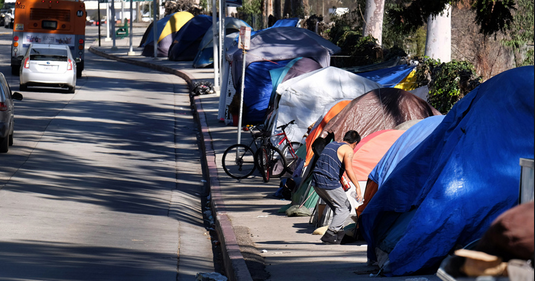
San Francisco, once a lovely city, is now a poster child for urban decay. The Drug-Homeless Complex rules this once home to strong retail stores, industry, and port activity. What San Francisco has now is a cadre of tax-benefitted app makers, a gargantuan government bureaucracy, and Poop Patrols tasked with washing human feces from sidewalks. What happened?
The Just Vote No Blog recommends a beautiful opinion piece by Lee Edwards, Heritage Foundation Fellow, that appeared in the Washington Times on October 14,Is San Francisco the Future of America? In this piece, Dr. Edwards speaks of visiting The City after some time of absence. He vividly describes a society that no longer believes in right or wrong, accepts a premise that the purpose of government is to rectify every injustice, and that disdains the universal benefits of the limited government our Founders envisioned.
The vividness of Dr. Edwards’ opinion piece is enhanced by his alluding to the fact that in an uncontrolled spiral, things fall apart. Also, the whole of America might have plunged into the spiral.
What has happened? Why is America slouching like some rough beast — not toward Bethlehem, but Gomorrah? Beyond dispute, things feel as if they are failing apart, and the common rules of a civil society no longer seem to apply.
So true that once civil society starts disintegrating, salvaging individual liberties, personal privacy, private property, and opportunity for upward mobility of all people becomes increasingly challenging. At this point halting and reversing San Francisco’s march towards Gomorrah – as well as halting the national tendency to march along – will require that responsible people pay attention to another admonition in W.B. Yeats often quoted poem The Second Coming.
Things fall apart; the centre cannot hold; Mere anarchy is loosed upon the world, The blood-dimmed tide is loosed, and everywhere The ceremony of innocence is drowned; The best lack all conviction, while the worst Are full of passionate intensity.
The Founding Fathers envisioned a limited government hopefully free of special interests such as San Francisco’s Drug-Homeless Complex. Halting the slouching away from such a vision will require responsible people to acquire conviction and the same passionate intensity as those who espouse anarchy and decay.
California Assembly Member Jim Patterson is not happy with what he calls the Governor’s classic example of bait and switch of transportation funds.
Central Valley State Assembly Member Jim Patterson made news a few days ago by calling attention to funds being diverted from lane widening on Route 99. Patterson attributed the halting of road work to Gavin Newsom’s Executive Order N-19-19 signed September 20, 2019, which states in part:
The California State Transportation Agency (CalSTA) is directed to invest its annual portfolio of $5 billion toward construction, operations and maintenance to help reverse the trend of increased fuel consumption and reduce greenhouse gas emissions associated with the transportation sector. CalSTA, in consultation with the Department of Finance, is also directed to align transportation spending, programming and mitigation with the state’s climate goals to achieve the objectives of the state’s Climate Change Scoping Plan, where feasible. Specifically the Governor is ordering a focus for transportation investments near housing, and on managing congestion through innovative strategies that encourage alternatives to driving.
With uncharacteristic speed, the State Transportation Agency published on October 4 its 2020 Interregional Transportation Strategic Plan (ITSP), proposing to repurpose “uncommitted funds” from several current projects, including Highway 99 work, and retain “$61,331,000 in uncommitted 2020 ITIP programming capacity to be held in reserve for priority rail projects and other priorities aligned with Executive Order N-19-19.”
Since Assembly Member Jim Patterson’s clarion call, other entities have taken up his warning that California has just witnessed a major case of bait and switch and other cases will soon follow. For example,
ABC30.com reported Highway 99 expansion funding cuts elicit angry reactions. This news segment featured Assembly Member Jim Patterson saying,
This is classic bait and switch. We were promised streets, roads and highways and we are getting everything but.
In an Opinion piece in the San Bernardino Sun of October 13, The Gas Tax Bait and Switch, Jon Coupal, President of the Howard Jarvis Taxpayers Association, said,
In September, Gov. Gavin Newsom signed an executive order that has redirected gas tax money to fund railway systems and other projects, rather than repairing and upgrading the state’s broken highways and roads. The governor and Caltrans claim that the diversion of funds is justified by the need to do something about climate change.
Like Assembly Member Jim Patterson, the Just Vote No Blog expects to see a lot more cases of Bait & Switch in the name of climate change.
The Just Vote No Blog recommends an article on California Political News and Views: “Proposition 13 News – Split-Roll Proposal, Again.” If voters are to vote wisely, they need to acquaint themselves with the opposing views inherent in all proposals.
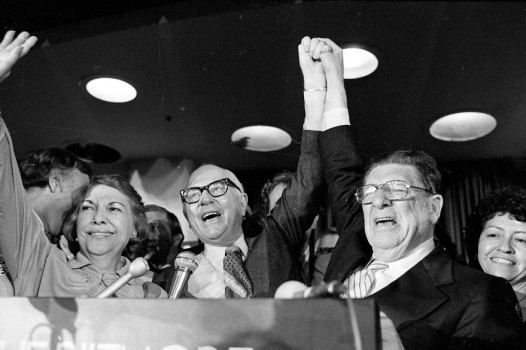
Howard Jarvis, Paul Gann and supporters celebrate the victory of Proposition 13 in 1978.
Proposition 13, overwhelmingly approved by voters in 1978, turned out to be not a mere voters’ initiative, but a cultural symbol defended by some and despised by others.
By placing a property tax cap on certain properties, Proposition 13 significantly reduced sources of revenue for a state that considers taxes lifeblood itself.
Never mind that the state devised a myriad other sources of revenue, and today stands #11 out of 50 in level of taxation – the focus remains on the loss of property taxes resulting from Proposition 13. Never mind that a 1976 court decision removed fiscal responsibility from school districts – the narrative remains that Proposition 13 destroyed local control of schools.
Because Proposition 13 enjoys some fierce defenders, the opposition has settled for incremental jabs rather than outright repeal. A significant blow will be attempted in the November 2020 election. The proposal would leave the cap on residences but remove it from commercial and industrial buildings in what has been called split-roll property tax assessment.
The California teachers’ union and others who view Proposition 13 as abhorrent are building a campaign war chest to support the 2020 proposal. Their narrative remains as it was in 1978.
The Just Vote No Blog recommends an article on California Political News and Views that provides a different narrative – Proposition 13 News: Split-Roll Proposal, Again.
If voters are to vote wisely, they need to acquaint themselves with the opposing views inherent in all proposals.
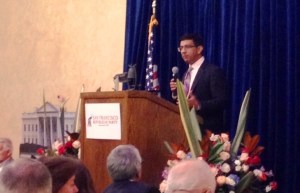
Dinesh d’Souza shared political guerrilla warfare strategies with a packed audience of fellow conservatives, in San Francisco.
Few if any in the in the U.S. conservative movement are unaware of Dinesh d’Souza, so he packs rooms wherever he speaks. On September 26, Mr. d’Souza was the keynote speaker at the San Francisco Lincoln-Reagan Dinner, a traditional annual fund raising event held by Republican Party operatives throughout the U.S.
Now, let this sink in: a large room full of clapping and cheering fans of a radical conservative, in San Francisco. The picture was sufficiently remarkable to prompt this Just Vote No editorial report of the event (by a non-Republican with long-time friends in both the Left and the Right).
The San Francisco Republican Party, as a rule a rather staid group, was energized enough to add the following to their announcement of the event:
Warning: No Safe Spaces Provided. A Limited Supply of Pacifiers Available for Democrat Attendees.
Mr. d’Souza was introduced at the event by a fellow fighter, and former Chair of the Republican Party of California, Harmeet Dhillon. John Dennis, current Chair of the San Francisco Republican Party and perennial Nancy Pelosi opposition candidate, opened the event. Note: John Dennis has fans not only in Republican circles but in the Libertarian community as well.
Fighting Fire With Fire
Appropriately, the subject of Dinesh d’Souza’s talk at this event was how conservatives can regain ground totally lost to liberals over the last 30 or so years. His prescription is simple: fight fire with fire. Grassroots liberals are masters of political guerrilla warfare. They are brilliant at re-framing any statement or event to fit the liberal agenda. Not so conservatives, according to Mr. d’Souza, who are too engaged in being proper and demure ladies and gentlemen.
The point of the talk was that we no longer live in a politically civil world. Today, one cannot possibly imagine a relationship such as that of Republican President Ronald Reagan and Democrat Speaker of the House Tip O’Neill, bitter political opponents who cooperated in leading the nation through a period of significant prosperity. At this juncture one cannot hope to go back to civility by simply acting civilly. The only effective conservative response is political guerrilla warfare.
Mr. d’Souza walks his talk, and for that he was convicted in 2014 for campaign finance fraud and sentenced to eight months in a community detention center and five years of probation. He had pleaded guilty after his pretrial motion to dismiss the indictment for selective prosecution was denied. Well, President Donald Trump did feel there was selective prosecution, so he pardoned Dinesh d’Souza in 2018, thus returning a firebrand conservative to the political arena. Mr. d’Souza gave as examples of fighting fire with fire his finagling donations to a political candidate exceeding legal limits and Mr. Trump’s pardon of his conviction.
Rules for Radicals
* The first rule appears to be to understand what is going on. For example, if conservatives keep saying, “Look at Venezuela!!” and Bernie Sanders keeps saying, “No, look at Denmark,” conservatives are missing the point.
Dinesh d’Souza feels that Bernie Sanders knows full well that there is no comparison between the culture, traditions, and tax structure of the U.S. vs. the Scandinavian countries, but he is counting on his voter base not knowing. A Sanders supporter with $76,000 in equivalent annual wages would soon be an ex-Sanders supporter if he understood that in Denmark he would be in a 56% tax bracket. Indeed, it is easy to vote for socialist candidates when one is under the impression that the other guy is going to pay for socialism!
* The next rule is to organize. Look for people who are distressed about the same things that distress you. High taxes? Lower-wage liberals as well as conservatives might feel distressed about all the taxes taken out of their paychecks.
Find out and bring them into the discussion with higher-income property owners unhappy with property taxes.
* Third rule: hit back – twice as hard. The effort of hitting back will also be twice as difficult. Conservatives stood back politely while liberals took over the press, entertainment, academia and social media. Now if conservatives wish to fight back, they will have to do it without the assistance of those entities.
Universal Rules for Winning
Dinesh d’Souza’s talk at the San Francisco 2019 Lincoln-Reagan Dinner was aimed at conservatives. However, remedies he suggested are simply universal rules for winning any political fight fought by any faction in the political spectrum in today’s political arenas. Using those rules expertly also enters into the prescription. A badly botched battle is more damaging to the success of a war than no battle at all.
The Just Vote No Blog is non-partisan. This event happened to be a Republican dinner during which a pretty good speaker gave some credible pointers on what it takes in today’s political landscape to gain ground.
Readers who are dedicated liberals might prefer to read the Just Vote No Blog article Antonio Gramsci: The New Hegemonyon how to successfully bring about a socialist state.
Fear is a good tool with which to implement control. California did a great job successfully passing hundreds of mandates removing voter control of housing by utilizing concerns about climate change.
Fear is a good tool with which to implement control. California did a great job successfully passing hundreds of mandates removing voter control of housing by utilizing concerns about climate change. The point here is not to engage in unwinnable arguments whether climate change is man-made or not, but to observe a transformation, some say not for the good, driven by constant talk of climate change.
California Political News and Views is an on-line publication popular among conservatives. “Conservative” includes ideas such as protection of private property and displeasure with government supported or controlled housing.
An article in the Political News and Views issue of September 16, observes the connection between California’s continuous talk of climate change and draconian housing legislation. Of special note is the morphing of climate change into climate justice, which led to massive taxation of the state’s residents to support subsidized housing.
Nobody likes to pay almost half of one’s wages for housing, but that is what is happening to so many California residents. Reasons for the astronomical housing costs vary according to whom one asks. However, regardless of reason, the situation is now promoted as a “crisis,” and duly exploited as such.
Of concern to the Just Vote No Blog is that the housing crisis is at the heart of today’s central planning, which renders residents and voters increasingly powerless in land use and housing decisions.
A Brief Background
In The Curious Case of Housing Legislation, the Just Vote No Blog noted the history behind today’s network of housing bills. The state’s evolving efforts to remove land use and housing decisions from voters is one of the evident aspects of such history. Here are some reminders:
The seminal Assembly Bill 32, The Global Warming Solutions Act of 2006, started the ball rolling by mandating the reduction of the state’s greenhouse gas emissions to 1990 levels by 2020 and to 80 percent below 1990 levels by 2050.
Climate crisis soon morphed into a land use crisis that required dense job/housing development along narrow corridors throughout the Bay Area, ostensibly to cut down on greenhouse gas emissions produced by workers commuting from homes in the suburbs.
Predictable pushback from neighborhoods, cities and counties not wanting to lose their chosen quality of life encouraged increasingly stronger state mandates. SB 330 and AB 1487 are the latest high-profile bills bent on removing housing decisions from cities and counties.
SB 330, the Housing Crisis Act of 2019, introduced in February by Senator Nancy Skinner and approved by the legislature September 6, has the general objective to “prohibit a county or city, including the electorate exercising its local initiative or referendum power, in which specified conditions exist, determined by the Department of Housing and Community Development as provided, from enacting a development policy, standard, or condition, as defined…..” Thus, the electorate is summarily dismissed.
AB 1487, the San Francisco Bay Area Regional Housing Finance Act of 2019, introduced in February by Assembly Member David Chiu is currently active and in desk process. This bill is a game changer. Voters, no matter how disempowered by mandates such as SB 330, at present can still vote down tax proposals that finance mandates they do not like. AB 1487 makes that strategy more difficult. This bill establishes a new agency, the Bay Area Housing Finance Authority, run by bureaucrats removed from the wrath of voters, with the power to place tax proposals on region-wide ballots, and to determine pass/fail on an aggregate region-wide basis.
Progression Towards Powerful Public-Private Partnerships
The plethora of housing bills in the style of SB 330 and AB 1487 passed into law during the past few years calls for a good deal of cash, perhaps more than the creative financing that could be achieved by the Housing Finance Authority would be able to raise on its own. Thus, enter powerful private players interested in housing development for reasons of their own, willing to forge partnerships with public entities. As one would expect, tech companies like Google and Facebook are becoming major players.
Google, Facebook and other deep-pocketed tech companies are at present investing in housing, a dream come true for housing advocates. They are also encouraging the California legislature to pass legislation that will streamline housing production (more on this later), since investors do not like lengthy bickering over what or where housing is built.
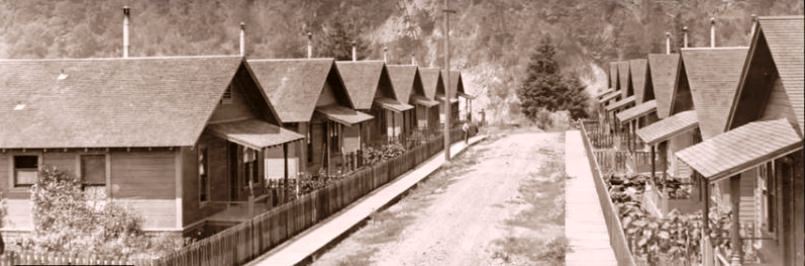
Of course, private influence in public affairs is nothing new. Neither is privately-funded housing developed with government blessings — company towns like Hershey, Marktown, and Pullman are examples. However, today California is witnessing not just tech-towns developed for tech workers, but also the much broader endeavor of using tech money to fund housing for the general population.
Recommended Articles on Public-Private Partnerships
A San Francisco Bay Area publication, 48 Hills, has been deeply concerned about the waning power of voters in land use, housing and transportation decisions. A series of articles by researcher and journalist Zelda Bronstein, published in 48 Hills, explains in great detail how a private entity, the Chan Zuckerberg Initiative, is poised to affect housing policy. In the first two installments published May 29, 2019 and August 29, 2019 of the series (there might be more to come), Ms. Bronstein zeroes in on Senate Bill 330 and Assembly Bill 1487.
The articles are rich with information that Bay Area residents will find useful in understanding who is becoming in charge of their neighborhoods.
Residents need to become aware of how much control they will cede to a regional agency such as the proposed BAHFA. Voters’ intentions to cast NO votes on BAHFA funding proposals might prove more effective than attempting to negotiate patches to AB 1487 with legislators. Putting lipstick on a piggy will not make it any pettier.
Assembly Member David Chiu, author of AB 1487, and his colleagues in the California legislature have removed all hint of what the bill would specifically do if signed into law. Now, in essence, the bill simply says that a new agency is being created with power to raise, administer, and allocate funding as it sees fit for affordable housing in the San Francisco Bay area.
Not much of what was said of Assembly Bill 1487 when it was first introduced in February 2019 applies. “Stakeholders and local leaders” are at present meeting with legislators to re-construct the peripherals of the bill. Of course, the core feature remains: Establishment of the Bay Area Housing Financing Authority, an agency that will initially share staffing with the Bay Area’s Metropolitan Transportation Commission, and that will have power to raise tax money from all counties in the Bay Area.
BAHFA as MTC’s Other Self
The proposed new agency will serve as the Metropolitan Transportation Commission’s other self, with the additional coveted ability to raise funds.
MTC, the Bay Area’s version of a federally-mandated Metropolitan Planning Organization, has what one might call a checkered past. Its major feats are finalizing the construction of a span of the Bay Bridge damaged by the 1989 Loma Prieta earthquake after years of delays and billions in costs overruns, and implementing central planning via Plan Bay Area (approved in 2013 by MTC Commissioners, but never by voters). Today, MTC doles out considerable sums under its various centrally-planned transportation and housing projects, but it does not have power to raise fund. It will indirectly should AB 1487 pass.
So, now the prospects are excellent for MTC’s other self, the Bay Area Housing Financing Authority, routinely to raise taxes regionally in the fashion of Measure AA. As the Just Vote No Blog noted in With AB 1487 There is No Opt Out, in 2015 Measure AA passed by the aggregate votes of all counties without possibility of any county opting out.
An Alternative to Putting Lipstick on AB 1487
AB 1487, last amended July 11, 2019, is currently an active bill in Floor process. A third reading in the Senate is scheduled for August 26, 2019.
Individuals and organizations concerned about BAHFA’s undue influence in the operation of their city or county should remember that the agency’s success in raising money depends entirely on the willingness of taxpayers to part with their hard-earned cash.
The possibility of residents becoming aware of how much control they will cede to a regional agency such as BAHFA and deciding to vote “No” on BAHFA funding proposals might give legislators some pause in moving forward with their plans. For those opposed to mandated central planning, aiming for such pause might be more effective than accepting BAHFA as fait accompli and merely attempting to negotiate damage control with legislators.
Putting lipstick on a piggy will not make it any pettier.
Addendum: The Transformation of NeighborhoodsParkmerced, a traditional privately owned residential community in the heart of San Francisco that houses over 3,000 residents, has developed Parkmerced Vision. Under the plan, the garden homes surrounding green spaces will be demolished to make room for taller, denser buildings. Some applaud the plan, others despise it. The transformation of neighborhoods is occurring for good or bad all over the state. A regional housing agency such as the proposed Bay Area Housing Financing Administration is intended to accelerate the process by injecting public funds for subsidized housing.
Guest Post: Announcement of Conservative Grassroots meeting Sunday, August 25, 2019.
Guest Post: Conservative Grass Roots group to meet Sunday –By Richard Eber
Following a trend we have seen in the past year, a group of conservatives not affiliated with the California Republican Party are meeting this Sunday, August 25, to map a grass roots strategy to deal with the Democratic Party domination of politics in California.
Organized by activist Kathryn (Kat) Knowles the event is to be held between 2 to 4 pm at 941 Terminal Way in San Carlos. She expressed frustration for “people who want to make a difference and will not accept defeat as what has occurred in recent years.” To buck this trend Knowles has brought grass roots guru Randy Ross from Florida to address the gathering.
In 2016 Ross was the campaign Chairman in Orange County, Florida, for the Donald Trump campaign. It has been agreed that carrying this critical area was an important element in winning the State for Donald Trump. His grass roots approach includes fearless fund raising, minority outreach, community organizing, and firing up the team to achieve victory.
Knowles wants to see this type of spirit extend to California where the Republican Party has floundered in recent years. She desires to “help establish common goals of furthering conservative values.”
This frustration with establishment political leadership has found its way all over the State. Jack Frost’s Small Biz CA organization has been espousing similar ideas to create grass roots leadership to promote conservative values in the Golden State. Others including Winston Chin’s Bay Area Conservatives and the Election Integrity Project in Ventura are all pointing in the same direction of compensating for what is perceived to be weak leadership in the California State GOP.
Also on the Sunday program are Anita Anderson from Sonoma County, publisher Terri Wilde of the Silicon Valley Conservative Newspaper, voter registration organizer Anna Krammer, and Minority recruiter Linda Rost. All of these individuals will try to communicate their efforts to raise the profile of conservative principles in California politics.
In addition Our Free WriteEditor-in-Chief Edward Shturman, a high school fellow at Stanford University will speak about educating young people with alternative views to what they receive by predominantly Progressive educators in the public schools.
It should be an interesting meeting this Sunday. If similar events held recently are to be any indication, there will be a standing room crowd in San Carlos. Conservatives want to have their voices heard in a sea of leftist ideology.
Those wishing to reserve space this Sunday can do so by emailing Kat Knowles <kat.knowles@aol.com> or by texting or calling her at 831.313.6072.
When we routinely see drug injection needles discarded in sidewalks, parking lots, and our kids’ playground, we really need to think whether the current narrative of gentrification and housing shortage as the primary cause for homelessness makes sense.
When we see so many people with no other place to call home except a piece of sidewalk or a tent, we need to ask whether our leadership is choosing the appropriate solution to challenges at hand. In the case of homelessness in numbers such as we see in purportedly rich California cities, the answer is probably “no.”
When we routinely see drug injection needles discarded in sidewalks, parking lots, and our kids’ playground, we really need to think whether the current narrative of gentrification and housing shortage as the primary cause for homelessness makes sense.
We need to ask what role the drug industry, facilitated by political leaders, may play in such a scenario. The folks in question here are not the usual small-fry drug dealers, but the legitimate barons of an industry not shy about prices. Injection needles and other drug paraphernalia cost serious money, so does the increasingly ubiquitous naloxone.
Naloxone maker Kaleo has an injection treatment called Evzio that has a list price of $4,100. The company plans to release a generic version of Evzio with a retail price of $178 for a two pack this year. A two-pack of Narcan, a naloxone nasal spray, has a retail price of about $125. Generic naloxone costs about $40 per dose. FDA Clears the Way to Increase Access and Lower Cost of Life-saving Opioid Overdose Treatment Drug. CNBC. January 28, 2019.
The increase has cost the federal Medicare and Medicaid health programs more than $142 million since 2014, according the Homeland Security permanent subcommittee on investigations. Drug Company Raised Price of Lifesaving Opioid Overdose Antidote More than 600 Percent USA Today November 19, 2018.
The Just Vote No Blog recommends the article Homelessness: Housing is not the Problem, in the California Political News and Views of August 4, 2019, for more on this unfortunate homelessness situation.
Nemesis is punishment showered upon those who regularly engage in hubris. Quentin Kopp just announced he will run against Scott Wiener.
Hubris is interesting, because you get people who are often very clever, very powerful, have achieved great things, and then something goes wrong – they just don’t know when to stop.Margaret MacMillan
On July 31, Quentin Kopp, a fearless fixture in California politics, announced that he intends to challenge incumbent Scott Wiener for the state Senate seat in District 11 representing San Francisco, Daly City, Colma, Broadmoor, and parts of South San Francisco. The 90-year old Kopp seems mad as heck and is not going to take it any more.
The last straw for Kopp of Wiener’s schemes was Senate Bill 281, hearing of which scheduled for May 6 was canceled at Wiener’s request. SB 281 was the most recent in a long line of attempts to transfer management and/or ownership of the iconic Cow Palace from the current board to a local county joint-powers authority.
The 78-year old exhibit hall sits on 68 acres of coveted land owned by the California Department of Food and Agriculture’s Division of Fairs and Expositions. Although its days of glory are over, when the Cow Palace hosted headliners like the Beatles, Rolling Stones, and Elvis Presley, the hall still has audiences that enjoy shows and fairs like the San Francisco Sport & Boat Show, Golden Gate Kennel Club Dog Show, Dickens Christmas Fair, and the Horse Show & Rodeo. The Crossroads of the West Gun Show will end after 2019 by decision of the Cow Palace Board.
Thanks to revenue from these exhibits, the Cow Palace receives very little funding from the California state budget.
In an interview with San Francisco Chronicle’s Phil Matier, Quentin Kopp indicated that he felt SB 281 was a land grab to build more highrises in residential neighborhoods. Apparently, he is correct according the the text of SB 281:
This bill would authorize the authority to, among other things, enter into contracts or agreements for the development of the property for affordable and market-rate mixed-use housing and establish minimum local zoning standards, including, but not limited to, standards for height, density, parking, and floor area ratio, that apply to a project on the property that are different from those adopted by any other affected local jurisdiction.
Quentin Kopp is no lightweight in California politics. His resume is impressive:
San Francisco Supervisor 1971-1986, representing the West Portal neighborhood. State Senator 1987-1994, representing the southern part of San Francisco and the northern part of San Mateo County. San Mateo Superior Court Judge 1994 -2004. He retired after leaving his Court post.
After retirement from the Court, Kopp was appointed in 2006 to the California High Speed Rail Authority, a post he held until 2010. As Chair he was instrumental in the passage of Proposition 1A, which authorized a $9.95 billion bond to develop a high-speed rail system that would zip passengers from San Francisco to Los Angeles in less than three hours. The project received $2.5 billion from the Federal Railroad Administration. So far, construction can only be seen in California’s Central Valley, for an estimated cost to completion of $20 billion. Today Quentin Kopp rants against how the Rail Authority mishandled the bond money every chance he gets. The Federal Railroad Administration is angry too, and wants its money back.
In September 2016, the San Francisco Board of Supervisors appointed Quentin Kopp to the City’s Ethics Commission. He resigned from the post in March 2019, noting the uselessness of the Commission in denting its backlog or tackling important reforms in its job of enforcing governmental ethics laws.
Term limits might keep Quentin Kopp from serving once again in the California Senate. His argument is that since his previous service occurred before passage of legislation implementing term limits, the rule would not apply to him. And, as is Kopp’s stand-up-and-fight nature, he declared that he will sue if the Secretary of State decides he is not eligible.
Today’s Gen X and Millennial voters, accustomed to undistinguishable politicians forever uttering prescribed sound bites, might want to get acquainted with Quentin Kopp, who might soon turn out to be nemesis to Scott Wiener’s hubris.
His column in the neighborhood newspaper, the Westside Observer, appears monthly.


 Few if any in the in the U.S. conservative movement are unaware of Dinesh d’Souza, so he packs rooms wherever he speaks. On September 26, Mr. d’Souza was the keynote speaker at the San Francisco
 Parkmerced, a traditional privately owned residential community in the heart of San Francisco that houses over 3,000 residents, has developed
 Just Vote No