Schools Need To be “Great Equalizers”

Horace Mann said schools were the great equalizers, where rich and poor would learn and prosper equally. This is a vision worth pursuing.

Parents have a lot on their plate these days, especially in expensive states like California, where stay-at-home Moms are a luxury rather than a norm. Thank goodness, there is a lot of information on the Internet on choosing schools, parenting, balancing time, etc. For example, two popular websites that rate schools from great to not so good are Great Schools and Niche.

Blackboard CAThe economic challenges parents face in costly California are compounded by another California feature: awful public schools. An article published in February 2018 in USA Today lays out the sobering statistics:

California Public Schools rank 35th among the 50 states.
High school graduation rate: 83.0% (21st lowest)
Public school spending: $9,417 per pupil (8th lowest)
8th grade NAEP proficiency: 27.1% (math) 28.4% (reading)
Adults with at least a bachelor’s degree: 32.9% (14th highest)
Adults 25-64 with incomes at or above national median: 51.7% (21st highest)

Such schools are far from being the “great equalizers” envisioned by educator Horace Mann.  They are in fact unequalizeers, in their pursuit of identity politics instead of teaching reading, writing, math, and history.  Are school districts focusing on finding ways to improve these schools? Read More.

Diversity vs. Performance

Has the constant talk of diversity integrated our schools, or equalized pay, or flooded Silicon Valley with high-level coders of both genders equally?

In the old days employers asked employees to keep job description manuals, so new employees and others in the office or shop could better understand how a task was performed or how a widget was made. Today employers focus on diversity and social justice manuals. Should this shift of emphasis from production and performance to personnel be included in statistics measuring GDP, national debt as percentage of GDP, balance of trade, decline of manufacturing, rise of an unskilled workforce, automation? Has the constant talk of diversity integrated our schools, or equalized pay, or flooded Silicon Valley with high-level coders of both genders equally?

If the response is “not really” then our doubling down on the diversity reasoning is innocently stupid, immensely hopeful, or intentionally evil. The quest for diversity permeates housing, employment and education. Although there is much to say on housing and employment, let’s start with this article on education, specifically school choice in New York City.

Should There Be a Debate On School Choice?

A new study entitled The Paradox of Choice: How School Choice Divides New York City Elementary Schools laments the “unintended consequences” of providing New York City parents with the choice of enrolling their kids in other than their zoned (neighborhood) schools.

Our analysis shows that the expansion of school choice in New York City in the past 10
years has, indeed, allowed thousands of children to leave low-performing schools for higher-performing schools, often outside their neighborhoods. But it has also resulted in higher concentrations of poverty and shrinking enrollments and budgets in the schools they leave behind, making it ever harder for those schools to serve their neighborhoods well.

The logic of choice can be used for segregation or integration. But in either case, it puts the onus on individual parents to find good schools for their children, rather than on society as a whole to provide for the education of all children. Correcting the disparities across the school system as a whole and providing equitable educational opportunity to all families should be a collective effort by all members of the community with strong central leadership from City Hall and the Department of Education.

A reasonable person should ask what is wrong with parents taking responsibility for finding good schools for their children. The legion of lower-income parents enrolling their kids in charter schools might wonder why any parent would not move their children out of poor-performing schools. True, newly arrived immigrants, speaking little or no English, would have a harder time navigating through the complex school-enrollment system; but hopefully these families anticipate such difficulties, persist, and eventually prevail.

Embedded in the lament for the consequences of school choice is the pervasive emphasis on diversity and government’s duty to ensure equity and social justice. Such focus obscures the success of parents and children who opt for production – performance, individual responsibility, effort, and hard work. There are such parents at all income levels and of all colors.

Who Leaves and Who Stays

The Paradox of School Choice discusses what families stay in their zoned school, and which do not. 60% of families in gentrifying neighborhoods choose kindergarten outside of their school zones, compared with 32% in higher-income neighborhoods (where schools tend to be higher-performing), and 35% in non-gentrifying poorer neighborhoods. Although 60% is significant, 35% of poorer families that, in spite of economic challenges, choose higher-performing schools outside their neighborhoods is impressive.

The study also offers a chart that further illustrates who left their zoned schools behind, and who stayed between 2007 and 2016.  Colors from bottom represent children who attended schools that were:  in their zone, in a different zone, had gifted children programs, had dual-language programs, were unzoned, were charter.

School Choice 6


The ideal situation would indeed be a system that did not exhibit disparities in quality between schools. However, significant disparities are an unfortunate reality that school officials have not corrected.  Therefore a growing number of parents are no longer waiting for someone to act on their children’s behalf, but are taking action themselves.  Their choices indicate what is important to them:  high-performing schools that exhibit good test scores.

End the Fed!

Who benefits from the Federal Reserve? Would the banking elite that created the Fed worry about your well being?

Recommended Book: Creature from Jekyll Island

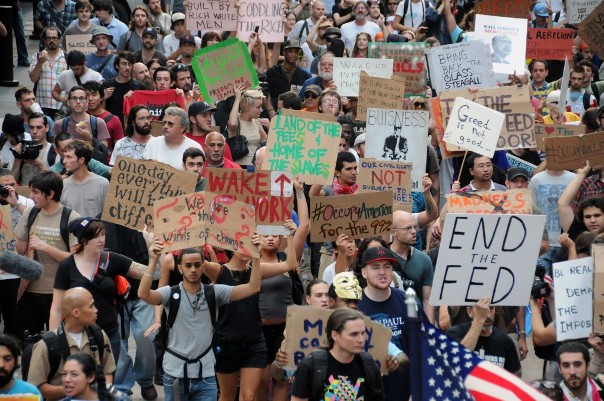
G. Edward Griffin wrote Creature from Jekyll Island in 1994. This 600-page book is now on its 5th printing, on Amazon, and all hard-core liberty-minded folks quote from it. It is not an easy read, but a project for maybe several months. However, because it reads like a thriller, you will be enthralled enough for how long it takes. By the end of the book, you should have a clearer idea why some people go around carrying signs at rallies reading “END THE FED!” You will know where the money to finance the U.S. endless wars comes from, and you will know how we have gone from a nation of pioneers to a nation of supplicants.

occupy-wall-street-protesters

Not a Horror Movie – Just Real Life

Ask a random number of people where or what is Jekyll Island, and most will respond with some association to Dr. Jekyll and Mr. Hyde. Most will be surprised that Jekyll Island is a very real, beautiful state-owned park off the coast of Georgia, managed and conserved by the Jekyll Island Authority, a self-supported state agency funded by the island’s leases, fees, and amenity operations. It acquired its name in 1733, when British colonial leader General James Edward Oglethorpe named the island in honor of Sir Joseph Jekyll, a financial backer of the colony of Georgia.

Jekyll Island went through several iterations and owners. However, the owner that interests us here is Christophe Poulain DuBignon, who consolidated his ownership of the island in 1794. He and his descendents owned the island from 1794 until 1886. John Eugene DuBignon, together with his brother in law Newton Finney, got the ball rolling in our story when they turned Jekyll Island into a private hunting club. Finney had contacts in New York among the monied social elite, and the likes of J.P. Morgan, Joseph Pulitzer, and William K. Vanderbilt invested in the new club. In 1886 Eugene DuBignon sold the club to the Jekyll Island Club Corporation.

They Did Not Go Duck Hunting

The plot thickens when in November 1910, Senator Nelson Aldrich from Rhode Island gathered some banking and finance folks — among them representatives from the U.S. Treasury, J.P. Morgan & Co., National City Bank, and Kuhn, Loeb & Co. – to go duck hunting at the Jekyll Island Club. Apparently, they did not hunt any ducks, but instead, under a cloak of great mystery that was not revealed until the 1930s, they wrote a plan to reform the nation’s banking system. Thus the Federal Reserve Bank was born.

The fact that the Federal Reserve was born on Jekyll Island backed by the cream of the banking elite, it enables a debt-based economy, and it finances wars is freely acknowledged even by the Federal Reserve. However, saying for instance that the Federal Reserve worked closely with the U.S. Treasury to sell Liberty Bonds to help the War Effort is different than saying the Fed enables eternal wars for oil and Wall Street. Therefore, The Creature from Jekyll Island is often relegated to conspiracy theory for stating the latter.

The banking elite did not really go duck hunting in November of 1910. What did they really do and why? What would be the purpose of a central bank in 1910, or in 1791? What track record of predecessor U.S. central banks was the banking elite considering in 1910? How do the writings of other people affirm what G. Edward Griffin said in Creature from Jekyll Island?

Bankers Reforming Banking

Observe that at Jekyll Island, bankers wrote the plan to reform banking. Since presumably these bankers were human, we need to assume their native instincts prompted them to benefit banks. In his 2012 article Who Benefits From The Federal Reserve Charles Hugh Smith asks “Cui bono–to whose benefit?” He then lists what the Federal Reserve does or enables others to do. Here is a summary list:

* Setting of interest rates at zero or near zero – Allows banks and other already powerful financial institutions to borrow great quantities of money. With this money such institutions concentrate their wealth and ensure their perpetuity by buying up competitors and becoming too big to fail. The high debt to equity ratio pushes earnings towards debt servicing, and away from productive investments, innovation and workers’ benefits.

* Accepting ever-expanding debt leveraged by questionable collateral – Normalizes junk financial tools such as derivatives and sub-prime mortgages. The proliferation of such financial tools spreads debt and leveraging throughout the economy. Households learn to survive on debt generated by mortgages and credit cards. Students and their parents become dependent on student loans that can limit the financial and emotional well being of young people for a long time.

* Supporting an inefficient and exploitative banking system – The Federal Reserve is sold to the general public as protection against economic panic caused by bank failures. Businesses fail when they are mismanaged by inept or bad-intentioned handlers. Banks are no exception. However, they have learned that if they are big enough and powerful enough they can behave as they please, since the Federal Reserve and the FDIC will be there to bail them out when they behave exceptionally poorly.

Predecessor Financiers

* The Fist Bank of the United States

The Bank of the United States, a national bank promoted by then Secretary of the Treasury Alexander Hamilton, was established by Congress in 1791. The bank was authorized to operate across state borders, and was intended to foster economic growth. It collect revenue, lent money to the U.S. Treasury, sold bonds to investors, and it helped to pay off the huge national debt created by the Revolutionary War. However, Thomas Jefferson and his followers viewed this central bank, as well as all other indication of federal expansion, with extreme distaste; they succeeded in causing the closure of the bank after 20 years of its operation.

* The Second Bank of the United States

Debt mounted again as a result of the War of 1812, but this time, Congress knew of a quick fix, and charted the Second Bank of the United States in 1817. To the dismay of central banking advocates, President Andrew Jackson, a foe of central banks which he viewed as benefitting Northern industry to the detriment of Southern agriculture, vetoed the re-chartering of the Second Bank of the United States in 1836.

Interestingly, central banking advocates blame a shortage of gold and silver currency and the ensuing economic panic of 1837 on Jackson’s elimination of the Second Bank of the United States. Why was there a shortage of hard money? Because the Second Bank of the United States encouraged debt instead of gold and silver.

Bottom Line: How are you better off with today’s central bank?

Widely distributed prosperity for the citizenry results from increases in real income that flow from productive investments and higher productivity that’s passed on to workers. The Fed’s model of “prosperity” is to enrich the banks and incentivize workers to take on more debt to boost their consumption and their purchase of phantom assets in stock bubbles, housing bubbles, etc.  Who Benefits From the Federal Reserve?  by Charles Hugh Smith, September 2012.

How many members of your household need to work outside the home to make ends meet?  If you own a home, how are you managing repaying your mortgage?  We send you our heartfelt wishes that you do not depend on your credit cards to pay your rent.

Balanced Budget Amendment: “Definition of Audacity”

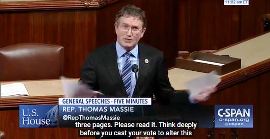
House Representative Thomas Massie said the Balanced Budget Amendment proposal was the definition of “audacity.” “It’s got a loophole you can drive a truck through.” The provision to which Representative Massie refers says that if 60% of both the House and Senate vote to waive the amendment, they can pass an unbalanced budget. The 2018 unbalanced budget passed by 60% in the House and by 65% in the Senate. Tell us how a BBA would have prevented the 2018 $1 billion increase to the U.S. budget.

Following up on the Just Vote No Blog previous articles on profligate spending by the U.S. Congress, and on the “solution” of a Balanced Budget Amendment, here is an update.

On March 23, 2018, Congress passed the “Omnibus Bill,” a budget plan to allow the federal government to continue “functioning” until September 30, 2018. The bill totals $1.3 trillion, and adds about $1 trillion to the already gargantuan U.S. budget of around $4 trillion. How could the cost of running the country increase by $1.3 trillion? Easy. Legislators need to say they “did something” about everything that happened during the previous year, so they provide for a myriad of new funding. Roughly, the 2018 budget calls for $695 billion in defense spending and $591 billion in non-defense spending. Here are a few highlights of the 2,232-page bill:

* School shootings: $2.3 billion in new funding for mental health, training, and school safety programs at the Departments of Justice, Education, and Health and Human Services.

* People overdosing from opiods: $4 billion in treatment, prevention, and law enforcement efforts.

* Potholes: $21 billion for infrastructure projects across the country, including transportation, energy, water, and “cyber.”

* Porous borders: $47.8 billion for the Department of Homeland Security to bolster border infrastructure, add more “boots on the ground,” increase detention space, and improve surveillance technology.

* Waning hegemony: $654.6 billion in both base and Global War on Terror/Overseas Contingency Operations funding.

“The Definition of Audacity”

Surely it is known to all members of Congress that a constantly growing national debt now standing at around $21 trillion is not sustainable. Surely they know that at some point voters might catch on that the Ponzi Scheme could cause the nation’s economic collapse. Therefore, after voting for yet more spending by passing the Omnibus Bill, legislators felt they must “do something.” Four days after House Representative Robert W. Goodlette voted “Yes” on the Omnibus Bill, he introduced the Balanced Budget Amendment (BBA).

House Representative Thomas Massie (R-Ky) said the BBA proposal was the definition of “audacity.” “It’s got a loophole you can drive a truck through.” The provision to which Representative Massie refers says that if three-fifths (60%) of both the House and Senate vote to waive the amendment, they can pass an unbalanced budget. Well, the 2018 unbalanced budget was passed by 60% of House members and 65% of Senate members. Tell us how a BBA would have prevented the 2018 $1 billion increase to the U.S. budget.

Thomas Massie 3

Thankfully, the BBA was too audacious even for Congress members, and it was voted down.

Are State Legislators So Different?

State legislators claim U.S. legislators need to be reigned in because they are growing the federal government and spending too much. Therefore, they also need to do something: A Convention of States under Article V of the U.S. Constitution to propose a balanced budget amendment among other things.

Do you trust your state’s proposal to amend the Constitution of the United States any more than you should trust the U.S. Congress’ “definition of audacity?”

Federal Debt: Who Will Be Left Holding the Bag?

Today’s federal debt is around $21 trillion, $64,724 for every man, woman, and child in the U.S., and growing every second.

Today’s U.S. federal debt is around $21 trillion, $64,724 for every man, woman, and child in the country., and growing every second. So, who cares, you say, as long as domestic production is so wonderful. That is what the experts tell you. What they don’t tell you is that you are paying for that debt in one way or another, by way of taxes, foregone services, or risk. Also they don’t tell you that at some point the folks who have been lending the U.S. all that money will get spooked at the size of the debt and bail out.

How did we get to owe $21 trillion to individuals, foreign countries, and even our own Federal Reserve Bank? Because we elect our representatives based on the largess they promise to deliver. We make sure we get subsidized healthcare, education, housing, food, childcare. We want security.

Trends in Spending and Deficits

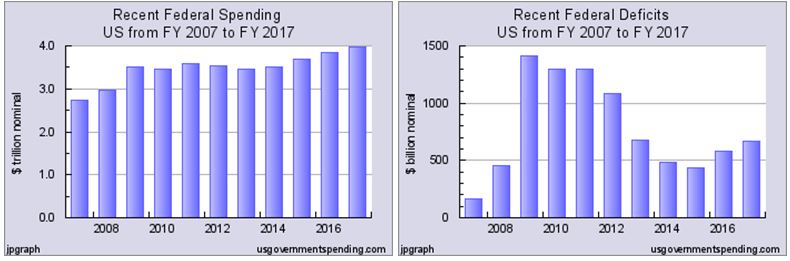
* The Congressional Budget Office says that in 2016, the federal government took in $3.3 trillion in revenues, and spent $3.9 trillion. The difference between revenues and expenditures is the federal deficit.

* 2007 – 2017 Spending and Deficits:

Spending and Deficits

Quick Review of Borrowing: 

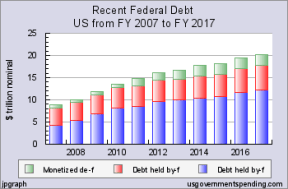
Federal DebtWhen job pays you less than you spend, you borrow from credit card companies, banks, credit unions, family, or friends. The federal government does the same thing – it borrows when it spends more than it earns. Here is a picture of the federal steadily-growing debt 2007 – 2017, showing debt in December 2017 at $21 trillion.

There are two main debt categories: Intra-government holdings (in 2017, this was $5.6 trillion borrowed from 230 government agencies; $2.801 trillion of which borrowed from Social Security), and debt held by the public (in 2017, $14.7 trillion borrowed from foreign countries, the Federal Reserve, mutual funds, state and local governments pension funds, private pension funds, banks, insurance companies, the general public, and other entities).

If the U.S. finds it owes so much money, and has to pay so much interest that there is little money left for any federal operations at all, then the country will have to either stop spending, raise taxes to astronomical levels, or default. If default had happened in 2017, guess who would be left holding the biggest bag? Look at foreign vs. domestic debt:

Foreign borrowers lent the U.S. federal government $6.004 trillion. Domestic borrowers, mostly folks contributing or receiving retirement money, lent $8.696 trillion.

How about the “Debt doesn’t matter” Argument?

Experts like Paul Krugman and Robert Reich used to tell us that debt does not matter since GDP made the country grow, debt or no debt. However, they seem to be clarifying their stance these days.

“Today’s debt is about 77 percent of our total national product. The reason it’s a problem is it’s growing faster than the economy is growing, so it’s on the way to becoming larger and larger in proportion.” Robert Reich

“What changes once we’re close to full employment? Basically, government borrowing once again competes with the private sector for a limited amount of money. This means that deficit spending no longer provides much if any economic boost, because it drives up interest rates and “crowds out” private investment.” Paul Krugman

It is difficult to tell whether these two gentlemen, champions of progressive politics, suddenly saw the light or they saw a Republican administration in Washington DC.

GDP is not supporting the debt, so what to do?

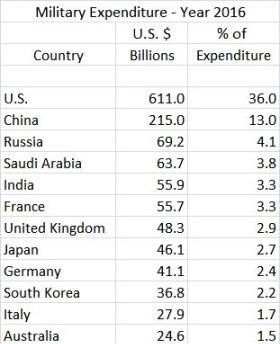
Military Spending 2
Forbes Stats: From Infographics

The U.S. debt-to-GDP ratio on December 29, 2017, was 104%: $20.493 trillion debt divided by $19.739 trillion GDP.

We could print more dollars to keep up with the debt and hope our creditors don’t mind their increasingly worthless investment.  We could hope we will be dead by the time the Ponzi scheme collapses.  Alternatively, we could bite the bullet and start fixing the mess by cutting spending and not giving tax cuts to billionaires.

We could start the spending cuts by bring our defense spending in line with everybody else in the world.

Article V Convention: Not Worth an Even Break

Certain ideas so defy logic that it is difficult to determine whether proponents aim to make suckers out of the unsuspecting or are being made suckers themselves. Such is the case with the currently proposed Article V Convention. Proponents either intentionally or credulously are placing the very nature of our Republic in peril. Therefore, as W.C. Fields would ask, why give suckers an even break?

WC FieldsCertain ideas so defy logic that it is difficult to determine whether proponents aim to make suckers out of the unsuspecting or are being made suckers themselves. Such is the case with the currently proposed Article V Convention, under which states would gather to propose amendments to the U.S. Constitution.  Proponents either intentionally or credulously are placing the very nature of our Republic in peril. Therefore, as W.C. Fields would ask, why give suckers an even break?

What is an Article V Convention?

The Founding Fathers built into the U.S. Constitution many protections against federal government overreach. One such protection is Article V, which says,

The Congress, whenever two thirds of both houses shall deem it necessary, shall propose amendments to this Constitution, or, on the application of the legislatures of two thirds of the several states, shall call a convention for proposing amendments, which, in either case, shall be valid to all intents and purposes, as part of this Constitution, when ratified by the legislatures of three fourths of the several states, or by conventions in three fourths thereof, as the one or the other mode of ratification may be proposed by the Congress; provided that no amendment which may be made prior to the year one thousand eight hundred and eight shall in any manner affect the first and fourth clauses in the ninth section of the first article; and that no state, without its consent, shall be deprived of its equal suffrage in the Senate.

Under this Article, states, with or without Congress’ consensus, can call a convention of states to propose amendments to the Constitution. Once such amendments are ratified by the legislatures or by conventions of three fourths of the states, the amendments become part of the constitution.

Who is interested in Article V these days?

* There are currently 28 states with active applications for an Article V Convention. Eight applications were submitted in 2017, and eight in 2016. Twelve were submitted in prior years.

* Most applications so far call for a balanced budget, restraining of the federal government, and overturning of the U.S. Supreme Court Decision on Citizens United vs. Federal Elections Commission. Conservative states support the first two subjects, and progressive states the third. Within both factions, there is opposition. Conservative Eagle Forum and liberal Common Cause have expressed deep concerns.

* Proponent money is coming from prominent groups, such as the American Legislative Exchange Council and the WolfPAC.

Where do the Suckers Come In?

* Article V only says that Congress must call a convention when a certain number of states apply, and proposed amendments become part of the Constitution once a certain number of states ratify.  Details, whether they abide by the intentions of the Founders or not, are left to the states.  Where does it say the convention needs to be limited to a specific subject? Interestingly, applications are somewhat vague. Reining in the federal government could mean anything. It could mean getting rid of the 2nd Amendment or of Roe vs Wade. For example, Hawaii’s application only requests Congress to “convene a limited national convention under article V for the exclusive purpose of proposing an amendment to the United States Constitution that will limit the influence of money in our electoral process.” Any money? A certain amount of money indexed for inflation?

* The U.S. National Debt is around $20 trillion. Debt to Gross National Product is 104%, and the tipping point (when a country is in peril of default) is 77% according to the World Bank. Pretty soon we will all be working and paying taxes just to pay interest on the debt. So, yes, a balanced budget amendment would be great – if folks at the convention agreed to cut the military budget, Social Security, Medicare, and other major federal entitlements and expenditures in half, and double the taxation rate, either all at once or over the next 15 years.

Then there is the ratification process. Red state legislators would be thrown out of office if they touched any entitlements or perhaps came back without “clarifying” the 2nd Amendment. Blue states legislators would have to find new jobs if they expected significant cuts to the military or to Social Security.

How about the manner in which the ratification process would take place? Where is the requirement that ratification needs to be by one state one vote, as proponents claim?

The Alternatives

If states are truly concerned about federal fiscal mismanagement, they could incentivize candidates for federal office from their state to come to Washington prepared to cut spending significantly or lose their state’s support. They could encourage voters within their state to elect or re-elect only candidates who truly desire a balanced federal budget. If states are truly concerned about Citizens United vs. the FEC they could simply limit campaign contributions across the board within their states, including contributions from unions.

If none of these alternatives are happening now, why would we be made to believe they would miraculously happen in the context of an Article V Convention? Defies logic.

Identity Politics: Good way to Divide and Conquer

Politicians use identity politics to cement their own power. As long as voters are fighting against one another, they are not noticing they are being sold a bill of goods.

Divide and Conquer GoetheIdentity wars are useful when politicians wish to deepen or to widen their power over the populace. Such wars divide populations into smaller groups, which can then be pitted against one another. While each group is focusing on its own challenges and fighting other groups to defend its limited interests, all groups are ignoring the big picture. They are missing opportunities. They are ignoring their real manipulator. They have been divided and conquered.

So, we the people, divided and conquered, focus on a myriad of wars: class, race, gender, disabilities, environmental, social justice, gentrification, fetus-as-person, open space, climate change, drug, opiod. Meanwhile, our liberties are decimated unnoticed. We are slaves to the IRS, mandated to pay our pound of flesh under dire penalties if we do not obey. We are hostages to the obscene costs of healthcare and education. We are automatic criminals given the numerous laws and regulations at every level of government, of which we are bound to break some unwittingly. Our Bill of Rights is constantly under siege.

Some enclaves in these United States have become epicenters of identity wars. California is such an epicenter. The state’s residents never tire of group warfare, while they lose their basic constitutional liberties, such as free speech, self defense against tyranny, or local jurisdictional control of their destiny. At present California is fighting the “housing crisis,” pitting NIMBYs vs. YIMBYs, while politicians crank out laws obliterating local control of what gets built where and how.

As Joseph-Marie, Comte de Maistre, 19th century lawyer, diplomat, writer, and philosopher said every nation has the government it deserves. In a republic such as the United States, where the ballot box is available to all citizens, this maxim could be interpreted as meaning every individual has the government he/she deserves.

Housing Affordability & Smart Cities

Who is really deciding what our cities look like and where we live?

A little conspiracy theory is good for helping us question the status quo.  The greater the number of people telling us something is so great, the faster we should start asking  who, what, why, and who benefits.  Compact, supposedly “sustainable” cities are being promoted by planners not only as wonderful places in which we all want to live, but also solutions to astronomically expensive housing.  If such dense cities are also “smart cities,” all the better.  We invite you to ask, “Really?”

….more and more it’s becoming apparent that to be modern, to be contemporary, to be cutting edge, buying and owning things is a bug not a feature. Buying and owning things prevents you from monetizing tomorrow, let alone optimizing today.  Ben Pring, Leasing the Future, Huffington Post.

Every digital click, swipe, “like”, buy, comment and search produces a unique virtual identity – something we call a Code Halo™. While Code Halos are important to each of us, they are becoming increasingly vital to the success of every business. A new book from our Center for the Future of Work reveals how organizations can catalyze business with Code Halo thinking.  Cognizant Technologies

We all have a personal responsibility to adapt to changing housing markets. For some, this will require adjusting our savings and spending patterns, our expectations regarding home size, access to ground/yards and distance from work or school. For others, it may require adapting expectations regarding the evolution of our neighborhood character, or the personal equity gains derived from the housing market.  10 Common Ground Principles for Affordable Housing, Smart Cities Dive

To what extent have businesses today bought into the theory that in order to survive in today’s market, they need to track everybody’s every move? Businesses could be content with convincing health-conscious consumers to wear a fitness tracker at all times, or businesses could amass enough political donation power to change the way cities are built in order to facilitate maximum interconnectivity.

For example, California’s Bay Area Silicon Valley is home to technology giants, as well as sophisticated business-led public policy advocacy organizations that aggressively support dense housing in limited spaces. California has taken to heart draconian policies that limits land use, establishes vast protected areas off limits to development, and invests taxpayer money in dense subsidized housing located in “transit corridors.” Also, California, especially the San Francisco Bay Area, experiences a housing market that is totally unaffordable. Therefore, it would seem that land use policies such as Plan Bay Area beg the questions,

* Does limited space on which to build result in higher housing prices, and calls for government-subsidized and government-preferred development?

* Is there a relationship between government-preferred development and political support from dominant technology giants?

* Does proximity facilitate interconnectivity, supposedly so crucial to business success?

* Does the current generation truly see ownership as a “bug not a feature,” or is the generation being sold a bill of goods?

So, just in case voters perceive even a remote relationship between efforts such as Code Halo and how much they are paying for housing, what to do? Simply remember that there is a choice whether to wear a fitness bracelet, vote for “affordable housing” bonds to support narrow housing corridors, or re-elect anyone who has specialized in proposing legislation that removes your control of where or how you live.

Smart Cities: Your Life in a Fish Bowl

“The Internet of Things really comes together with the connection of sensors and machines. That is to say, the real value that the Internet of Things creates is at the intersection of gathering data and leveraging it. All the information gathered by all the sensors in the world isn’t worth very much if there isn’t an infrastructure in place to analyze it in real time.”

Amazon-Dash-Image-Tide 2Smart Cities are a national, state and county goal, for whatever reason anyone can come up with. Here is the reason offered by the U.S. Department of Transportation,

In December 2015, we launched our Smart City Challenge, asking mid-sized cities across America to develop ideas for an integrated, first-of-its-kind smart transportation system that would use data, applications, and technology to help people and goods move more quickly, cheaply, and efficiently.

Sensors Are at the Heart of Smart Cities

* Builders are developing ways to use smart concrete to make bridges, highways, and buildings laced with carbon fibers able to respond to stress and monitor activity.

This new invention allows construction of smart concrete structures, able to detect even minute changes in the amount of stress inside. This new composite material is able to self-monitor for signs of cracks or stress.

In addition, smart concrete is expected to be used for building facility management, i.e. to weigh each room of a building to monitor the room occupancy in real time, thereby saving money and energy by allowing the lighting, heating, cooling and ventilation of the room to be controlled according to the occupancy level.

* Manufacturers are making smart appliances.

…select Whirlpool® smart appliances now support the Google Assistant and Amazon Alexa, allowing families to control their appliances from anywhere in the house with simple voice commands. So whether in the other room helping with homework or cooking dinner with messy hands, families can care for their loved ones better, faster and smarter.

Technology Companies Are Leading the Way

Facebook, Google, LinkedIn, and Microsoft are the natural candidates in the building of smart cities. They already thrive on collecting and evaluating data. Microsoft is building the city of Belmont in the state  of Arizona.

Belmont (as the town will be called) will feature 80,000 residential units, public schools, and commercial buildings. Everything in the 25,000-acre property will be built around a flexible infrastructure model, which is why many are calling the proposed town a smart city. In many ways, Belmont will be a location where the latest technologies and innovative designs can be tested on a actual community, creating a real-life blueprint for how cities of the future could be run.

The Internet of Things

Thus, in a smart city we reach the pinnacle of The Internet of Things, where all is connected, watched and evaluated.

The Internet of Things really comes together with the connection of sensors and machines. That is to say, the real value that the Internet of Things creates is at the intersection of gathering data and leveraging it. All the information gathered by all the sensors in the world isn’t worth very much if there isn’t an infrastructure in place to analyze it in real time.

Watch for the Downside

Since Biblical times knowing where you live is understanding who you are.

I know thy works, and where thou dwellest (Revelation 2.13)

Now imagine not only knowing where you live, but also where you are at all times via your phone, your appliances, your city. Imagine not only knowing where you are, but also what are you doing or buying. Or do you for a moment think that the information gathered about you is not inventoried, catalogued, evaluated, and used?

Not everyone is happy with smart cities. Critics are concerned about the rise of the tech oligarchy.

The tech oligarchs who already dominate our culture and commerce, manipulate our moods, and shape the behaviors of our children while accumulating capital at a rate unprecedented in at least a century want to fashion our urban future in a way that dramatically extends the reach of the surveillance state already evident in airports and on our phones.

The drive to redesign our cities, however, is not really the end of the agenda of those who Aldous Huxley described as the top of the “scientific caste system.” The oligarchy has also worked to make our homes, our personal space, “connected” to their monitoring and money machines.

Your Life, Your Choice

Do you want maximum convenience because you are so pressed for time? Do you want to keep up with your peers and have the latest tech gadget on the market? Is your desire to help stop climate change high enough for you to actively support housing-dense villages filled with sensors that constantly monitor your use of energy?

If so, then you need to accept your life in a virtual fish bowl, where your actions can be relayed to a cloud server and analyzed for purposes beyond your control. You need to accept the possibility that the information gathered from you might be about you in particular, not just about what everyone does in the aggregate. And you need to accept the risk that in a future you do not at present foresee, someone possessing considerable power may not like what they see in the data gathered from you.

Just Vote No If Big Data Does not Appeal to You

Technology, the Internet, smart phones have increased our productivity, enriched our lives and given us power as individuals to express our thoughts and share our discoveries.  Therefore, it behooves us to ensure that the positive blessings of technology remain friendly towards us.

However, it appears that Big Data might be developing in ways akin to Big Pharma.  Regulation has been suggested for both biggies, but can one really regulate away people’s natural profit motives or the market’s unforgiving forces?  Probably not, or at least not without ushering in tyranny.  If the free and open market demands smart cities, great! However, if they are foisted on an unsuspecting public by interested parties, that’s not so great.

If you are not a supporter of Big Data, you might consider choosing leaders who do not use your tax dollars to subsidize developers of smart cities.  Find out if your city or county leaders are falling all over one another rushing to give technology companies tax breaks, while your small business has none.  Be aware of who wants to change things in your neighborhood, and just vote no on tax proposals sure to be on your ballot to support such changes.

The Socialist Establishment Threat

It is so comforting to know you are being taken care of, even when you are a healthy adult. Oh, but is that called slavery?

The Establishment and its supporters are not at all happy with current events in Washington DC. The discontent is not a partisan issue, since the Capitol is populated mostly by Establishment folk regardless of party affiliation.

Establishment folk like their constituents to be taken care of, be free of risk, remain docile and unquestioning. Any questioning would place front and center the unsustainable national debt, fiat currency, endless wars, gargantuan bureaucracy, and a populace dependent on public assistance and/or public services. Questioning might bring to mind the list of societies that disintegrated under the weight of those same events – from the Roman Empire to Venezuela.

So what appears to be different lately? The difference could be summarized by a couple of memes. One meme implies that government holds the responsibility for an individual’s well being; that government’s job is to do whatever it takes to provide all manner of services, since all services are rights. The other meme implies that government exists only to protect everyone’s life, liberty and property; everything else is each individual’s responsibility.

Border Wall 3

To be sure, today’s Washington DC is a very long way from returning to the nation the Founding Fathers intended. The military-crony capitalism-welfare state is still here. The national debt is still a distant blur in Congress’ collective mind. The Establishment folk are still sucking up gobs of tax money in salaries and benefits while they prance around “resisting.” It remains to be seen whether the corporation tax cut will result in more jobs or more bonuses. It remains to be seen if the economy grows sufficiently to make up for the tax cuts.

But progress can be seen in the slow shrinkage of the bureaucracy through attrition, efforts to awaken the nation’s dormant manufacturing, and promises in speeches of jobs not public-assistance.  Let’s hope it is not too late for this nation to escape the fate of Rome.  Let’s hope we are are able to fix what we broke, and not make debt and dependency our legacy to our grandchildren.