Big Tech as Ideological Enforcer

Joseph Stalin made the landed Kulaks and other dissidents disappear. Although not by means as drastic as those of Stalin, one can also easily disappear at the hands of Big Digital by simply using the “wrong” pronoun.

Big Digital, also known as Big Tech, has joined Big Oil, Big Tobacco, and Big Pharma in the pantheon of industries capable of exercising vast control over the lives of average people.

However, at present, Big Digital enjoys greater potential for control than do the other biggies. Big Digital, via the growing Internet of Things, is literally everywhere. One can do without a private automobile, refuse to smoke, or try alternative remedies when unwell. But living without some government entity or business requiring on-line interaction for some needed service is becoming increasingly difficult.

Baby monitor over child's cribActually, most consumers welcome the Internet of Things. Many cannot imagine living without a baby monitor over their child’s crib or going anywhere without their GPS navigation device. Many welcome the concept of smart cities, where everything and everybody is connected.  Cell phones are always at the ready to post one’s dining experience or one’s successful business endeavor.

Big Digital and Corporate Socialism

The assumption that Internet usage is universal combined with consumers’ love affair with digital gadgets translates into fertile ground for control. As in the case of imaginary worlds such as predicted in 1984 or of real worlds such as the former Soviet Union, the objective of control is ideological enforcement that benefits ruling entities.

Michael Rectenwald, retired New York University liberal studies professor and author, recently published The Google Archipelago, in which he discusses “corporate socialism.” One’s first intuition might be to reject such expression. Isn’t Google a big capitalist corporation, and doesn’t socialism hate capitalism? Not so, says professor Rectenwald.

An article in The Epoch Times, The Endgame of Big Tech Is Corporate Socialism, explains Michael Rectenwald’s view of corporate socialism, and how closely the objectives of monopolies align with the objectives of socialism.

Rectenwald acknowledges that Big Digital leaders genuinely believe in leftist politics. He points out, however, that many aspects of leftism align with practical corporate interests too, at least for companies with monopolistic ambitions.  The Endgame of Big Tech.

Three good examples of alignment:

* Open borders = free flow of labor
* Identity politics = market niches
* globalization = only one set of rules applied to corporations

Hardly a Free Marketplace of Ideas

If we accept the premise that Big Digital benefits from and thus espouses global socialism, then we need to also accept that Big Digital cannot be the free marketplace of ideas it purports to be. It needs to be a place where control maintains dogma. A free marketplace is where all goods, services and ideas are civilly exchanged without fear of banishment. Is that what today’s on-line or social-media experience offers?

Joseph Stalin made the landed Kulaks and other dissidents disappear. Although not by means as drastic as those of Stalin, one can also easily disappear at the hands of Big Digital by simply using the “wrong” pronoun.

A Just Vote No Blog Postscript

It is the prerogative of private companies to run their business as they wish within the legal framework in which they operate.  If a private company wishes to espouse the religious principles of its owner, fine.  If a company wishes to adopt progressive views, fine too.  The challenge for average consumers is the growing power of government-encouraged monopolies to control thought and action.

In the case of Big Tech, as controlling monopolistic growth becomes harder to camouflage, a new strategy is emerging, one that embraces control as beneficial to consumers.  This will be the subject of another Just Vote No Blog post.  Stay tuned.



Warnings From a Former Communist

On October 17, GGLR Meetup hosted a presentation from a former Chinese Communist Party member. The speaker had serious warning for America.

Shen Yun

Report from the Trenches

On October 17, Meet Up Group Golden Gate Liberty Revolution hosted speaker June Gilliam, who shared her story with an audience of about 40 assorted conservatives, libertarians, skeptics, and ordinary seekers of truth. Ms. Gilliam called her presentation a Journey From Indoctrination To Awareness: From a Collectivist Mindset all the way to Conservatism, From Chinese Communist Patriotism to American Patriotism.

The presentation had much information about the nature of the Chinese Communist Party, repression of traditional culture and spiritual belief, pervasive indoctrination, and veiled cracks in the CCP’s economic edifice.

However, the main takeaway of the talk was a recommendation that members of the audience acquaint themselves with 4 items. Then spread the word about those items.

* Item 1: The Naked Communist, a book by Cleon Skousen (1958). Central to Skousen’s work are the 45 Communist Goals. A few of the goals might not entirely pass muster with libertarians, but some of the goals highlighted in the presentation are worth noting.

#15 Capture one or both of the political parties in the United States.
#17 Get control of the schools.
#20 Infiltrate the press.
#22 Continue discrediting American culture by degrading all forms of artistic expression.
#29 Discredit the American Constitution by calling it inadequate, old-fashioned, out of step.
#30 Discredit the American Founding Fathers.

Readers can place a check mark “Done!” after the goals they feel have been accomplished.

* Item 2: Shen Yun. The website of this splendid show lists the “9 Characteristics of Shen Yun.” The very first is Reclaiming a Lost Heritage. Heritage, culture, spiritual experience needs to be anathema to any form of tyrannical government. A people steeped in any of these three attributes will more likely fight against tyrannical encroachment into their practices. Beautiful art uplifts the soul whereas tyranny aims to squash it.

* Item 3: Falun Gong. This spiritual practice, unsurprisingly, is also banned in China, for the same reason Shen Yun is banned. Here is a brief description from their website.

Falun Gong is a Buddhist-based practice of meditation and moral living. Although introduced to the public in China in 1992, its roots extend back thousands of years. Tens of millions of people practice in China. Falun Gong is also practiced in over 90 countries around the world.

* Item 4:  The Epoch Times. This weekly publication is both print and digital. It is published in the U.S., but carries a National and a China section. From their website:

The Epoch Times was founded in the United States in the year 2000 in response to communist repression and censorship in China. Our founders, Chinese-Americans who themselves had fled communism, sought to create an independent media to bring the world uncensored and truthful information.

Note: Whether The Epoch Times is published by Falun Gong, is pro-Trump, is banned on social media, or suffers from all the other ills the mainstream media ascribes to it is irrelevant to this present discussion. What is relevant is that the publication contains stories not likely found elsewhere that readers can see and then dig for some more information if desired.

Truth is Available to Those Who Dig For It

June Gilliam’s presentation on October 17 was riveting. Her message is that the acknowledged objective of Communism is global infiltration. In her view the infiltration in the U.S. is pretty much widespread in the guise of progressivism, socialism, democratic-socialism, or green deals.

A Word About Golden Gate Liberty Revolution (GGLR)

This San Francisco-based Meetup that hosted this presentation on Chinese Communism has over 700 members. It started as the Ron Paul Meetup Group in 2008. In those days weekly meetings were packed with folks of all shades of the liberty movement focused on helping garner voter attention for then Texas U.S. Congress Member and Presidential candidate Ron Paul.

Today, the group meets monthly, the room is not packed. But the loyal liberty loving members, many going back to the days of Ron Paul precinct walks, do fill the room when from time to time GGLR presents a guest speaker. It has become an accepted fact that only quality speakers show up at GGLR.

Syrian Kurds: Stateless and Depending on Assad

Syrian Kurds suffered attacks from ISIS, and now are enduring bombing from Turks. And their predicament as a stateless people is not being discussed nearly enough.

Map of the Kurdish Region
The dotted area on this map is occupied by Kurds. Readers can find this map on the website “The Kurdish Project.”

President Donald Trump last week ordered the withdrawal of U.S. ground troops from Kurdish-occupied northern Syria. Immediately after, invectives rained upon the President’s head for suddenly leaving the Kurds, who helped the U.S. defeat ISIS, to fend for themselves against attack by Turkish troops.

The media is in a frenzy of Trump accusations. Both sides of the Congressional aisle stand united in rebuke of Trump. Vocal opponent of U.S. interventionism, Representative from Hawaii Tulsi Gabbard, called the Turkish incursion into northern Syria genocide against the Kurds, and stated that because of “Trump’s failure to end the regime change war in Syria the Kurds are now paying the price.”

President Trump has a way of making his decisions seem impulsive, and he is in the habit of speaking loosely. No one should be comfortable with Turkish troops bombing Kurds, or with taking such a scenario lightly. However, it might be useful to review the other side of the current media narrative.

The Background

Trump was elected in part based on his campaign pledge to end forever wars. After assuming the presidency, Trump has on numerous occasions condemned U.S. foreign incursions, unless the underlying conflict involved clear and resolvable threats to U.S. specific interests abroad. Therefore, the withdrawal of ground troops from Syria should not have surprised anyone.

In December 2018, President Trump specifically said he would withdraw ground troops from Syria. He indicated that ISIS had been sufficiently defeated, and therefore, there was no further need for U.S. fighting in Syria.

ISIS perpetrated enough destruction that it needs to be viewed as a threat to orderly democratic social structures. In 2014, the newly-formed Coalition to Defeat ISIS consisted of 79 member countries, several of which engaged in actual military action against ISIS in the Middle East.  Thus, although the U.S. acted in a leadership position, the U.S. is not the only country responsible for ensuring against the resurgence of ISIS or assuring the safety of Kurds.  Russia is a member of the Coalition and also an ally of Syria.

A rough estimate of 18 million ethnic Kurds reside in Turkey, some of whom have militantly called for a separate Kurdish state for the last 10 years. Turkey has vehemently opposed Kurdish separatism, clamping down Kurdish language and culture inside Turkey. It should not be surprising that as soon as the opportunity arose, Turkish troops started bombing Syria in an effort to establish a buffer zone inside Syria to put distance between Turkey and Syrian Kurds.

Since 2011, millions of Syrians have fled the country’s civil war. Turkey accepted 3.6 million of the fleeing refugees. With the withdrawal of U.S. troops, Turkey wants to carve a “security zone” along the border on Syrian territory in which Syrian refugees can be resettled.  This zone would be in territory occupied by Kurds.

One of President Trump’s responses to criticism over the Syrian withdrawal is that the Kurds and the Turks have been fighting over Kurdish autonomy for a long time, so a new fight upon U.S. troop withdrawal would be nothing new. Indeed, the conflict can be said to date back to the end of World War I.

At the end of WWI, the victorious Allies partitioned the defeated Ottoman Empire into newly-created countries under the control of Britain, France and Italy. Several treaties ensued, but for the purpose of this discussion the last two treaties are the most significant. The Treaty of Sevres (August 1920) included the regions of Anatolia and Kurdistan, and no specific Turkish country. Soon after the signing, prominent Turkish leader Kemal Ataturk, began a fierce battle for Turkish independence. The new Treaty of Lausanne (July 1923) was ratified, Anatolia became independent Turkey, and the Kurds were left without their autonomous region.

Kurds Today

The region today sometimes unofficially referred to as Kurdistan is an area spanning parts of Iran, Iraq, Syria and Turkey – the general region of Kurdistan under the Treaty of Sevres. Kurds are considered the largest stateless ethnic group in the world. They have some level of autonomy in Iraq, but little or none elsewhere.

Since 2011, the U.S. has been critical of Syria’s President Bashar Hafez al-Assad, accusing him of tyranny and use of chemical weapons. It is understandable that the U.S. military and officials hate to see Kurds in alliance with him, but alliance with Assad is what Kurds had to do, and did, in the wake of the U.S. withdrawal. Upon some thought, one should realize that Assad is protecting his own country by agreeing to fight the Turkish incursion.

Statelessness is painful, as Jews, Palestinians, Kurds, and so many other ethnic or religious groups now or formerly without a country can attest. Kurds are a capable people, and of course deserve a country of their own. The question is where. Meanwhile Kurds forcefully defend the territory they inhabit, anticipating that some day they will be able to establish meaningful autonomy for themselves.

Cities, Hostage to the Drug-Homeless Complex

More articles are appearing on the Internet pointing to the relationships between homelessness, dug abuse, and permissive policies. But is anyone paying attention?

Drug injection needles on the street

Today’s guiding principles in the purported War on Homelessness are remarkably similar to those of the War on Poverty and the War on Drugs. Unsurprisingly, the result of all three responses to challenges is the same – homelessness, poverty and drug use flourished.

When a significant number of people stand to benefit from “fighting” a particular challenge, that challenge will grow. Think of the army of bureaucrats employed by the countless government agencies and government-enabled non-profits that make up these three Wars. They need their jobs to feed their families just like the rest of us.

So, they develop policies divorced from realities. The War on Poverty ignores the fact that people respond to free services by decreasing remunerative efforts that once enabled them to pay for those services. The War on Drugs ignores the insidiousness of the underground market. Today’s War on Homelessness, especially in populous progressive cities like San Francisco, ignores the principal reason for homelessness.

As the article posted on the Just Vote No Blog a few weeks ago, Homelessness: Is Housing the Problem? pointed out, most of today’s homelessness is a product of drug abuse, not a product of lack of affordable housing.

An informative website, The City Journal, in its Autumn 2019 publication carried an article by Heather Mac Donald entitled, San Francisco, Hostage to the Homeless. The Just Vote No Blog recommends this article.  Although Ms. Mac Donald’s suggested solution could be interpreted to mean it’s a good thing for cities that act irresponsibly to spread their costs regionally, she reports in excellent details what the homeless interviewed on the streets are saying. They readily admit that “Everyone is on drugs here.”

An inadequate supply of affordable housing is not the first thing that comes to mind when conversing with San Francisco’s street denizens. Their behavioral problems—above all, addiction and mental illness—are too obvious.

Yet, as Ms. Mac Donald points out, the City continues to spend millions of taxpayers’ cash on condoning and normalizing drug use. San Francisco supplies thousands of free injection needles that are openly used in vast homeless encampments. Police are discouraged from interfering with drug sales visible to all passersby. Taxpayers are saddled with funding Poop Patrols the sole function of which is scooping human feces from sidewalks.

This scenario, although painfully entrenched in San Francisco, is supported in many other cities in the U.S. and abroad.  The enabling policies are advocated by the principle of “harm reduction,” a strategy largely funded by George Soro’s Open Society Foundations“Harm reduction” in this case applies to those addicted to drugs, not to the sober.

As long as “compassion” dictates everyone live under such conditions, and as long as speech and thought enforcers are at the ready with invectives as soon as anyone objects, the homeless, in the midst of their own misery, will continue to hold cities like San Francisco hostage.

Dinesh d’Souza on Guerrilla Warfare

Dinesh d’Souza shared political guerrilla warfare strategies with a packed audience of fellow conservatives, in San Francisco.

Keynote speaker Dinesh d'SouzaFew if any in the in the U.S. conservative movement are unaware of Dinesh d’Souza, so he packs rooms wherever he speaks. On September 26, Mr. d’Souza was the keynote speaker at the San Francisco Lincoln-Reagan Dinner, a traditional annual fund raising event held by Republican Party operatives throughout the U.S.
Now, let this sink in: a large room full of clapping and cheering fans of a radical conservative, in San Francisco. The picture was sufficiently remarkable to prompt this Just Vote No editorial report of the event (by a non-Republican with long-time friends in both the Left and the Right).

The San Francisco Republican Party, as a rule a rather staid group, was energized enough to add the following to their announcement of the event:

Warning: No Safe Spaces Provided. A Limited Supply of Pacifiers Available for Democrat Attendees.

Mr. d’Souza was introduced at the event by a fellow fighter, and former Chair of the Republican Party of California, Harmeet Dhillon. John Dennis, current Chair of the San Francisco Republican Party and perennial Nancy Pelosi opposition candidate, opened the event.  Note:  John Dennis has fans not only in Republican circles but in the Libertarian community as well.

Fighting Fire With Fire

Appropriately, the subject of Dinesh d’Souza’s talk at this event was how conservatives can regain ground totally lost to liberals over the last 30 or so years. His prescription is simple: fight fire with fire. Grassroots liberals are masters of political guerrilla warfare. They are brilliant at re-framing any statement or event to fit the liberal agenda. Not so conservatives, according to Mr. d’Souza, who are too engaged in being proper and demure ladies and gentlemen.

The point of the talk was that we no longer live in a politically civil world. Today, one cannot possibly imagine a relationship such as that of Republican President Ronald Reagan and Democrat Speaker of the House Tip O’Neill, bitter political opponents who cooperated in leading the nation through a period of significant prosperity. At this juncture one cannot hope to go back to civility by simply acting civilly. The only effective conservative response is political guerrilla warfare.

Mr. d’Souza walks his talk, and for that he was convicted in 2014 for campaign finance fraud and sentenced to eight months in a community detention center and five years of probation. He had pleaded guilty after his pretrial motion to dismiss the indictment for selective prosecution was denied. Well, President Donald Trump did feel there was selective prosecution, so he pardoned Dinesh d’Souza in 2018, thus returning a firebrand conservative to the political arena. Mr. d’Souza gave as examples of fighting fire with fire his finagling donations to a political candidate exceeding legal limits and Mr. Trump’s pardon of his conviction.

Rules for Radicals

* The first rule appears to be to understand what is going on. For example, if conservatives keep saying, “Look at Venezuela!!” and Bernie Sanders keeps saying, “No, look at Denmark,” conservatives are missing the point.

Dinesh d’Souza feels that Bernie Sanders knows full well that there is no comparison between the culture, traditions, and tax structure of the U.S. vs. the Scandinavian countries, but he is counting on his voter base not knowing.  A Sanders supporter with $76,000 in equivalent annual wages would soon be an ex-Sanders supporter if he understood that in Denmark he would be in a 56% tax bracket. Indeed, it is easy to vote for socialist candidates when one is under the impression that the other guy is going to pay for socialism!

* The next rule is to organize. Look for people who are distressed about the same things that distress you. High taxes? Lower-wage liberals as well as conservatives might feel distressed about all the taxes taken out of their paychecks.

Find out and bring them into the discussion with higher-income property owners unhappy with property taxes.

* Third rule: hit back – twice as hard. The effort of hitting back will also be twice as difficult. Conservatives stood back politely while liberals took over the press, entertainment, academia and social media. Now if conservatives wish to fight back, they will have to do it without the assistance of those entities.

Universal Rules for Winning

Dinesh d’Souza’s talk at the San Francisco 2019 Lincoln-Reagan Dinner was aimed at conservatives. However, remedies he suggested are simply universal rules for winning any political fight fought by any faction in the political spectrum in today’s political arenas.  Using those rules expertly also enters into the prescription. A badly botched battle is more damaging to the success of a war than no battle at all.

The Just Vote No Blog is non-partisan. This event happened to be a Republican dinner during which a pretty good speaker gave some credible pointers on what it takes in today’s political landscape to gain ground.

Readers who are dedicated liberals might prefer to read the Just Vote No Blog article Antonio Gramsci: The New Hegemony on how to successfully bring about a socialist state.

UN Climate Action: Anybody Left Out?

The United Nations mostly called for action from governments and corporations. They should have asked who they were leaving out!

The last few days have been significant for those who have been watching the development of the climate change movement.

The Children’s Marches

The September 20th children’s Climate Action marches throughout the world were a model of effective organizing. The chosen face of the children’s demand for action, 16-year-old Greta Thunberg, performed admirably in event after event.

UN Climate Action Summit

In New York City, the United Nations Climate Action Summit 2019 on September 23rd was a wonder to behold.  World leaders meticulously selected for their commitment to fighting climate change reported on their country’s progress in implementing the mandates of the Paris Agreement.

Greta Thunberg’s presentation before the heads of state made headlines. The teen environmental activist strongly rebuked the grownups for thrashing the Planet and leaving a mess that will shorten or effectively end lives in her generation and that of her progeny.  Ms. Thunberg spoke of the abject fear the “existential crisis” of climate change has wrought upon today’s youth.

Mr. Antonio Guterres, current UN Secretary General and former Socialist Party Prime Minister of Portugal, echoed the children’s concern. His young granddaughters, he said, would not inherit a hospitable Planet unless we fixed our destruction through the collective action and distribution of resources prescribed in the Paris Agreement.

Some Reminders

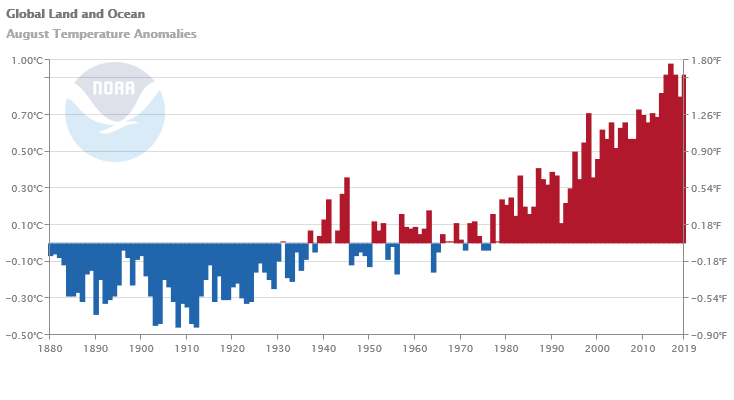
Yes, our Planet has been warming. And yes, just as ice floating in the surface of your sangria melts faster in hot weather, so does Polar ice floating in the oceans. The meltdown might even eventually return the Poles to their ice-free condition during the time of the dinosaurs.  Ocean-front cities will be the first to go.

Chart showing Earth's cold and hot cycle
NOAA Climate Information – Extreme Events, Trends

However, if industrialization contributed to a current natural warming, perhaps we can delay the inevitable through some lifestyle changes.

We could use some lifestyle changes anyway to clean up our air and quit dumping non-biodegradable garbage everywhere.

The 74th Session of the U.N. General Assembly

Leaders of the United Nations member states met in New York City on September 24th for the 74th Session of the UN General Assembly and Debate.  All presentations are available for watching on YouTube or the UN WebTV.

In his opening presentation, UN Secretary General Guterres once again insisted on the end of talk and the start of evidence of prescribed action under the Paris Agreement. He views the Agreement as a social and moral contract that signatories need to honor if we are to avoid climate catastrophe. The Agreement principally calls for a drastic world-wide reduction in CO2 through phasing out of fossil fuels.

By contrast, recently elected Brazilian President Jair Bolsonaro , clearly and forcefully indicated to the assembled dignitaries that Brazil is a sovereign nation that has demonstrated in words and actions that it is committed to environmental protection that is specifically adapted to the country’s own characteristics. President Bolsonaro took the opportunity to indicate his distaste for widespread media fallacies, political correctness that replaces reality, and socialist ideology that routinely leaves a “trail of misery.” Socialism is working in Venezuela, he said – everybody is now poor.

Compliant leaders like Emmanuel Macron of France, Angela Merkel of Germany, and Sebastian Pinera of Chile did report their progress in implementing climate fighting mandates contained in the Paris Agreement.

In a show of inclusiveness, organizers of the 2019 UN Session invited the input of entrepreneurs who could contribute to the climate fight through technology and customer reach. Entrepreneurs spoke of devises farmers in poor countries can use to predict the approach of threatening weather conditions. Representatives of Google, Microsoft, Ubisoft and other gaming companies reported on their success in reducing the energy consumption of their games and data storage, and including ideas on Planet protection in the theme of their games.

Who Did the UN Leave Out?

The United Nations mostly called for action from governments and corporations. They should have asked who they were leaving out! The Summit left out people – buyers, consumers, trend setters, and boycotters.

Consumer distaste wiped the Ford Company’s Edsel and the New Coke off the market within a short time of the products’ introduction. Conversely, The Blair Witch Project was a 1999 movie produced for $60,000 that grossed $140.5 million, because people thought the low-budged viral marketing and the shaky camera effect were really cool.

Maybe if all those children that demanded climate action from government refused to ride on gas guzzlers, gave up watching anything on energy-sucking plasma entertainment screens, and reduced their meat consumption they might set a trend. Their Climate Action Fridays could be spent reaching out to consumers and featuring companies that work on making their premises as carbon neutral as possible.

American Worker

The Obamas’ film “American Factory” presents a picture of today’s American marketplace. Looks like it’s time to develop a new business model.

In most American cities, the once prosperous middle class has been decimated. In major cities like San Francisco and New York, where living costs are high and lower-wage service jobs dominate a large portion of the economy, the rich thrive and the working poor live off government programs. The middle class is too poor to afford the living costs and too rich to qualify for government subsidies.

The Fixes

The easy fix to the problem of the disappearing middle class is to subsidize people who are above the poverty line. The very hard fix is to increase the availability of higher-paying trade jobs, reform the current misguided education system so it produces workers that are able to fill those jobs, and re-think collective bargaining as we know it today.

Most major cities employ the easy fix, while the federal government is attempting to implement a version of the hard fix. This version, however, relies heavily on mercantilism, focusing on tariffs and other methods of discouraging U.S. imports. Worker skills and challenges posed by today’s globalization-influenced and automation-prone economy are not being addressed as forcefully as trade.

An American Factory

American Factory is a Netflix film by Higher Ground Productions, a partnership between former President Barack Obama, his wife Michelle Obama and Netflix. The 2019 original documentary describes the early days in 2016 of an automotive glass production facility owned by the Chinese company Fuyao Glass located on the site of a shuttered GM plant in Moraine, Ohio.  Film directors Steven Bognar and Julia Reichert filmed the company’s workers and managers for three years, and released American Factory in August 2019.

Residents of Moraine were jubilant at again having jobs available and a thriving town. But reality soon set in. The company brought in Chinese personnel to train and work along-side the local recruits. Pay stayed lower than at the GM former plant. Tasks often proved dangerous.

Union agitation soon followed, in spite of company warnings from the start that this was to be a non-union shop. A 2017 attempt to unionize failed. Several workers were fired.
Whether the company’s talk of automation was prompted by the unionization attempt or was in the plan all along is difficult to say.

The Changing Workplace

The American middle class, once the backbone of the U.S. economy, boasted strongly-unionized assembly workers. American families drove Ford, GM, Chrysler, and AMC automobiles as they enjoyed rising post-WWII prosperity.

But this period was an anomaly, even if wishful thinking sought to enshrine it as an indication of intrinsic American superiority: by the ’70s and ’80s, what was true all along finally became practicable. Markets opened, information began flowing, capital aggregated, and most of all people in other parts of the world proved that they were willing and able to do the work that Americans firmly believed only we could do.  The Obama Film American Factory Backfires, aier.org, August 26, 2019.

By the 1980s The European Common Market succeeded in cementing the fact that globalization was the new way of doing things. So, American leaders and workers alike convinced themselves that the gods of Competitive Advantage had allocated to us in perpetuity the technological niche. We could be OK with Toyota taking over our automobile market because we could make Cray Supercomputers.

However, we neglected a crucial challenge: Things seldom remain static.

A New Reality for Chinese Companies

China, for example, went from being a supplier of our kids’ plastic toys, to a supplier of technology equipment parts, to the manufacturer of the Sunway TaihuLight – the machine that beat the U.S. Cray Supercomputer in 2016. In 2018, China had 206 out of the top 500 fastest supercomputers in the world, while the U.S. had 124.

China’s leaders went from wearing stodgy Mao jackets to wearing dapper business suits. Their negotiating style changed to match their business attires.  China developed a moneyed class engaged in business and trade. Efforts to deal with rural poverty are on their way.

Needless to say, with the rise of a moneyed class, comes a rise in general living standards, and with that comes a rise in the cost and complexity of doing business.

China’s evolving life style brings us back to Fuyao Glass. According to some observers, Chinese companies are locating manufacturing facilities externally because of China’s rising labor costs, taxes, and regulations!  Among those companies is Fuyao Glass.

The American Worker

American Factory presents a picture of what the American marketplace looks like today:  a significant number of American workers employed by U.S.-based foreign companies and facing the turmoil that comes from cultural clashes. The film’s message, however, is open to interpretation.

Workers at Fuyao have filed lawsuits against the company for a variety of reasons,  including allegedly illegally punishing workers for trying to unionize. Meanwhile, Fuyao has not been shy in expressing dissatisfaction with the habits of American workers.  The threat of automation lurks in the background, as the company’s chairman, Cao Dewang, seeks what he euphemistically calls a future in technology.

The wearying and expensive battle of wills is not productive or conducive to worker satisfaction. However, is it avoidable? Would the scenario be any different if this glass company were owned and managed by Americans? Today marks the third day of a nation-wide workers’ strike against General Motors.  So, maybe the American worker faces a deeper challenge than Chinese employers.

An Unintended Wake Up Call

The status quo no longer works in today’s rapidly changing globalized automation-prone world. Would it be better to move on to another model?

One idea might be to return to training skilled production workers, which stopped when the college-loan industry figured it would be profitable to promote the paper-shuffling industry, thereby helping to kill American manufacturing in the U.S. The production of goods by American companies located in foreign countries does no good to the American worker.

Another idea, which goes in tandem with the first, is to promote college as a place you go because you want to be there, can handle a high-level level of purely mental work, and cannot be distracted by constant political agitation. Highly trained technicians can help the U.S. keep up with a modern world not at all lacking in first-class universities offering outstanding technical education.

American Factory succeeds as a wake-up call. However, that wake-up call might not be the one intended by the film’s producers. American Factory perhaps serves as a reminder how American workers have been deceived by their legislators, used by their modern-day unions, and left unprepared to compete in today’s market place.

American Factory ribbon cutting
American Factory:  Fuyao Glass ribbon cutting in Moraine, Ohio

The Blurred Line Between Order & Chaos

A good article by Nathan Kreider posted on Being Libertarian says the “line between order and chaos is not as clear as many assume.” So true!

Chaos - CopyA good article by Nathan Kreider posted on Being Libertarian says the “line between order and chaos is not as clear as many assume.” The Just Vote No Blog recommends that article as means of dispelling a misconception on the nature of order and chaos.

Excerpt:

It is true, the laws by government can enforce order. But at the same time, there are many examples (continuously pointed out by libertarians) that certain laws can disrupt an already existing order, producing chaos. And when law becomes excessive, creating a needlessly bureaucratic mess, this is far more chaotic than a system with fewer, simpler laws.

Truer words were never spoken.  Read More of Nathan Kreider’s article.

Remembering September 11

It is good to remember and honor lives lost in tragic events. It is good to reflect on the events that 9/11 unleashed to establish our “post 9/11 world.”

ribbonIt’s good to remember and honor innocent lives lost in tragic events. On September 11, 2001, 2976 men, women, and children from all walks of life died at the hand of 19 suicide hijackers in New York, Pennsylvania, and Virginia.
It is not good to say their death were not unique, since innocent civilians are routinely massacred during times of conflict. It is not good to dismiss this tragedy as the work of some hidden nefarious entity.

It is best to honor these lost lives by reflecting on the utter uselessness and evil of endless conflict and war.

Our reflection on this calamity should include the events the attack on these lives unleashed. It should include our assessment is the “post-9/11” world leaders created, and citizens demanded in the name of “security.”

A measure of conflict is unavoidable in any group, be it parents and children or the family of nations. However, any group regardless of size, location, ethnicity or religion could reflect on the uselessness of oppression, thirst for power, and myopic battles.

May the souls lost on September 11 be resting in peace. May we the living work towards an end to conflicts that inevitably result in slaughter of the innocent.

John Bolton is Gone: Why Was He Ever Chosen?

Today, Donald Trump fired John Bolton. One might ask why Trump, a self-described deal maker, chose a quintessential foreign policy hawk in the first place.

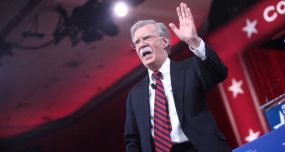
BoltonOn September 10, 2019, President Donald Trump accepted the resignation of John Bolton, the National Security Advisor he chose in April of 2018.

Bolton is the quintessential foreign policy hawk, who believes forceful action — what some call regime change — should be the preferred option in dealing with nations the U.S.  perceives as threats.

The question could enter people’s mind as to why a President who saw himself as an accomplished deal maker and campaigned on the promise of ending U.S. endless wars would choose an advisor like Bolton. Perhaps the answer is that John Bolton’s purported aim is the same as Donald Trump’s: advocate for American interests.

But, unfortunately, no matter how sincere is Bolton’s aim, Trump must have finally faced the fact that the devil is in the details, and Bolton’s strategy has never included deal making or ending war in the maintenance of regime change.

As noted in a comprehensive article in The Atlantic, in his memoir Surrender is Not an Option John Bolton expresses contempt for what he views as soft foreign policy.

State careerists are schooled in accommodation and compromise with foreigners, rather than aggressive advocacy of U.S. interests, which might inconveniently disrupt the serenity of diplomatic exchanges, not to mention dinner parties and receptions.

The problem that Trump possibly had to face in Bolton’s case is that in government, just as in business, something either works as advertised or it does not. True, the bigger the entity, the more freely it can paper over discrepancies between what is said and what is done.

However, the failures of regime changes are becoming simply too obvious to hide: Guatemala, Chile, Iran, Zaire, Afghanistan, Iraq.  The autocrats that took over these nations after the U.S. intervened left them no better than before intervention.

There is a saying, “War is the health of the state.” Hawks like John Bolton probably sincerely believe that. However, Thomas Jefferson might have had a better idea,

Peace, commerce, and honest friendship with all nations – entangling alliances with none.  Thomas Jefferson, Inaugural Address.