The Curious Case of Housing Legislation

Sacramento has been generating buckets full of high-profile real estate bills (which legislators call housing bills) containing draconian mandates that cities and counties must follow, whether such mandates overrule local land-use laws or not. The latest proposal is Senate Bill 330. Good luck trying to place a voter initiative on a ballot should SB 330 be approved.

California is littered with billionaires, mansions, 2 million-dollar shacks, and the highest number of souls who call the state’s grimy streets their home. Meanwhile, state legislators are on a mission to pass legislation that result in the tearing down of older more affordable buildings, destruction of traditional neighborhoods, out-migration of the middle class, and in-migration of both the well off and the destitute.

A Background Worth Reiterating

Sacramento has been generating buckets full of high-profile real estate bills (which legislators call housing bills) for the last half a dozen years or so. At first, the reason behind the earlier bills was the “climate crisis,” a “matter of state-wide concern” that required the state to implement drastic mandates whether such mandates overruled local land-use laws or not.

The seminal piece of legislation behind these bills was California Assembly Bill 32, The Global Warming Solutions Act, signed into law by Governor Arnold Schwarzenegger on September 27, 2006. AB 32 mandated a reduction of the state’s greenhouse gas emissions to 1990 levels by 2020 and to 80 percent below 1990 levels by 2050.

California Senate Bill 375, The Sustainable Communities and Climate Protection Act, signed into law by Governor Schwarzenegger in 2008, zeroed in on cars as the primary culprits in the imminent demise of Mother Earth. SB 375 mandated 1) the California Air Resources Board set regional emissions-reduction targets from passenger vehicles, and 2) the Metropolitan Planning Organization for each region develop a Sustainable Communities Strategy that integrated transportation, land-use and housing policies.

Bingo! SB 375 earned its spurs by 1) pulling in land use and housing policies into the climate change crisis, and 2) shifting responsibility for land-use policies from cities and counties to state-enabled regional agencies. The Metropolitan Transportation Commission (the San Francisco Bay Area region Metropolitan Planning Organization) enshrined SB 375 in recognition of the bill’s stature:
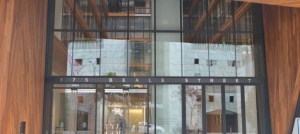
375 Beale St

Headquarters of the Bay Area Metropolitan Transportation Commission. From the MTC’s website:   “The building’s address — 375 Beale Street — is a nod to Senate Bill 375, the landmark state law passed to foster a more sustainable future for California’s metro areas.”

After SB 375, transit-oriented development bills, created in the name of reducing green-house gas emissions produced by commuters, encouraged housing clusters within permissible areas and discouraged sprawl.  Housing prices within narrow transit corridors skyrocketed.  Speculators poured in, developers came seeking customers for luxury housing, and construction unions clamored for their piece of the already high-cost pie.

The Enabling Legislation

Recently, three pieces of real estate legislation garnered nation-wide attention:
Senate Bill 827, introduced by Senator Scott Wiener, focused on inserting dense housing in any and all transit corridors, regardless of local zoning. The bill was so ferociously opposed by counties, cities and neighborhoods that it was mercifully killed in the legislation’s Transportation Committee in April of 2018. SB 827 was brazen, but it was also bizarre. The transit mentioned in the bill included bus routes, which could conceivably disappear overnight before SB 827 glommed on to the route.

The demise of SB 827 spawned Senate Bill 50, also introduced by Senator Wiener. SB 50 was even more brazen than SB 827, since it not only mandated density in any and all transit corridors regardless of local zoning, but mandated the same in “job-rich” areas. Job rich meant any neighborhood in any corridor leading to any business cluster that provided jobs. So, a neighborhood of single-family homes adjacent to transit that takes residents to jobs is job-rich and open by mandate to developers that want to build multi-unit housing. Opposition again mounted. SB 50 was tabled by the legislation’s Appropriations Committee on May 16, 2019.

Now Californians have been presented with Senate Bill 330, the Housing Crisis Act of 2019, introduced by Senator Nancy Skinner on February 2019. The bill is currently active and pending referral.

SB 330 consists of 24 pages of minutia that purportedly aims to “temporarily,” until 2025, enhance the ability of developers to obtain building permits regardless of local rules. In the process, SB 330 obliterates county and city land-use and zoning rules enacted since January 1, 2018 that the bill’s authors view as impediments to nearly unfettered housing development.

Like SB 827 and SB 50, SB 330 transfers by edict land-use decisions from cities, counties and neighborhoods to the state, even curbing the ability of cities’ and counties’ electorates from placing initiatives or referendums on ballots.

And, of course, SB 330 contains the obligatory clause featured in legislation that nullifies local rules, including rules enacted by charter cities. Charter cities are protected from outside meddling by the California State Constitution, unless the meddling is a matter of “statewide concern rather than a municipal affair.”

Here are some clauses of SB 330

* Prohibits retroactively from January 1, 2018 any city or county from imposing or increasing any requirement that a proposed housing development include parking in excess of specified amounts, and prohibits any city or county from charging approval fees in excess of specified amounts.

* Prohibits retroactively from January 1, 2018, any city or county from disallowing a proposed housing development project that has been given a conditional use permit if that project would have been eligible under a city’s or county’s general land-use plan and zoning ordinances in effect on January 1, 2018.

* Prohibits retroactively from January 1, 2018, any city or county, or any voter initiative or referendum, from a) changing the land use designation or zoning of a parcel of property to a less dense use or reducing the parcel’s density; b) imposing or enforcing a moratorium on housing development; c) imposing or enforcing new design standards that are not objective design standards; d) establishing or implementing certain limits on the number of permits issued.

* Requires enforcing agencies to grant to owners of substandard housing delays up to 7 years for correction of violations or nuisances if owners submit an application for such delay and if the enforcing agency determines that correction or abatement of the violation or nuisance is not necessary to protect health and safety.

Check out the California Political Review for a more passionate post on the perils of SB 330.

Rules for Radicals

One could almost think that Saul Alinsky’s Rule #10 could be found somewhere in California’s State Constitution, judging by the relentless tsunami of housing-related legislation generated by state legislators purportedly in their effort to fix a crisis they themselves help create. Rule #10 says,

The major premise for tactics is the development of operations that will maintain a constant pressure upon the opposition.
Antonio Gramsci: The New Hegemony

Antonio Gramsci formulated possibly the most influential philosophy of our times – rule brought about not by violent force but by consent of the subjugated class. Some call Gramsci’s philosophy Neo-Marxism, but Gramsci himself does not appear to have called his philosophy anything; he simply described the plan’s components: hegemony, praxis, and civil society.

One of the most fascinating political writers of the early 20th century was Antonio Francesco Gramsci. Gramsci was born in 1891 in the beautiful Mediterranean island of Sardinia, and died at only 46 in Rome in 1937. During such a short life, he was able to formulate possibly the most influential philosophy of our times – rule brought about not by violent force but by consent of the subjugated class. Some call Gramsci’s philosophy Neo-Marxism, since it aims to achieve similar results without the extreme authoritarianism of Traditional Marxism. Gramsci himself does not appear to have called his philosophy anything; he simply described and emphasized the plan’s components: hegemony, praxis, and civil society.

Gramsci’s writings, mostly essays, are divided into pre-prison time and prison time. Prison time, courtesy of Benito Mussolini’s anti-Marxist Fascist Italy, lasted six years, 1929-1935. According to those who study Gramsci’s work, the pre-prison essays (1910-1926) lean towards the politically specific, while the latter woks are more historical and theoretical. Interestingly, Gramsci’s socio-political theories provide insight into common strategies used by both capitalists and Marxists. Concepts of hegemony, praxis, and civil society are entirely adaptable.

Hegemony

The bourgeoisie, in Gramsci’s view, develops a hegemonic culture using ideology rather than violence, economic force, or coercion. Hegemonic culture propagates its own values and norms so that they become the “common sense” values of all and thus maintain the status quo. Hegemonic power is therefore used to maintain consent to the capitalist order, rather than coercive power using force to maintain order. This cultural hegemony is produced and reproduced by the dominant class through the institutions that form the superstructure.  Wikipedia, Antonio Gramsci

The bourgeoisie indeed ruled, until it was officially challenged in the 1960s by Lyndon Johnson’s Great Society.  During the last 50 years, the U.S. has experienced a gradual and relatively peaceful normalization of the socialist order. The newly- socialist-bent institutions of the superstructure (courts, universities, news media) provide support to the superstructure itself (today popularly alternately called the military-industrial complex, the deep state, or the central banks). Meanwhile “the capitalist order” has assumed the full mantle of crony capitalism and is busy normalizing its own crony newspeak (bailouts, affordable housing, industry tax breaks). Hegemony brought about by the consent of the subjugated (taxpayers, the working-poor dependent on public assistance, the priced out renter) is totally fungible.

Praxis

Praxis is the process by which a theory, lesson, or skill is enacted, embodied, or realized. Praxis may also refer to the act of engaging, applying, exercising, realizing, or practicing ideas … It has meaning in the political, educational, spiritual and medical realms.  Wikipedia, Praxis

In other words, praxis is the end result of observation, study, and thinking. It is doing.  It can be action oriented towards changing societal norms and values. Or it can be action to defend the status quo against factions desiring change.  Endless discussions on the virtues of capitalism vs. socialism are fine, but movement towards or against one or the other can only come about via mobilization of armies of volunteers, financial supporters, and strategists.  Praxis is exemplified by mobilizers such as the Tea Party or MoveOn and the Koch brothers or George Soros.

Civil Society

What we can do, for the moment, is to fix two major superstructural “levels”: the one that can be called “civil society”, that is the ensemble of organisms commonly called “private”, and that of “political society” or “the State”. These two levels correspond on the one hand to the function of “hegemony” which the dominant group exercises throughout society and on the other hand to that of “direct domination” or command exercised through the State and “juridical” government. The functions in question are precisely organisational and connective. The intellectuals are the dominant group’s “deputies” exercising the sub-altern functions of social hegemony and political government.  Archive.org, Antonio Gramsci, Selections from the Prison Notebooks

In summary, civil society lives by consent, while the State ensures by force the continuation of consent. Intellectuals function as the principal manufacturers of consent.  Academics are the foot soldiers that help either preserve the status quo or generate fresh value systems from which new hegemony arises.  Civil society is the battleground that gives rise to hegemony.

The International Gramsci Society, until recently presided by the late literary scholar Joseph Buttigieg (father of Rhodes-scholar and Mayor of South Bend, Peter Buttigieg, a presidential candidate in the 2020 U.S. elections), is one of many societies developing the socialist/Marxist consensual hegemony within today’s civil society.

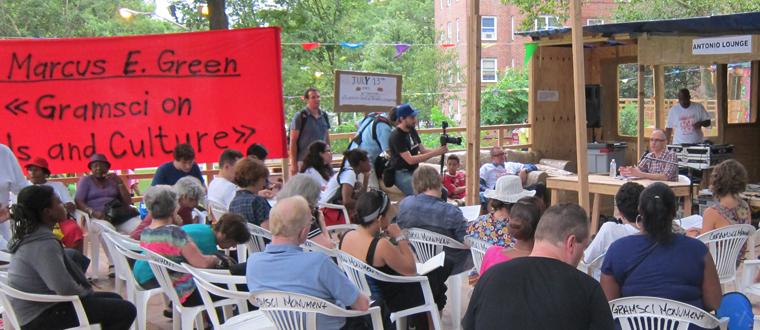
Gransci meetingPictured lecturer:  Marcus E. Green, Phd, Pasadena City College, author of several Gramsci-related essays and secretary of the International Gramsci Society.

Gramsci’s Other Concepts

Antonio Gramsci discussed several other important concepts, many of which we can clearly see playing out today. Here are three:

Organic intellectuals: Scholars, artists, and functionaries (administrators, bureaucrats, industrial managers, and politicians) that identify with the economic structure of their society more than traditional intellectuals. Thus, organic intellectuals are more able to spread organic ideology, since their communication is with structures they identify as their own. Our representatives in the U.S. Congress are good examples of organic intellectuals; they identify with today’s penchant for kicking the can of the obviously unsustainable national debt down the road, and their ideological hegemony persists.

War of Position: Struggle against the existing hegemonic system is necessary for the establishment of a new system. The war to establish a dominant position must be waged on all three levels of society – economic, political and cultural. The current thrashing about between the administrative and legislative arms of our federal government should go down in history as a quintessential war of position.

Organic Crisis: Differs from ordinary financial, economic, or political crises. It encompasses an entire system that is no longer able to generate social consensus because the system’s ruling classes are unable to resolve conflicts. Organic crisis appears when, as Antonio Gramsci describes in his Prison Notebooks, “the old is dying and the new cannot be born.” Has the U.S. reached that point yet?

Update on who California legislators work for

California Senate Bill 50 is tabled until at least 2020. That’s a good start in doing away with this bill altogether, since as its author say, “everyone hates SB 50.”

Dogpatch Neighborhood - CopyCalifornia Senate Bill 50, authored by Senator Scott Wiener, was tabled today by the Appropriations Committee until “at least 2020.”  In a previous post Just Vote No asked Who Are California Legislators Working For?  After all, if Senator Wiener states that “everyone hates SB50”, then why, pray tell, would he continue to hawk that bill?  Are legislators not supposed to represent their constituents?
SB 50 has been put to sleep, it has not been done away with.  So, the pressure against it needs to continue.  This is a bill universally despised by just about every city, including San Francisco and Los Angeles, simply because SB 50 shamelessly attempts to remove control of land-use planning from every singly city and county in California.

Here are a couple of articles announcing the news:

California transit density proposal SB 50 on pause until 2020, L.A. Curbed 05/16/19

High-profile California housing bill dies without a vote.  Sacramento Bee 05/16/19

Gentrification: One Way it Happens

“The neighborhood wants to blame somebody else rather than themselves and they want to blame the bad landlord,” said Wilson…The community doesn’t shop here, they love to have it and it makes their houses worth a lot of money but they’re going down to Safeway.”

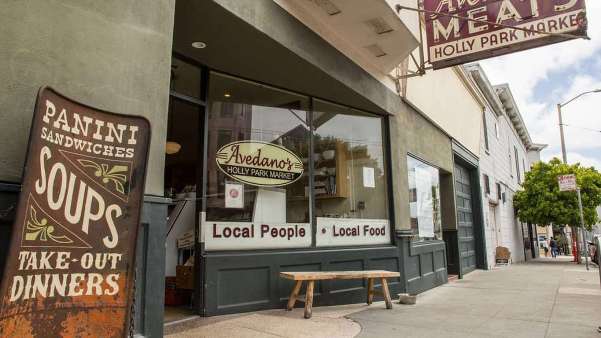
A neighborhood butcher shop, Avedano’s, in an old and beautiful neighborhood in San Francisco, Bernal Heights, has made news, mostly because its owner, Angela Wilson, gave such a clear and empathetic description of how neighborhoods change.  Her story is happening in countless neighborhoods throughout the nation.  Her story is one variable in the dreaded word “gentrification” that is often left out when politicians, activists, homeowners, and renters talk about fear of being priced out.

According to Wilson, the fact that she has a new landlord with plans for massive construction and renovation isn’t the real problem, though that project would effectively end their access to a kitchen for the foreseeable future. “It has more to do with the demographics of the city and the fact that people buy things online and want to use stores to supplement what they buy online,” says Wilson. “We’ve created two market places for the same amount of people.”

“The neighborhood wants to blame somebody else rather than themselves and they want to blame the bad landlord,” said Wilson. “My old landlord had the building since 1955, so my rent did increase but it’s not the new landlord’s fault. The community doesn’t shop here, they love to have it and it makes their houses worth a lot of money but they’re going down to Safeway.” 

Without a New Plan, Bernal Butcher Shop Avedano’s Will Close in June, Eater, MSNBC, May 10, 2019.

Avedanos Shop 2

In a previous article Just Vote No talked about California Senate Bill 50, which would greatly facilitate the replacement of older buildings with new much more expensive ones.  A reader raised the question, how would a new building take the place of an old one to begin with?

Changes in demographics, lifestyles, and consumer preferences is one way.  When in older times families would shop at the neighborhood butcher shop, now they shop at Costco for several days’ or weeks’ worth of supplies, order whole dinners on line, or stop by their favorite take-out shop on their way from work. So, the butcher shop has difficulty staying open.

Add to that scenario, aging landlords who decide to sell their buildings and retire.  Most likely their buildings will be purchased by deep pocketed developers, who, incentivized by legislation such as Senate Bill 50, might want to tear down old buildings and replace them with denser, more expensive ones that yield higher profits. Rents double and renters already struggling leave unable to afford the new rent.

Just Vote No hopes Angela Wilson’s shop will survive in some manner.

Who Are California Legislators Working For?

In a representative type of government, legislators supposedly represent the majority of their constituents without neglecting the minority. Senator Scott Wiener says “everyone hates SB 50,” yet he is on a mission to get that piece of legislation passed. Who is Senator Wiener working for?

California claims multiple bragging rights – environmental leader, 4th largest economy in the world, highest GDP in the U.S., and lots of sunshine. Astronomical living cost, highest homelessness in the nation, and jewel cities like San Francisco noted for not-so-clean streets all are challenges legislators are working on…and on. However, California has an especially worrisome condition: legislators that do what they determine is good for their constituents, regardless of what those constituents want.

Prime Example: Senate Bill 50

The desire of California legislators to remake the state in their own image is exemplified by Senator Scott Wiener’s proposed Senate Bill 50 which is relentlessly winding its way through legislative committees. The bill claims it aims to fix the state’s notoriously high housing costs by requiring that all cities in California allow developers to build multi-family housing by receiving “communities incentives” in any neighborhood adjacent to transit or adjacent to “job-rich” hubs, regardless of local zoning laws.

This bill would require a city, county, or city and county to grant upon request an equitable communities incentive when a development proponent seeks and agrees to construct a residential development, as defined, that satisfies specified criteria, including, among other things, that the residential development is either a job-rich housing project or a transit-rich housing project, as those terms are defined… Senate Bill 50

Thus if a bus line runs along main street in your single-family neighborhood, multi-family housing – luxury or non-profit, containing any number of subsidized units, and casting whatever shadow it wants onto your yard — shall be built whether you like it or not. The same will occur if your neighborhood is considered by the state to be in an area that offers jobs, such as Silicon Valley or Walnut Creek.

As an aside, SB 50 is a remake of SB 827, which went down in flames at its first committee hearing in 2018. However, this time around the bill offers some tenant protections in an effort to pacify residents that fear being priced out of their neighborhoods; and it requires “labor protections,” such as prevailing (union) wages.

Everybody Hates SB 50

CDogpatch Neighborhood - Copyalifornia is home not only to a lot of homeless and housing insecure people, but also home to rich people. Recent statistics say California is #1 in the nation in the number of resident billionaires. Also, the state boasts some lovely single-family and/or low-density neighborhoods – seaside, suburban, and urban – that few would want to give up.
Thus, there is a nearly universal aversion for SB 50.

Local governments across the state have lined up against SB50, including the San Francisco Board of Supervisors and Los Angeles City Council. There is widespread opposition along the Peninsula and in the South Bay, in Palo Alto, San Mateo, Cupertino and Sunnyvale, which like the East Bay suburbs could see their zoning rules upended because of their designation as “jobs-rich areas.  Wealthy Bay Area Suburbs Could Have a Whole New Look Under California’s Housing Bill, San Francisco Chronicle, May 10, 2019

“Everyone hates SB 50—everyone hates it,” said California state Sen. Scott Wiener at a recent forum on the state’s housing crisis. “You hear people getting upset about it, yelling about it, coming down to City Hall and yelling.” Flanked by real estate developers and housing rights advocates, Wiener, a Democrat who represents San Francisco, had come to discuss his ideas for solving the problem—which meant talking about the heated reaction to his signature piece of legislation, Senate Bill 50—the housing bill Californians seem to love to hate.  Everyone Agrees California Has a Housing Crisis. Trying to Fix It Has Become a Battle, Mother Jones, May 3, 2019.

Who Does Your Legislator Work For?

In a representative type of government, legislators supposedly represent the majority of their constituents without neglecting the minority. In California, legislators increasingly ignore their constituents’ wishes in favor of determining on their own what is best for those constituents.

Senator Scott Wiener says “everyone hates SB 50,” yet he is on a mission to get that piece of legislation passed. Who is Senator Wiener working for?

Tax Cuts: Rising Tide That Lifts Some Boats

The 2017 tax cuts gave a boost to the U.S. economy. Workers are finding jobs. Lower-income folks take home a little more on pay day than they did before the tax cuts. U.S. companies have more after-tax money that could trickle down to workers once stockholders are appeased. The bad news is that all this is really a band-aid that leaves underlying problems untouched.

On December 22, 2017, President Donald Trump signed the Tax Cuts and Jobs Act after approval of the bill by the Senate and the House of Representatives on December 20, 2017. Thus the most significant tax changes since the Reagan years were enacted. Ever since, the “tax cuts” have joined the growing list of subjects that elicit a great deal of hand wringing from just about everybody.

Rather than post yet another laundry list of what the Tax Cuts and Jobs Act says, here is a brief review of what has happened since the bill became law that might interest workers.

* Job Creation:

At the beginning of May 2019, the unemployment rate stood at 3.6%, lowest level since the 1960s, indicating that companies are creating jobs and hiring workers. The long-term trend since well-paying manufacturing jobs vanished continued, and most growth occurred in low-paying sectors. A lot of hand wringing from our legislators culminated in Senator Chuck Schumer’s sudden concern about “income inequality” as associated with the tax cuts, when the rich have been getting a lot richer for years.

* Wage Growth:

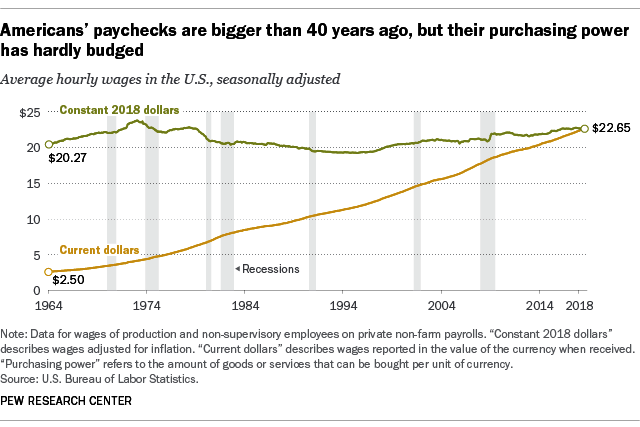
January 2019 posted a real wage gain of 1.7%, and a nominal gain of 3.2%. Real wage figures are adjusted for inflation, while nominal wage figures are not. Lower-paid workers saw the highest gain, around a quarter to a third of that gain probably due to new minimum wage laws and the rest due to job growth that requires employers to pay more to attract workers. The 1.7% figure is a nice gain from 2018, but not much different than year-over-year figures since the 1960s. In other words, in-spite of astronomical rises in the prices of goods in major U.S. cities, real wages have been downright stagnant. The hand wringing comes in again when legislators so concerned about the rich getting richer want interest rates to remain low, which means stock prices remain high, creating wealth mostly for those who can afford stocks (of course, low interest rates “benefit” the poor and middle class, since low rates facilitate more consumption based on a sea of debt).

Pew Research Center:  For Most U.S. Workers, Real Wages Have Barely Budged in Decades.  August 7, 2018.Real and nominal wages

* Company Profits:

The tax cuts lowered the corporate tax rate from 35% to 21%, in hopes employers would make capital investments, hire more workers, and increase workers’ pay. That is not what usually happens. Blessed with a windfall such as the 2017 tax cuts, major corporations usually benefit their shareholders first with investments such as stock buybacks and generous bonuses. Capital improvements that can increase productivity and worker benefits trickle down eventually, though. Such facts did not prevent major hand wringing from the mainstream media when the usual corporate behavior occurred after the 2017 tax cuts.

* Growth of Gross Domestic Product:

The Gross Domestic Product (GDP) is the total value of all end-product goods and services in the country, including personal consumption, business investment, and government spending on goods and services (welfare payments and interest on the national debt are excluded). The U.S. real (adjusted for inflation) GDP growth rate for 2017 was 2.27% and estimated for 2018 2.80%. For comparison, the real GDP of our two neighboring countries are: Canada 3.05 for 2017 and 2.00 estimated for 2018. Mexico 2.04 for 2017 and 2.10 estimated for 2018.

A healthy GDP is thought of as the tide that lifts all boats. However, sometimes the rise is perilous enough to endanger the people in the boats or uneven enough that some boats get lifted more than others.

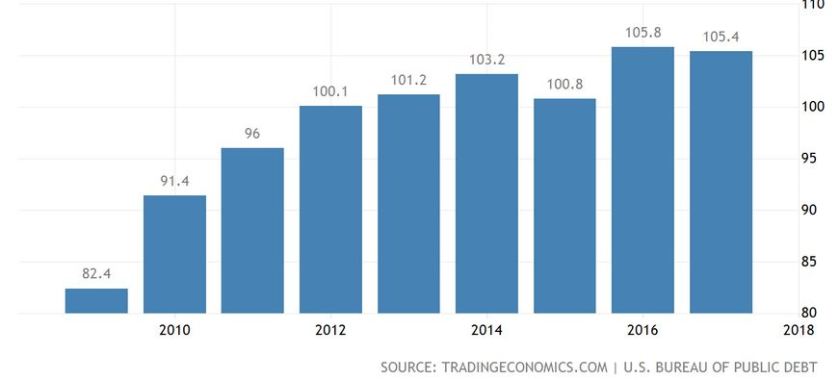
At present the U.S. national debt to GDP is hovering on the perilous. That is because legislators, in their effort to get re-elected, want to make the U.S. economy look good, regardless of underlying financial land mines. Deficit spending that keeps adding to the national debt is the financial land mine of our time.

Debt to GDP

Theoretically, as GDP grows so does the wealth of a country’s citizens. However, wages of lower and middle-income workers are stagnant, while the asset-based wealth of the rich is growing. Nobody dares talk about the growth of monopolies – they are too big to annoy.  Nobody dares do much about the “plantation” into which lower-income folks have been assigned – keep the plantation denizens dependent and they will deliver the vote.

In Summary:

The 2017 tax cuts gave a good boost to the U.S. economy.  Workers are finding jobs.  Lower-income folks take home a little more on pay day than they did before the tax cuts.  U.S. companies have more after-tax money that could trickle down to workers once stockholders are appeased.  To the ire of profligate states like California, federal deductions for astronomical state and property taxes are now limited (as an aside, most workers in expensive states like California rent their home, and thus do not have property tax deductions).

The eye-popping downside of the tax cuts is that they will add to the already significant national deficit (the U.S. spends more than it takes in revenues).  By October 2018, the deficit grew to $779 billion, a 17% increase over 2017.  Deficits end up being paid by borrowing, just like in any household.

The unfortunate downside is that tax cuts — any tax cuts — act like a band-aid.  The economy gets a boost and the political faction that brought about the cuts can hope for votes if all goes well.  Meanwhile the underlying variables that support monopolies, stagnant wages, income inequality, and perilous government borrowing remain untouched.

In-Car Deliveries: What Could Go Wrong?

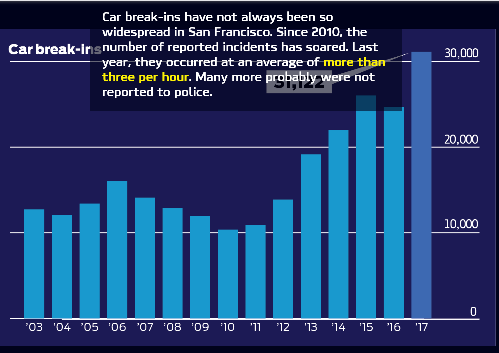
Just Vote No wishes nothing but good luck to Amazon and its new in-car delivery service; especially in cities like San Francisco, with soaring car break-ins.

Amazon transformed itself from an on-line bookseller to a huge seller of everything.  Its delivery network is therefore impressive.  In 2017 Amazon introduced in-home delivery for subscribers that wanted their packages delivered inside their homes.

Now Amazon introduced in-car delivery.  Any Amazon Key customer with a “connected car” can have their Amazon packages delivered to their parked car!  Great idea, since this service would certainly help stem the explosion of car break-ins in cities like San Francisco.  Or, what could possibly go wrong?  An article from San Francisco’s  SF Gate asks the question.

Another article, in the San Francisco Chronicle, has the figures on car break-ins for San Francisco.  The article also notes that arrests amount to less than 2%.

SF Car break ins 2

As cities like San Francisco descend into the questionable prosperity of being home to the very rich and the very poor, break-ins of smart cars preferred by the former should be expected to proliferate.

Just Vote No wishes nothing but good luck to Amazon.  Perhaps the company will need a lot of that with in-car deliveries.

“Ballot Harvesting” in California

Liberty requires dialog, exchange of ideas, choices. Nothing resembling that exists in California, where a one-party system emboldens questionable action. “Ballot harvesting” helps perpetrate the system, and need to end.

California is a one-party state. At present, that political party happens to be the Democrat Party. The party is so entrenched that its political views permeate all sectors of California living. The Just Vote No Blog is non-partisan, but liberty-leaning, and therefore categorically opposed to a political system dominated by only one set of views.

Liberty requires dialog, exchange of ideas, choices. Nothing resembling that exists in the Sunshine State. One way to change that status quo is for ordinary people to find the time, will, and courage to support alternative political parties, be they American Independent, Green, Libertarian, Peace and Freedom, or Republican.

When a group – any group – becomes entrenched, too powerful, then bad things happen. People start feeling emboldened to take questionable action. One example of such scenario is “ballot harvesting.” Ballot harvesting occurs when individuals, often associated with political organizations, go door-to-door and offer to pick up absentee ballots from voters and deliver them to the county registrar of voters. Often seniors and the disabled are targeted. Sounds like a caring thing to do, right? The problem is that there is no chain of custody for the ballot that gets picked up. What proof is there that the ballot was indeed delivered to the registrar of voters? What proof is there that the voters’ voice was heard at all at the polls?

Fighting the actions of entrenched power one law suit at the time is sometimes the only way to regain a measure of liberty. The Just Vote No Blog recommends you read this article on The California Political Review, Need Help to End Absentee Ballot Harvesting, by Steve Frank, published on April 29, 2019. These folks happen to support the Republican Party, but perhaps other political parties might want to join in their effort.  Here is what needs to happen for this step in ending ballot harvesting to succeed according to Steve Frank:

In California the attorneys are looking for the following type of Plaintiff and situations, for a proposed lawsuit. We need the information as quickly as possible.

  • If you gave your ballot to someone who came to the door, was it counted? Check with your registrar of voters
  • Were you harassed the last thirty days of the November, 2018 by unknown people coming to your door, day after day, demanding your absentee ballot
  • Did you receive an absentee ballot when you did not ask for it?
  • Did you get the name of the person or organization that was sponsoring the door to door pick up of absentee ballots?
  • Did someone offer to help you finish filling out your ballot?

If you have experienced any of the situations listed above, please consider contacting Steve Frank at stephenfrank@sbcglobal.net.

ChooseLibertyAccepting California’s status quo in order to simply get on with our lives is fine, but perhaps we might consider going beyond that and choosing liberty.  Perhaps we might consider taking action to change the that status quo.

The Rough Beast at Your Ballot Box

“Things fall apart; the centre cannot hold … The best lack all conviction, while the worst are full of passionate intensity.” Sounds like politics!

W.B. Yeats wrote his often-quoted poem The Second Coming in 1919, in the wake of the devastation of WWI and that war’s chaotic aftermath that foretold the inevitability of WWII.

The poem is short, free verse with iambic pentameter, and somewhat to the point – “somewhat,” since, like all good art, The Second Coming does not spell out, but only hints. Here is the poem,

The Second Coming

Turning and turning in the widening gyre
The falcon cannot hear the falconer;
Things fall apart; the centre cannot hold;
Mere anarchy is loosed upon the world,
The blood-dimmed tide is loosed, and everywhere
The ceremony of innocence is drowned;
The best lack all conviction, while the worst
Are full of passionate intensity.

Surely some revelation is at hand;
Surely the Second Coming is at hand.
The Second Coming! Hardly are those words out
When a vast image out of Spiritus Mundi
Troubles my sight: a waste of desert sand;
A shape with lion body and the head of a man,
A gaze blank and pitiless as the sun,
Is moving its slow thighs, while all about it
Wind shadows of the indignant desert birds.

The darkness drops again but now I know
That twenty centuries of stony sleep
Were vexed to nightmare by a rocking cradle,
And what rough beast, its hour come round at last,
Slouches towards Bethlehem to be born?

Battle of SommeClick here for a link to a beautiful audio version.

The images on the audio/visual Youtube post are from the World War II Battle of Somme — 141 days July 1 to November 18, 1916, of trench warfare on the Western Front, with a million men wounded or killed by its end.  The war did not end until 1918.

Why is the Just Vote No Blog Recommending Yeats Poem?

So, why would the Just Vote No Blog recommend The Second Coming? The poem makes for beautiful reading or listening, and it raises a favorite question of the Just Vote No Blog: are the forces of destruction and chaos inevitable reality or the result of bad ideas?

The literati in their analysis of The Second Coming often wax eloquent about Yeats’ reference to “the widening gyre” as testimony of his view of humanity and history as cyclical in the Biblical or mystic sense – birth, death and rebirth. Indeed the history of nations bears out such trajectory, with the rise and fall of the Roman Empire standing as prime example.

But here is what the Just Vote No Blog prefers to offer as testimony instead:

The best lack all conviction, while the worst
Are full of passionate intensity.

When a politician says that there ought to be a chicken in every pot and a car in every garage, he or she makes sure passion and intensity accompanies the message, which “the worst” immediately take up with equal verve and soon turn the message into reality. While “the best” often remain cynically aloof, lacking in conviction.

By the way, defining the difference between “the worst” and “the best” is up to you.  Maybe, though, you could look at results, or promises vs. reality.

The Rough Beast

Yeats ends The Second Coming with possibly the most utilized line in modern western literature:

And what rough beast, its hour come round at last,
Slouches towards Bethlehem to be born?

The Biblical second comer is no sloucher,

For as the lightning comes from the east and flashes as far as the west, so will be the coming of the Son of Man.  Matthew 24:27 

The vision Yates creates is of someone moving patiently but relentlessly towards a goal. What if we chose to take that beast as the embodiment of bad ideas, the type of bad ideas we vote for at the polls, or bad ideas proselytized by politicians? What if we just say no? Would we stop the beast?

Obviously, a website titled the Just Vote No Blog would have to say “yes.”

No Sign Congress Wants to Go Back to Work

Certainly, we the people want Congress to root out corruption, and the fall from grace of many who Mueller dispatched into the arms of the judicial system might have been worthwhile. But, was this mere collateral damage within a higher agenda? Is it time for every voter and taxpayer to ask whether there is a higher agenda and what that agenda might be?

If anyone at all harbored any hope that the U.S. Congress would go back to work after Special Counsel Robert Mueller issued his report on “Russian Collusion” stating there was none, those unfortunate hopeful folks need to abandon all optimism and go back to just shelling out tax money.

After nearly two years and approximately $30 million in expenses incurred by the Mueller investigation, Congress and the public got to see a redacted version of the Mueller Report in April 2019 – and a new round of pulling of hair and rending of garments commenced. The Democrat majority in the House of Representatives renewed its cry for more investigations and possible impeachment of the President. They want to look into his tax returns and his private real estate deals. They want to investigate who paid for his inaugural event, and why he is calling for changes in the U.S. Census.

Monopoly OligarchCertainly, we the people want Congress to root out corruption, and the fall from grace of many who Mueller dispatched into the arms of the judicial system might have been worthwhile. But, was this mere collateral damage within a higher agenda? Is it time for every voter and taxpayer to ask whether there is a higher agenda and what that agenda might be? Might such a higher agenda be the innocent belief that Donald Trump threatens the venues that government uses to take care of us? Or might the higher agenda be that of oligarchs who do not wish to relinquish control of government venues in charge of funneling wealth?

The innocents truly believe government can better their lives by providing free stuff. They ignore the fact that there is no such thing as free stuff. Take education that became unaffordable to the average American college aspirant when predictably colleges raised tuition in order to capture the largess offered by taxpayer-funded student loans.

On the other hand, oligarchs know exactly what they are doing by encouraging endless printing of fiat money. Think your rent is so high you barely can keep a roof over your family’s head? Look at all the practically free money created by rock bottom interest rates that end up parked in real estate that remains vacant for decades. Think your city is full of techies that can afford to price you out of purchasing a home? Look again at all the fiat money floating around that needs to be parked somewhere, and tech companies are as good a parking space right now as anything else. By the way, this scenario is not the result of capitalism, but the result of policies such as those established by the Federal Reserve (low interest rates) and your government at work (endless spending on entitlements and forever wars).

Voters and taxpayers might want to consider the invisible strings pulling the visible puppets that are so intent on avoiding change at all cost.