Editorial: Vicious Fishes, memories, and gentrification

As folks move from populous expensive regions to our small affordable town, spurring development, we will have a fancier town. But comforting places like Vicious Fishes will be priced out and gone.

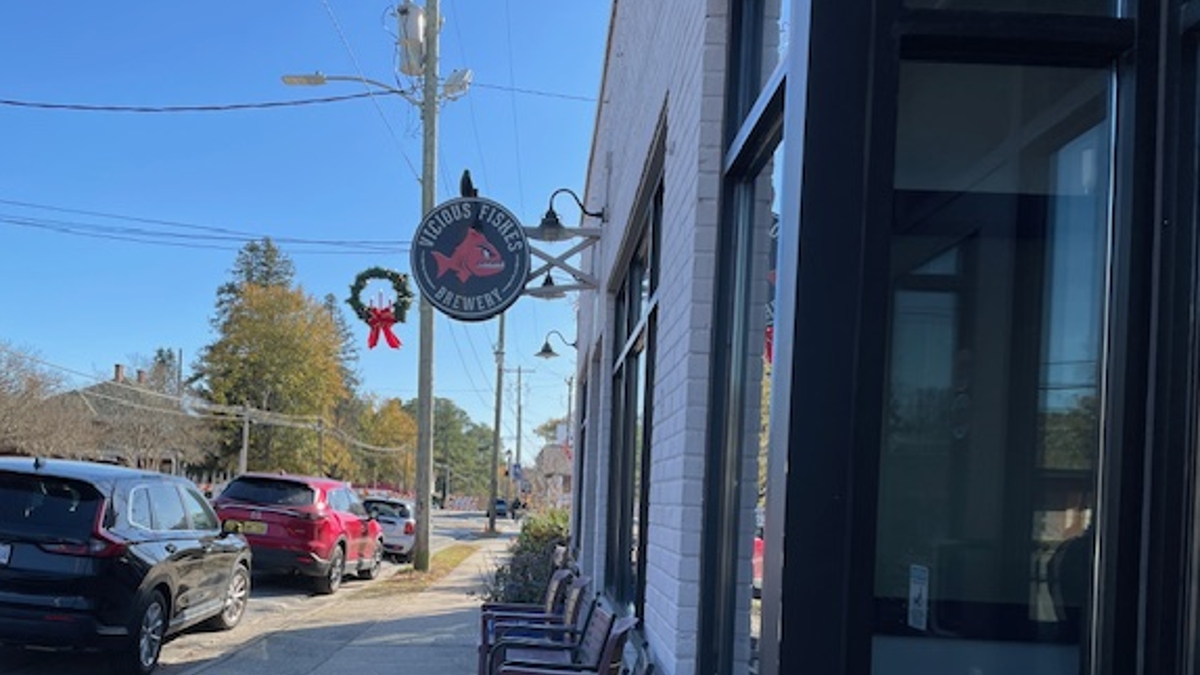
Yesterday, Vicious Fishes Fuquay Tap and Kitchen closed for good. The company said,

“Our lease is up – and the proposal is for a 55% rent hike. Given the dramatic increase and after a lot of consideration, we’ve decided we need to focus on what’s core to Vicious Fishes Brewery, which is making the best beer we can and serving it directly to patrons in our taprooms.”

Although the town of Fuquay Varina has its share of welcoming places where family and friends gather, Vicious Fishes was special. Maybe it was the staff that greeted you warmly, maybe it was the yummy food, maybe it was the family atmosphere.

Memories

On our family’s third day of moving to North Carolina – not knowing a soul, and trusting Providence that all would be alright – we went to dinner at Vicious Fishes. Somehow, that visit made us feel confident and welcomed in our newly adopted state. We went back many times after that.

Judging by the numerous comments on on-line posts about the departure of Vicious Fishes from our town, we were definitely not the only ones saddened by the loss of that place of comfort.

Gentrification

Businesses often think it best to return to their core function after experimenting with expansion. However, a 55% rent increase is bound to influence such decision!

Our town of 49,257 residents is rapidly growing, with a population increase of 42.54% since 2020. Town leaders are delighted. But some folks are not happy that farmland is shrinking, trees are being cut down, not as many deer are walking around neighborhoods, and development is everywhere.

Those are the inevitable results of people from populous, expensive regions moving to small, affordable towns like ours. As more folks move in spurring development, real estate prices go up. Some call this gentrification.

We will have a fancier town, but the comforting places like Vicious Fishes might no longer be there.

Paycheck to paycheck and waiting for SNAP

The furor over the recent interruption of SNAP food subsidies might be better placed on the unfortunate fact that 12% of US residents cannot afford groceries.

During the latest federal government shutdown, mainstream media has been awash with concern about families’ well being in the absence of SNAP (Supplemental Nutrition Assistance Program, formerly Food Stamps). While that concern is valid, more significant would be the question why 12% of US residents can’t afford groceries.

SNAP is one of the several US Department of Agriculture Food and Nutrition services, intended to help US residents unable to ensure food on their table. SNAP is the largest of the Food and Nutrition programs, clocking in at 70.2% of spending. The other USDA programs are child nutrition, 20.2%; WIC (Women, Infants, and Children) 5%; all other 4.6%.

USDA data shows that in fiscal year 2023, children accounted for about 39% of all SNAP participants, adults ages 18–59 represented 42%, and seniors 60 and older represented about 19%.

Most non-disabled working age SNAP recipients do work, but in today’s many non-steady, low-paying industries. They are part of the growing numbers of workers in Paycheck to Paycheck America.

What is poverty in our Humpty Dumpty World?

Some of the challenges in Paycheck to Paycheck America come from an ever-changing meaning of words. In Alice in Wonderland, Humpty Dumpty helps us understand that situation:

“When I use a word, it means just what I choose it to mean. Neither more or less.” Alice responded to Humpty Dumpty, “The question is, whether you can make words mean so many different things?” Humpty Dumpty retorted: “The question is, which is to be master? That’s all.”

The word “poverty” seems to fall into the Humpty Dumpty category of meaning what “masters” want it to mean.

In the very old days poor people were just that – poor, and they made do with what goods or services they and their children provided to others. In the 1960s, a poverty threshold was developed, people below that threshold became entitled to taxpayer assistance – and the “poverty rate” decreased. In 2011, the Supplemental Poverty Measure, which took into account all sorts of variables, was implemented – and the “poverty rate” decreased some more.

However, regardless of official statistics, folks remain poor. Decrease in poverty since the 1960s does not mean folks make more money for themselves. It means folks receive more money from public assistance.

Thus, the dire situation brought about by an interruption in SNAP subsidies.

In an ideal world, SNAP subsidies would not exist

In an ideal world, efforts would not be placed in ensuring lower-income individuals receive public assistance, but ensuring those individuals did not need public assistance, at least not to the extent that is needed at present.

A good start would be looking at prices vs. wages increases.

Here are numbers quoted by the Ludwig Institute for Shared Economic Prosperity:

“… from 2001 to 2023, the cost of affording basic economic security doubled, rising 99.5%, 38% faster than the Consumer Price Index. Housing costs soared 130%, healthcare 178%, and the savings required to attend an in-state, public university 122%.”

Meanwhile, the Economic Policy Institute says,

“… new data on wages through 2024. Cumulative median wage growth was just 29% since 1979—or less than 0.6% per year on average.”

Efforts like minimum wage, rent control, government-controlled healthcare, taxing the rich have been tried. Results have been to allow the poor to live a little better, but seldom move up an economic ladder.

So, we might look at other variables

* Price inflation: Government prints money faster than it increases gross domestic product. National debt to GDP is now 125%. This causes the proverbial too much money chasing too few goods.

* Housing shortage: In the old days people built houses when they needed houses. These days, regulations, union demands, environmental concerns, not-in-my-backyardness, monopolistic corporate ownership of rentals, all conspire to greatly increase the price of housing.

* “Healthcare” today is not what it meant in the past: Prior to the 1960s, those lucky enough to be insured through their employer, union, or privately received coverage for hospital stays and needed surgeries. Urban as well as rural doctors, nurses, midwives, and even pharmacists did the rest. Pharmaceutical companies had not yet developed drugs for every malady. And there were a lot of healthy young people around. Today, insurers and providers of medical care deal with an aging population, higher incidences of chronic diseases, a vast array of prescription drugs, new procedures like sports medicine and gender-affirming care, and the ever-present threat of medical law suits.

* College tuition: The answer to why college tuition increased so significantly since the 1980s will depend on who you ask. But there are a few reasons that are generally accepted. Competition based on costly amenities. Increase in administrators, counselors, and other non-teaching staff. Increased perception that a college degree is essential to success. Reduced federal funding of grants. There is one reason widely quoted but often denied – In 1978 federal student loans became available to all students regardless of income, and colleges took advantage of that largess to increase tuition.

Addressing these variables

Rather than focus on extending public assistance like SNAP, it might be more productive to focus on the variables that likely make individuals and families dependent on public assistance.

The recent furor over the suspension of SNAP serves as a reminder of the old saying:

“If your government is big enough to give you everything you want, it is big enough to take away everything you have.”

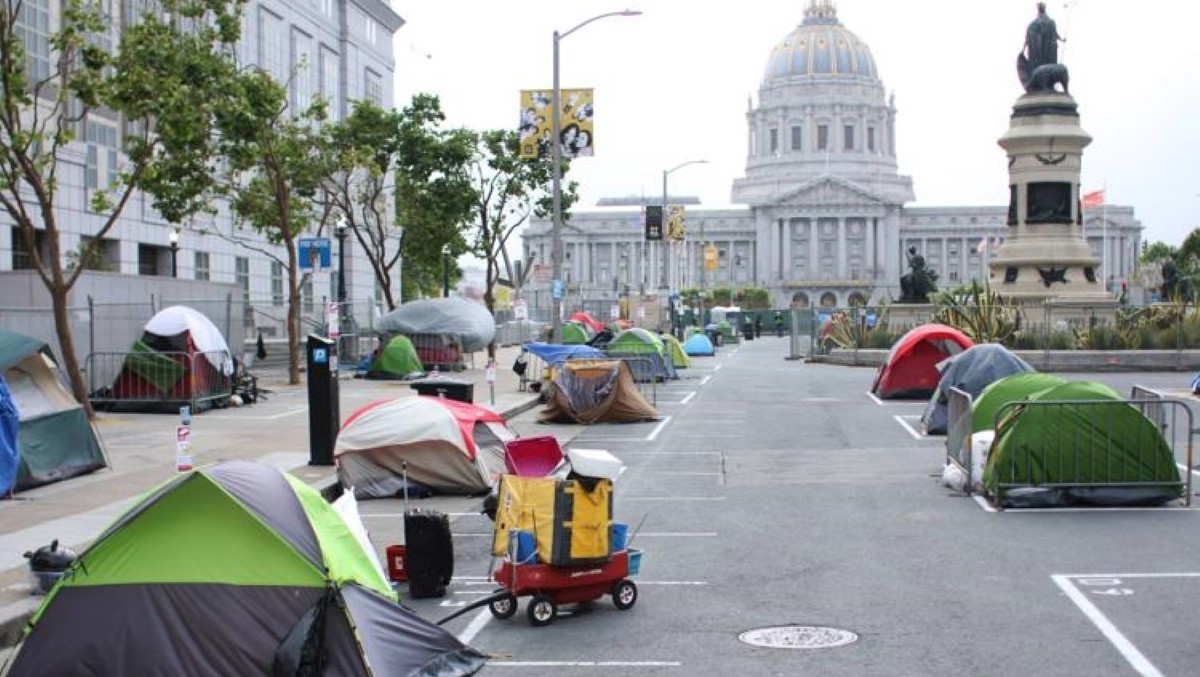
Picture: From the website of the US Department of Agriculture. USDA has 29 agencies administering programs like Agricultural Research, Animal Plant Health Inspection, Food Safety and Inspection, Farm Services, Food and Nutrition, and several other services.

Paycheck to paycheck America

Increasingly, since the 1970s Americans get stuck in survival mode, rather than thrive mode. More and more workers are living paycheck to paycheck. What happened?

There is no longer denying that the rich are getting richer and the poor are getting poorer. The once iconic American middle class has all but disappeared. There is, however, plenty of denying contributing events – and therefore solutions – for such a pickle.

There were plenty of events. Here are some, certainly not all:

The 1970s saw an economic watershed.

From the end of WWII until the 1970s, incomes of the rich, not so rich, and poor rose around the same pace. Household savings rates were around 7 to 10%, a healthy percentage that allowed people to build capital and improve their lot.

The 1970s saw the start of a widening income, savings, and wealth gap. Today’s average household savings rate is 4.5%. Incomes of the less-than-rich tend to cover household expenses and not much else. Moving up the economic ladder under such circumstances is a nearly impossible feat.

The 1970s also saw a cultural watershed.

Lyndon Johnson’s Great Society was a herculean effort to deal with poverty through social welfare. Congress passed legislation enshrining President Johnson’s agenda between 1964 and 1968. By the 1970s public assistance was culturally accepted as the way to improve the lot of the poor.

That is still the case today. Legions of government programs, non-profits, and billionaires’ tax-advantaged foundations exist today to end poverty.

1971 saw the birth of fiat money.

The Great Society social programs that started in 1964, the Vietnam War (1955 – 1975), and a Federal Reserve that did not respond forcefully enough to unbridled government spending and rising prices, all contributed to inflation that reached 5.89% in 1969.

Such level of inflation decimated the value of the U.S. dollar, and a run on U.S. gold appeared probable. So, President Richard Nixon ended the country’s gold standard in 1971 – releasing the fiat money genie out of the bottle!

Without the market restraints inherent in a gold standard, government folks became free to borrow and spend. And free to keep interest rates down to facilitate payment in the ever increasing national debt.

Sharp-eyed folks in the general population figured windows of low interest rates and cheap money allowed them to borrow, invest, and grow rich.

Technology helped.

In the olden days, stocks were considered risky business not suitable for average respectable people. However, as technology gave average respectable people the Internet, access to on-line accounts, apps, social media, and a dizzying array of asset classes, investment in intangibles was democratized.

Then came financialization.

An old working paper dated December 2007, by Thomas Palley, in conjunction with The Levy Economics Institute of Bard College, has a very good description of financialization. In Financialization: What is it and Why it Matters, Dr. Palley wrote:

“Financialization is a process whereby financial markets, financial institutions, and financial elites gain greater influence over economic policy and economic outcomes. Financialization transforms the functioning of economic systems at both the macro and micro levels.

Its principal impacts are to (1) elevate the significance of the financial sector relative to the real sector (2) transfer income from the real sector to the financial sector, and (3) increase income inequality and contribute to wage stagnation. Additionally, there are reasons to believe that financialization may put the economy at risk of debt deflation and prolonged recession.

Financialization operates through three different conduits: changes in the structure and operation of financial markets, changes in the behavior of nonfinancial corporations, and changes in economic policy.”

Basically, financialization says, why should a company bother with working to create better widgets or bother with managing a productive labor force. So much easier to make money from financial transactions like acquisitions facilitated by fiat money, stock buybacks to inflate value of outstanding shares, or speculation with today’s equivalent of puka shells– cryptocurrencies. What companies save on labor, goes to CEOs and shareholders.

On the other side, much of workers’ consumption changed from that based on wages to that based on debt. And looks like powers that be in the marketplace and in government are fine with that.

The rise of institutional investors followed.

Around the late 1970s, institutions like Vanguard, Fidelity Investors, and other fund managers popularized a variety of financial products, including mutual funds and 401-k management. This attracted investors, contributed to fund managers’ growth, and eventually resulted in institutional investors today accounting for about 80% of the volume of trades on the New York Stock Exchange.

Note that these institutions do not own the stocks and other instruments they manage. It is America’s wealthiest 1% that own 50% of stocks, while the 10% wealthiest own nearly 90% of stocks.

This level of shareholder power is bound to divert profits from labor to dividends and/or CEO compensation. Note that a large portion of CEO compensation today is in stock and tied to how well the CEO enriches the company’s shareholders.

Meanwhile, wars on poverty focus on social welfare.

Since the 1960s rivers of money have gone into social welfare. Most improvement, if any, in the lot of the poor has come from handouts. Lower-income earners have remained stuck in survival mode, rather than rise to thriving mode.

Certainly, there have been the relatively few that rose from very modest beginnings to wealth. But here we are talking about the average worker in the fast-food, home-health care, hospitality, and other lower-paying industries.

Included in handouts are government mandates such as minimum wage increases and rent control. These two mandates especially reveal the cynicism inherent in legislatures. Politicians surely have a modicum of knowledge of the realities of the marketplace, which they purposefully to ignore.

Surely, they must realize that when you increase people’s power to spend without an equal or greater increase in output, you end up with inflation. A 3% increase in the price of hamburger is not a big deal for the well to do, but very unfortunate for the poor.

Politicians must also realize that investors, like landlords, want a certain profit, and when you mess with that profit through rent control, they stop being landlords and go invest in something else. Fewer landlords mean fewer housing, and potentially more poor families living in their car or worse.

Awareness is the first step to cure

We cannot go back in time, but we can stop pretending handouts work.

Schools that teach not indoctrinate or coddle work, discipline works (in school and at home, for kids and for adults), work ethics work.

Cottage industries (stuff you make at home and sell) work. Fiscal responsibility at home and in government works (especially reducing the national debt before interest eats up all of GDP!). Politicians that promise wider opportunities for people to earn a living, not freebies and AI, work.

America is still the land people of over the world want to come to. But many American families must be wondering, “What happened to the Middle Class.”

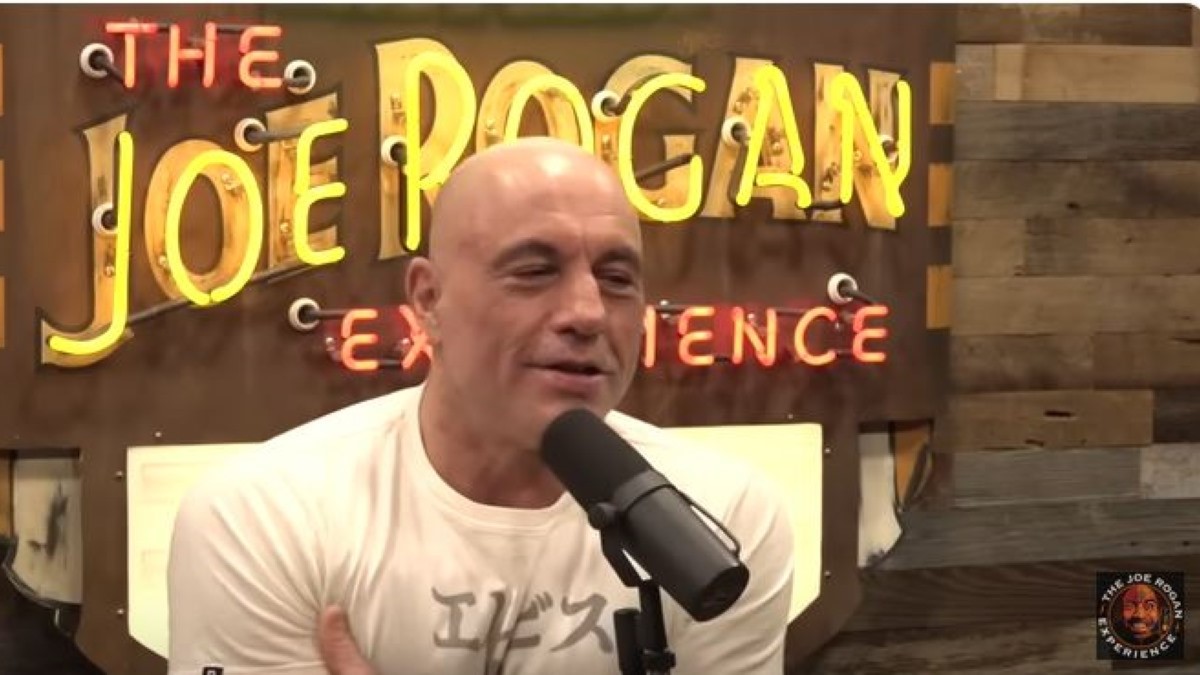
Recommended eye opener: Joe Rogan podcast #2281 with Elon Musk

This recommendation is for folks not familiar with The Joe Rogan Experience podcasts. And for those who would like to understand what DOGE is really doing and why.

This recommendation is for those not yet familiar with Rogan’s conversations with folks like J.D. Vance, Mark Zuckerberg, Mel Gibson, Rod Blagojevich, Tulsi Gabbard, Donald J. Trump, Woody Harrelson, Bob Lazar, Gad Saad, and many others with a lot to say.  Those who are already Rogan enthusiasts will surely have already listened to this episode.

Briefly regarding the Joe Rogan Experience podcasts: Rogan, born in 1967, started his podcast in 2009 on YouTube.  Today, the podcast has massive audiences on all popular platforms.  The recommended episode #2281 with Elon Musk had 10,518,308 views and 66,911 comments on YouTube as of this writing.  Joe Rogan lives in Austin, Texas.  He practices martial and fighting arts, and is an avid archer and bow hunter (yes, he and his family eat everything he kills).  Rogan is able enthusiastically to discuss all kinds of subjects with his podcast guests.

So, why is the Joe Rogan Experience episode #2281 with Elon Musk important?  Because this episode has the potential of forcing DOGE opponents to understand what DOGE is really doing and why it needs to be done.

In episode #2281, Elon Musk says that Americans are living in two separate universes.  There is the DOGE opponents’ universe, and there is the DOGE supporters’ universe.  As a rule, opponents most likely get their news and facts only from mainstream media sources like MSNBC, AP, Washington Post, New York Times, and Facebook.  As a rule, DOGE supporters most likely also consume alternative media like X and the Joe Rogan podcasts. 

Today’s mainstream media shows DOGE protesters speaking of service cuts to the needy, fears of deportation from the U.S., anxiety over changes to Social Security and Medicare, shattered dreams of laid off government employees.  It shows legislators pointing to the “human impact of DOGE cuts.”  It talks about DOGE usurping Congress’ job.  All valid concerns.

Alternative media like X and the Joe Rogan podcasts expose DOGE’s findings in the underbelly of a government doing its best to delay its certain collapse.  The alternative media tacitly brings awareness that DOGE is indeed doing the job Congress has failed to do, since Congress remains unconcerned that absent policy changes the U.S. will face bankruptcy in the not too distant future.   

Just a few numbers can show why DOGE needs to take a chainsaw to the U.S.’s bloated bureaucracy – a task Congress should do but will not.

*   National debt as percentage of gross national debt was 123% as of fiscal year 2024.  As debt increases faster than GDP, this percentage will increase, eventually resulting in unsustainability.

*   House Continuing Resolution No. 14 passed on February 25, 2025, along party lines, with the sole Republican “Nay” coming from Thomas Massie (R-KY).  The Resolution recommended increased amounts of debt each year, resulting in a 47.5% cumulative increase 2025 to 2034.  The Economic Times sounded a warning in November 2024, which like all other warnings, was ignored by the U.S. Congress.

America’s national debt has reached a record high of $36 trillion, with a $2 trillion increase this year alone … The situation is becoming more dire, with the US debt now standing at 125% of the country’s GDP. Experts predict that this debt-to-GDP ratio could reach 200% in the coming years, meaning that the national debt could be twice the size of the entire US economy.  This is expected to result in the government spending more on interest payments than on essential areas such as infrastructure, development, and education.” America Headed for Bankruptcy, The Economic Times, November 25, 2024.

*   In 2024 the U.S. national debt was $35.5 trillion.  The combined wealth of billionaires was $6.2 trillion.  The combined wealth of millionaires was $26.1 trillion.  Even if the government taxed all the wealth of billionaires and millionaires in 2024, it would not succeed in reducing the national debt to zero.  Congress has preferred to remain ambivalent on calls to fix the country’s deficits by taxing the rich, because it can’t be done.

It would be great if DOGE’s opponents among voters would listen to Elon Musk’s conversation of February 28, 2025, with Joe Rogan. The entire 3-hour conversation is worth listening to, with plenty of entertaining topics — like responses from the sassy sexy voice from Grok. But the segment starting at 13.56 relates to DOGE findings and is the most crucial part of the podcast. 

Here are just a few observations by Musk:

*   Today’s dominant notion is that although a business needs to at least break even to survive, government can spend way beyond its revenues.  That notion is flawed, and on the current trajectory, the U.S. government will collapse in the near future. 

*   Again comparing government to business, a business must pass audits (external or internal) showing clearly described payment (where the money goes and why).  The U.S. Treasury issues numerous payments without codes or descriptions, the destination of which no one can readily determine.  [Note: This observation about the U.S. Treasury is not new.  For example, a report issued by the Office of Inspector General released May 29, 2024, concluded that the Treasury lacked sufficient controls to be fully compliant with the Payment Integrity Information Act of 2019.  Apparently, nothing has changed.]

*    About 1.5 million non-government organizations (NGOs) operate in the U.S.  An estimated 30% of NGOs rely on U.S government grants.  Payments to them are often on autopilot, without any follow-up as to the NGOs activities or efficiency. 

*   Concerns over the fate of Social Security are valid.  Concerns should include the fact that Social Security is a pay-as-you-go system that has created massive unfunded liabilities.  Future obligations are far greater than payments.  If the system is not rectified soon, it will collapse.

*  “DOGE staffers”:  These are the worker bees of DOGE.  They work as employees of government agencies and are vetted in the same way as any other government employee.  Their role is explained in the Executive Order of January 20, 2025. 

*   What DOGE does is shown event by event, line by line, on the DOGE website.  The website is accessible to anyone, including DOGE critics who express concern about not knowing what DOGE does. 

It is unfortunate that those truly concerned about the economic future of our nation had to resort to drastic unconventional action.  But inaction would have been an even more unfortunate choice. 

Picture:  Joe Rogan in his studio on February 28, 2025.

Student loans and the Great Bailout

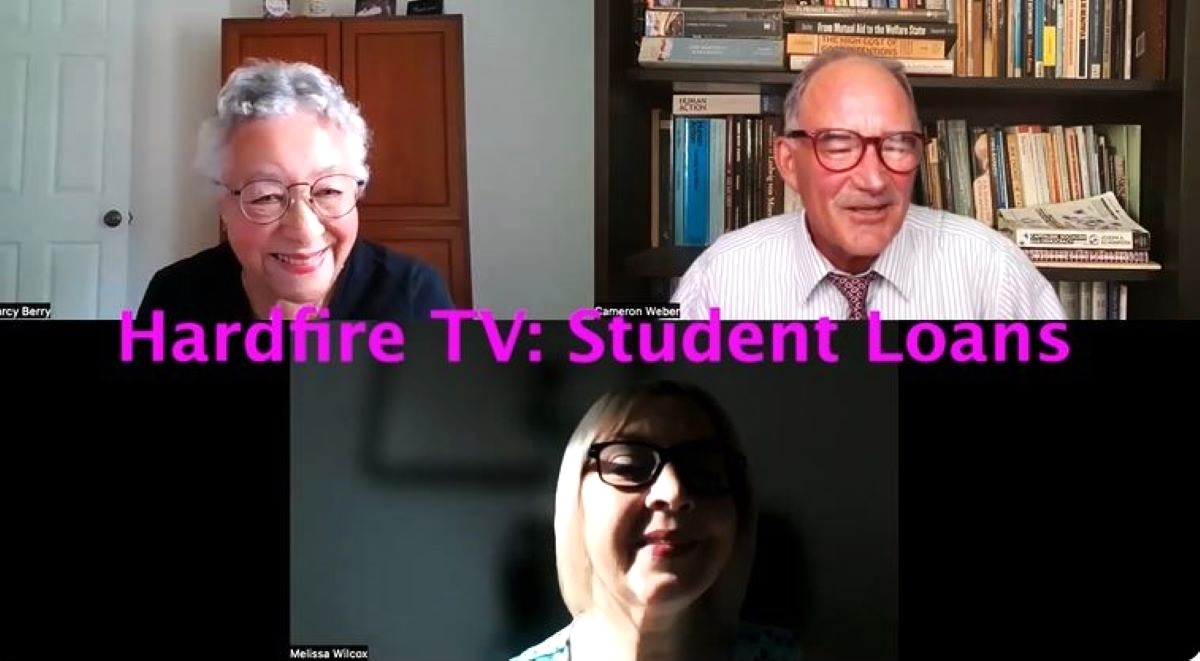
Recommended item: Cameron Weber – economist, historian, and author of the popular book Economics for Everyone, is also producer of Hardfire TV, a political economics talk show. His latest show discusses student loan debt and debt “forgiveness.” It is worth watching for a different perspective.

Recommended item: Cameron Weber – economist, historian, and author of the popular book Economics for Everyone, is also producer of Hardfire TV, a political economics talk show. His latest show discusses student loan debt and debt “forgiveness.”

College tuition and student loan debt have suffered mind-boggling increases since the early 2000s. In an October 2023 report Education Data reported the following,

“Before adjusting for inflation, the average student loan debt at graduation has increased 106% since 2007; after adjusting for inflation, the average debt increased 41%.”

When adding to this sad statistic a February 2024 report by Inside Higher Ed indicating that nowadays 52% of college graduates are underemployed, seems that young people need to do some homework on what is causing such unfortunate situation.

The student loan segment on Hardfire TV might help. The show can be seen on YouTube.

A few words on political economics as preview.

Economics, especially political economics, wears several hats. It is not akin to, say, mathematics. Political economics is more like the costume of Le Bon Florian, Anatole France’s harlequin – viewed from one perspective the costume is red, and viewed from another it is blue.

The libertarian-leaning perspective of student loans and the accompanying student loan debt is that government intervention – subsidies – has incentivized colleges to raise their tuition to unsustainable levels. As tuition rises, so does student loan debt. The solution is to end the subsidies. This will force colleges to trim their offerings, staff, and tuition. Also, colleges will likely return to emphasizing work-study programs, and financial institutions in the marketplace will again compete to offer college assistance.

The progressive-leaning perspective is that government is a better provider than the marketplace. The marketplace increased tuition and student loan debt to untenable levels. Therefore, government needs to step in and abate that debt. Students and former students carrying the heavy burden of student loan debt are constrained from investing sufficiently in goods and services, thus fail to contribute fully to the economy. Everyone benefits when everyone contributes, which justifies taxation – income and debt redistribution.

And in the middle of these harlequinesque perspectives is the vision of the nation’s Founding Parents. This nation was founded as a grand experiment. It would be ruled not by kings or other sole decision makers, but by the people, like farmers, silversmiths, and carpenters. Therefore, education beyond that of the well to do and privileged was necessary. George Washington, Thomas Jefferson, John Adams were among those that argued in favor of public schools and colleges that would provide the populace with the wisdom, knowledge and awareness necessary to make wise decisions at the ballot box.

Letter from Thomas Jefferson to Richard Price, January 8, 1789. “… wherever the people are well informed they can be trusted with their own government…”

Letter from John Adams to John Jebb, September 10, 1785. “There should not be a district of one Mile Square without a school in it, not founded by a Charitable individual but maintained at the expense of the People themselves.”

So, would our Founders then support the idea of having free colleges today? Probably not. Today, things are quite different than back in the 1800s.

Today we talk about money earned by college graduates vs. non-graduates. Young people often major in trendy subjects, like gender studies or DEI, hoping to find positions in government programs or equally trendy corporations. Hardly expectations seeped in wisdom and awareness.

Agreed that not all was perfect back then. It took nearly 100 years for women and Black students to be routinely admitted into colleges. For a brief historical perspective:

Harvard University (originally called New College) was established in 1636, and Yale University in 1701. These and other equally fine schools, were Colonial institutions established for the education of white, mostly upper class, males.

Oberlin College started accepting women in 1837. 1865 saw the emergence of women’s colleges that offered courses comparable to those of men. By the 1880s women could acquire higher education at Vassar, Smith, Wellesley, Bryn Mawr, and Mount Holyoke colleges.

There were only a few Black colleges before the Civil War. However, between 1865 and 1900, several Historically Black Colleges were established, the majority in 1867, two years after Emancipation.

Today, qualified students are admitted to colleges and universities regardless of sex and color. But whether they are receiving the skills, wisdom, and work ethic the Founders had in mind is questionable.

As libertarian-leaning economists consistently point out, government often creates problems which it then tries to take credit for solving, only to create more problems. The problem of the ballooning student loan debt, and the perceived need for debt forgiveness is a prime example. Those of a libertarian bent suggest that government get out of the student loan business, and let private banks compete to offer students the best loan deal.

Maybe the November 2024 elections will inform us which side of the harlequin’s costume is the most appealing.

Picture: From YouTube video of the Hardfire TV show on Student Loans, with host Cameron Weber and guests Marcy Berry and Melissa Wilcox.

The Piper must eventually be paid

No, Ms. Janet Yellen, the Fitch downgrade of the U.S. credit rating is not “arbitrary.” Mr. Paul Krugman, the downgrade is not “bizarre” either. And you both know it.

Fitch, one of three major global credit agencies, told it like it is on August 1, 2023, and slapped a downgraded credit rating of AA+, down from AAA, to the United States of America. The temerity! Well, it took guts, since the last time a downgrade happened – that one in 2011 by S&P, another of the three major global credit agencies – the U.S. Justice Department launched an investigation on S&P that resulted in the firing of the agency’s CEO.

Fitch’s downgrade elicited predictable reactions

The current downgrade by Fitch was predictably met with fire and brimstone by the Biden administration and its assorted allies. The New York Times had a short summary of criticisms:

The Biden administration and others pushed back. Treasury Secretary Janet Yellen called the downgrade “arbitrary,” noting that Fitch had shown U.S. governance deteriorating as far back as 2018 but hadn’t moved until now. “The American economy is fundamentally strong,” she added.

Paul Krugman, the Times Opinion columnist and Nobel laureate, said the move was “bizarre.” And Larry Summers, the former Treasury secretary, told Bloomberg, “I can’t imagine any serious credit analyst is going to give this weight.”

Fitch will be pilloried by most members of Congress,” Henrietta Trey, director of macroeconomic policy research at Veda Partners, told The Times.

Predictably also, experts like Janet Yellen commenting on the downgrade focused on the visible economic strength of the U.S. economy. Fair enough, since most folks are driving nice cars, consuming prodigiously, and paying taxes. But these experts mostly ignored the underlying weaknesses mentioned on the Fitch report.

Main points of the Fitch report were,

  • Steady deterioration in standards of governance over the last 20 years.
  • Repeated debt-limit political standoffs and last minute resolutions that have eroded confidence in fiscal management.
  • Successive debt increases over the last decade
  • Limited progress in tackling medium-term challenges related to rising costs of Social Security and Medicare
  • Rising general government deficits, reflecting cyclically weaker federal revenues, new spending initiatives and a higher interest burden.
  • Rise in general government debt. The 112.9% debt to GDP on report date is over two-and-a-half times higher than the ‘AAA’ median of 39.3% of GDP and ‘AA’ median of 44.7% of GDP.
  • Absence of policy reforms to address medium-term fiscal challenges: Increased interest service burden due to rising debt and rising interest rates. An aging population that will increase mandatory spending on Medicare and Social Security, depleting these funds by 2035.
  • Risk of recession due to projected tighter credit, weakening business investment, slowdown in consumption, and slowdown in GDP growth

These challenges did not develop yesterday or three years ago.

These weaknesses pointed by Fitch are structural deficiencies that have developed over the last 20 years, which absent deep reforms will render the current appearance of abundance unsustainable. Janet Yellen, Paul Krugman, Larry Summers, Henrietta Treyz, and all other talking heads certainly know this. They are not stupid. However, they choose to focus on superficial appearances of plenty and deflect blame.

They focus only on the readily visible and ignore the foreseeable.

In July of 1850, French economist Frédéric Bastiat wrote an essay called What is Seen and What is Not Seen. Here is a piece from that essay.

In the economic sphere an act, a habit, an institution, a law produces not only one effect, but a series of effects. Of these effects, the first alone is immediate; it appears simultaneously with its cause; it is seen. The other effects emerge only subsequently; they are not seen; we are fortunate if we foresee them.

There is only one difference between a bad economist and a good one: the bad economist confines himself to the visible effect; the good economist takes into account both the effect that can be seen and those effects that must be foreseen.

Yet this difference is tremendous; for it almost always happens that when the immediate consequence is favorable, the later consequences are disastrous, and vice versa. Whence it follows that the bad economist pursues a small present good that will be followed by a great evil to come, while the good economist pursues a great good to come, at the risk of a small present evil.

Perhaps Frédéric Bastiat only meant to call the “bad” economists “incompetent.” But economists as well as politicians who referred to the downgrade uncalled for, arbitrary, or bizarre – while surely being aware of unattended serious structural weaknesses – are more than merely incompetent. They are deceitful.

They know people have children to raise and mortgages to pay, which precludes adding the burden of sacrifice today for a greater tomorrow. So, the experts lie, voters vote for the status quo, and the unseen untreated rot continues to eat into the fabric of our nation.

Socialism: A self-inflicted wound

Political commentator Bruce Bialosky recently wrote that progressive U.S. cities like San Francisco, Seattle, Portland, Chicago are at the vanguard of social and economic deconstruction. He compares these once great cities to the former economic powerhouse, Venezuela.

Dependence on government largess is the hallmark of a socialist populace. Unfortunately, sources of largess are not unlimited, and eventually government leaders run out of money. Then, inevitably moral and economic collapse ensues. Examples going back to the fall of the Roman Republic and beyond abound. Sadly, the U.S., once the bedrock of true capitalism, is going the way of Venezuela.

Bruce Bialosky, CPA and political commentator, recently wrote on flashreport.org that progressive U.S. cities like San Francisco, Seattle, Portland, Chicago are at the vanguard of social and economic deconstruction. He compares these once great cities – no longer clean, safe, or worth visiting – to the former economic powerhouse, Venezuela. This South American nation, Bialosky says, is now a “full-blown humanitarian crisis.” On We Are Becoming Venezuela (flashport.org, May 21, 2023) he wrote,

At one point not too long ago, Venezuela had the best economy in Latin America and was in the top 20 economies in the world. It has the largest oil reserves in the world. In the last two decades of the 20th century, the economy started to decline. It was still a country with which many people I know did business and visited regularly. I wanted to vacation there. I heard wonderful things about Caracas, the capital.

Then Hugo Chavez became president promising a Bolivian (socialist) revolution. He indeed provided a revolution until he died. A revolution of despair. The current leader, Nicolas Maduro, took over the country and finished destroying any semblance of civilized life. Human Rights Watch has reported there is a full-blown humanitarian crisis lacking safe water, basic nutrition, and healthcare. Whoever can get out has gotten out.

Yet, Mr. Bialosky, says, U.S. cities continue to follow the socialist path. He cites Chicago.

There is another city I am thinking of adding to the list. Just 18 months ago after numerous prior visits, we were in Chicago. We were there when possibly the worst mayor in American history was in office – Lori Lightfoot. She was so bad her constituency gave her only 17% in the election primary, thus eliminating her from the general election.

Given an opportunity to begin correcting the malaise Lightfoot created, the residents of Chicago doubled down by electing someone who could easily become worse. With a failing school system they elected someone who received 95% of his contributions from public employee unions, largely from the teachers’ union.

Bruce Bialosky is referring to Brandon Johnson, elected Mayor of Chicago in a runoff election April 2023, and on whom Bialosky does not place much faith:

Mr. Johnson won his election largely on the back of two groups voting for him – blacks and, you guessed it, the most dangerous group in America – white liberals.

Harsh words! Bialosky elucidates on the source of the devolution experienced by declining cities.

You cannot blame any of this on blacks or other minorities as they represent a minor portion of the population in these cities. No, the dismal decline of these cities is caused by the most dangerous people in America – white liberals. They have voted for hard-core Leftists to come into office with their extreme policies. They think they are doing well for others allowing the public-school systems to corrode while sending their own children to private schools. They believe criminals should not have ramifications for their crimes because crimes were just a manifestation of their challenging past.

Let that sink in, “the most dangerous people in America – white liberals.” Mr. Bialosky denounces white liberals for implementing destructive leftist ideology. The Just Vote No Blog would like to excoriate white liberals, as well as their opportunistic counterparts of color, even further.

Look around, look them up on the Internet, what are the liberals saying? Are they encouraging the populace to practice self-reliance and self-discipline? Are they talking about Black or Latino entrepreneurs, educators, authors, nurturing fathers and mothers? Did they ever mention businesswoman and philanthropist Sheila Johnson, the first Black woman billionaire? No, white liberals, along with Black opportunist like Al Sharpton and Nikole Hannah-Jones, promote victimhood. Victimhood, synonymous with dependence, propagates the socialism for which liberals crave.

The U.S. is today at a forked road with three, not two, divergent paths. One path will lead to the U.S. becoming yet another failed socialist state like Venezuela; the other path will lead to the mirror image of liberal extremism which is repressive conservative extremism; and the third path could lead to a productive self-reliant populace, prosperity, individual liberty, and true help for the few who are unable to provide for themselves.

We still have ballot boxes, and what is placed in them in the next few years will determine which path our country will take.

North Carolina, rent control is not a solution

State Senator Linda Grafstein recently introduced Bill 255 aimed at repealing North Carolina’s prohibition of rent control. Surely, Senator Grafstein is aware of the inefficiencies inherent in rent control?

Recently North Carolina state Senator Lisa Grafstein (Democrat – Senate District 13), submitted Bill 255, Act to Permit Local Governments to Enact Rent Control. Bill 255, if enacted, will repeal Statute 42-14-1 Rent Control, and allow municipalities to enact any form of rent control.

Statute 42-14-1 prohibits North Carolina jurisdictions from implementing rules that interfere with the rental of private property:

No county or city as defined by G.S. 160A‑1 may enact, maintain, or enforce any ordinance or resolution which regulates the amount of rent to be charged for privately owned, single‑family or multiple unit residential or commercial rental property.

Senator Grafstein’s reason for introducing this bill is the usual one: rising rental costs are causing financial hardships. Indeed, that is the case, especially since the start of the Covid-19 pandemic in 2019. Rent control is the easiest way to show constituents a representative is “doing something.”

Rent control is also an inefficient way to address housing costs.

Unfortunately, rent control is also plagued with consequences and uneven results. Renters under rent control love their housing cost stability. Lower-income workers with hopes of stable housing costs support rent control. On the other side of the coin, landlords who are unable to pass their rising costs to tenants due to rent control seek solutions detrimental to tenants: poor property maintenance, raising rents on units not under control (thus raising overall rental costs), or withdrawal from the controlled market.

Given rent control’s uneven consequences, opinions on it vary widely. Here are two seemingly heart-felt quotes.

…our family was always able to afford a roof over our heads, because we were living in a rent-controlled building. That most minimal form of economic security was crucial for our family. Senator Bernie Sanders, CNN Opinion, July 30, 1919.

In many cases rent control appears to be the most efficient technique presently known to destroy a city—except for bombing. Assar Lindbeck, The Political Economy of the New Left, 1972.

While lower-income residents, especially those in more progressive cities, support rent control in hopes of stabilizing their housing costs, economists generally agree controls are destructive. Here is a good summary of the challenges economists see in rent control. The author is economist John Phelan in his essay 81% of economists agree that rent controls are bad policy, Center of the American Experiment, December 18, 2018.

… there are, in fact, areas where the economists’ cacophony dies down and they speak with more or less one voice.

One such area is rent control. This proposal – to cap the price landlords can charge tenants – crops up perennially as a solution to high rents. This is mistaking the symptom for the illness. When prices are high they are sending you information. They are telling you that demand is high relative to supply. If you want to do something about this, act to either reduce demand or increase supply. Either way, trying to fiddle with the signal makes no more sense then trying to slow down your car by breaking the speedometer.

But fiddling with the signal is expedient if not effective.

Decreasing demand for housing or increasing supply are solutions to high rents more complex than implementing rent control. Decreasing demand requires decreasing population growth, a solution not embraced by governors or legislators. Increasing supply (and growth) sounds good to state leaders, but their efforts are very often met with public outcry from residents rejecting loss of open spaces, increased traffic, and change in neighborhood character.

Thus, legislators sometimes opt for rent control – even though rent control seldom works as intended.

At present, two states, California and Oregon, plus the District of Columbia have state-wide rent control ordinances. Seven states allow local rent control: California, New York, New Jersey, Maryland, Maine, Oregon, and Minnesota. California, New York and New Jersey have the highest rents in the nation.

Most certainly Senator Linda Grafstein is aware of challenges inherent in both rising rents and rent control. Hopefully, so are her constituents.

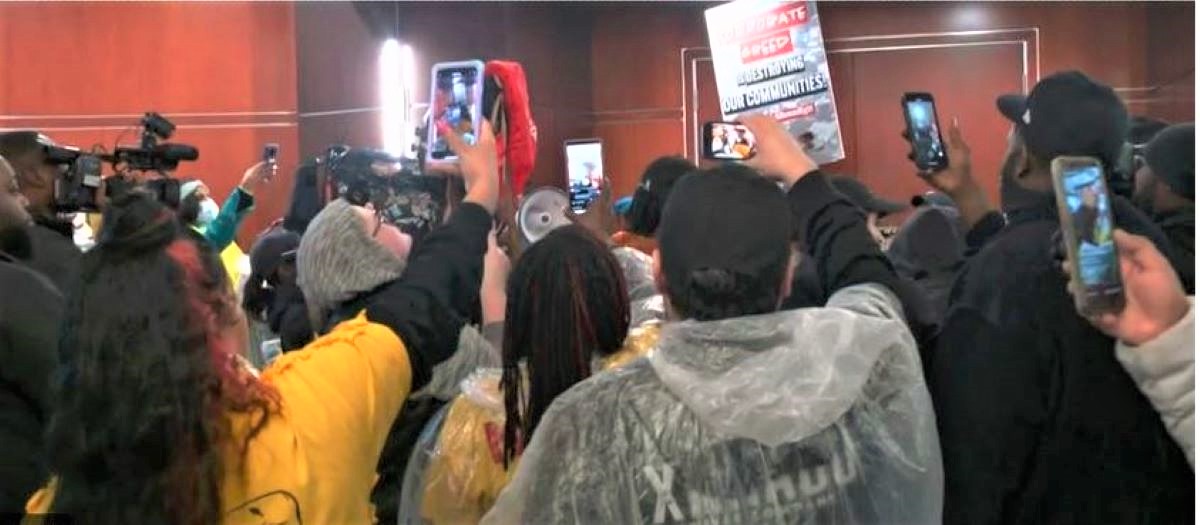
Pictured: From widely circulated videos of protesters in Charlotte, NC, on January 25, 2023. Protesters were demanding accountability from corporate landlords; specifically, a stop to the growing ownership of homes by corporate landlords, improved building maintenance, and a 3% cap on rents.

Biden’s 2024 Budget: 5 loaves and two fish

The current trajectory of the U.S. national debt could be attributed to Keynesian Economics or to Modern Monetary Theory. However, a more accurate description would be Kicking the Can Down the Road.

Annually, our national leaders repeat the ritual: The President presents a budget, Congress frets over it, after a lot of fretting the budget is adopted, and a couple of trillion dollars are added to the already unsustainable national debt.

Democrat President Joe Biden presented his generous $6.8 trillion spending plan on March 9, 2023. $4.7 trillion in taxes on corporations and high earners is also in the budget. As is a promise to cut deficits by $3 trillion over the next 10 years. Republicans controlling the House of Representatives immediately declared the budget dead on arrival.

Many articles have been written on how this budget would achieve its goal of reducing deficits (the shortfall between revenues and expenditures: $722.6 billion so far this fiscal year). Some have pointed that this budget will not reduce the national debt (the accumulation of years and years of deficits: $31.4 trillion as of 03/16/23).

Here, it will suffice to say that Jesus fed 5,000 people with 5 loaves and two fish (John 6:1-14), and perhaps President Biden truly believes he can accomplish something similar.

Barring miracles, can the U.S. sustain its current debt?

In its Financial Report posted on January 31, 2023, the U.S. Department of the Treasury, Bureau of the Fiscal Service, said the following,

The current fiscal path is unsustainable … The debt-to-GDP ratio was approximately 100 percent at the end of FY 2021, and under current policy and based on this report’s assumptions is projected to reach 701 percent in 2096.

The national debt is the nation’s credit card.

Just like an individual’s credit card, the national debt can avoid immediate full payment of obligations. Also, just like an individual’s creditor (the bank or credit union that issued the credit card), creditors that hold U.S. debt (China, for instance), will not lend indefinitely. At some point, creditors start worrying about losing their money and stop lending.

Credit card companies watch your credit balance in relation to the money you said you make. This will give them an idea whether you can pay down your balance or not. Creditors of the United States do the same. They watch the U.S. national debt as a percentage of the U.S. Gross National Product. By traditional metrics, when the Debt to GDP ratio reaches 77%, its time to worry. The U.S. Debt to GDP at the end of the 4th quarter 2022 was 120%. When there is not enough money in the kitty to pay creditors, “full faith and credit” does not mean much.

How about infrastructure and benefits?

The higher the national debt, the more revenue goes toward paying interest on the debt, and less revenue goes toward infrastructure or benefits like healthcare.

Lowering interest rates makes it easier to pay back debt but will unleash inflation. The current rising interest rates will suck money away from other government expenditures.

Why is it practically impossible to lower the national debt?

Politicians depend on donors and voters to keep their job. Dependence on government largess is widespread, and nobody likes to pay taxes.

The most a President and Congress can do is prepare a complex budget that promises to lower deficits over 8 or 10 years (which means nothing when a new President and new Congress comes into power), raise the debt limit each year, and hope that when the day of reckoning arrives they will be long dead.

Accepted economic theories

The current trajectory of the U.S. national debt could be attributed to Keynesian Economics or to Modern Monetary Theory. However, a more accurate description would be Kicking the Can Down the Road.

Views from a happy California expat

California boasts of being an economic powerhouse and a compassionate sanctuary. So, why are so many Californians moving to other states?

Thank you to Richard Eber, frequent contributor to California Political News & Views, for his article on reasons people are leaving California, and for including the Just Vote No Blog editor’s views. Actually, the article wonders why anyone would choose to stay in the once Golden State.

Certainly, there are reasons not to join the California exodus — family ties, a good job, balmy weather, lovely scenery, world-class art and music venues, health constraints, dependence on California’s generous welfare, or reliance on bountiful flow of drugs. However, as Richard Eber’s article points out, the reasons to leave are mounting.

Although Californians are leaving mainly because of exorbitant taxes, housing prices, and living costs, many are rejecting the principal underlying cause of those costs – the all-enveloping far-left one-party rule.

The resulting inefficiencies of the one-party rule make California less desirable than, say, North Carolina, one of the destination states mentioned in Eber’s article. Sure, there are Republicans, Greens, and Libertarians in California. But they have descended into near irrelevance given the power of the Democrat machine. Power of such magnitude, regardless of what party or faction holds it, empowers, and inspires extremes.

Richard Eber’s article is reproduced below:

__________________________________

Leaving California, by Richard Eber, published September 22, 2022, in California Political News & Views

It’s no secret families of all economic classes from the poor to the super rich are leaving California in droves. From illegal aliens to billionaire Elon Musk folks of all backgrounds are quickly putting the former “Golden State” in their rear view mirrors

Libertarian types like me would like to attribute the migration of about half a million people each year to Texas to be politically motivated. In reality this is not the case. Spurred by the socialistic government headed by Governor Gavin Newsom, high taxes, housing costs, energy costs, crime, and poor schools, are more important than politics.

Migrating businesses are following as well. Texas has been the main beneficiary of what amounts to a wealth transfer of billions of GNP each year welcoming 500,000 new residents. It is no coincidence Austin is quickly gaining the reputation of becoming the Silicon Valley of the South.

Typical is the family of my daughter’s best friend and her family who packed their life and moved to Texas after Lexi graduated from high school. Despite both of her parents having decent jobs, they could not afford to purchase a house in the Bay Area.

This soon changed in Texas when they bought a 2500 square foot home for less than half of what it might cost in California. If Lexi’s family would have stayed, it is doubtful they could even have purchased sardine like dwelling in a Priority Development Area (PDA) Sacramento believes people prefer to single family homes.

Prospering with an upper middle class standard of living, my daughter’s friends have never regretted bolting California. They are pretty much apolitical believing their standard of living and lifestyle is more important than living under expensive Progressive social values.

The truth of the matter is Bill Clinton’s campaign advisor James Carville’s remark in the 1992 Presidential election “It’s the economy stupid” is in the forefront of the exodus of folks departing for greener pastures. While this phenomenon has been partially balanced by immigrants settling in California from South of the border, there is major disparity in tax revenue being taken in.

Last week it was reported government revenues declined 11% in the last quarter. While Sacramento might sugar coat these statistics blaming Covid-19 for the drop, many economists believe this will be a preview of coming attractions as the land of Hollywood is fast losing its luster.

Apparently, Gavin Newsom with his fixation with promoting the use of electric vehicles doesn’t care if it costs up to $35.00 dollars more to fill up ones tank compared with several other states. This is but a tip of the iceberg families pay to live in a so called sunny paradise.

If those departing California were really interested in staying rather than being fitted for PF Fliers, they would try to change the Progressive agenda which dominates politics in all but a few rural communities. What then prevents voters from supporting more rational policies that would lower their cost of living?

There is no clear answer for middle of the road and conservative individuals who might want to change the current system. There doesn’t seem to be a clear path for those who wish to slow down going all in on climate change, Sanctuary Cities, defunding the police, reducing the influence of public employee labor unions and paying for costly social programs.

Apparently, this growing group of disenfranchised citizens doesn’t feel the Republican Party of California has the ability to elect candidates to carry out their wishes.

In contrast we have my friend Marcy Berry who recently departed San Francisco to live near her daughter’s family who relocated to North Carolina. As a Libertarian, she has been delighted with the political environment there. After a few months, here is her report from the land of Tar Heels and Blue Devils:

Hello from a transplanted Californian in North Carolina. Why are y’all still in California? Family ties, great job? Legitimate reasons. Barring that, anyone who stays must love California’s all-enveloping progressive reign. Just sayin’. And here are some more unsolicited opinions:

California’s all-enveloping progressive reign is the state’s most salient characteristic, and is what makes California so politically different from North Carolina, a swing state. Folks in a swing state just behave differently than those in a dominant regime.

North Carolina has a Democrat governor, and a majority-Republican but not veto-proof state legislature. Governor Roy Cooper navigates a peaceful balance, without the histrionics that Governor Gavin Newsom can perpetrate in his all-Democrat dominion.

Voter profile in North Carolina is currently 34.6% Democrat, 30.3% Republican, 1% Libertarian, and a whopping 34.5% unaffiliated. The unaffiliated contingent could account for the majority-Democrat voters and majority-Republican legislature. Let’s see what happens in the 2022 midterm elections, with unaffiliated voters residing mostly in the most populous counties.

North Carolina, not having (yet?) a dominant political party, is awash in both right and left-leaning voices. The local newspaper in my county leans left, my neighbors lean right, I am told that transplants arriving daily from California due to North Carolina’s rapidly expanding technology sector lean semi-left (they are aware of the mess they left behind but are not sure how else to think).

Unlike Republicans in California, Republicans in North Carolina are vocal and determined. Current and aspiring political candidates know they matter. They know they have a shot at making the state legislature veto proof and of turning the U.S. Senate majority-Republican.

Is there still hope to bring the two-party system back to California? Will the domination of the three quarters Democratic legislature and all State office holders continue indefinitely? The answer to this question is unequivocally “yes”. My only regret is wondering if such a change might occur in my lifetime.

I would suppose GOP State Chairwoman Jessica Patterson and her inept followers will eventually be replaced (if there is still a Republican Party). In a similar vein it is likely if Gavin Newsom and his successors continue to run the State into ground with their Marxist-Lite policies, needed changes will eventually occur.

There are so many “could have should of” scenarios to contend with in predicting California’s future. All we can do is hope.

__________________________________

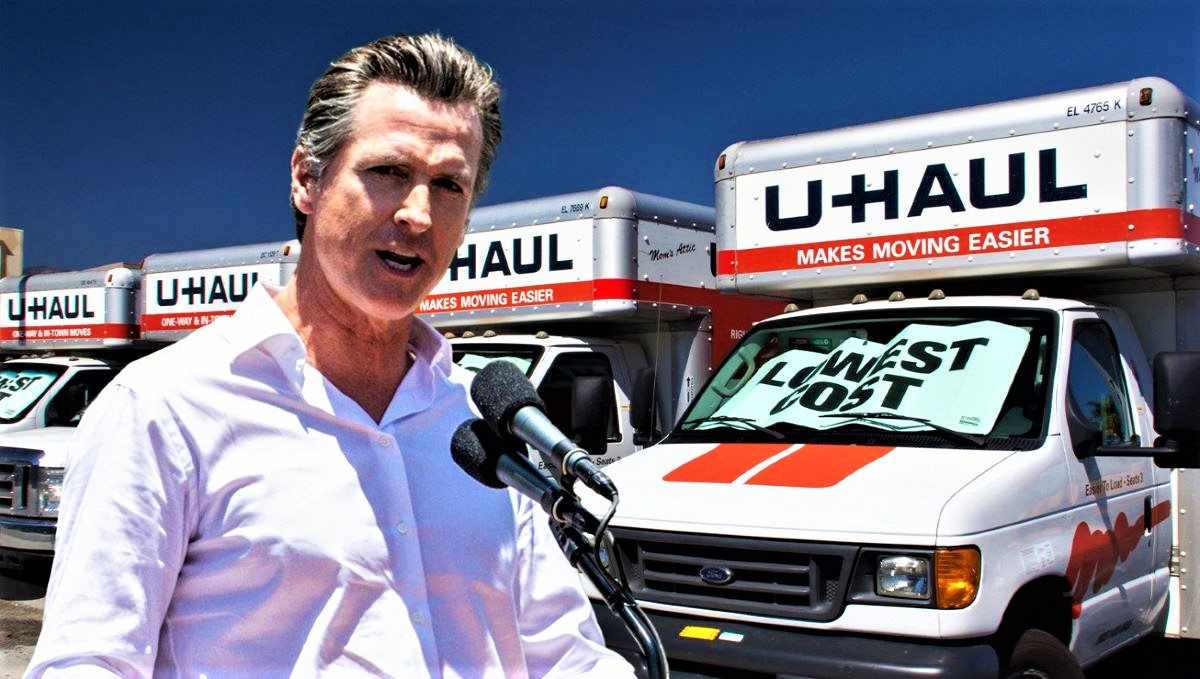
Picture: Meme from Babylon Bee, a publication that never tires of having fun at California’s cost.