The Coming of Nemesis: Kopp vs. Wiener

Nemesis is punishment showered upon those who regularly engage in hubris. Quentin Kopp just announced he will run against Scott Wiener.

Hubris is interesting, because you get people who are often very clever, very powerful, have achieved great things, and then something goes wrong – they just don’t know when to stop. Margaret MacMillan

On July 31, Quentin Kopp, a fearless fixture in California politics, announced that he intends to challenge incumbent Scott Wiener for the state Senate seat in District 11 representing San Francisco, Daly City, Colma, Broadmoor, and parts of South San Francisco. The 90-year old Kopp seems mad as heck and is not going to take it any more.

The last straw for Kopp of Wiener’s schemes was Senate Bill 281, hearing of which scheduled for May 6 was canceled at Wiener’s request. SB 281 was the most recent in a long line of attempts to transfer management and/or ownership of the iconic Cow Palace from the current board to a local county joint-powers authority.

The 78-year old exhibit hall sits on 68 acres of coveted land owned by the California Department of Food and Agriculture’s Division of Fairs and Expositions. Although its days of glory are over, when the Cow Palace hosted headliners like the Beatles, Rolling Stones, and Elvis Presley, the hall still has audiences that enjoy shows and fairs like the San Francisco Sport & Boat Show, Golden Gate Kennel Club Dog Show, Dickens Christmas Fair, and the Horse Show & Rodeo. The Crossroads of the West Gun Show will end after 2019 by decision of the Cow Palace Board.

Thanks to revenue from these exhibits, the Cow Palace receives very little funding from the California state budget.

In an interview with San Francisco Chronicle’s Phil Matier, Quentin Kopp indicated that he felt SB 281 was a land grab to build more highrises in residential neighborhoods. Apparently, he is correct according the the text of SB 281:

This bill would authorize the authority to, among other things, enter into contracts or agreements for the development of the property for affordable and market-rate mixed-use housing and establish minimum local zoning standards, including, but not limited to, standards for height, density, parking, and floor area ratio, that apply to a project on the property that are different from those adopted by any other affected local jurisdiction.

Quentin Kopp is no lightweight in California politics. His resume is impressive:
San Francisco Supervisor 1971-1986, representing the West Portal neighborhood. State Senator 1987-1994, representing the southern part of San Francisco and the northern part of San Mateo County. San Mateo Superior Court Judge 1994 -2004. He retired after leaving his Court post.

After retirement from the Court, Kopp was appointed in 2006 to the California High Speed Rail Authority, a post he held until 2010. As Chair he was instrumental in the passage of Proposition 1A, which authorized a $9.95 billion bond to develop a high-speed rail system that would zip passengers from San Francisco to Los Angeles in less than three hours. The project received $2.5 billion from the Federal Railroad Administration. So far, construction can only be seen in California’s Central Valley, for an estimated cost to completion of $20 billion. Today Quentin Kopp rants against how the Rail Authority mishandled the bond money every chance he gets. The Federal Railroad Administration is angry too, and wants its money back.

In September 2016, the San Francisco Board of Supervisors appointed Quentin Kopp to the City’s Ethics Commission. He resigned from the post in March 2019, noting the uselessness of the Commission in denting its backlog or tackling important reforms in its job of enforcing governmental ethics laws.

Term limits might keep Quentin Kopp from serving once again in the California Senate. His argument is that since his previous service occurred before passage of legislation implementing term limits, the rule would not apply to him. And, as is Kopp’s stand-up-and-fight nature, he declared that he will sue if the Secretary of State decides he is not eligible.

Today’s Gen X and Millennial voters, accustomed to undistinguishable politicians forever uttering prescribed sound bites, might want to get acquainted with Quentin Kopp, who might soon turn out to be nemesis to Scott Wiener’s hubris.

His column in the neighborhood newspaper, the Westside Observer, appears monthly.

With AB 1487 There is No Opt Out

California legislators are devising a superb way to remove land-use planning from the hands of cities and counties: A regional housing authority that can levy taxes, and provides for no opt out.

What is California Assembly Bill 1487?

Authored by Assembly Member David Chiu (D-San Francisco), this bill enacts the San Francisco Bay Area Regional Housing Finance Act, which authorizes the creation of a region-wide housing authority with powers to “raise, administer, and allocate funding for affordable housing in the San Francisco Bay area.”

Thus, the Bay Area Housing Finance Authority (BAHFA) would act as a permanent agency, the purpose of which would be to place on the ballot of all nine Bay Area counties concurrently identical ballot measures proposing fees, taxes and bonds to finance construction of affordable housing, preserve existing rent-controlled housing, and to provide tenant protections.  BAHFA would be one more regional agency operating under the wing, and sharing staff with, the Bay Area Metropolitan Transportation Commission.

CA Housing JuntaThe passage by the California legislature of numerous housing-related bills during the past four or so years made it possible for developers to receive ministerial stream-lined approval of housing developments throughout the state – regardless of city or county zoning rules.   (Pictured are Senator Scott Wiener, Assembly Member David Chiu, and Senator Nancy Skinner, the more prolific affordable housing advocates in the California State Legislature.)

Fees, taxes and bonds approved regionally by voters under AB 1487 would help finance development projects regionally – regardless of whether voters in each individual county voted to approve such measures or not.

Examples of the success of such region-wide measures enabled by state legislation are Measure AA (enabled by AB 746) approved regionally by voters June 2016, and Regional Measure 3 (enabled by SB 595) approved regionally by voters June 2018.

AB 1487 is currently housed in the Senate Appropriations Committee. As of today, no hearing date has been indicated. Perhaps legislators are having second thoughts about the viability of AB 1487? After all, the Appropriations Committee was the one that summarily placed Senate Bill 50 (the bill some have labeled WIMBY – Wall Street in My Back Yard) in hibernation.

Highlights of AB 1487

* The findings and declarations in Section 64501, i.e. why the bill’s author thinks his bill should be enacted, follow the by-now required mantra that there is a grand housing crisis due in essence to cities and counties failure to provide “enough” housing, and therefore, legislation needs to be enacted overriding local laws and regulations.

The housing crisis in the San Francisco Bay area is regional in nature and too great to be addressed individually by the region’s 101 cities and 9 counties.

However, the current process is anything but regional; instead each city and county is each responsible for their own decisions around housing …

Regional funding is necessary to help address the housing crisis in the San Francisco Bay area by delivering resources and technical assistance at a regional scale …

* The version previous to amendments made to AB 1487 on July 10, listed in great detail the powers of the Bay Area Housing Finance Authority. The current version does not. In other words, the door is left wide open as to what the Authority would be empowered to do. Here is what is left of the list of powers, in Section 64514, including the bills applicability to any other agency that might replace the Metropolitan Transportation Commission.

The board may make and enforce rules and regulations necessary for governing the authority, the preservation of order, and the transaction of business.

In exercising the powers and duties conferred on the authority by this title, the board may act by resolution.

It is the intent of the Legislature that the powers granted to the authority and the executive board under this title shall be transferred to a future regional agency if an agency is established to replace the Metropolitan Transportation Commission and the Association of Bay Area Governments and integrate regional transportation and housing funding and policy decisions within the San Francisco Bay area under one governing board, subsequent to a robust public engagement process at the regional level.

* Because California legislators have labeled the current high-cost housing in the state a crisis – not state and regional land-use policies unbeneficial to the general public – they can enact legislation that overrides any and all local laws and regulations. For example, AB 1487 specifically indicates the bill is not subject to either the orderly reorganization of city and county governments, or the relative independence of charter cities.

The formation and jurisdictional boundaries of the authority are not subject to the Cortese-Knox-Hertzberg Local Government Reorganization Act of 2000 (Division 3 (commencing with Section 56000) of Title 5).

The Legislature finds and declares that providing a regional financing mechanism for affordable housing development and preservation in the San Francisco Bay area, as described in this section and Section 64501, is a matter of statewide concern and is not a municipal affair as that term is used in Section 5 of Article XI of the California Constitution. Therefore, this title applies to all cities within the San Francisco Bay area, including charter cities.

California’s Acme Co.

Acme CoRemember Willie E. Coyote? He tried so hard to defeat the Road Runner, but he consistently used products manufactured by the Acme Co. that failed to operate at all, exploded prematurely, or otherwise caused Willie Coyote the worst of harm. Some folks just don’t learn….

If after half a dozen or so years, say from the implementation of Plan Bay Area, and after numerous state mandates purportedly intended to make housing more affordable, California still sports the most unaffordable housing in the nation, then it would appear the state is facing a Willie E. Coyote vs. The Road Runner struggle.

The main characters in the struggle: On one side homeowners who worked hard to purchase a single-family home in a nice and quiet neighborhood, and wish to keep their neighborhood nice and quiet, as well as their home values astronomical. On the other side newcomers who want to live in those neighborhoods, whether the neighborhoods remain nice and quiet or not, and whether they can afford the market cost of those neighborhoods.

The supporting characters: Legislators at all levels of state government understand that clustering job-creating businesses as well as homes within narrow areas increases the value of both, which translates into higher state GDP and higher revenue from property taxes. Couple that with residents in the quiet nice neighborhoods that do not want job-creating businesses anywhere near them.

So, everybody in California seems to be a fan of the Acme Co. Will AB 1487 reach the finish line and thus change the entire character of city and county land-use planning? Will California residents realize AB 1487 offers no opt out for cities and counties?

The Ballot Box is the Ultimate Decider

AB 1487, as all affordable housing bills, will surely come with a price tag, because somebody has to pay for somebody to benefit.  In the case of AB 1487, the price tag will be in the billions,

The San Francisco Bay area faces an annual funding shortfall of two billion five hundred million dollars ($2,500,000,000) in its efforts to address the affordable housing crisis.  Section 64501 (e)

So far, legislators have not succeeded in doing away with voters’ rights to weigh in on tax proposals. Therefore, the expectedly huge amount of taxes needed to fund AB 1487 would have to be approved at the ballot box.

Since the bill does not offer residents an opt out, the ballot box will become the only venue available to those opposed to the bill to just say no.

Update July 13, 2019

It now has surfaced that on July 9, two days before the scheduled hearing before the Senate Governance and Finance Committee, the sponsors of AB 1487 wrote a letter “To Whom it May Concern” saying they are “temporarily hitting the pause button…” on AB 1487 to allow for more time for feedback from the two main Bay Area bureaucracies deeply involved in land-use issues, the Metropolitan Transportation Commission and the Association of Bay Area Governments.  The Marin Post has a good article about the letter.

Good time for voters to use the “pause” to provide their own feedback.

California AB 1054 Says PG&E is TBTF

Assembly Bill 1054 is being called an unfair bailout of PG&E and crucial to the economic well-being of the state.

California is once again divided.  This time it is over state Assembly Bill 1054, which opponents call a bailout of the utility company PG&E and supporters view as necessary if the state is to enjoy stable and increasingly “clean” power.  The bill is presently in committee process and will be heard at the state Senate Appropriations Committee on 07/08/19.

By Way of Background

PGE TruckPacific Gas & Electric is facing liabilities that could exceed $30 billion as a result of law suits arising from California’s devastating 2017 and 2018 fires.  PG&E has been cleared of responsibility for the 2017 Tubbs fire, but residents that suffered losses in that fire can sue PG&E anyway. Conversely, PG&E was found culpable in the 2018 Camp Fire.

As a deep-pocket presence, PG&E is vulnerable when losses of lives and property occur in areas serviced by PG&E; even though other factors today contribute to the intensity and destructiveness of wildfires, mainly, warming due to climate change and housing development increasingly closer to fire-prone areas.

To deal with the onslaught of liabilities, PG&E filed for bankruptcy protection on January 2019.  In June, the bankruptcy judge decided the court has sole jurisdiction over PG&E’s disposition of its contract obligations, including obligations with major clean-power energy suppliers.

Fiscal instability of a major utility company like PG&E places billions of dollars in retirement accounts in jeopardy, individuals and families invested with PG&E stock as part of their savings might see no dividends and maybe no stock, energy suppliers may not get paid, lenders that financed nascent clean power-suppliers might not see repayment.  So, California is facing a too-big-to-fail situation which no doubt was the catalyst for AB 1054.

Highlights of 1054

Assembly Bill 1054 applies to utility companies in California.  Language, however, refers to “certain electrical corporations,” among which PG&E would be included.  The bill is especially convoluted, so here are a few very basic highlights of AB 1054:

*   Creates a California Wildfire Safety Advisory Board consisting of 7 members appointed by the Governor, Speaker of the Assembly and Senate Committee on Rules, who would serve 4 year terms and make recommendations related to wildfire safety.

*   Establishes a Wildfire Fund to pay eligible claims arising from a wildfire.

*   Creates a Department of Water Resources Charge Fund, and requires proceeds and revenues from bonds, which the Department of Water Resources are at present authorized to issue, to be deposited the Charge Fund.  Monies from the Charge Fund can be transferred to the Wildfire Fund.

*   The Wildfire Fund will be replenished by money from the Charge Fund, contributions by PG&E, and charges to ratepayers.

Here is Just Vote No Layperson’s View

PG&E is under bankruptcy protection.  All claims against PG&E will be filed before the general bar date of October 21, 2019.  After that date, the Court will sift and mull over those claims and eventually decide who is entitled to what, based on merit of each claim and funds available for payment.

Meanwhile, pretty much nobody gets paid and PG&E has a chance to build some reserves.  Therefore, AB 1054 would seem an effort to make sure everybody gets paid and contractors are not dropped (think the clean energy folks) by spreading the cost of payments.  Taxpayers will pay for the expanded bureaucracy and for servicing the bonds issued by the Department of Water Resources.  Ratepayers will pay a “nonbypassable charge” intended for the Wildfire Fund.

During the proceedings, the Court will decide whether PG&E is to remain a going concern, able to continue its job of providing energy to its customers, or be mortally hobbled by a Court order that it must sell assets to satisfy creditors.  One might expect significant battles between supporters and opponents of either choice.


The Curious Case of Housing Legislation

Sacramento has been generating buckets full of high-profile real estate bills (which legislators call housing bills) containing draconian mandates that cities and counties must follow, whether such mandates overrule local land-use laws or not. The latest proposal is Senate Bill 330. Good luck trying to place a voter initiative on a ballot should SB 330 be approved.

California is littered with billionaires, mansions, 2 million-dollar shacks, and the highest number of souls who call the state’s grimy streets their home. Meanwhile, state legislators are on a mission to pass legislation that result in the tearing down of older more affordable buildings, destruction of traditional neighborhoods, out-migration of the middle class, and in-migration of both the well off and the destitute.

A Background Worth Reiterating

Sacramento has been generating buckets full of high-profile real estate bills (which legislators call housing bills) for the last half a dozen years or so. At first, the reason behind the earlier bills was the “climate crisis,” a “matter of state-wide concern” that required the state to implement drastic mandates whether such mandates overruled local land-use laws or not.

The seminal piece of legislation behind these bills was California Assembly Bill 32, The Global Warming Solutions Act, signed into law by Governor Arnold Schwarzenegger on September 27, 2006. AB 32 mandated a reduction of the state’s greenhouse gas emissions to 1990 levels by 2020 and to 80 percent below 1990 levels by 2050.

California Senate Bill 375, The Sustainable Communities and Climate Protection Act, signed into law by Governor Schwarzenegger in 2008, zeroed in on cars as the primary culprits in the imminent demise of Mother Earth. SB 375 mandated 1) the California Air Resources Board set regional emissions-reduction targets from passenger vehicles, and 2) the Metropolitan Planning Organization for each region develop a Sustainable Communities Strategy that integrated transportation, land-use and housing policies.

Bingo! SB 375 earned its spurs by 1) pulling in land use and housing policies into the climate change crisis, and 2) shifting responsibility for land-use policies from cities and counties to state-enabled regional agencies. The Metropolitan Transportation Commission (the San Francisco Bay Area region Metropolitan Planning Organization) enshrined SB 375 in recognition of the bill’s stature:

375 Beale St

Headquarters of the Bay Area Metropolitan Transportation Commission. From the MTC’s website:   “The building’s address — 375 Beale Street — is a nod to Senate Bill 375, the landmark state law passed to foster a more sustainable future for California’s metro areas.”

After SB 375, transit-oriented development bills, created in the name of reducing green-house gas emissions produced by commuters, encouraged housing clusters within permissible areas and discouraged sprawl.  Housing prices within narrow transit corridors skyrocketed.  Speculators poured in, developers came seeking customers for luxury housing, and construction unions clamored for their piece of the already high-cost pie.

The Enabling Legislation

Recently, three pieces of real estate legislation garnered nation-wide attention:
Senate Bill 827, introduced by Senator Scott Wiener, focused on inserting dense housing in any and all transit corridors, regardless of local zoning. The bill was so ferociously opposed by counties, cities and neighborhoods that it was mercifully killed in the legislation’s Transportation Committee in April of 2018. SB 827 was brazen, but it was also bizarre. The transit mentioned in the bill included bus routes, which could conceivably disappear overnight before SB 827 glommed on to the route.

The demise of SB 827 spawned Senate Bill 50, also introduced by Senator Wiener. SB 50 was even more brazen than SB 827, since it not only mandated density in any and all transit corridors regardless of local zoning, but mandated the same in “job-rich” areas. Job rich meant any neighborhood in any corridor leading to any business cluster that provided jobs. So, a neighborhood of single-family homes adjacent to transit that takes residents to jobs is job-rich and open by mandate to developers that want to build multi-unit housing. Opposition again mounted. SB 50 was tabled by the legislation’s Appropriations Committee on May 16, 2019.

Now Californians have been presented with Senate Bill 330, the Housing Crisis Act of 2019, introduced by Senator Nancy Skinner on February 2019. The bill is currently active and pending referral.

SB 330 consists of 24 pages of minutia that purportedly aims to “temporarily,” until 2025, enhance the ability of developers to obtain building permits regardless of local rules. In the process, SB 330 obliterates county and city land-use and zoning rules enacted since January 1, 2018 that the bill’s authors view as impediments to nearly unfettered housing development.

Like SB 827 and SB 50, SB 330 transfers by edict land-use decisions from cities, counties and neighborhoods to the state, even curbing the ability of cities’ and counties’ electorates from placing initiatives or referendums on ballots.

And, of course, SB 330 contains the obligatory clause featured in legislation that nullifies local rules, including rules enacted by charter cities. Charter cities are protected from outside meddling by the California State Constitution, unless the meddling is a matter of “statewide concern rather than a municipal affair.”

Here are some clauses of SB 330

* Prohibits retroactively from January 1, 2018 any city or county from imposing or increasing any requirement that a proposed housing development include parking in excess of specified amounts, and prohibits any city or county from charging approval fees in excess of specified amounts.

* Prohibits retroactively from January 1, 2018, any city or county from disallowing a proposed housing development project that has been given a conditional use permit if that project would have been eligible under a city’s or county’s general land-use plan and zoning ordinances in effect on January 1, 2018.

* Prohibits retroactively from January 1, 2018, any city or county, or any voter initiative or referendum, from a) changing the land use designation or zoning of a parcel of property to a less dense use or reducing the parcel’s density; b) imposing or enforcing a moratorium on housing development; c) imposing or enforcing new design standards that are not objective design standards; d) establishing or implementing certain limits on the number of permits issued.

* Requires enforcing agencies to grant to owners of substandard housing delays up to 7 years for correction of violations or nuisances if owners submit an application for such delay and if the enforcing agency determines that correction or abatement of the violation or nuisance is not necessary to protect health and safety.

Check out the California Political Review for a more passionate post on the perils of SB 330.

Rules for Radicals

One could almost think that Saul Alinsky’s Rule #10 could be found somewhere in California’s State Constitution, judging by the relentless tsunami of housing-related legislation generated by state legislators purportedly in their effort to fix a crisis they themselves help create. Rule #10 says,

The major premise for tactics is the development of operations that will maintain a constant pressure upon the opposition.

Update on who California legislators work for

California Senate Bill 50 is tabled until at least 2020. That’s a good start in doing away with this bill altogether, since as its author say, “everyone hates SB 50.”

Dogpatch Neighborhood - CopyCalifornia Senate Bill 50, authored by Senator Scott Wiener, was tabled today by the Appropriations Committee until “at least 2020.”  In a previous post Just Vote No asked Who Are California Legislators Working For?  After all, if Senator Wiener states that “everyone hates SB50”, then why, pray tell, would he continue to hawk that bill?  Are legislators not supposed to represent their constituents?

SB 50 has been put to sleep, it has not been done away with.  So, the pressure against it needs to continue.  This is a bill universally despised by just about every city, including San Francisco and Los Angeles, simply because SB 50 shamelessly attempts to remove control of land-use planning from every singly city and county in California.

Here are a couple of articles announcing the news:

California transit density proposal SB 50 on pause until 2020, L.A. Curbed 05/16/19

High-profile California housing bill dies without a vote.  Sacramento Bee 05/16/19

Who Are California Legislators Working For?

In a representative type of government, legislators supposedly represent the majority of their constituents without neglecting the minority. Senator Scott Wiener says “everyone hates SB 50,” yet he is on a mission to get that piece of legislation passed. Who is Senator Wiener working for?

California claims multiple bragging rights – environmental leader, 4th largest economy in the world, highest GDP in the U.S., and lots of sunshine. Astronomical living cost, highest homelessness in the nation, and jewel cities like San Francisco noted for not-so-clean streets all are challenges legislators are working on…and on. However, California has an especially worrisome condition: legislators that do what they determine is good for their constituents, regardless of what those constituents want.

Prime Example: Senate Bill 50

The desire of California legislators to remake the state in their own image is exemplified by Senator Scott Wiener’s proposed Senate Bill 50 which is relentlessly winding its way through legislative committees. The bill claims it aims to fix the state’s notoriously high housing costs by requiring that all cities in California allow developers to build multi-family housing by receiving “communities incentives” in any neighborhood adjacent to transit or adjacent to “job-rich” hubs, regardless of local zoning laws.

This bill would require a city, county, or city and county to grant upon request an equitable communities incentive when a development proponent seeks and agrees to construct a residential development, as defined, that satisfies specified criteria, including, among other things, that the residential development is either a job-rich housing project or a transit-rich housing project, as those terms are defined… Senate Bill 50

Thus if a bus line runs along main street in your single-family neighborhood, multi-family housing – luxury or non-profit, containing any number of subsidized units, and casting whatever shadow it wants onto your yard — shall be built whether you like it or not. The same will occur if your neighborhood is considered by the state to be in an area that offers jobs, such as Silicon Valley or Walnut Creek.

As an aside, SB 50 is a remake of SB 827, which went down in flames at its first committee hearing in 2018. However, this time around the bill offers some tenant protections in an effort to pacify residents that fear being priced out of their neighborhoods; and it requires “labor protections,” such as prevailing (union) wages.

Everybody Hates SB 50

CDogpatch Neighborhood - Copyalifornia is home not only to a lot of homeless and housing insecure people, but also home to rich people. Recent statistics say California is #1 in the nation in the number of resident billionaires. Also, the state boasts some lovely single-family and/or low-density neighborhoods – seaside, suburban, and urban – that few would want to give up.

Thus, there is a nearly universal aversion for SB 50.

Local governments across the state have lined up against SB50, including the San Francisco Board of Supervisors and Los Angeles City Council. There is widespread opposition along the Peninsula and in the South Bay, in Palo Alto, San Mateo, Cupertino and Sunnyvale, which like the East Bay suburbs could see their zoning rules upended because of their designation as “jobs-rich areas.  Wealthy Bay Area Suburbs Could Have a Whole New Look Under California’s Housing Bill, San Francisco Chronicle, May 10, 2019

“Everyone hates SB 50—everyone hates it,” said California state Sen. Scott Wiener at a recent forum on the state’s housing crisis. “You hear people getting upset about it, yelling about it, coming down to City Hall and yelling.” Flanked by real estate developers and housing rights advocates, Wiener, a Democrat who represents San Francisco, had come to discuss his ideas for solving the problem—which meant talking about the heated reaction to his signature piece of legislation, Senate Bill 50—the housing bill Californians seem to love to hate.  Everyone Agrees California Has a Housing Crisis. Trying to Fix It Has Become a Battle, Mother Jones, May 3, 2019.

Who Does Your Legislator Work For?

In a representative type of government, legislators supposedly represent the majority of their constituents without neglecting the minority. In California, legislators increasingly ignore their constituents’ wishes in favor of determining on their own what is best for those constituents.

Senator Scott Wiener says “everyone hates SB 50,” yet he is on a mission to get that piece of legislation passed. Who is Senator Wiener working for?

“Ballot Harvesting” in California

Liberty requires dialog, exchange of ideas, choices. Nothing resembling that exists in California, where a one-party system emboldens questionable action. “Ballot harvesting” helps perpetrate the system, and need to end.

California is a one-party state. At present, that political party happens to be the Democrat Party. The party is so entrenched that its political views permeate all sectors of California living. The Just Vote No Blog is non-partisan, but liberty-leaning, and therefore categorically opposed to a political system dominated by only one set of views.

Liberty requires dialog, exchange of ideas, choices. Nothing resembling that exists in the Sunshine State. One way to change that status quo is for ordinary people to find the time, will, and courage to support alternative political parties, be they American Independent, Green, Libertarian, Peace and Freedom, or Republican.

When a group – any group – becomes entrenched, too powerful, then bad things happen. People start feeling emboldened to take questionable action. One example of such scenario is “ballot harvesting.” Ballot harvesting occurs when individuals, often associated with political organizations, go door-to-door and offer to pick up absentee ballots from voters and deliver them to the county registrar of voters. Often seniors and the disabled are targeted. Sounds like a caring thing to do, right? The problem is that there is no chain of custody for the ballot that gets picked up. What proof is there that the ballot was indeed delivered to the registrar of voters? What proof is there that the voters’ voice was heard at all at the polls?

Fighting the actions of entrenched power one law suit at the time is sometimes the only way to regain a measure of liberty. The Just Vote No Blog recommends you read this article on The California Political Review, Need Help to End Absentee Ballot Harvesting, by Steve Frank, published on April 29, 2019. These folks happen to support the Republican Party, but perhaps other political parties might want to join in their effort.  Here is what needs to happen for this step in ending ballot harvesting to succeed according to Steve Frank:

In California the attorneys are looking for the following type of Plaintiff and situations, for a proposed lawsuit. We need the information as quickly as possible.

  • If you gave your ballot to someone who came to the door, was it counted? Check with your registrar of voters
  • Were you harassed the last thirty days of the November, 2018 by unknown people coming to your door, day after day, demanding your absentee ballot
  • Did you receive an absentee ballot when you did not ask for it?
  • Did you get the name of the person or organization that was sponsoring the door to door pick up of absentee ballots?
  • Did someone offer to help you finish filling out your ballot?

If you have experienced any of the situations listed above, please consider contacting Steve Frank at stephenfrank@sbcglobal.net.

ChooseLibertyAccepting California’s status quo in order to simply get on with our lives is fine, but perhaps we might consider going beyond that and choosing liberty.  Perhaps we might consider taking action to change the that status quo.
Bay Area IPO’s Coming to Raise Your Rent

The San Francisco Bay Area is a poster child for unaffordability. Things are set to get worse when expected IPO’s infuse a load of cash into the pockets of technology workers. Time to find a line of defense!

The San Francisco Bay Area seems to be on a housing treadmill. Just as housing inventory started to grow and prices responded accordingly in some areas, tech companies are planning to go public. Airbnb, Lyft, Pintrest, Slack Technologies, and Uber are expected to issue initial public offerings in 2019. This will mean an infusion of cash into the pockets of the many tech workers who own their company’s stock. The logical thing to expect these workers to do is to use the cash to purchase a home. No more growing housing inventory and possible growing housing prices.

IPOs and Housing Prices

Doubt the correlation between IPOs and housing prices? Market Watch has a good article on the subject.

Zillow examined the link between Facebook’s IPO in 2012 and rising home prices across the Bay Area and found that home values rose more quickly in neighborhoods with higher concentrations of Facebook employees after the social network became a publicly-traded company.

Specifically, every 10 Facebook employees living in a given U.S. Census tract at the time of the IPO were associated with an extra 1.6-percentage-points increase in home values over the following year, the report said.

In dollar figures, the median value home in a neighborhood with a high concentration of Facebook workers rose by an extra $20,800 between May 2012 and May 2013.

Business Clusters 

In the Bay Area, companies highly valued by market standards, as well as startups hoping to join the value crowd at some point, are concentrated in close proximity to one another.  They comprise the world-famous Silicon Valley hub. This concentration affords the most return on investment for the companies, for their host government jurisdiction, and for homeowners in the community.

Clusters and cluster strategies cannot be seen as the answer to every economic challenge faced by a community or region. However, they do represent a valuable tool that economic development stakeholders should have at their disposal. A cluster approach may be most useful in helping officials and practitioners to see a community’s economy in a new way—not as a collection of individual firms, but as a system in which interventions can assist companies, industries, and the entire community.  Cluster-Based Economic Development Strategies, International City/County Management Association, March 29, 2012

Business clusters are the in thing, and the Bay Area has jumped on the bandwagon with two feet. But, when cluster advocates say clusters benefit “the entire community,” are they including those folks in the community’s lower and middle-income brackets who rent their homes? Those community residents might be employed by fast-food restaurant, or might be the people educating your kids in neighborhood schools or caring for your toddlers. Chances are they will never get their hands on IPOs, do not own a home, and never will own a home in the Bay Area.  But as prices increase due to the IPO infusion of cash, their rents will go up.  And forget about rent control, since everybody pays for that by way of taxes or prices.

Is There a Line of Defense?

The Bay Area has chosen to engage in an endless tug of war between developers and slow-growth advocates, high-income workers and lower-income workers, landlords and renters, YIMBYs and NYMBYs.  Meanwhile, housing costs are transforming the Bay Area into a poster child for unaffordability.  Maybe it is time for all sectors to give in a little by balancing housing and business spaces in every community.

Jeff Adachi – A True Believer

Jeff Adachi took seriously one of the basic principles of this republic – Justice is blind. Justice should not look to whether your wallet is full, your skin is of a certain color, or your papers are in order. Justice’s only job is to review the case of any accused and determine what needs to be done under the law.

San Francisco lost a true believer on February 22, Jeff Adachi. The City’s Public Defender died unexpectedly at 59. His professional life was dedicated to defending whoever needed defending, no matter what. To that end, he did not observe political niceties, and preferred instead to go after the likes of powerful unions and their potentially unsustainable public pensions, City officials that did not hold police accountable for unwarranted shootings, and Board of Supervisor members who wavered on funding to defend the undocumented when necessary.

Perhaps a less publicized side of Adachi were his California Bar exam guides and books, and the time he spent selflessly preparing both traditional and non-traditional students for the grueling California Bar exam. His dedication to ensuring that everyone had the tools to succeed on a notoriously difficult test was unwavering; so much so that many California lawyers often credit Adachi for being the sole reason they passed the Bar.

Jeff Adachi took seriously one of the basic principles of this republic – Justice is blind. Justice should not look to whether your wallet is full, your skin is of a certain color, or your papers are in order. Justice’s only job is to review the case of any accused and determine what needs to be done under the law.

Adachi’s Public Defender’s Office was not the usual staid lawyer’s den. It was a place where questions were raised, public officials were called into account, and the rich or powerful got the same treatment as the downtrodden.

We will see who takes Adachi’s place. Matt Gonzalez, Deputy Public Defender, an equally true believer who is not know for running away from a good fight? Let’s hope that the Chief Public Defender that follows Jeff Adachi truly defends and does not merely appease the powerful. Let’s hope he or she is as dedicated in providing a level playing field.

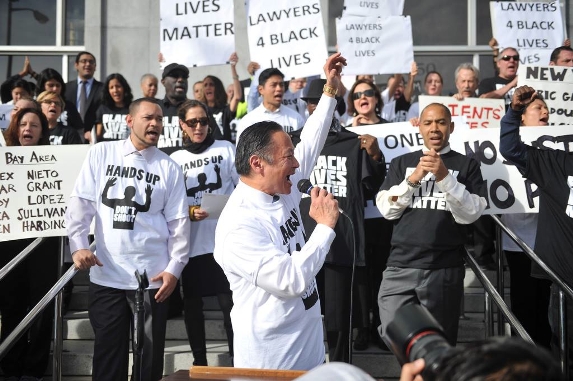
Adachi protest 2
Jeff Adachi leads a “Hands Up Don’t Shoot” rally in San Francisco in 2014

Progressive Cities: We Have a Problem

San Francisco is one of California’s jewel cities. Prized not only for its magnificent views, but also for its progressive populace. There is not a tax the City does not love, or a compassionate deed that is left undone.

San Francisco is one of California’s jewel cities.  Prized not only for its magnificent views, but also for its progressive populace.  There is not a tax the City does not love, or a compassionate deed that is left undone.

Yet, the City’s vistas, cable cars, resident technology giants, multi-million dollar mansions, as well as its busybody Board of Supervisors have taken a back seat in the City’s consciousness to its streets littered with human feces, discarded needles, and homeless misery. San Francisco has 7,499 unsheltered and sheltered individuals, in the streets or in temporary living arrangements. This number is not surprising, since one-quarter of homeless people in the United States live in California, even though Californians make up only 12% of the U.S. population.

Once Far Back In Time and Now

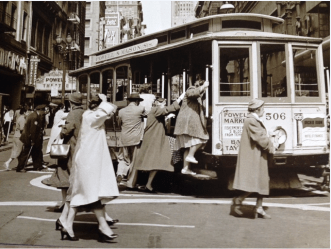
CableCarTurstile

San Francisco was once called “The City That Knows How,” where streets were clean and safe. Those were the days before the immense tragedy of the AIDS epidemic, before liberals took over City Hall, before developers – for profit or not – joined forces with corporate think tanks to redraw the City, before environmentalists hit upon the gold mine of climate change, and before the City’s Department of Public Works had a Poop Patrol or the City’s Department of Health had free injection needles.

Now Downtown, and increasingly the neighborhoods, is a place where one walks gingerly in order not to accidentally step of human faces or on discarded needles. In spite of the talk about placing children’s playgrounds in every neighborhood, parents are cautious least their children are inadvertently injured by drug paraphernalia on the ground.

Why the Descent Into Hades?

Unfortunately, no one agrees on the cause of the City’s descent; therefore, remedies are irrelevant and ineffective. The laundry list of culprits is varied:

* High-income technology workers that bid up housing costs and displace lower-income residents.

* Out-of-towners attracted by relatively balmy weather that allow for outdoor living, generous public assistance, a permissive population, and free injection needles.

* A welfare-homeless cabal that profits from the homeless trade. Think social workers, non-profit organizations, shelter operators, food banks.

* Legislators that seem to work to attract and keep the homeless. For example, the City is working hard to establish “safe-injection sites,” where homeless addicts can shoot up under the supervision of medical professionals. Another example, the City’s Mayor has proposed legislation that would forcefully place homeless individuals who cannot take care of themselves into conservatorships administered by the City’s Public Guardian. Once plugged into a conservatorship, no legal escape from the City is possible without a Court order.

From the Experts

The health implications of the mounting trash are stark. Discarded needles may be contaminated with diseases like Hepatitis B and C and HIV, infectious disease scientist Lee Riley told NBC Bay Area back in February. Dried feces, he added, can release viruses into the air … Riley, a University of California, Berkeley scientist who has researched the effects of extreme poverty on the health of some of the poorest groups in the world, said the contamination in San Francisco was “much greater than [in] communities in Brazil or Kenya or India.”  Newsweek 08/02/18

Mohammed Nuru, the director of San Francisco Public Works, told Boston’s NPR-affiliated WBUR station the waste is tied to the San Francisco’s high rates of homelessness. People often live in tents with little access to sanitation facilities or trash collection, he said … “Our city has been a magnet for providing services, and you know a large number of the people we see on our streets are not necessarily from San Francisco,” Nuru told WBUR. “They’re coming from surrounding counties and in some cases even from across state lines.”  Newsweek 08/02/18

San Francisco has a ‘Poop Patrol’ to deal with its feces problem, and workers make more than $184,000 a year in salary and benefits.  Business Insider 08/24/18

The main reason that so many people in San Francisco, and other cities like Los Angeles, are living on the streets is that the cost of housing over the past two decades has vastly exceeded the amount of income that people earn making minimum-wage jobs or bring in from modest pensions, disability, or welfare … Before Reagan took office and destroyed the American safety net, and San Francisco decided to be the West Coast Manhattan, you could live on SSI or a low-wage job and still pay rent in this town. When that changed, people who were formerly housed became homeless.  San Francisco Tenants Union 06/07/18

Bad and Beautiful

As one approaches the City for the first time as a tourist, a convention attendee, or a prospective resident, one might notice two breathtakingly beautiful bridges, as well as an ugly as sin structure visible for miles from all parts of the City. The dichotomy is made readily clear.