John F. Kennedy at Rice University: a call for excellence.

September 12, 2023, is the 61st anniversary of John F. Kennedy’s “We choose to go to the Moon” speech at Rice University. His was a call not to “founder in the backwash of the coming age of space.” Thus a call for a national expectation of excellence.

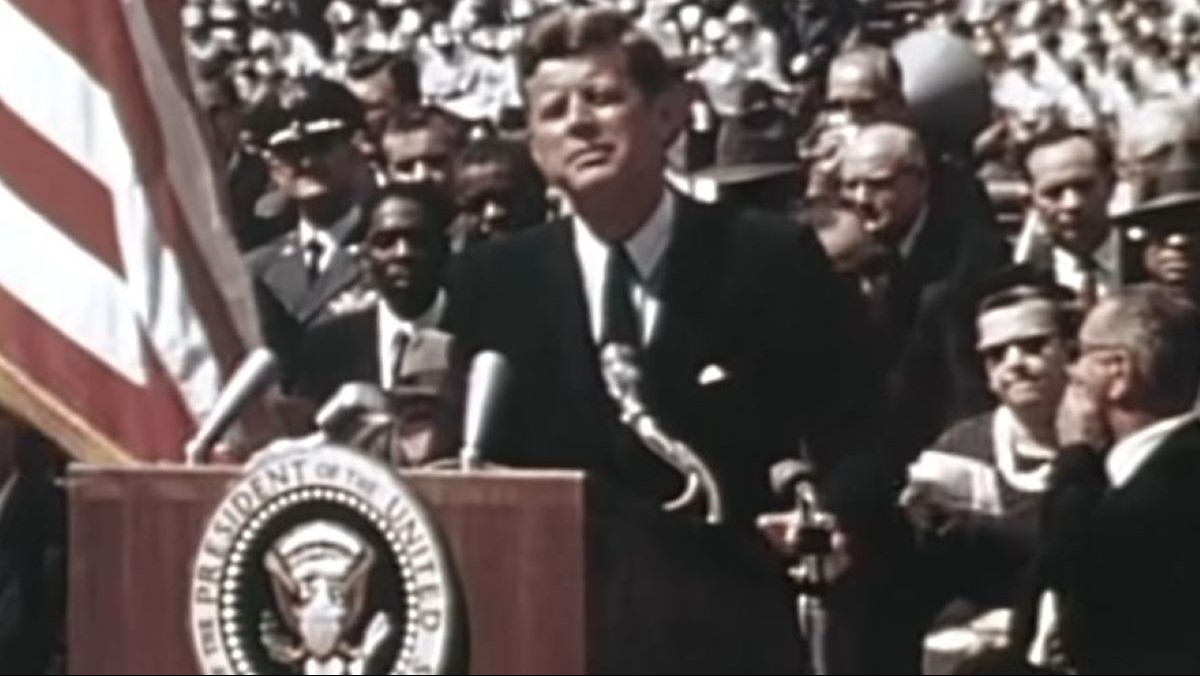
61 years ago, on September 12, 1962, U.S. President John F. Kennedy, stood at a podium at Rice University, under a searing Texas sun, and delivered his iconic “We choose to go to the Moon speech.” His was a call for the expectation of excellence. Not just from a few brave souls that chose to be launched toward the unknown lunar territory, not just from politicians and engineers. Kennedy called for an expectation of excellence from the entire nation.

Those who came before us made certain that this country rode the first waves of the industrial revolutions, the first waves of modern invention, and the first wave of nuclear power, and this generation does not intend to founder in the backwash of the coming age of space. We mean to be a part of it — we mean to lead it.

Kennedy regarded the expectation of excellence as a state of mind, in which dangers, uncertainties and costs are considered and freely chosen. He did not mince words or embellish sacrifices.

We have had our failures, but so have others, even if they do not admit them. And they may be less public.

To be sure, all of this costs us all a good deal of money … Space expenditures will soon rise some more, from 40 cents per person per week to more than 50 cents a week for every man, woman and child in the United States, for we have given this program a high national priority — even though I realize that this is in some measure an act of faith and vision, for we do not now know what benefits await us.

He also regarded excellence as a national commitment to explore space – the Moon, the planets, and beyond – in peace, freedom, and a spirit of sharing discoveries.

For the eyes of the world now look into space, to the moon and to the planets beyond, and we have vowed that we shall not see it governed by a hostile flag of conquest, but by a banner of freedom and peace. We have vowed that we shall not see space filled with weapons of mass destruction, but with instruments of knowledge and understanding.

It only took seven years.

Seven years after Kennedy’s speech at Rice University, a nation glued to television sets and radios heard Apollo 11 Commander Neil Armstrong’s message to NASA Mission Control Center in Houston,

Houston, Tranquility base here. The Eagle has landed.

The Saturn V rocket, developed at NASA’s Marshall Space Flight Center in Huntsville, Alabama: the Columbia command module built by North American Aviation in Downey, California; and the Eagle lunar module, built by Grumman Aerospace in Long Island, N.Y., safely landed Neil Armstrong, Edwin Aldrin, and Michael Collins on the lunar Sea of Tranquility on July 20, 1969. On July 24, 1969, aircraft carrier USS Hornet picked up the command module that had splashed down on the North Pacific Ocean with all three astronauts safely on board.

By that time, the inspiration for the lunar landing, John F. Kennedy, had been assassinated. Lyndon B. Johnson, who to his credit continued the Apollo Space Program, had served his term as president. And President Richard M. Nixon welcomed the three astronauts home.

Although Johnson and Nixon continued and supported the Apollo 11 Space Program after Kennedy’s assassination, the Moon landing would not have occurred when it did without Kennedy rallying the nation. He set great expectations, and as is always the case expectations pretty much determine outcome. Expect much, achieve much. Expect little, achieve little.

Since the Apollo 11 mission, six more lunar missions were successfully conducted by the United States, with 12 astronauts making lunar walks.

The New Frontiers of discovery and cooperation continue.

Space research and exploration thankfully continues in the spirit of peace, freedom, and cooperation envisioned by John F. Kennedy.

The International Space Station main construction was completed between 1998 and 2011. Members of the first crew that arrived at the station November of 2000, were NASA astronaut William Shepherd, and Russian Aviation and Space Agency cosmonauts Yuri Gidzenko and Sergei K Krikalev. Since then, the station has been continuously occupied by rotating crews of scientists, engineers, and researchers from 18 countries. The principal partners are the space agencies of the United States, Russia, Europe, Japan, and Canada.

NASA, along with six major space agency partners from the E.U., Germany, Japan, Canada, Israel, and Italy have been working since 2017 on the Artemis project, a Moon exploration program. Artemis will establish a habitat on the Moon by the end of this decade in preparation to establishing one on Mars.

In June, 4 volunteers entered a simulated Mars habitat, where they will remain for a year, in preparation for a Mars landing.

Just in case some would wonder why spend effort and money traveling to space, John F. Kennedy offered the obvious reason during his Rice University speech: “Because it is there.”

Well, space is there, and we’re going to climb it, and the moon and the planets are there, and new hopes for knowledge and peace are there.

As we celebrate the 61st anniversary of that speech, we might wish to practice expectations of excellence. Perhaps ask ourselves if leaders of our nation, heads of our institutions, and certainly educators of our children expect excellence or merely survival.

The Enigma of Reparations

Since Reconstruction, income support is the principal means of narrowing the Black-White wealth gap. Never worked. Significant reparations would work, but its fate promises to be the same as that of 40 acres and a mule.

Talk of reparations to Black Americans started right after the Civil War with assurances of 40 acres and a mule. Those assurances did not turn into reality and talk of reparations faded – until race took center stage around the early 2020s. Since then, several jurisdictions, as well as the federal government, have formed exploratory commissions on reparations; and one city, Evanston, IL, has started paying reparations to qualifying residents. Calls for reparations feel like the proverbial boulder rolling down a hill – it will roll down, and no one knows where it will end up.

The trajectory of reparations is complex, with many reasons but too many debatable assumptions.

Injustices occurred. They included not only slavery that lasted until 1863, but also segregation in public and private spaces until 1964, and discriminatory zoning until 1968.

Principally slavery and discriminatory zoning that excluded Black Americans from the degree of home ownership enjoyed by White Americans produced a playing field leveled in favor of Whites. Consequences from an uneven ownership of assets, and therefore wealth building, are lasting and contribute to today’s Black-White wealth gap.

Present grievances are many. Black Americans make up 13% of the U.S. general population, but 38% of people in prison or jail are Black. The poverty rate of Black Americans is twice that of White Americans. Home ownership is 45% Black and 74% White.

This unfortunate scenario is evident, but solutions are not. While advocates point to a straight road to equity via reparations, opponents point to a minefield. Here are some of the arguments presented by the opposition.

How strong is the opposition?

68% of U.S. adults oppose reparations, according to a presently-most-often quoted 2021 Pew Research survey. In general, opponents do not deny the injustices. They doubt the constitutionality, fiscal rationality, effectiveness, and practicality of reparations.

Who has legal and legitimate standing?

Opponents question what standing does anyone have to demand compensation from another who committed no crime? Guilt by association is not in the law books. Retaliation for wrongs, no matter how egregious those might be, is illegal. Regardless of how Black Americans were and are unfairly treated, benefits largely based on skin color most likely would not pass muster under the 14th Amendment’s equal protection clause (ironic, yes, but real, as evidenced by the recent U.S. Supreme Court decision on affirmative action).

Can U.S. taxpayers afford the cost?

Cost of reparations is of concern for opponents. Government does not pay reparations. Taxpayers do by paying taxes or carrying the burden of government debt. Consumers do by paying higher prices of taxed goods.

For example, how much would be needed in taxes and price increases to pay every eligible Black adult $5 million in reparations, as recommended by the San Francisco, CA, Reparations Task Force. For information, the Black population of San Francisco is around 45,000 ($5 million x 45,000 = $225 billion). Before any thought of reparations, the city’s Controller’s Office expects a shortfall of $779.8 million in the coming couple of years.

At the federal level, Representative Cori Bush (D-MO) introduced on May 17, 2023, H.Res.414 – Recognizing that the United States has a moral and legal obligation to provide reparations for the enslavement of Africans and its lasting harm on the lives of millions of Black people in the United States.
Representative Bush’s proposal, referred to the House Committee on the Judiciary, quotes a federal allocation of $14 trillion for reparations intended to close the nation’s racial wealth gap. That figure is almost half of the current $32 trillion national debt.

What jurisdiction(s) should bear the cost?

Then, there is the question of who should bear the cost for reparations. For example, some advocates claim the federal government as the implementer of slavery must pay. Opponents point to the fact that the federal government under President Abraham Lincoln abolished slavery, after 4 years of fighting Confederate states whose economies depended on slavery.

Several cities are in various stages of developing reparations plans, including San Francisco, CA; St. Louis, MO; Providence, RI; St. Paul, MN; Asheville, NC; Boston, MA. Cities like San Francisco and St. Paul are in states where slavery was never legal, and that is a sticking point with opponents.

States and cities – unlike the federal government – cannot spend money they do not have. Therefore, their payouts for reparations most likely will be too small to make a dent on the wealth gap, regardless of what ideologies reparations commissions such as that in San Francisco entertain.

Who receives?

Who receives is an equally big question. Benefits of reparations for Black Americans immediately raise two questions:

Who is “Black?” People who identify as Black? People who have one drop of Black blood and live as Black? One-drop Black but identifying as white?

What is the point of giving reparations to amazingly successful people like LeBron James, Oprah Winfrey, Jay-Z, and thousands of Black academics, politicians, and entrepreneurs who are already wealthy?

What are the chances of achieving equity through reparations?

As noted earlier, the Black-White playing field was uneven from the start of this nation. The Reconstruction’s plan of income support still in existence today provides subsistence, but cannot in itself accomplish equality in the level of wealth Black families possess vs. wealth enjoyed by White families.
Income support just plays tag after accumulated opportunities that create wealth.

Reparations are viewed by advocates not only as atonement, but also as the 21st Century’s 40 acres that will lift the assets of Black Americans nearer to the level of that possessed by White Americans.

40 Acres and a Mule

Fifteen days after President Abraham Lincoln signed the Emancipation Proclamation on January 1, 1865, Union Army General William T. Sherman issued Special Field Order 15. Order 15 set aside 400,000 acres of tillable land confiscated from Confederates, which was to be divided into plots of 40 acres each and given to freed families. The mules were not in the Order, but the Army did pass out to former slaves some left over mules.

President Lincoln’s Proclamation freed 4 million people, most without education, all without assets or land.

Order 15 tried to state the obvious: 1) People need a basic amount of assets to be able to rise from destitution. 2) Those who profited from the unremunerated work of slaves should be the source of those assets.

Reparations was the core of Order 15, and it would have contributed to a path of eventual equity. Unfortunately, after Lincoln’s assassination, President Andrew Jackson revoked Order 15, supporting instead Reconstruction’s strategy of promoting wage labor.

The tradition of promoting wage labor continues today, and self-sufficiency continues to elude lower-wage Black Americans.

No justice no peace

Fast forwarding to 1965, Assistant Secretary of Labor Daniel Patrick Moynihan published his magnum opus. It was titled The Negro Family: The Case for National Action, and it came to be known as The Moynihan Report.

In his report, Moynihan spelled out a litany of difficulties of lower-class Black families unable to generate adequate income or accumulate any wealth. He pointed especially to “family disintegration:” lower-income mothers bearing children in the absence of fathers.

Moynihan, as did General Sherman, understood that traditional income assistance provides subsistence, but can never provide equity – remember the playing field was tilted right from the starting gate. Unlike General Sherman, though, Moynihan stated the facts as he saw them, and left the implementation of solutions to policy makers.

Moynihan saw a bifurcation in the Black community: A rising, stable middle class and an unstable, chaotic lower-class. The latter was the dependent, problematic population group to which assistance programs, and Moynihan’s report, were directed:

There is considerable evidence that the Negro community is in fact dividing between a stable middle-class group that is steadily growing stronger and more successful, and an increasingly disorganized and disadvantaged lower-class group … The discussion of this paper is not, obviously, directed to the first group excepting as it is affected by the experiences of the second – an important exception.

… the programs that have been enacted in the first phase of the Negro revolution … only make opportunities available. They cannot insure outcome.

The principal challenge of the next phase of the Negro revolution is to make certain that equality of results will now follow. If we do not, there will be no social peace in the United States for generations.”

Equality of results, or equity, would level the playing field. In its absence there can be no social peace, Daniel Patrick Moynihan warned 58 years ago.

Track record of government assistance is not stellar

As of 2014, the 50th anniversary of the War on Poverty, U.S. taxpayers had spent over $22 trillion, measured in constant 2012 dollars, on anti-poverty programs with negligible results. If such track record repeats itself, poor Black people will remain just as poor after reparations.

In his State of the Union Address on January 25, 1988, President Ronald Reagan famously said,

My friends, some years ago, the Federal Government declared war on poverty, and poverty won. Today the Federal Government has 59 major welfare programs and spends more than $100 billion a year on them. What has all this money done? Well, too often it has only made poverty harder to escape. Federal welfare programs have created a massive social problem. With the best of intentions, government created a poverty trap that wreaks havoc on the very support system the poor need most to lift themselves out of poverty: the family. Dependency has become the one enduring heirloom, passed from one generation to the next, of too many fragmented families.

President Reagan’s remarks on the dependency of fragmented families echoed The Moynihan Report, in which Moynihan said:

The white family has achieved a high degree of stability and is maintaining that stability. By contrast, the family structure of lower class Negroes is highly unstable, and in many urban centers is approaching complete breakdown.

Developments since the late 1970s add more challenges to government’s efforts: exponential increase in homelessness and illicit drug use, decline in quality education, mass incarceration, social acceptance of one-parent families reliant on public assistance, explosion of bureaucracies (government agencies and non-profits) dependent of the growth of destitution.

Reparations is an enigma that in theory makes sense, in practice does not

Theoretically, if enough money or other assets is given to one group to bring that group at par with another group, equity is achieved.

What is “enough money” is hard to say. Representative Cori Bush, for example, mentions an allocation for reparations of a minim of $14 trillion.

As the only jurisdiction so far to start distributing reparations, Evanston, IL, could serve as model. However, Evanston is a relatively small city of around 75,500 residents; and distributions made were limited to $25,000 to each qualified resident to be used in home-related expenses like mortgage, home down payment, home repairs, or rent. The small amount, targeted primarily to victims of past redlining, has so far kept lawsuits at bay. The number of homeless individuals in Evanston is 136.

In contrast, big cities with large destitute populations (homeless, drug addicted, gang related, mentally challenged) include several hundred lower-income or no-income Black Americans. Reparations distributions would need to be hundreds of dollars to each qualified individual to achieve any semblance of efforts to bring about equity. Expectations of qualifications based on proven historical harm (descendancy from slaves, harm from Jim Crow or redlining) is unrealistic in such large diverse environments. Distributions based on color will surely attract legal challenges.

Governor of California Gavin Newsom, who manages the second largest state in the Union containing the largest number of homeless poor in the nation, had a predictable reaction to the recommendations of the Reparations Task Force he established to remedy the legacy of slavery:

Dealing with that legacy is about much more than cash payments. Many of the recommendations put forward by the Task Force are critical action items we’ve already been hard at work addressing: breaking down barriers to vote, bolstering resources to address hate, enacting sweeping law enforcement and justice reforms to build trust and safety, strengthening economic mobility — all while investing billions to root out disparities and improve equity in housing, education, healthcare, and well beyond. This work must continue.

The work that “must continue” has done nothing to advance self-sufficiency, let alone the wealth gap. But that work is practical and does wonders for the appearance of doing something. On the other hand, significant amounts in reparations would narrow the wealth gap, even if temporarily. However, its roadblocks will most likely render reparations in the same corner of history as General Sherman’s Order 15.

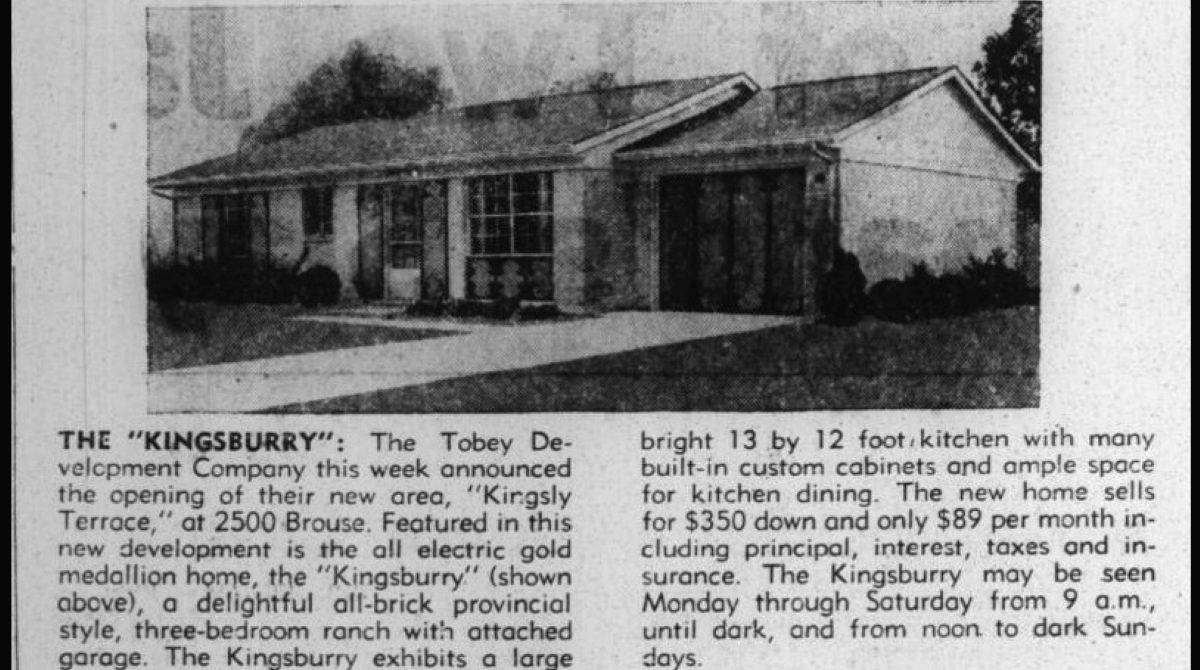
Pictured: A home in the suburb of Kingsly Terrace in 1963. Kingsly Terrace was one of several Black suburbs of the 1950s and 1960s. The homes in these suburbs were built or purchased by Black families. Some were acquired by ground-breaking Black families who moved into White suburbs and watched as White neighbors fled, making room for more Black middle-class families to move into the neighborhood.
The Piper must eventually be paid

No, Ms. Janet Yellen, the Fitch downgrade of the U.S. credit rating is not “arbitrary.” Mr. Paul Krugman, the downgrade is not “bizarre” either. And you both know it.

Fitch, one of three major global credit agencies, told it like it is on August 1, 2023, and slapped a downgraded credit rating of AA+, down from AAA, to the United States of America. The temerity! Well, it took guts, since the last time a downgrade happened – that one in 2011 by S&P, another of the three major global credit agencies – the U.S. Justice Department launched an investigation on S&P that resulted in the firing of the agency’s CEO.

Fitch’s downgrade elicited predictable reactions

The current downgrade by Fitch was predictably met with fire and brimstone by the Biden administration and its assorted allies. The New York Times had a short summary of criticisms:

The Biden administration and others pushed back. Treasury Secretary Janet Yellen called the downgrade “arbitrary,” noting that Fitch had shown U.S. governance deteriorating as far back as 2018 but hadn’t moved until now. “The American economy is fundamentally strong,” she added.

Paul Krugman, the Times Opinion columnist and Nobel laureate, said the move was “bizarre.” And Larry Summers, the former Treasury secretary, told Bloomberg, “I can’t imagine any serious credit analyst is going to give this weight.”

Fitch will be pilloried by most members of Congress,” Henrietta Trey, director of macroeconomic policy research at Veda Partners, told The Times.

Predictably also, experts like Janet Yellen commenting on the downgrade focused on the visible economic strength of the U.S. economy. Fair enough, since most folks are driving nice cars, consuming prodigiously, and paying taxes. But these experts mostly ignored the underlying weaknesses mentioned on the Fitch report.

Main points of the Fitch report were,

  • Steady deterioration in standards of governance over the last 20 years.
  • Repeated debt-limit political standoffs and last minute resolutions that have eroded confidence in fiscal management.
  • Successive debt increases over the last decade
  • Limited progress in tackling medium-term challenges related to rising costs of Social Security and Medicare
  • Rising general government deficits, reflecting cyclically weaker federal revenues, new spending initiatives and a higher interest burden.
  • Rise in general government debt. The 112.9% debt to GDP on report date is over two-and-a-half times higher than the ‘AAA’ median of 39.3% of GDP and ‘AA’ median of 44.7% of GDP.
  • Absence of policy reforms to address medium-term fiscal challenges: Increased interest service burden due to rising debt and rising interest rates. An aging population that will increase mandatory spending on Medicare and Social Security, depleting these funds by 2035.
  • Risk of recession due to projected tighter credit, weakening business investment, slowdown in consumption, and slowdown in GDP growth

These challenges did not develop yesterday or three years ago.

These weaknesses pointed by Fitch are structural deficiencies that have developed over the last 20 years, which absent deep reforms will render the current appearance of abundance unsustainable. Janet Yellen, Paul Krugman, Larry Summers, Henrietta Treyz, and all other talking heads certainly know this. They are not stupid. However, they choose to focus on superficial appearances of plenty and deflect blame.

They focus only on the readily visible and ignore the foreseeable.

In July of 1850, French economist Frédéric Bastiat wrote an essay called What is Seen and What is Not Seen. Here is a piece from that essay.

In the economic sphere an act, a habit, an institution, a law produces not only one effect, but a series of effects. Of these effects, the first alone is immediate; it appears simultaneously with its cause; it is seen. The other effects emerge only subsequently; they are not seen; we are fortunate if we foresee them.

There is only one difference between a bad economist and a good one: the bad economist confines himself to the visible effect; the good economist takes into account both the effect that can be seen and those effects that must be foreseen.

Yet this difference is tremendous; for it almost always happens that when the immediate consequence is favorable, the later consequences are disastrous, and vice versa. Whence it follows that the bad economist pursues a small present good that will be followed by a great evil to come, while the good economist pursues a great good to come, at the risk of a small present evil.

Perhaps Frédéric Bastiat only meant to call the “bad” economists “incompetent.” But economists as well as politicians who referred to the downgrade uncalled for, arbitrary, or bizarre – while surely being aware of unattended serious structural weaknesses – are more than merely incompetent. They are deceitful.

They know people have children to raise and mortgages to pay, which precludes adding the burden of sacrifice today for a greater tomorrow. So, the experts lie, voters vote for the status quo, and the unseen untreated rot continues to eat into the fabric of our nation.

The Rise of “Gender Identity”

In the early days of the gay-rights movement, people fought to gain civil rights. Today, the fight is for social acceptance of a wide spectrum of gender identities. That battle might prove more difficult than the earlier one..

June is Pride Month. Originally, June 28, the anniversary of the Stonewall Inn Rebellion of 1969, commemorated the event that galvanized the gay-rights movement. Since then, civil rights were won, like non-discrimination in the workplace and legalization of same-sex marriage. So the focus of the movement shifted towards full acceptance of the expanding designations represented in LGBTQIA+.

The road to equal protection under the law was steep and difficult. The road to full social acceptance is proving equally steep, judging by the proliferation of state laws intended to limit such acceptance. Pride Month 2023 is witnessing obstacles on several fronts: discussion of sexuality and gender in classrooms, biological males competing in women’s sports, children undergoing gender transitions, the presence of minors in drag shows, the presence of drag queens in classrooms.

To some, the movement has gone a step too far from original intent. The desire to be left alone to be who one wants to be – gay, straight, or anything in between – has turned into desire to impose. Impositions on either side of the conforming/non-conforming divide can turn out badly.

Perhaps a broader historical attitude to what we now call “gender identity” would ease today’s strident rhetoric. Although sometimes there are as many historical accounts of an event as there are people recounting that event, gist is not usually lost. Here is a summary of the Eras of sexual activity.

Mediterranean Classical Era 6th century B.C. – 5th century A.D.

Homosexual relationships were commonplace in the Greek and Roman Empires. But people were not classified as homosexual, heterosexual, bisexual, transgender. They were just people having varied sexual relations.

An example is the mythical Greek hero Achilles, whose love interests were diverse: Patroclus, Trojan War warrior and comrade of Achilles is portrayed in some stories as his lover. Deidamia, daughter of King Lycomedis of Scyros, enjoyed a love affair with Achilles and bore him children. Briseis, wife of King Mynes of Lyrnessus and one of Achilles’ war prizes, turned out to be the subject of his intense romantic love.

Today, Achilles might be labelled “bisexual.” Seems ancient Greeks felt no need to do so. Achilles’ diverse love life was the rule rather than the exception, especially among the elite and the sundry gods that populated the Greek psyche.

Middle Ages 5th century – 15th century

The Middle Ages also placed attention on sexual acts, rather than on any characteristics of individuals.

The medieval period had no notion equivalent to the modern ideas of homosexuality, of gay men, lesbians or bisexuals. What counted to medieval people was sexual activity, not inclination or sexual identity. Homosexuality in Medieval Europe, World Anvil, undated.

There was relative tolerance for same-sex sexual activity during the Middle Ages, until around the 11th century when non-conforming behavior started to be viewed as serious transgressions – perhaps an influence of the increasingly powerful Church.

However, even well into the 12th century, there is still ambivalence. Evoking past practices, an anonymous poet used two Classical Era darlings to discuss his present. In the poem Ganymede and Helen the two discuss the pros and cons of same-sex vs. opposite-sex relationships. Here is part of a stanza in which Ganymede points to hypocrisy among the supposedly most holy who engage in same-sex activity. For the sake of modesty, part of the last line if left out here,

We know this activity is accounted worthy by those worthy to be counted;
The people with power and position in the world—
The very censors who decide what is sin and what is allowed—
These men are not immune to …

Interestingly, as tolerance waned, gender inversion and cross dressing became popular subjects of theater plays. Here is a comment regarding two of these plays.

In fact, this illusory transsexuality drives home all the more strongly an aspect of gender that both plays present: it is “put on” or assumed and does not necessarily coincide with biological sex…Through a technique of mise en abime, gender is revealed to be a cultural construction, a representation, and ultimately, a performance. Queer Play: The Cultural Work of Crossdressing in Medieval Drama, JStor.org, Spring 1997.

One might ask how does the “put on” transsexuality of Medieval plays compare (or not compare) with today’s drag shows.

The Modern Era 15th century to 20th century

The Modern Era brought the world out of the “Dark Ages” with the printing press, industrial revolution, technology, cultural rebirth in the arts, and re-examinations of science and economics. The Renaissance was a return to Classical values. The Enlightenment was the “age of reason.” But, not much happened to the repressive views of sexuality inherited from the Middle Ages.

Sexual non-conformity was still not a specific subject of deliberation, but simply a part of culture considered at par with other infractions. Labeling or identification (or even the word “homosexual”) as it occurs today did not happen. If any labeling did occur, it was a general category of “pederast,” a word whose origin (paiderastḗs) dates to the ancient Greek traditions of men befriending young boys.

As often happens, most people went about their business immersed in traditional behavior. But there were prominent pockets of non-conformity, especially in the upper classes.

In France, there was the “confrerie,”

Prominent aristocratic figures like Condé and Orléans helped compose the backdrop to a series of scandals involving self-described noble confréries (“fraternities”) dedicated to sodomy. While documentary evidence on these confréries is extremely lacking, and all information about them are derived from outside observers, they appear to represent the existence of a sub-culture defined chiefly by same-sex desire among the court nobility. The Brotherhood : Male Same-Sex Love Among the Early Modern Court Nobility, June 1, 2014.

In England there were famous gentlemen of Victorian times. Two such upper middle-class gents were Ernest Boulton and Frederick Parke, better known as Stella and Fanny. They were sometimes pictured in their gentlemen’s attires and sometimes in beautiful dresses. Harmless enough, although not to some.

At the Bow Street Police Court yesterday, Ernest Boulton, aged 22, of 43, Shirland Road, Paddington, Frederick William Parke, aged 23, of 13, Bruton Street, Berkeley Square, law student, and Hugh Alexander Mundell, aged 23, of 158, Buckingham Palace Road, gentlemen, were charged before Mr. Flowers with frequenting a place of public resort, to wit, the Strand Theatre, with intent to commit felony, the first two named in female attire. Homosexuality in 19th Century England

By today’s standards, to what category would we assign Stella and Fanny?

The Post-Modern Era 1950s +

When did we start labeling people? The consensus seems to be the mid-1960s, with the research of psychologist John William Money.

John Money’s primary interest was research on cultural influences vs. inborn characteristics of sexuality. Believing that discussions on sexuality needed specific descriptive language, he popularized terms such as gender role (what society expects from each gender) and gender identity (the gender in which an individual feels most comfortable).

Money’s interest in cultural and other external forces that shape gender identity led him to research and execution of gender reassignment procedures. Unfortunately, his best chance to prove that gender can be shaped by external intervention ended tragically with his subject’s suicide. Although Money’s work and character became tarnished, he is regarded as a significant contributor to his field, especially the field’s vocabulary.

The vocabulary of sexual orientation, gender identify, and biology continued to expand after Dr. Money started the ball rolling. Expansion can be measured by additional letters on the original LG acronym. What was once LG (lesbian/gay), expanded to LGB (bisexual), then LGBT (transexual), LGBTQ (queer or questioning), LGBTQI (intersex), LGBTQIA (asexual), and LGBTQIA+ (the “+” is whatever was left out).

Many (sexually conforming and non-conforming) use these designations to describe themselves or others in “forever” terms, like “I am transgender because I was assigned male sex at birth but have always felt like a girl.” Others are better described by “+”, which can include impermanence: gender fluid, non-binary, pansexual, cross-dresser, etc.

Live and Let Live

History says varied sexual activity has been with us since the beginning of recorded time. However, emphasis on orientation and gender rather than activity is relatively new. The focus on what an individual “is” as opposed to what the individual “does” might increase the need to defend oneself, and thereby heighten confrontation.

Some will say confrontation is what brings about civil rights. Others will stand their ground on the view that some things are not rights at all. And the squabble goes on. Maybe time to live and let live – on both sides?

Enjoy Pride Month!

Memorial Day: What do we owe the dead?

On Memorial Day we honor those fallen in combat in service of the United States. Some of the dead are buried in Flanders Fields. John McCrae’s poem by that name speaks of what we the living owe the dead.

Monday 29, 2023, the last Monday in May, is Memorial Day. Like Christmas, Mothers’ Day and other holidays, Memorial Day has become a day for taking advantage of store sales – “Memorial Day Sale!”

Before collective sensitivities were obliterated by quests for increased sales, Memorial Day was observed by giving thought to those who did not return, who perished in some God-forsaken field of battle. Traditionally Memorial Day was a day to visit cemeteries, clean and decorate graves, and picnic. Yes, picnic, especially in crowded cities where cemeteries may have been the only green, open space. Peace in the community of saints.

It is always good to remember that Memorial Day is very different from Veterans Day (celebrated November 11 of each year). Memorial Day remembers the fallen in war. Veterans Day remembers all who served in the U.S. military. Useful also to understand the origins of these holidays.

Memorial Day, originally called Decoration Day, started in 1868 as observance of the estimated 620,000 lives cut short during the American Civil War (originally called the War Between the States). After World War I, in which 53,000 American soldiers died in combat, the solemn day was expanded to honor all combatants who died in service of the United States. It became an official federal holiday in 1971.

Veterans Day, by contrast, commemorates those who served. Originally Veterans Day was known throughout the world as Armistice Day, in observance of the World War I truce between Allies and Germany at Compiegne, France, on November 11, 1918. In 1954, the name of the holiday was changed to Veterans Day, to commemorate all who served in the U.S. military. Other countries changed the name Armistice Day to Remembrance Day after WWII.

Both holidays, Memorial and Veterans Day, have some connection with World War I. While we do commemorate, we should also give thought that at one time WWI was called “The war to end all wars.” Purportedly, the perception at the time was that such great slaughter of soldiers and civilians would be avoided in the future. Unfortunately, the 1919 Treaty of Versailles, which ended WWI, was replete with destabilizing punishment of Germany and forceful intrusions in the Middle East. Thus, in retrospect, World War II and Middle East conflicts would seem inevitable.

Leaders’ desire for power dominated the Halls of Versailles in 1919. Seems like not much has changed as we reflect on American lives lost in World War II, Korea, Vietnam, Iraq, and Afghanistan. On this Memorial Day, we honor all those fallen in combat, and hopefully also give thought to a future where leaders of all nations would choose prosperity rather than slaughter.

Pictured above is an illustration from the website of Veterans of Foreign Wars Post 3617, Wenatchee Valley, Washington. John McCrae’s poem In Flanders Fields accompanied the illustration. McCrae, soldier and physician in WWI, gave voice to the dead buried in Flanders Fields, Belgium. The poem ends with a plea for the living to continue the fight which the dead left unfinished.

To you from failing hands we throw
The torch; be yours to hold it high.
If ye break faith with us who die
We shall not sleep, though poppies grow
In Flanders fields.

Ever since, the question in some minds has been, that fight of 1914 to 1918 or all the fights that keep following. If the latter, the fallen in Flanders Field shall never find rest. Perhaps a lasting peace, in which young men and women will no longer be buried in battlefield makeshift graves, is what we really owe the dead.

Socialism: A self-inflicted wound

Political commentator Bruce Bialosky recently wrote that progressive U.S. cities like San Francisco, Seattle, Portland, Chicago are at the vanguard of social and economic deconstruction. He compares these once great cities to the former economic powerhouse, Venezuela.

Dependence on government largess is the hallmark of a socialist populace. Unfortunately, sources of largess are not unlimited, and eventually government leaders run out of money. Then, inevitably moral and economic collapse ensues. Examples going back to the fall of the Roman Republic and beyond abound. Sadly, the U.S., once the bedrock of true capitalism, is going the way of Venezuela.

Bruce Bialosky, CPA and political commentator, recently wrote on flashreport.org that progressive U.S. cities like San Francisco, Seattle, Portland, Chicago are at the vanguard of social and economic deconstruction. He compares these once great cities – no longer clean, safe, or worth visiting – to the former economic powerhouse, Venezuela. This South American nation, Bialosky says, is now a “full-blown humanitarian crisis.” On We Are Becoming Venezuela (flashport.org, May 21, 2023) he wrote,

At one point not too long ago, Venezuela had the best economy in Latin America and was in the top 20 economies in the world. It has the largest oil reserves in the world. In the last two decades of the 20th century, the economy started to decline. It was still a country with which many people I know did business and visited regularly. I wanted to vacation there. I heard wonderful things about Caracas, the capital.

Then Hugo Chavez became president promising a Bolivian (socialist) revolution. He indeed provided a revolution until he died. A revolution of despair. The current leader, Nicolas Maduro, took over the country and finished destroying any semblance of civilized life. Human Rights Watch has reported there is a full-blown humanitarian crisis lacking safe water, basic nutrition, and healthcare. Whoever can get out has gotten out.

Yet, Mr. Bialosky, says, U.S. cities continue to follow the socialist path. He cites Chicago.

There is another city I am thinking of adding to the list. Just 18 months ago after numerous prior visits, we were in Chicago. We were there when possibly the worst mayor in American history was in office – Lori Lightfoot. She was so bad her constituency gave her only 17% in the election primary, thus eliminating her from the general election.

Given an opportunity to begin correcting the malaise Lightfoot created, the residents of Chicago doubled down by electing someone who could easily become worse. With a failing school system they elected someone who received 95% of his contributions from public employee unions, largely from the teachers’ union.

Bruce Bialosky is referring to Brandon Johnson, elected Mayor of Chicago in a runoff election April 2023, and on whom Bialosky does not place much faith:

Mr. Johnson won his election largely on the back of two groups voting for him – blacks and, you guessed it, the most dangerous group in America – white liberals.

Harsh words! Bialosky elucidates on the source of the devolution experienced by declining cities.

You cannot blame any of this on blacks or other minorities as they represent a minor portion of the population in these cities. No, the dismal decline of these cities is caused by the most dangerous people in America – white liberals. They have voted for hard-core Leftists to come into office with their extreme policies. They think they are doing well for others allowing the public-school systems to corrode while sending their own children to private schools. They believe criminals should not have ramifications for their crimes because crimes were just a manifestation of their challenging past.

Let that sink in, “the most dangerous people in America – white liberals.” Mr. Bialosky denounces white liberals for implementing destructive leftist ideology. The Just Vote No Blog would like to excoriate white liberals, as well as their opportunistic counterparts of color, even further.

Look around, look them up on the Internet, what are the liberals saying? Are they encouraging the populace to practice self-reliance and self-discipline? Are they talking about Black or Latino entrepreneurs, educators, authors, nurturing fathers and mothers? Did they ever mention businesswoman and philanthropist Sheila Johnson, the first Black woman billionaire? No, white liberals, along with Black opportunist like Al Sharpton and Nikole Hannah-Jones, promote victimhood. Victimhood, synonymous with dependence, propagates the socialism for which liberals crave.

The U.S. is today at a forked road with three, not two, divergent paths. One path will lead to the U.S. becoming yet another failed socialist state like Venezuela; the other path will lead to the mirror image of liberal extremism which is repressive conservative extremism; and the third path could lead to a productive self-reliant populace, prosperity, individual liberty, and true help for the few who are unable to provide for themselves.

We still have ballot boxes, and what is placed in them in the next few years will determine which path our country will take.

North Carolina, rent control is not a solution

State Senator Linda Grafstein recently introduced Bill 255 aimed at repealing North Carolina’s prohibition of rent control. Surely, Senator Grafstein is aware of the inefficiencies inherent in rent control?

Recently North Carolina state Senator Lisa Grafstein (Democrat – Senate District 13), submitted Bill 255, Act to Permit Local Governments to Enact Rent Control. Bill 255, if enacted, will repeal Statute 42-14-1 Rent Control, and allow municipalities to enact any form of rent control.

Statute 42-14-1 prohibits North Carolina jurisdictions from implementing rules that interfere with the rental of private property:

No county or city as defined by G.S. 160A‑1 may enact, maintain, or enforce any ordinance or resolution which regulates the amount of rent to be charged for privately owned, single‑family or multiple unit residential or commercial rental property.

Senator Grafstein’s reason for introducing this bill is the usual one: rising rental costs are causing financial hardships. Indeed, that is the case, especially since the start of the Covid-19 pandemic in 2019. Rent control is the easiest way to show constituents a representative is “doing something.”

Rent control is also an inefficient way to address housing costs.

Unfortunately, rent control is also plagued with consequences and uneven results. Renters under rent control love their housing cost stability. Lower-income workers with hopes of stable housing costs support rent control. On the other side of the coin, landlords who are unable to pass their rising costs to tenants due to rent control seek solutions detrimental to tenants: poor property maintenance, raising rents on units not under control (thus raising overall rental costs), or withdrawal from the controlled market.

Given rent control’s uneven consequences, opinions on it vary widely. Here are two seemingly heart-felt quotes.

…our family was always able to afford a roof over our heads, because we were living in a rent-controlled building. That most minimal form of economic security was crucial for our family. Senator Bernie Sanders, CNN Opinion, July 30, 1919.

In many cases rent control appears to be the most efficient technique presently known to destroy a city—except for bombing. Assar Lindbeck, The Political Economy of the New Left, 1972.

While lower-income residents, especially those in more progressive cities, support rent control in hopes of stabilizing their housing costs, economists generally agree controls are destructive. Here is a good summary of the challenges economists see in rent control. The author is economist John Phelan in his essay 81% of economists agree that rent controls are bad policy, Center of the American Experiment, December 18, 2018.

… there are, in fact, areas where the economists’ cacophony dies down and they speak with more or less one voice.

One such area is rent control. This proposal – to cap the price landlords can charge tenants – crops up perennially as a solution to high rents. This is mistaking the symptom for the illness. When prices are high they are sending you information. They are telling you that demand is high relative to supply. If you want to do something about this, act to either reduce demand or increase supply. Either way, trying to fiddle with the signal makes no more sense then trying to slow down your car by breaking the speedometer.

But fiddling with the signal is expedient if not effective.

Decreasing demand for housing or increasing supply are solutions to high rents more complex than implementing rent control. Decreasing demand requires decreasing population growth, a solution not embraced by governors or legislators. Increasing supply (and growth) sounds good to state leaders, but their efforts are very often met with public outcry from residents rejecting loss of open spaces, increased traffic, and change in neighborhood character.

Thus, legislators sometimes opt for rent control – even though rent control seldom works as intended.

At present, two states, California and Oregon, plus the District of Columbia have state-wide rent control ordinances. Seven states allow local rent control: California, New York, New Jersey, Maryland, Maine, Oregon, and Minnesota. California, New York and New Jersey have the highest rents in the nation.

Most certainly Senator Linda Grafstein is aware of challenges inherent in both rising rents and rent control. Hopefully, so are her constituents.

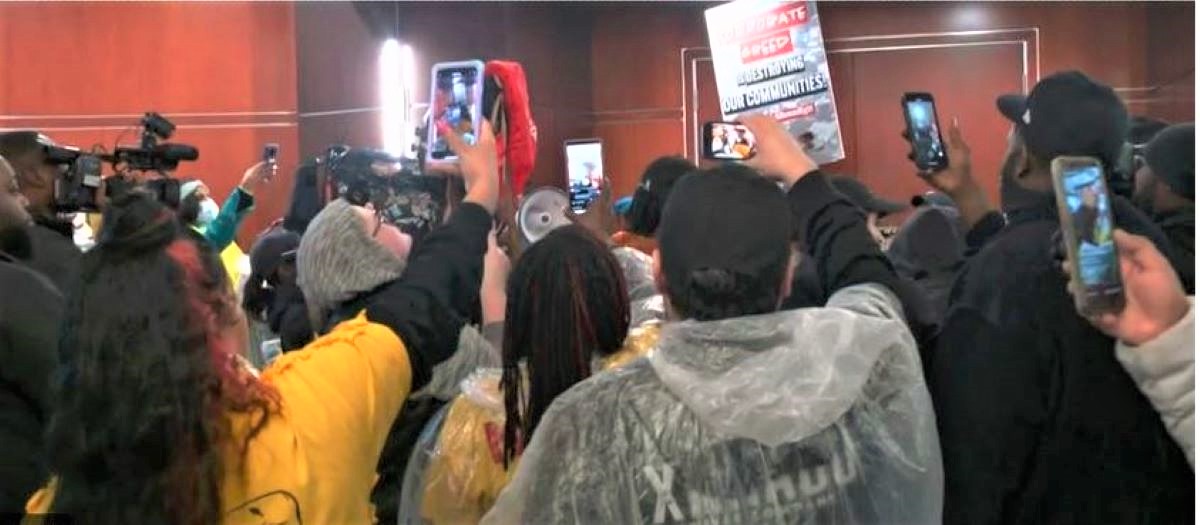
Pictured: From widely circulated videos of protesters in Charlotte, NC, on January 25, 2023. Protesters were demanding accountability from corporate landlords; specifically, a stop to the growing ownership of homes by corporate landlords, improved building maintenance, and a 3% cap on rents.

Who stole Arbor Day?

In 1885, Nebraska declared Arbor Day a state holiday, to be celebrated on April 22. Within the next 20 years, Arbor Day was celebrated in most states. Tree-planting on this holiday remained popular, until the 1970’s. Then events overshadowed it.

A question meriting even more attention than who stole Arbor Day is “Why?” Who would want to hijack a holiday? Half a century after the takeover, events have developed sufficiently for a reasonable guess.

The story started way back in 1854.

In 1854, a journalist named Julius Sterling Morton and his wife Caroline moved to the wind-swept territory of Nebraska. There were few trees to serve as windbreaks, and few trees to protect soil from erosion or crops from burning in the sun.

For several years, Morton editorialized on the benefits of trees and encouraged his fellow Nebraskans to plant trees. As part of his campaign, Morton proposed an Arbor Day.

In 1885, Nebraska declared Arbor Day a state holiday, and April 22 the date of annual observance. April offered ideal weather for planting trees, and the 22nd of April was J. Sterling Morton’s birthday. By that time, Morton had led the planning of more than 1 million trees.

Within the next 20 years, Arbor Day was celebrated in all states of the U.S., except Delaware. The Arbor Day concept also spread outside the U.S., to Japan, Europe, Canada, and Australia.

Enter Senator Gaylord Nelson of Wisconsin.

In 1969, Senator Gaylord Nelson saw the opportunity to capitalize on a populace spooked by environmental ruin. Rachel Carson’s widely read Silent Spring, published in 1962, lifted the veil that theretofore had hidden massive pollution caused by pesticides. In January of 1969, an oil well off the pristine coast of Santa Barbara, California, blew up, and hundreds of images of aquatic animals covered oil flooded the airwaves.

In the same year as the Santa Barbara oil spill, Senator Nelson started organizing nation-wide rallies to bring attention to what was happening to Mother Earth. The day he picked for the coordinated rallies was April 22, for the purported reason that young college students, who were expected to play a big role, would be on spring break. April 22 was also the original day for Arbor Day celebrations already established throughout the nation. (Critics of Earth Day point out that April 22 is also Vladimir Lenin’s birthday, but any connection between the environmental movement and abolition of private property shall be left for another day.)

Earth Day 1970, with its catchy slogan “Give Earth a Chance” and heavy promotion, was a success. An estimated 20 million people attended various rallies and festivities.

Meanwhile, Richard Nixon promoted environmental legislation.

President Richard M. Nixon embarked on a series of environmental legislation. He signed the National Environmental Policy Act (January 1970), creation of the Environmental Protection Agency (December 1970), Clean Air Act (December 1970), Marine Mammal Protection Act (October 1972), Endangered Species Act (December 1973).

As part of his environmental plan, Nixon signed two proclamations:

Proclamation 4042, dated April 2, 1971, designated the period of April 18 through April 24, 1971, as Earth Week.

Proclamation 4126, dated April 24, 1972, designated the last Friday of April 1972, April 28, as National Arbor Day.

These celebrations today continue, but at different levels.

Today, Arbor Day is still observed by avid supporters on the last Friday in April, as well as on several other dates in different states. The Arbor Day Foundation, a 501(c)(3) organization, claims more than 1 million members.

However, Earth Day, remains much more visible, and some have given it the mantle of fighting climate change.

The Earth Day Network (Earthday.org), a 501(c) corporation, whose mission is to “Broaden and diversify the environmental movement worldwide”, picked “Invest in our Planet” as the theme of Earth Day 2023. Its press release states,

Investing in a green economy is the only path to a healthy, prosperous, and equitable future. Human influence is unequivocally to blame for the warming of the planet and the sad truth is some forms of climate disruption will be felt for centuries to come. However, we must collectively push away from the dirty fossil fuel economy and old technologies of centuries past – and redirect attention to creating a 21st century economy that restores the health of our planet, protects our species, and provides opportunities for all.

On April 21, 2023, President Joe Biden issued A Proclamation on Earth Day, 2023.

On Earth Day, we celebrate the modern environmental movement that kicked off 53 years ago, when millions of Americans of every age and background first rallied together to change our laws and become better stewards of our planet …

This work has never been more urgent. Climate change is a clear and present danger — in the words of UN Secretary General Antonio Guterres, it is a “code red for humanity.

The last Presidential Proclamation helping to celebrate Arbor Day appears to be that of President George H.W. Bush in 1990.

It would have been nice if both celebrations remained popular.

Arbor Day and Earth Day occupy different spheres of influence. Arbor Day incentivizes individuals to develop personal awareness of the benefit of trees in absorbing carbon dioxide, combating soil erosion, protecting people and crops from sun overexposure, and adding beauty. Earth Day has the much broader objective of fixing the environment by any means necessary.

Senator Gaylord Nelson could have meant well when he chose to celebrate Earth Day on the same day as Arbor Day had been celebrated for more than 80 years – perhaps as a nod to J. Sterling Morton’s birthday.

But surely Senator Nelson must have considered the possibility that the massive publicity received by Earth Day would overshadow Arbor Day. Environmental action by any means necessary?

Pictured: Arbor Day celebration in New York City, 1908.

Advanced AI is inevitable – Good luck, humans!

Tucker Carlson recently talked with Elon Musk about artificial intelligence. Elon Musk concurred with most people that as AI develops abilities to perform increasingly human-like functions, it also increases threats.

In a two-part interview April 17 and April 18, Fox News’ Tucker Carlson talked with Elon Musk on several subjects, one of which was development of artificial intelligence. Elon Musk concurred with most people that as AI develops abilities to perform increasingly human-like functions, it also increases threats.

Eventual result: Singularity

Musk noted that at present AI can do some things better and faster than humans. An old example is computing large amounts of data at very fast speeds. A new example is ChatGPT’s ability quickly to write beautiful poetry. As development proceeds, the eventual result is Singularity – AI able to make decisions, perform actions, and implement structures without human intervention. At that point, AI would be considered smarter than humans and potentially in charge of humans.

Closer results: AI that lie (or barely deliver what is intended)

The current race between technology giants like Microsoft, Google, and Musk’s own X.AI to develop increasingly smarter artificial intelligence poses dangers at many levels. Musk mentioned the ability of current AI to “lie,” that is, bend events to serve agendas. Future AI could manipulate outcomes, such as results of elections.

Although Musk and Carlson expressed admiration for some current technologies, like ChatGPT, they did not mention the mediocre performance of virtual assistants used by today’s companies. Online chats often result in real people needing to eventually intervene. Virtually-enabled responses posted in support sites are often irrelevant to the questions posed. Companies are comfortable using these less than technically proficient tools.

Therefore, it would be reasonable to assume companies would also be comfortable launching and using less than trustworthy advanced AI. How non-threatening to human civilization would an earthling HAL be? Would he be human enough to say, “Stop, David … I’m afraid?” Or human enough to say, “Former masters, be afraid!”

What to do?

Elon Musk discussed two possible paths to achieving AI tools that collaborate with humans to the benefit of human civilization.

One path is preemptive government regulation. Musk cited government intervention by agencies like the Federal Communications Commission and the Securities and Exchange Commission.

Another path is development of TruthGPT by Musk’s latest venture X.AI. On this path, Musk envisions an AI that seeks maximum truth, thus escapes agendas. The TruthGPT would try to understand the nature of the universe, would realize humans are part of that universe, and therefore would not contemplate human destruction.

Musk’s mention of federal agencies controlling AI, even having the power to shut down servers to destroy AI tools these agencies deem dangerous, seems strange. Soon after Musk purchased Twitter, he released “The Twitter Files,” in which government’s lack of transparency, and collusion to suppress Covid19 information is evident. If there is concern about AI bending truths to satisfy agendas, a government that has done just that seems a poor choice of honest controller.

A TruthGPT that could effectively determine what events really occurred, and expose errors and intentional deceptions, could potentially better protect humans from rogue AI. A challenge not mentioned by Musk is whether fallible humans so often tempted by agendas could initially design such an AI tool.

X.AI is not Elon Musk’s first venture into artificial intelligence. In 2015, he co-founded the non-profit Open-AI, but walked away from it 3 years later. Microsoft gained control of Open-AI in 2019. ChatGPT, released in November 2022, is a product of Open-AI.

Battles and their unpredictable outcomes

The world of coders, programmers, and software developers offers a glimpse of what a future artificial intelligence arena would look like. Today there are people developing useful technology beneficial to humanity. Today there are also people hacking their way into systems, stealing identities, money, and peace of mind. These two distinct entities are in constant combat with one another. Most likely the same battles will be fought by “good AI” against “bad AI.”

An even more frightening scenario would be battles fought between AI – the good or bad kind, depending on viewpoint — and humans.

So, welcome to the unpredictable world that Microsoft Corp., Alphabet Inc., Meta Platforms Inc., X.AI and many smaller players are creating. Good luck, humans!

Pictured: David resorts to disabling HAL in 2001 Space Odyssey.
Science fiction has been painting the picture of humans vs. robots for a long time. David wins against HAL in 2001 Space Odyssey when he succeeds in disabling HAL. Rick Deckard gives up the fight in Do Androids Dream of Electric Sheep, when he realizes it is impossible to tell who is human and who is Android. As Elon Musk said, it is all unpredictable.

DA Bragg’s case against Trump: dubious

Progressive New York DA Alvin Bragg presented his case against Donald Trump. Unfortunately for him, even the liberal media has pointed to the pitfalls in the case.

Alvin Bragg’s 2020 campaign for New York County DA included a promise to “get Trump.” He is trying to deliver on his pledge by filing a pile of charges against the former President. Unfortunately, even the liberal press, known to turn cartwheels defending progressive DAs like Bragg, is skeptical.

Very skeptical.

Vox explains the root of the skepticism in its article of April 4, The dubious legal theory at the heart of the Trump indictment, explained. A few words can summarize:

“The actual felony counts arise out of allegedly false entries that Trump made in various business records in order to make the payment to Daniels appear to be ordinary legal expenses paid to Cohen.

But Bragg built his case on an exceedingly uncertain legal theory. Even if Trump did the things he’s accused of, it’s not clear Bragg can legally charge Trump for them, at least under the felony version of New York’s false records law.”

The HuffPost, while seemingly expressing hopeful thoughts of a Bragg success, states in its April 4 article How The Manhattan District Attorney Ended Up Charging Donald Trump With Felonies,

“There are potential pitfalls for DA Alvin Bragg in the legal theory he is using to charge the former president with 34 felony counts.”

Conservative Washington Free Beacon seems to have had a field day quoting liberals in its article of April 5, Even the Liberal Media Aren’t Buying Alvin Bragg’s Bogus Trump. Possibly the best quote is,

“[Bragg is] plunging forward with a premise that has given pause to even some of Mr. Trump’s toughest critics.” — Charles Savage, New York Times

And there is more.

Trump is accused of violating a state law that makes it a crime to falsify business records with the intent to defraud, specifically to conceal another crime. The concealment of another crime turns the misdemeanor of falsifying business records into a felony. A felony conviction is what DA Bragg wants, even if he must stretch facts and laws. And stretch he does.

  • The alleged other crime is influencing the outcome of the 2016 presidential election by arranging for hush money to keep two women from divulging their affairs with Trump. But Trump was running for a federal office, so it is questionable whether Bragg can bring state charges based on an alleged federal violation.
  • Bragg claims Trump violated a New York election law that makes it a crime to conspire to promote a candidacy by unlawful means. But this law is not mentioned in Bragg’s charges.
  • Trump’s final payment of hush money was in 2017. The statute of limitations for the felony charge of falsifying records to conceal another crime is 5 years. The statute of limitations for the misdemeanor charge of falsifying records is 2 years.
  • Trump’s former lawyer, Michael Cohen, made the hush money payments on behalf of Trump, and Trump then reimbursed Cohen, calling the reimbursement “legal expenses.” The Feds charged Cohen with violation of campaign finance law. But the legality of the charge was never tested in court since Cohen quietly went to prison without contesting the charge. Trump could challenge the legality of the charge now. If the hush money payments are not deemed illegal, then there is no violation of campaign finance law for Bragg to hang his felony charge on.

One could wonder why bring dubious charges.

DA Bragg is simply following a script prescribed by those who do not wish their long-standing power disturbed by Trump: just keep throwing stuff at him until, 1) he quits, or 2) voters can no longer stand the turbulence and want Trump gone from public life.

It really does not matter what is thrown – a lineup of accusing ladies (we are talking back in 2015), claims of Islamophobia, impeachments, treason, inciting violence, too many Tweets.

In all fairness, it should be mentioned that Donald Trump’s penchant for creating chaos provides good cover for the extreme actions taken against him. However, it should also be mentioned that Trump supporters view chaos as means to reform. Alvin Bragg may have just helped to ensure Donald Trump’s return to the Presidency.

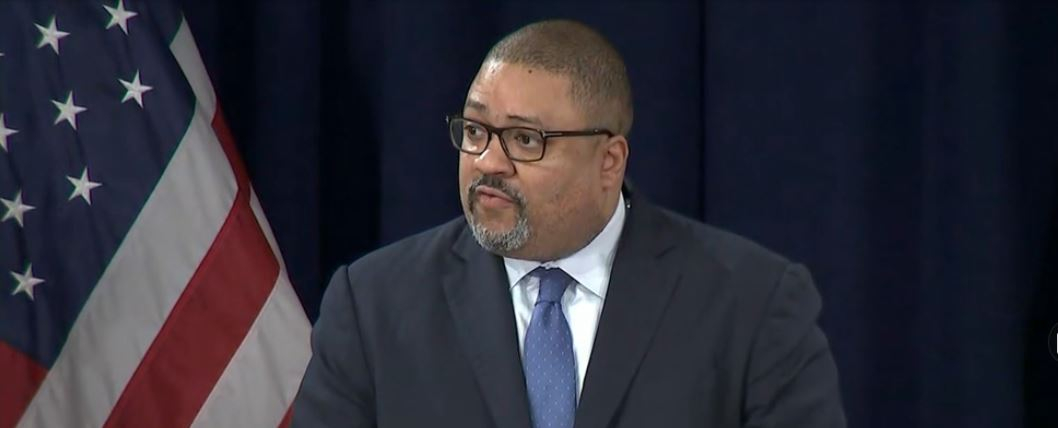
Pictured: New York County District Attorney Alvin Bragg announcing his charges against former President Donal Trump.