Today’s mantra is “We need the Federal Reserve, or the country would experience terrible economic cycles.” Really? How come countries without a central bank do just fine?
Monday, June 25, 2018 7:00 – 10:00 pm
Community Room (located behind the station building)
Richmond Police Station (between Geary Blvd. and Anza St.)
461 – 6th Avenue, San Francisco, California
Hosted by Golden Gate Liberty Revolution Meetup (fka the Ron Paul Meetup). GGLR holds its meetings on the 4th Monday of the month. Meetings are free and open to the public.
After-meeting socials are around 10:00 pm at Overtime Sports Bar & Restaurant, 4134 Geary Blvd, San Francisco.
Details contributed by lecture presenter Chris Silber:
The Federal Reserve has received renewed criticism and scrutiny in the decade since the global financial crisis. Yet the Fed has large and powerful lobbies of apologists among the mainstream press, academics, and policymakers who have argued without the Fed the U.S. banking system would return to the more frequent and disruptive financial crises of the pre-Fed era.
While it’s true that the U.S suffered from frequent banking panics throughout the 19th century, was the absence of a central bank really the cause? And if so, why then during the same period did countries like Canada and Scotland experience remarkable financial stability without a central bank? Were in fact pernicious state and federal regulations the real source of the U.S. banking system’s fragility? And if so shouldn’t Fed apologists in academia and the mainstream press know better?
Chris Silber will discuss the regulatory history of U.S. banking including the real causes of frequent financial crises during the period: restrictive unit banking laws, America’s antebellum central banks, and the post-Civil War National Banking System. The similarly unstable English and contrasting sound Canadian and Scottish systems will also be examined.
Chris Silber previously presented at GGLR Meetup lectures on monetary history, business cycles, and the Great Depression.
As the country busies itself renaming schools and other public places, removing or defacing monuments, giving new meaning to words and deeds, as well as quoting 1984, one would not be blamed to wonder what all this is about. Is the commotion an effort to right wrongs of the past, or a stealth long-range plan to force the country into a different path?
As the country busies itself renaming schools and other public places, removing or defacing monuments, giving new meaning to words and deeds, as well as quoting 1984, one would not be blamed to wonder what all this is about. Is the commotion an effort to right wrongs of the past, or a stealth long-range plan to force the country into a different path?
What does righting wrongs entail?
How far a group goes in its pursuit of righting wrongs depends on how determined the group is. For example, Joseph Stalin either killed or removed from history all folks he deemed wrong for the times.
However, efforts need not be so extreme. Persuasive discourse may take longer, but it is equally effective. A master in such art was self-professed radical activist Saul Alynski, whose Rules for Radicals, published in 1971, remains a radical’s guide to success. Here are two of the Rules:
The major premise for tactics is the development of operations that will maintain a constant pressure upon the opposition.
Pick the target, freeze it, personalize it, and polarize it.
So, today’s radicals target symbols of the Confederacy, keep relentless focus on the targets, ensure that people take the matter personally by using words such as “white supremacy,” and popularize identity politics. And the constant pressure upon the opposition allows for the expansion of targets.
Men such as Washington and Thomas Jefferson, among other founders, embedded the American ideals of equality and justice, even if they did not live them in their daily lives, the historians said. NBC News, August 17, 2017.
“Our position is, we don’t want in your public spaces any slave masters or Confederates, those are people who should not be venerated,” Suber said, citing Washington and President Andrew Jackson as figures whose statues should be removed. Malcolm Suber, Take Em Down NOLA, NBC News, August 17, 2017.
It bears assumption that if the Founding Fathers are not to be honored, neither is their work. Will there soon be a call to replace the U.S. Constitution by a new manifesto?
Human Nature is on the side of revisionists
Today’s revisionists are certainly not alone in their efforts to reframe history by removing old symbols. We have all at some low-point in our lives discarded mementos or reframed our vision of ex-spouses or rebellious children. Nature helps cleanse the mind of unpleasant thoughts. New political trends and new regimes do the same.
pixel
Constant Pressure, Forever
The problem with cleansing thought is that the job is never done. The effort can never stop.
The job of tyrants and busybodies* is never done. When they accomplish one goal, they move their agenda to something else. Walter Williams, professor of economics at George Mason University, June 14, 2017.
* Of all tyrannies, a tyranny sincerely exercised for the good of its victim may be the most oppressive. It may be better to live under robber barons than under omnipotent moral busybodies. The robber baron’s cruelty may sometimes sleep, his cupidity may at some point be satiated, but those who torment us for our own good will torment us without end for they do so with the approval of their own conscience.” C.S. Lewis, God in the Dock.
Horace Mann said schools were the great equalizers, where rich and poor would learn and prosper equally. This is a vision worth pursuing.
Parents have a lot on their plate these days, especially in expensive states like California, where stay-at-home Moms are a luxury rather than a norm. Thank goodness, there is a lot of information on the Internet on choosing schools, parenting, balancing time, etc. For example, two popular websites that rate schools from great to not so good are Great Schools and Niche.
The economic challenges parents face in costly California are compounded by another California feature: awful public schools. An article published in February 2018 in USA Today lays out the sobering statistics:
California Public Schools rank 35th among the 50 states.
High school graduation rate: 83.0% (21st lowest)
Public school spending: $9,417 per pupil (8th lowest)
8th grade NAEP proficiency: 27.1% (math) 28.4% (reading)
Adults with at least a bachelor’s degree: 32.9% (14th highest)
Adults 25-64 with incomes at or above national median: 51.7% (21st highest)
Such schools are far from being the “great equalizers” envisioned by educator Horace Mann. They are in fact unequalizeers, in their pursuit of identity politics instead of teaching reading, writing, math, and history. Are school districts focusing on finding ways to improve these schools? Read More.
California government schools not only fail to teach children to read proficiently, but also blame the children for it.
The City & County of San Francisco adequately reflects Sacramento’s inept approach to governing: tax and spend as much as possible on ineffectual projects. The City’s Board of Education operates on the same principle. Here are some quotes.
George Washington High School, in San Francisco’s Richmond District, is among the public schools in The City that bears the name of a historical figure with a questionable legacy. Photo caption. S.F. Examiner, May 14, 2018.
This discussion of changing names of public institutions and taking down public statues, particularly ones that serve to honor the Confederacy, has become more prominent across the country, especially with the rise of white supremacists who have been given implicit and explicit permission to come out in the open to display their bigotry by our so-called president. Opinion piece by by Stevon Cook and Mark Sanchez, S.F. Examiner, May 14, 2018.
The San Francisco Board of Education is at present considering a blue-ribbon panel composed of historians and other luminaries to review all San Francisco government schools that bear names declared inappropriate. For example, George Washington High School will be considered for a name change, since an old white slave owner simply does not fit into San Francisco Values.
Right about now, George Orwell is saying I told you so, and reminding us that, “Who controls the past controls the future, and who controls the present controls the past.”
Available information does not specify whether these blue-ribbon panelists will receive taxpayer-funded stipends or expense reimbursements; although the panelists will certainly place taxpayers on the hook for the considerable costs of changing the schools’ name signs, letter heads, forms, documents, websites, email addresses, and whatever else bears old names.
Distract When You Cannot Deliver
We need to place the School Board’s resolution in context. California government schools are at the bottom of the national rankings. The ability to read proficiently is a key element in an individual’s ability to lead a self-directed life. Yet only 32% of 8th grade California students read at or above proficiency level. Given such an abysmal score, why are any resources spent on changing names of schools and not on finding new and more efficient ways of teaching children to read?
The school name change effort, like the statue demolition or the focus on movements, serves the system well. While parents and voters are embroiled in discussions about how horrible George Washington was, they are not paying attention to the fact their kids can’t read proficiently.
Although parental involvement in California government schools is not outstanding, the system has succeeded in distracting parents that do get involved. For example, Brea Olinda parents have become distressed about the name of one of their schools, William E. Fanning Elementary School, saying Mr. Fanning represents a racist past. All this angst in spite of the Brea Historical Society’s curator reporting that “the case for saying Fanning was a Klan member is flimsy at best.”
Scapegoating the Poor and the Immigrants
California government school bureaucrats are quick to excuse themselves from their responsibility of delivering proper education by quoting the high percentage of lower-income and non-English speaking students in the government school system. So, are these bureaucrats saying that lower-income and non-English speakers are less able to learn than other students? If so, that is unfortunate.
The nation’s Founding Fathers encouraged awareness and learning as means of preserving the Republic. That is, a Republic depends on its residents’ ability to remain self-sufficient, so that government remains within the boundaries prescribed by its Constitution. The Founders’ vision of education was further expanded by Horace Mann, who said,
Education then, beyond all other devices of human origin, is a great equalizer of the conditions of men — the balance wheel of the social machinery.
Mann visualized the child of more affluent parents and the child of working-class parents coming into a class-blind arena, where he would be motivated to learn the skills necessary to achieve his chosen goal. Whether the child chose to be a scientist or an artisan, educators would support the child’s inclinations. Mann went as far as to say that such widespread education targeted to each child’s strength would erase poverty.
… the sufficiency, comfort, competence, of every individual, in regard to food, raiment, and shelter. And these necessaries and conveniences of life should be obtained by each individual for himself, or by each family for themselves, rather than accepted from the hand of charity, or extorted by poor-laws.
California government schools not only fail to teach children to read proficiently, but also blame the children for it. What to do?
Ella T. v. State of California
Two well-established law firms, Public Counsel and Morrison & Foerster, filed Ella T. v. State of California in Los Angeles Superior Court on December 5, 2017. The case, brought under the California Constitution, claims the right of all students to access literacy and receive schooling equal to that of other students in the State of California. The lawsuit demands that schools adopt the following:
* Evidence-based literacy instruction at the elementary and secondary level.
* A stable, supported, and appropriately trained teaching staff.
* Opportunities for parents and families to engage in students’ literacy education.
* School conditions that promote readiness for learning.
A hearing date is scheduled for later in May, 2018.
Alternative Learning
People come in different shapes, sizes, and types. Therefore, to place a group of children in a confined space and expect them to follow the space’s strict rules borders on insanity. Yet, traditional government schools do just that. However, they offer and allow some choices within the otherwise rigid setting.
* Charter Schools:
Publicly funded, but have more control over academic achievement and school management than traditional government schools.
* Homeschooling:
California allows for ways that parents can teach their children at home: through an existing private school, through a public charter or independent study program, and in many instances by opening their own private home based school.
* Language Immersion:
Designed for children whose primary language is English, these schools teach all or most subjects in another language.
* Magnet Schools:
Specialize in specific subjects, such as art or science, and children need to prove their inclination towards those subjects.
* Public Montessori
Associated with the American Montessori Society, these schools follow the Montessori “child-centric” method, which assumes all children are curious and will learn if their curiosity is property encouraged.
Kids Cannot Fight on Their Own
Little kids learning the basics of reading, writing, and math cannot fight for their rights to be taught by competent and caring educators. Kids need grownups in their lives to fight for them. Not an easy feat when parents must work two jobs to make ends meet, or one parent is the sole breadwinner. Being involved is a difficult but crucial balancing act.
This book report by a 3rd grader is part of the Exhibits in the Ella T v. California law suit.
Has the constant talk of diversity integrated our schools, or equalized pay, or flooded Silicon Valley with high-level coders of both genders equally?
In the old days employers asked employees to keep job description manuals, so new employees and others in the office or shop could better understand how a task was performed or how a widget was made. Today employers focus on diversity and social justice manuals. Should this shift of emphasis from production and performance to personnel be included in statistics measuring GDP, national debt as percentage of GDP, balance of trade, decline of manufacturing, rise of an unskilled workforce, automation? Has the constant talk of diversity integrated our schools, or equalized pay, or flooded Silicon Valley with high-level coders of both genders equally?
If the response is “not really” then our doubling down on the diversity reasoning is innocently stupid, immensely hopeful, or intentionally evil. The quest for diversity permeates housing, employment and education. Although there is much to say on housing and employment, let’s start with this article on education, specifically school choice in New York City.
Our analysis shows that the expansion of school choice in New York City in the past 10 years has, indeed, allowed thousands of children to leave low-performing schools for higher-performing schools, often outside their neighborhoods. But it has also resulted in higher concentrations of poverty and shrinking enrollments and budgets in the schools they leave behind, making it ever harder for those schools to serve their neighborhoods well.
The logic of choice can be used for segregation or integration. But in either case, it puts the onus on individual parents to find good schools for their children, rather than on society as a whole to provide for the education of all children. Correcting the disparities across the school system as a whole and providing equitable educational opportunity to all families should be a collective effort by all members of the community with strong central leadership from City Hall and the Department of Education.
A reasonable person should ask what is wrong with parents taking responsibility for finding good schools for their children. The legion of lower-income parents enrolling their kids in charter schools might wonder why any parent would not move their children out of poor-performing schools. True, newly arrived immigrants, speaking little or no English, would have a harder time navigating through the complex school-enrollment system; but hopefully these families anticipate such difficulties, persist, and eventually prevail.
Embedded in the lament for the consequences of school choice is the pervasive emphasis on diversity and government’s duty to ensure equity and social justice. Such focus obscures the success of parents and children who opt for production – performance, individual responsibility, effort, and hard work. There are such parents at all income levels and of all colors.
Who Leaves and Who Stays
The Paradox of School Choice discusses what families stay in their zoned school, and which do not. 60% of families in gentrifying neighborhoods choose kindergarten outside of their school zones, compared with 32% in higher-income neighborhoods (where schools tend to be higher-performing), and 35% in non-gentrifying poorer neighborhoods. Although 60% is significant, 35% of poorer families that, in spite of economic challenges, choose higher-performing schools outside their neighborhoods is impressive.
The study also offers a chart that further illustrates who left their zoned schools behind, and who stayed between 2007 and 2016. Colors from bottom represent children who attended schools that were: in their zone, in a different zone, had gifted children programs, had dual-language programs, were unzoned, were charter.
The ideal situation would indeed be a system that did not exhibit disparities in quality between schools. However, significant disparities are an unfortunate reality that school officials have not corrected. Therefore a growing number of parents are no longer waiting for someone to act on their children’s behalf, but are taking action themselves. Their choices indicate what is important to them: high-performing schools that exhibit good test scores.
Who benefits from the Federal Reserve? Would the banking elite that created the Fed worry about your well being?
Recommended Book: Creature from Jekyll Island
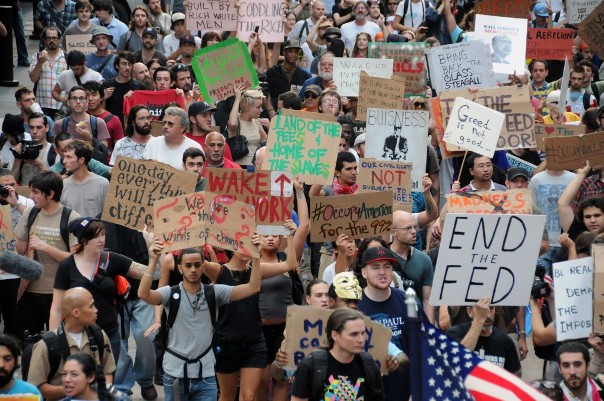
G. Edward Griffin wrote Creature from Jekyll Island in 1994. This 600-page book is now on its 5th printing, on Amazon, and all hard-core liberty-minded folks quote from it. It is not an easy read, but a project for maybe several months. However, because it reads like a thriller, you will be enthralled enough for how long it takes. By the end of the book, you should have a clearer idea why some people go around carrying signs at rallies reading “END THE FED!” You will know where the money to finance the U.S. endless wars comes from, and you will know how we have gone from a nation of pioneers to a nation of supplicants.
Not a Horror Movie – Just Real Life
Ask a random number of people where or what is Jekyll Island, and most will respond with some association to Dr. Jekyll and Mr. Hyde. Most will be surprised that Jekyll Island is a very real, beautiful state-owned park off the coast of Georgia, managed and conserved by the Jekyll Island Authority, a self-supported state agency funded by the island’s leases, fees, and amenity operations. It acquired its name in 1733, when British colonial leader General James Edward Oglethorpe named the island in honor of Sir Joseph Jekyll, a financial backer of the colony of Georgia.
Jekyll Island went through several iterations and owners. However, the owner that interests us here is Christophe Poulain DuBignon, who consolidated his ownership of the island in 1794. He and his descendents owned the island from 1794 until 1886. John Eugene DuBignon, together with his brother in law Newton Finney, got the ball rolling in our story when they turned Jekyll Island into a private hunting club. Finney had contacts in New York among the monied social elite, and the likes of J.P. Morgan, Joseph Pulitzer, and William K. Vanderbilt invested in the new club. In 1886 Eugene DuBignon sold the club to the Jekyll Island Club Corporation.
They Did Not Go Duck Hunting
The plot thickens when in November 1910, Senator Nelson Aldrich from Rhode Island gathered some banking and finance folks — among them representatives from the U.S. Treasury, J.P. Morgan & Co., National City Bank, and Kuhn, Loeb & Co. – to go duck hunting at the Jekyll Island Club. Apparently, they did not hunt any ducks, but instead, under a cloak of great mystery that was not revealed until the 1930s, they wrote a plan to reform the nation’s banking system. Thus the Federal Reserve Bank was born.
The fact that the Federal Reserve was born on Jekyll Island backed by the cream of the banking elite, it enables a debt-based economy, and it finances wars is freely acknowledged even by the Federal Reserve. However, saying for instance that the Federal Reserve worked closely with the U.S. Treasury to sell Liberty Bonds to help the War Effort is different than saying the Fed enables eternal wars for oil and Wall Street. Therefore, The Creature from Jekyll Island is often relegated to conspiracy theory for stating the latter.
The banking elite did not really go duck hunting in November of 1910. What did they really do and why? What would be the purpose of a central bank in 1910, or in 1791? What track record of predecessor U.S. central banks was the banking elite considering in 1910? How do the writings of other people affirm what G. Edward Griffin said in Creature from Jekyll Island?
Bankers Reforming Banking
Observe that at Jekyll Island, bankers wrote the plan to reform banking. Since presumably these bankers were human, we need to assume their native instincts prompted them to benefit banks. In his 2012 article Who Benefits From The Federal Reserve Charles Hugh Smith asks “Cui bono–to whose benefit?” He then lists what the Federal Reserve does or enables others to do. Here is a summary list:
* Setting of interest rates at zero or near zero – Allows banks and other already powerful financial institutions to borrow great quantities of money. With this money such institutions concentrate their wealth and ensure their perpetuity by buying up competitors and becoming too big to fail. The high debt to equity ratio pushes earnings towards debt servicing, and away from productive investments, innovation and workers’ benefits.
* Accepting ever-expanding debt leveraged by questionable collateral – Normalizes junk financial tools such as derivatives and sub-prime mortgages. The proliferation of such financial tools spreads debt and leveraging throughout the economy. Households learn to survive on debt generated by mortgages and credit cards. Students and their parents become dependent on student loans that can limit the financial and emotional well being of young people for a long time.
* Supporting an inefficient and exploitative banking system – The Federal Reserve is sold to the general public as protection against economic panic caused by bank failures. Businesses fail when they are mismanaged by inept or bad-intentioned handlers. Banks are no exception. However, they have learned that if they are big enough and powerful enough they can behave as they please, since the Federal Reserve and the FDIC will be there to bail them out when they behave exceptionally poorly.
Predecessor Financiers
* The Fist Bank of the United States
The Bank of the United States, a national bank promoted by then Secretary of the Treasury Alexander Hamilton, was established by Congress in 1791. The bank was authorized to operate across state borders, and was intended to foster economic growth. It collect revenue, lent money to the U.S. Treasury, sold bonds to investors, and it helped to pay off the huge national debt created by the Revolutionary War. However, Thomas Jefferson and his followers viewed this central bank, as well as all other indication of federal expansion, with extreme distaste; they succeeded in causing the closure of the bank after 20 years of its operation.
* The Second Bank of the United States
Debt mounted again as a result of the War of 1812, but this time, Congress knew of a quick fix, and charted the Second Bank of the United States in 1817. To the dismay of central banking advocates, President Andrew Jackson, a foe of central banks which he viewed as benefitting Northern industry to the detriment of Southern agriculture, vetoed the re-chartering of the Second Bank of the United States in 1836.
Interestingly, central banking advocates blame a shortage of gold and silver currency and the ensuing economic panic of 1837 on Jackson’s elimination of the Second Bank of the United States. Why was there a shortage of hard money? Because the Second Bank of the United States encouraged debt instead of gold and silver.
Bottom Line: How are you better off with today’s central bank?
Widely distributed prosperity for the citizenry results from increases in real income that flow from productive investments and higher productivity that’s passed on to workers. The Fed’s model of “prosperity” is to enrich the banks and incentivize workers to take on more debt to boost their consumption and their purchase of phantom assets in stock bubbles, housing bubbles, etc. Who Benefits From the Federal Reserve? by Charles Hugh Smith, September 2012.
How many members of your household need to work outside the home to make ends meet? If you own a home, how are you managing repaying your mortgage? We send you our heartfelt wishes that you do not depend on your credit cards to pay your rent.
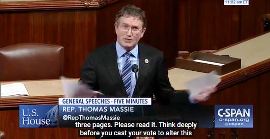
House Representative Thomas Massie said the Balanced Budget Amendment proposal was the definition of “audacity.” “It’s got a loophole you can drive a truck through.” The provision to which Representative Massie refers says that if 60% of both the House and Senate vote to waive the amendment, they can pass an unbalanced budget. The 2018 unbalanced budget passed by 60% in the House and by 65% in the Senate. Tell us how a BBA would have prevented the 2018 $1 billion increase to the U.S. budget.
Following up on the Just Vote No Blog previous articles on profligate spending by the U.S. Congress, and on the “solution” of a Balanced Budget Amendment, here is an update.
On March 23, 2018, Congress passed the “Omnibus Bill,” a budget plan to allow the federal government to continue “functioning” until September 30, 2018. The bill totals $1.3 trillion, and adds about $1 trillion to the already gargantuan U.S. budget of around $4 trillion. How could the cost of running the country increase by $1.3 trillion? Easy. Legislators need to say they “did something” about everything that happened during the previous year, so they provide for a myriad of new funding. Roughly, the 2018 budget calls for $695 billion in defense spending and $591 billion in non-defense spending. Here are a few highlights of the 2,232-page bill:
* School shootings: $2.3 billion in new funding for mental health, training, and school safety programs at the Departments of Justice, Education, and Health and Human Services.
* People overdosing from opiods: $4 billion in treatment, prevention, and law enforcement efforts.
* Potholes: $21 billion for infrastructure projects across the country, including transportation, energy, water, and “cyber.”
* Porous borders: $47.8 billion for the Department of Homeland Security to bolster border infrastructure, add more “boots on the ground,” increase detention space, and improve surveillance technology.
* Waning hegemony: $654.6 billion in both base and Global War on Terror/Overseas Contingency Operations funding.
“The Definition of Audacity”
Surely it is known to all members of Congress that a constantly growing national debt now standing at around $21 trillion is not sustainable. Surely they know that at some point voters might catch on that the Ponzi Scheme could cause the nation’s economic collapse. Therefore, after voting for yet more spending by passing the Omnibus Bill, legislators felt they must “do something.” Four days after House Representative Robert W. Goodlette voted “Yes” on the Omnibus Bill, he introduced the Balanced Budget Amendment (BBA).
House Representative Thomas Massie (R-Ky) said the BBA proposal was the definition of “audacity.” “It’s got a loophole you can drive a truck through.” The provision to which Representative Massie refers says that if three-fifths (60%) of both the House and Senate vote to waive the amendment, they can pass an unbalanced budget. Well, the 2018 unbalanced budget was passed by 60% of House members and 65% of Senate members. Tell us how a BBA would have prevented the 2018 $1 billion increase to the U.S. budget.
Thankfully, the BBA was too audacious even for Congress members, and it was voted down.
Are State Legislators So Different?
State legislators claim U.S. legislators need to be reigned in because they are growing the federal government and spending too much. Therefore, they also need to do something: A Convention of States under Article V of the U.S. Constitution to propose a balanced budget amendment among other things.
Do you trust your state’s proposal to amend the Constitution of the United States any more than you should trust the U.S. Congress’ “definition of audacity?”
Today’s federal debt is around $21 trillion, $64,724 for every man, woman, and child in the U.S., and growing every second.
Today’s U.S. federal debt is around $21 trillion, $64,724 for every man, woman, and child in the country., and growing every second. So, who cares, you say, as long as domestic production is so wonderful. That is what the experts tell you. What they don’t tell you is that you are paying for that debt in one way or another, by way of taxes, foregone services, or risk. Also they don’t tell you that at some point the folks who have been lending the U.S. all that money will get spooked at the size of the debt and bail out.
How did we get to owe $21 trillion to individuals, foreign countries, and even our own Federal Reserve Bank? Because we elect our representatives based on the largess they promise to deliver. We make sure we get subsidized healthcare, education, housing, food, childcare. We want security.
Trends in Spending and Deficits
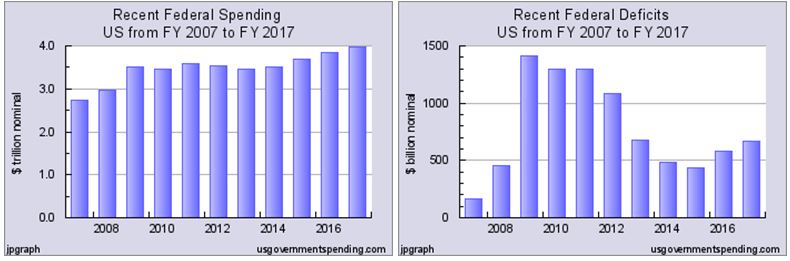
* The Congressional Budget Office says that in 2016, the federal government took in $3.3 trillion in revenues, and spent $3.9 trillion. The difference between revenues and expenditures is the federal deficit.
When job pays you less than you spend, you borrow from credit card companies, banks, credit unions, family, or friends. The federal government does the same thing – it borrows when it spends more than it earns. Here is a picture of the federal steadily-growing debt 2007 – 2017, showing debt in December 2017 at $21 trillion.
There are two main debt categories: Intra-government holdings (in 2017, this was $5.6 trillion borrowed from 230 government agencies; $2.801 trillion of which borrowed from Social Security), and debt held by the public (in 2017, $14.7 trillion borrowed from foreign countries, the Federal Reserve, mutual funds, state and local governments pension funds, private pension funds, banks, insurance companies, the general public, and other entities).
If the U.S. finds it owes so much money, and has to pay so much interest that there is little money left for any federal operations at all, then the country will have to either stop spending, raise taxes to astronomical levels, or default. If default had happened in 2017, guess who would be left holding the biggest bag? Look at foreign vs. domestic debt:
Foreign borrowers lent the U.S. federal government $6.004 trillion. Domestic borrowers, mostly folks contributing or receiving retirement money, lent $8.696 trillion.
How about the “Debt doesn’t matter” Argument?
Experts like Paul Krugman and Robert Reich used to tell us that debt does not matter since GDP made the country grow, debt or no debt. However, they seem to be clarifying their stance these days.
“Today’s debt is about 77 percent of our total national product. The reason it’s a problem is it’s growing faster than the economy is growing, so it’s on the way to becoming larger and larger in proportion.” Robert Reich
“What changes once we’re close to full employment? Basically, government borrowing once again competes with the private sector for a limited amount of money. This means that deficit spending no longer provides much if any economic boost, because it drives up interest rates and “crowds out” private investment.” Paul Krugman
It is difficult to tell whether these two gentlemen, champions of progressive politics, suddenly saw the light or they saw a Republican administration in Washington DC.
The U.S. debt-to-GDP ratio on December 29, 2017, was 104%: $20.493 trillion debt divided by $19.739 trillion GDP.
We could print more dollars to keep up with the debt and hope our creditors don’t mind their increasingly worthless investment. We could hope we will be dead by the time the Ponzi scheme collapses. Alternatively, we could bite the bullet and start fixing the mess by cutting spending and not giving tax cuts to billionaires.
We could start the spending cuts by bring our defense spending in line with everybody else in the world.
Certain ideas so defy logic that it is difficult to determine whether proponents aim to make suckers out of the unsuspecting or are being made suckers themselves. Such is the case with the currently proposed Article V Convention. Proponents either intentionally or credulously are placing the very nature of our Republic in peril. Therefore, as W.C. Fields would ask, why give suckers an even break?
Certain ideas so defy logic that it is difficult to determine whether proponents aim to make suckers out of the unsuspecting or are being made suckers themselves. Such is the case with the currently proposed Article V Convention, under which states would gather to propose amendments to the U.S. Constitution. Proponents either intentionally or credulously are placing the very nature of our Republic in peril. Therefore, as W.C. Fields would ask, why give suckers an even break?
What is an Article V Convention?
The Founding Fathers built into the U.S. Constitution many protections against federal government overreach. One such protection is Article V, which says,
The Congress, whenever two thirds of both houses shall deem it necessary, shall propose amendments to this Constitution, or, on the application of the legislatures of two thirds of the several states, shall call a convention for proposing amendments, which, in either case, shall be valid to all intents and purposes, as part of this Constitution, when ratified by the legislatures of three fourths of the several states, or by conventions in three fourths thereof, as the one or the other mode of ratification may be proposed by the Congress; provided that no amendment which may be made prior to the year one thousand eight hundred and eight shall in any manner affect the first and fourth clauses in the ninth section of the first article; and that no state, without its consent, shall be deprived of its equal suffrage in the Senate.
Under this Article, states, with or without Congress’ consensus, can call a convention of states to propose amendments to the Constitution. Once such amendments are ratified by the legislatures or by conventions of three fourths of the states, the amendments become part of the constitution.
Who is interested in Article V these days?
* There are currently 28 states with active applications for an Article V Convention. Eight applications were submitted in 2017, and eight in 2016. Twelve were submitted in prior years.
* Most applications so far call for a balanced budget, restraining of the federal government, and overturning of the U.S. Supreme Court Decision on Citizens United vs. Federal Elections Commission. Conservative states support the first two subjects, and progressive states the third. Within both factions, there is opposition. Conservative Eagle Forum and liberal Common Cause have expressed deep concerns.
* Article V only says that Congress must call a convention when a certain number of states apply, and proposed amendments become part of the Constitution once a certain number of states ratify. Details, whether they abide by the intentions of the Founders or not, are left to the states. Where does it say the convention needs to be limited to a specific subject? Interestingly, applications are somewhat vague. Reining in the federal government could mean anything. It could mean getting rid of the 2nd Amendment or of Roe vs Wade. For example, Hawaii’s application only requests Congress to “convene a limited national convention under article V for the exclusive purpose of proposing an amendment to the United States Constitution that will limit the influence of money in our electoral process.” Any money? A certain amount of money indexed for inflation?
* The U.S. National Debt is around $20 trillion. Debt to Gross National Product is 104%, and the tipping point (when a country is in peril of default) is 77% according to the World Bank. Pretty soon we will all be working and paying taxes just to pay interest on the debt. So, yes, a balanced budget amendment would be great – if folks at the convention agreed to cut the military budget, Social Security, Medicare, and other major federal entitlements and expenditures in half, and double the taxation rate, either all at once or over the next 15 years.
Then there is the ratification process. Red state legislators would be thrown out of office if they touched any entitlements or perhaps came back without “clarifying” the 2nd Amendment. Blue states legislators would have to find new jobs if they expected significant cuts to the military or to Social Security.
How about the manner in which the ratification process would take place? Where is the requirement that ratification needs to be by one state one vote, as proponents claim?
The Alternatives
If states are truly concerned about federal fiscal mismanagement, they could incentivize candidates for federal office from their state to come to Washington prepared to cut spending significantly or lose their state’s support. They could encourage voters within their state to elect or re-elect only candidates who truly desire a balanced federal budget. If states are truly concerned about Citizens United vs. the FEC they could simply limit campaign contributions across the board within their states, including contributions from unions.
If none of these alternatives are happening now, why would we be made to believe they would miraculously happen in the context of an Article V Convention? Defies logic.
California is an epicenter of identity politics, adept at promoting crisis after crisis to foment identity wars. The current crisis is housing, the current war is NIMBY vs. YIMBY, and the featured promoter is Senator Scott Wiener armed with his Senate Bill 827.
Never let a crisis go to waste. And if there is no crisis, start one. When fomenting a crisis, it helps to encourage group identification, then to pit one group against another. This has been the modus operandi of political leaders going all the way back to Philip II, whose maxim “divide and conquer” served him well in transforming self-governing city states into one big Macedonian kingdom.
The latest California crisis (besides the coastal progressives’ obsession with “resisting” something or other in Washington DC they are not supposed to like) is housing, and the latest division is between NIMBYs and YIMBYs.
The Not In My Backyard faction identifies with older residents who like the way things are in their neighborhood. They like their neighborhood’s “character,” they own or hope someday to own a single-family home with a backyard, they prefer not to take public transit, and they fiercely defend their turf from outsiders who feel entitled to change it. Bastions of NIMBYism, such as the Bay Area’s Marin County and San Francisco’s Westside, have traditionally used city and county zoning to preserve their neighborhoods.
The current California YIMBY movement goes back only to 2014, with the founding of BARF, Bay Area Renters’ Federation, by a charming and articulate former math teacher by the name of Sonja Trauss. In a 2015 article, What’s Your Housing Utopia, Sonja states her case unequivocally,
I want the market to provide a unit I can afford… I want to consume housing the way I consume all other products: Buy used, old or out of fashion, buy scratched and dented, buy odd lots, split the cost with friends… How do we get market rate housing for all markets? Step One: End the shortage. If we need 100,000 units, we have a lot of work ahead of us. If you’re involved in opposing a new housing project, stop, just stop. Our need for housing at all price levels far outstrips our supply at any level. Are you preoccupied with whether the new units “match” the rest of the neighborhood? Matching is for your belt and your shoes. Housing supply is a serious problem. If you’re sentimental about the past, swallow your tears.”
Then there is SPUR, San Francisco Bay Area Planning and Urban Research Association, renamed from San Francisco Planning and Urban Renewal Association in 1977, after the razing in the 1960s of San Francisco’s Fillmore District in the name of “urban renewal.” Gabriel Metcalf, president and CEO of SPUR, elevates the NIMBY/YIMBY war to the level of opposing views on private property – homes as property purchased and owned by someone vs. homes as infrastructure provided to all regardless of means.
I think there are more people understanding housing as a social-justice issue. While they might not like their communities changing with higher-density buildings, more people understand that they are necessary to live up to our values as progressives.
A recent article in the neighborhood newspaper, The Westside Observer reports on a community meeting discussion on California Senate Bill 827, which would mandate construction of buildings up to eight stories high along all transportation routes – bus routes as well as fixed rail – regardless of local zoning or neighborhood character.
What had started out as a community meeting slowly became a referendum on the land value of homes and apartments that younger generations would like to take away from older generations — right now!
The war, yet another identity-politics war, is on. Absent politicians never letting a crisis resolve itself peacefully, NIMBYs and YIMBYs, in spite of their vastly different outlook and needs, might have worked things out. However, that is not to be.
If we understand what is going on, we can choose our political leaders and our legislation with an eye to rejecting continuing crises provoked by identity wars. We can choose instead peacemakers who can encourage local solutions and compromises that offer remedies to challenges.


 The economic challenges parents face in costly California are compounded by another California feature: awful public schools. An article published in February 2018 in USA Today lays out the sobering statistics:

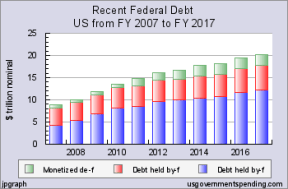 When job pays you less than you spend, you borrow from credit card companies, banks, credit unions, family, or friends. The federal government does the same thing – it borrows when it spends more than it earns. Here is a picture of the federal steadily-growing debt 2007 – 2017, showing debt in December 2017 at $21 trillion.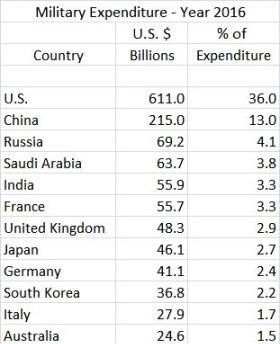
 Certain ideas so defy logic that it is difficult to determine whether proponents aim to make suckers out of the unsuspecting or are being made suckers themselves. Such is the case with the currently proposed Article V Convention, under which states would gather to propose amendments to the U.S. Constitution. Proponents either intentionally or credulously are placing the very nature of our Republic in peril. Therefore, as W.C. Fields would ask, why give suckers an even break?
 Never let a crisis go to waste. And if there is no crisis, start one. When fomenting a crisis, it helps to encourage group identification, then to pit one group against another. This has been the modus operandi of political leaders going all the way back to Philip II, whose maxim “divide and conquer” served him well in transforming self-governing city states into one big Macedonian kingdom.
 Just Vote No