The Just Vote No Blog recommends an article on California Political News and Views: “Proposition 13 News – Split-Roll Proposal, Again.” If voters are to vote wisely, they need to acquaint themselves with the opposing views inherent in all proposals.
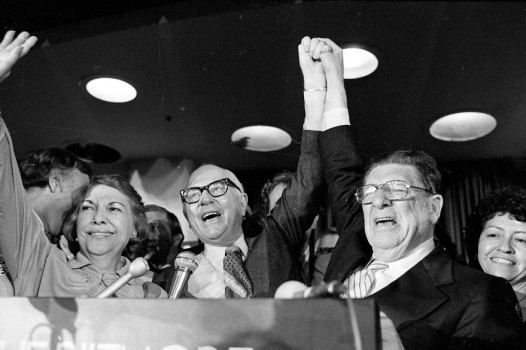
Howard Jarvis, Paul Gann and supporters celebrate the victory of Proposition 13 in 1978.
Proposition 13, overwhelmingly approved by voters in 1978, turned out to be not a mere voters’ initiative, but a cultural symbol defended by some and despised by others.
By placing a property tax cap on certain properties, Proposition 13 significantly reduced sources of revenue for a state that considers taxes lifeblood itself.
Never mind that the state devised a myriad other sources of revenue, and today stands #11 out of 50 in level of taxation – the focus remains on the loss of property taxes resulting from Proposition 13. Never mind that a 1976 court decision removed fiscal responsibility from school districts – the narrative remains that Proposition 13 destroyed local control of schools.
Because Proposition 13 enjoys some fierce defenders, the opposition has settled for incremental jabs rather than outright repeal. A significant blow will be attempted in the November 2020 election. The proposal would leave the cap on residences but remove it from commercial and industrial buildings in what has been called split-roll property tax assessment.
The California teachers’ union and others who view Proposition 13 as abhorrent are building a campaign war chest to support the 2020 proposal. Their narrative remains as it was in 1978.
The Just Vote No Blog recommends an article on California Political News and Views that provides a different narrative – Proposition 13 News: Split-Roll Proposal, Again.
If voters are to vote wisely, they need to acquaint themselves with the opposing views inherent in all proposals.
More articles are appearing on the Internet pointing to the relationships between homelessness, dug abuse, and permissive policies. But is anyone paying attention?
Today’s guiding principles in the purported War on Homelessness are remarkably similar to those of the War on Poverty and the War on Drugs. Unsurprisingly, the result of all three responses to challenges is the same – homelessness, poverty and drug use flourished.
When a significant number of people stand to benefit from “fighting” a particular challenge, that challenge will grow. Think of the army of bureaucrats employed by the countless government agencies and government-enabled non-profits that make up these three Wars. They need their jobs to feed their families just like the rest of us.
So, they develop policies divorced from realities. The War on Poverty ignores the fact that people respond to free services by decreasing remunerative efforts that once enabled them to pay for those services. The War on Drugs ignores the insidiousness of the underground market. Today’s War on Homelessness, especially in populous progressive cities like San Francisco, ignores the principal reason for homelessness.
As the article posted on the Just Vote No Blog a few weeks ago, Homelessness: Is Housing the Problem?pointed out, most of today’s homelessness is a product of drug abuse, not a product of lack of affordable housing.
An informative website, The City Journal, in its Autumn 2019 publication carried an article by Heather Mac Donald entitled, San Francisco, Hostage to the Homeless. The Just Vote No Blog recommends this article. Although Ms. Mac Donald’s suggested solution could be interpreted to mean it’s a good thing for cities that act irresponsibly to spread their costs regionally, she reports in excellent details what the homeless interviewed on the streets are saying. They readily admit that “Everyone is on drugs here.”
An inadequate supply of affordable housing is not the first thing that comes to mind when conversing with San Francisco’s street denizens. Their behavioral problems—above all, addiction and mental illness—are too obvious.
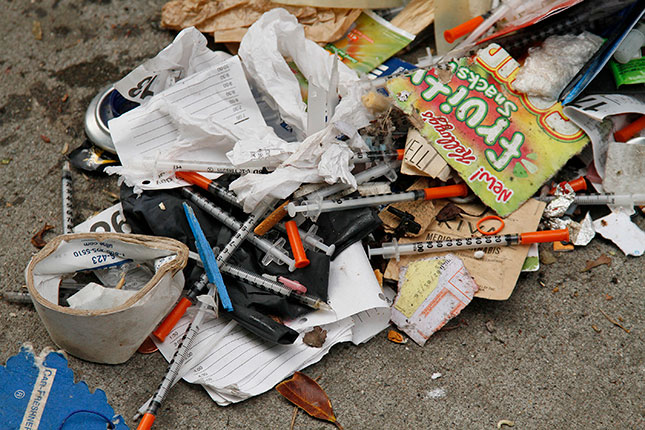
Yet, as Ms. Mac Donald points out, the City continues to spend millions of taxpayers’ cash on condoning and normalizing drug use. San Francisco supplies thousands of free injection needles that are openly used in vast homeless encampments. Police are discouraged from interfering with drug sales visible to all passersby. Taxpayers are saddled with funding Poop Patrols the sole function of which is scooping human feces from sidewalks.
This scenario, although painfully entrenched in San Francisco, is supported in many other cities in the U.S. and abroad. The enabling policies are advocated by the principle of “harm reduction,” a strategy largely funded by George Soro’s Open Society Foundations. “Harm reduction” in this case applies to those addicted to drugs, not to the sober.
As long as “compassion” dictates everyone live under such conditions, and as long as speech and thought enforcers are at the ready with invectives as soon as anyone objects, the homeless, in the midst of their own misery, will continue to hold cities like San Francisco hostage.
Dinesh d’Souza shared political guerrilla warfare strategies with a packed audience of fellow conservatives, in San Francisco.
Few if any in the in the U.S. conservative movement are unaware of Dinesh d’Souza, so he packs rooms wherever he speaks. On September 26, Mr. d’Souza was the keynote speaker at the San Francisco Lincoln-Reagan Dinner, a traditional annual fund raising event held by Republican Party operatives throughout the U.S.
Now, let this sink in: a large room full of clapping and cheering fans of a radical conservative, in San Francisco. The picture was sufficiently remarkable to prompt this Just Vote No editorial report of the event (by a non-Republican with long-time friends in both the Left and the Right).
The San Francisco Republican Party, as a rule a rather staid group, was energized enough to add the following to their announcement of the event:
Warning: No Safe Spaces Provided. A Limited Supply of Pacifiers Available for Democrat Attendees.
Mr. d’Souza was introduced at the event by a fellow fighter, and former Chair of the Republican Party of California, Harmeet Dhillon. John Dennis, current Chair of the San Francisco Republican Party and perennial Nancy Pelosi opposition candidate, opened the event. Note: John Dennis has fans not only in Republican circles but in the Libertarian community as well.
Fighting Fire With Fire
Appropriately, the subject of Dinesh d’Souza’s talk at this event was how conservatives can regain ground totally lost to liberals over the last 30 or so years. His prescription is simple: fight fire with fire. Grassroots liberals are masters of political guerrilla warfare. They are brilliant at re-framing any statement or event to fit the liberal agenda. Not so conservatives, according to Mr. d’Souza, who are too engaged in being proper and demure ladies and gentlemen.
The point of the talk was that we no longer live in a politically civil world. Today, one cannot possibly imagine a relationship such as that of Republican President Ronald Reagan and Democrat Speaker of the House Tip O’Neill, bitter political opponents who cooperated in leading the nation through a period of significant prosperity. At this juncture one cannot hope to go back to civility by simply acting civilly. The only effective conservative response is political guerrilla warfare.
Mr. d’Souza walks his talk, and for that he was convicted in 2014 for campaign finance fraud and sentenced to eight months in a community detention center and five years of probation. He had pleaded guilty after his pretrial motion to dismiss the indictment for selective prosecution was denied. Well, President Donald Trump did feel there was selective prosecution, so he pardoned Dinesh d’Souza in 2018, thus returning a firebrand conservative to the political arena. Mr. d’Souza gave as examples of fighting fire with fire his finagling donations to a political candidate exceeding legal limits and Mr. Trump’s pardon of his conviction.
Rules for Radicals
* The first rule appears to be to understand what is going on. For example, if conservatives keep saying, “Look at Venezuela!!” and Bernie Sanders keeps saying, “No, look at Denmark,” conservatives are missing the point.
Dinesh d’Souza feels that Bernie Sanders knows full well that there is no comparison between the culture, traditions, and tax structure of the U.S. vs. the Scandinavian countries, but he is counting on his voter base not knowing. A Sanders supporter with $76,000 in equivalent annual wages would soon be an ex-Sanders supporter if he understood that in Denmark he would be in a 56% tax bracket. Indeed, it is easy to vote for socialist candidates when one is under the impression that the other guy is going to pay for socialism!
* The next rule is to organize. Look for people who are distressed about the same things that distress you. High taxes? Lower-wage liberals as well as conservatives might feel distressed about all the taxes taken out of their paychecks.
Find out and bring them into the discussion with higher-income property owners unhappy with property taxes.
* Third rule: hit back – twice as hard. The effort of hitting back will also be twice as difficult. Conservatives stood back politely while liberals took over the press, entertainment, academia and social media. Now if conservatives wish to fight back, they will have to do it without the assistance of those entities.
Universal Rules for Winning
Dinesh d’Souza’s talk at the San Francisco 2019 Lincoln-Reagan Dinner was aimed at conservatives. However, remedies he suggested are simply universal rules for winning any political fight fought by any faction in the political spectrum in today’s political arenas. Using those rules expertly also enters into the prescription. A badly botched battle is more damaging to the success of a war than no battle at all.
The Just Vote No Blog is non-partisan. This event happened to be a Republican dinner during which a pretty good speaker gave some credible pointers on what it takes in today’s political landscape to gain ground.
Readers who are dedicated liberals might prefer to read the Just Vote No Blog article Antonio Gramsci: The New Hegemonyon how to successfully bring about a socialist state.
The United Nations mostly called for action from governments and corporations. They should have asked who they were leaving out!
The last few days have been significant for those who have been watching the development of the climate change movement.
The Children’s Marches
The September 20th children’s Climate Action marches throughout the world were a model of effective organizing. The chosen face of the children’s demand for action, 16-year-old Greta Thunberg, performed admirably in event after event.
UN Climate Action Summit
In New York City, the United Nations Climate Action Summit 2019 on September 23rd was a wonder to behold. World leaders meticulously selected for their commitment to fighting climate change reported on their country’s progress in implementing the mandates of the Paris Agreement.
Greta Thunberg’s presentation before the heads of state made headlines. The teen environmental activist strongly rebuked the grownups for thrashing the Planet and leaving a mess that will shorten or effectively end lives in her generation and that of her progeny. Ms. Thunberg spoke of the abject fear the “existential crisis” of climate change has wrought upon today’s youth.
Mr. Antonio Guterres, current UN Secretary General and former Socialist Party Prime Minister of Portugal, echoed the children’s concern. His young granddaughters, he said, would not inherit a hospitable Planet unless we fixed our destruction through the collective action and distribution of resources prescribed in the Paris Agreement.
Some Reminders
Yes, our Planet has been warming. And yes, just as ice floating in the surface of your sangria melts faster in hot weather, so does Polar ice floating in the oceans. The meltdown might even eventually return the Poles to their ice-free condition during the time of the dinosaurs. Ocean-front cities will be the first to go.
However, if industrialization contributed to a current natural warming, perhaps we can delay the inevitable through some lifestyle changes.
We could use some lifestyle changes anyway to clean up our air and quit dumping non-biodegradable garbage everywhere.
The 74th Session of the U.N. General Assembly
Leaders of the United Nations member states met in New York City on September 24th for the 74th Session of the UN General Assembly and Debate. All presentations are available for watching on YouTube or the UN WebTV.
In his opening presentation, UN Secretary General Guterres once again insisted on the end of talk and the start of evidence of prescribed action under the Paris Agreement. He views the Agreement as a social and moral contract that signatories need to honor if we are to avoid climate catastrophe. The Agreement principally calls for a drastic world-wide reduction in CO2 through phasing out of fossil fuels.
By contrast, recently elected Brazilian President Jair Bolsonaro , clearly and forcefully indicated to the assembled dignitaries that Brazil is a sovereign nation that has demonstrated in words and actions that it is committed to environmental protection that is specifically adapted to the country’s own characteristics. President Bolsonaro took the opportunity to indicate his distaste for widespread media fallacies, political correctness that replaces reality, and socialist ideology that routinely leaves a “trail of misery.” Socialism is working in Venezuela, he said – everybody is now poor.
Compliant leaders like Emmanuel Macron of France, Angela Merkel of Germany, and Sebastian Pinera of Chile did report their progress in implementing climate fighting mandates contained in the Paris Agreement.
In a show of inclusiveness, organizers of the 2019 UN Session invited the input of entrepreneurs who could contribute to the climate fight through technology and customer reach. Entrepreneurs spoke of devises farmers in poor countries can use to predict the approach of threatening weather conditions. Representatives of Google, Microsoft, Ubisoft and other gaming companies reported on their success in reducing the energy consumption of their games and data storage, and including ideas on Planet protection in the theme of their games.
Who Did the UN Leave Out?
The United Nations mostly called for action from governments and corporations. They should have asked who they were leaving out! The Summit left out people – buyers, consumers, trend setters, and boycotters.
Consumer distaste wiped the Ford Company’s Edsel and the New Coke off the market within a short time of the products’ introduction. Conversely, The Blair Witch Project was a 1999 movie produced for $60,000 that grossed $140.5 million, because people thought the low-budged viral marketing and the shaky camera effect were really cool.
Maybe if all those children that demanded climate action from government refused to ride on gas guzzlers, gave up watching anything on energy-sucking plasma entertainment screens, and reduced their meat consumption they might set a trend. Their Climate Action Fridays could be spent reaching out to consumers and featuring companies that work on making their premises as carbon neutral as possible.
Everybody says that in the old days there was magic. Not delusion, but wonder. Kids did not feel there was any reason to question that fact.
An Editor’s Note About the Old Days:
There is a difference between magic and delusion. In the old days, we kids experienced magic, wonder. There was no TV, laptops, no IPhones, no video games. So, we had time to explore the world. Those lucky enough to have bikes rode them to where someone said there was a huge ant hill or some birds’ eggs in the grass. Those without bikes played tag or hide & seek, or jumped rope.
When I was about six or seven, my parents and I lived in a neighborhood filled with huge old houses. It was a changing place. Some houses were still occupied by the original families. Some were converted into apartments or rooming houses. Some were empty. The once opulent but still well off mingled every Sunday at the farmers’ market with the poor working families. You had to mingle if you wanted to hear, and even discuss, the news of the neighborhood.
One day, one of the kids breathlessly brought the news that the front door of one of the big houses up on the hill was wide open and inside, on one of the walls of the huge front room was a movie screen alive with a Laurel and Hardy movie. Without thinking twice, we all dashed up the hill and made ourselves at home, sitting on the clean polished wood floor watching the movie. There was no furniture or other obstructions. But soon it was time to go home. The rule was immutable for all of us: home in time for dinner.
There was no schedule or rhyme or reason. We just knew that once in a while the front door of the big house was open, the floor was shinny and spotless, and the Charlie Chaplin and Laurel and Hardy movies were playing. Some of us told our parents about it. The response was always, “Oh, that old house is empty. Nobody lives there.”
Since nobody stayed past time for dinner, nobody ever knew when the movies stopped. We just knew they must have stopped at some time because the door was closed the next day.
No one questioned the strangeness of the situation. No one feared or investigated. For all everyone knew, it was magic, and that was that.
The Obamas’ film “American Factory” presents a picture of today’s American marketplace. Looks like it’s time to develop a new business model.
In most American cities, the once prosperous middle class has been decimated. In major cities like San Francisco and New York, where living costs are high and lower-wage service jobs dominate a large portion of the economy, the rich thrive and the working poor live off government programs. The middle class is too poor to afford the living costs and too rich to qualify for government subsidies.
The Fixes
The easy fix to the problem of the disappearing middle class is to subsidize people who are above the poverty line. The very hard fix is to increase the availability of higher-paying trade jobs, reform the current misguided education system so it produces workers that are able to fill those jobs, and re-think collective bargaining as we know it today.
Most major cities employ the easy fix, while the federal government is attempting to implement a version of the hard fix. This version, however, relies heavily on mercantilism, focusing on tariffs and other methods of discouraging U.S. imports. Worker skills and challenges posed by today’s globalization-influenced and automation-prone economy are not being addressed as forcefully as trade.
An American Factory
American Factory is a Netflix film by Higher Ground Productions, a partnership between former President Barack Obama, his wife Michelle Obama and Netflix. The 2019 original documentary describes the early days in 2016 of an automotive glass production facility owned by the Chinese company Fuyao Glass located on the site of a shuttered GM plant in Moraine, Ohio. Film directors Steven Bognar and Julia Reichert filmed the company’s workers and managers for three years, and released American Factory in August 2019.
Residents of Moraine were jubilant at again having jobs available and a thriving town. But reality soon set in. The company brought in Chinese personnel to train and work along-side the local recruits. Pay stayed lower than at the GM former plant. Tasks often proved dangerous.
Union agitation soon followed, in spite of company warnings from the start that this was to be a non-union shop. A 2017 attempt to unionize failed. Several workers were fired.
Whether the company’s talk of automation was prompted by the unionization attempt or was in the plan all along is difficult to say.
The Changing Workplace
The American middle class, once the backbone of the U.S. economy, boasted strongly-unionized assembly workers. American families drove Ford, GM, Chrysler, and AMC automobiles as they enjoyed rising post-WWII prosperity.
But this period was an anomaly, even if wishful thinking sought to enshrine it as an indication of intrinsic American superiority: by the ’70s and ’80s, what was true all along finally became practicable. Markets opened, information began flowing, capital aggregated, and most of all people in other parts of the world proved that they were willing and able to do the work that Americans firmly believed only we could do. The Obama Film American Factory Backfires, aier.org, August 26, 2019.
By the 1980s The European Common Market succeeded in cementing the fact that globalization was the new way of doing things. So, American leaders and workers alike convinced themselves that the gods of Competitive Advantage had allocated to us in perpetuity the technological niche. We could be OK with Toyota taking over our automobile market because we could make Cray Supercomputers.
However, we neglected a crucial challenge: Things seldom remain static.
A New Reality for Chinese Companies
China, for example, went from being a supplier of our kids’ plastic toys, to a supplier of technology equipment parts, to the manufacturer of the Sunway TaihuLight – the machine that beat the U.S. Cray Supercomputer in 2016. In 2018, China had 206 out of the top 500 fastest supercomputers in the world, while the U.S. had 124.
China’s leaders went from wearing stodgy Mao jackets to wearing dapper business suits. Their negotiating style changed to match their business attires. China developed a moneyed class engaged in business and trade. Efforts to deal with rural poverty are on their way.
Needless to say, with the rise of a moneyed class, comes a rise in general living standards, and with that comes a rise in the cost and complexity of doing business.
China’s evolving life style brings us back to Fuyao Glass. According to some observers, Chinese companies are locating manufacturing facilities externally because of China’s rising labor costs, taxes, and regulations! Among those companies is Fuyao Glass.
The American Worker
American Factory presents a picture of what the American marketplace looks like today: a significant number of American workers employed by U.S.-based foreign companies and facing the turmoil that comes from cultural clashes. The film’s message, however, is open to interpretation.
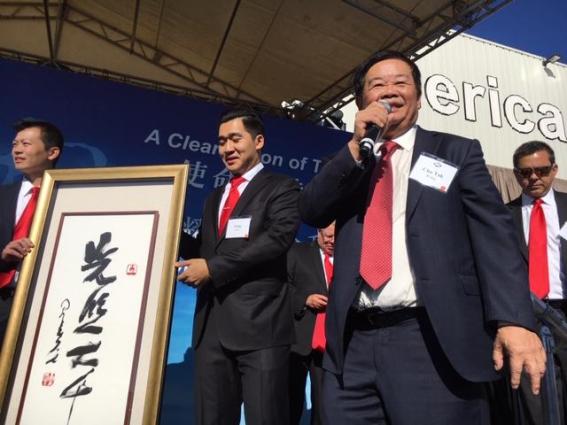
Workers at Fuyao have filed lawsuits against the company for a variety of reasons, including allegedly illegally punishing workers for trying to unionize. Meanwhile, Fuyao has not been shy in expressing dissatisfaction with the habits of American workers. The threat of automation lurks in the background, as the company’s chairman, Cao Dewang, seeks what he euphemistically calls a future in technology.
The wearying and expensive battle of wills is not productive or conducive to worker satisfaction. However, is it avoidable? Would the scenario be any different if this glass company were owned and managed by Americans? Today marks the third day of a nation-wide workers’ strike against General Motors. So, maybe the American worker faces a deeper challenge than Chinese employers.
An Unintended Wake Up Call
The status quo no longer works in today’s rapidly changing globalized automation-prone world. Would it be better to move on to another model?
One idea might be to return to training skilled production workers, which stopped when the college-loan industry figured it would be profitable to promote the paper-shuffling industry, thereby helping to kill American manufacturing in the U.S. The production of goods by American companies located in foreign countries does no good to the American worker.
Another idea, which goes in tandem with the first, is to promote college as a place you go because you want to be there, can handle a high-level level of purely mental work, and cannot be distracted by constant political agitation. Highly trained technicians can help the U.S. keep up with a modern world not at all lacking in first-class universities offering outstanding technical education.
American Factory succeeds as a wake-up call. However, that wake-up call might not be the one intended by the film’s producers. American Factory perhaps serves as a reminder how American workers have been deceived by their legislators, used by their modern-day unions, and left unprepared to compete in today’s market place.
American Factory: Fuyao Glass ribbon cutting in Moraine, Ohio
Fear is a good tool with which to implement control. California did a great job successfully passing hundreds of mandates removing voter control of housing by utilizing concerns about climate change.
Fear is a good tool with which to implement control. California did a great job successfully passing hundreds of mandates removing voter control of housing by utilizing concerns about climate change. The point here is not to engage in unwinnable arguments whether climate change is man-made or not, but to observe a transformation, some say not for the good, driven by constant talk of climate change.
California Political News and Views is an on-line publication popular among conservatives. “Conservative” includes ideas such as protection of private property and displeasure with government supported or controlled housing.
An article in the Political News and Views issue of September 16, observes the connection between California’s continuous talk of climate change and draconian housing legislation. Of special note is the morphing of climate change into climate justice, which led to massive taxation of the state’s residents to support subsidized housing.
A good article by Nathan Kreider posted on Being Libertarian says the “line between order and chaos is not as clear as many assume.” So true!
A good article by Nathan Kreider posted on Being Libertariansays the “line between order and chaos is not as clear as many assume.” The Just Vote No Blog recommends that article as means of dispelling a misconception on the nature of order and chaos.
Excerpt:
It is true, the laws by government can enforce order. But at the same time, there are many examples (continuously pointed out by libertarians) that certain laws can disrupt an already existing order, producing chaos. And when law becomes excessive, creating a needlessly bureaucratic mess, this is far more chaotic than a system with fewer, simpler laws.
Truer words were never spoken. Read More of Nathan Kreider’s article.
So your favorite candidate for office is promising to ban oil production leases and fracking? Sounds like your kids’ toys will be getting more expensive.
Green deals are popping up like dandelions. Left-leaning folks are ready to downright ban oil. No more fossil fuels! No more fracking! To be responsibly green, we will need to do a lot more than what is common sense like investing in clean, effective and useful transit systems.
Aside from the question whether we need to anticipate flying in solar-powered airplanes, we also need to reflect on how many things around the house we will need to replace when oil becomes prohibitively expensive or just plain unavailable.
Of course, our toddler’s toys, eating utensils, backyard kiddie pool, and playground slides will need to go away. Disposable diapers will be a problem — outer shell is plastic. Crayons — oil based.
Also to depart will be the cheap bag of fertilizer we use for our potted plants. Inexpensive T-shirts will need to be replaced by cotton or maybe even Irish linen. Regarding shoes, we will have to face a huge dilemma, since the alternative to synthetic might be leather from little innocent cows.
Vaseline, lipstick, nail polish — all petroleum based.
So, when a candidate for office says at a neighborhood town hall that she would suspend all fossil fuel drilling leases for offshore and public lands, start worrying about all those T-shits and sneakers.
Oh, but wait, the U.S. imports like 70% of all that stuff anyway, so we would not need domestic oil, right? Other countries can increase their oil production to make up for the U.S. decrease, no? Oh, that will fight global warming how, again?
It is good to remember and honor lives lost in tragic events. It is good to reflect on the events that 9/11 unleashed to establish our “post 9/11 world.”
It’s good to remember and honor innocent lives lost in tragic events. On September 11, 2001, 2976 men, women, and children from all walks of life died at the hand of 19 suicide hijackers in New York, Pennsylvania, and Virginia.
It is not good to say their death were not unique, since innocent civilians are routinely massacred during times of conflict. It is not good to dismiss this tragedy as the work of some hidden nefarious entity.
It is best to honor these lost lives by reflecting on the utter uselessness and evil of endless conflict and war.
Our reflection on this calamity should include the events the attack on these lives unleashed. It should include our assessment is the “post-9/11” world leaders created, and citizens demanded in the name of “security.”
A measure of conflict is unavoidable in any group, be it parents and children or the family of nations. However, any group regardless of size, location, ethnicity or religion could reflect on the uselessness of oppression, thirst for power, and myopic battles.
May the souls lost on September 11 be resting in peace. May we the living work towards an end to conflicts that inevitably result in slaughter of the innocent.
 Few if any in the in the U.S. conservative movement are unaware of Dinesh d’Souza, so he packs rooms wherever he speaks. On September 26, Mr. d’Souza was the keynote speaker at the San Francisco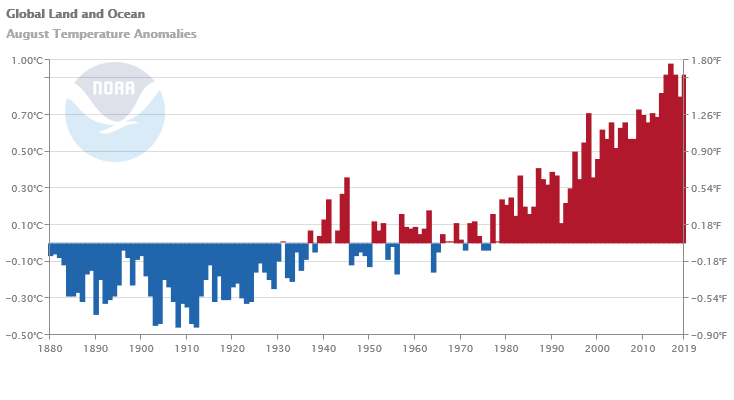


 A good article by Nathan Kreider posted on
  Green deals are popping up like dandelions. Left-leaning folks are ready to downright ban oil. No more fossil fuels! No more fracking! To be responsibly green, we will need to do a lot more than what is common sense like investing in clean, effective and useful transit systems.
 It’s good to remember and honor innocent lives lost in tragic events. On September 11, 2001, 2976 men, women, and children from all walks of life died at the hand of 19 suicide hijackers in New York, Pennsylvania, and Virginia.
 Just Vote No