Talk of reparations to Black Americans started right after the Civil War with assurances of 40 acres and a mule. Those assurances did not turn into reality and talk of reparations faded – until race took center stage around the early 2020s. Since then, several jurisdictions, as well as the federal government, have formed exploratory commissions on reparations; and one city, Evanston, IL, has started paying reparations to qualifying residents. Calls for reparations feel like the proverbial boulder rolling down a hill – it will roll down, and no one knows where it will end up.
The trajectory of reparations is complex, with many reasons but too many debatable assumptions.
Injustices occurred. They included not only slavery that lasted until 1863, but also segregation in public and private spaces until 1964, and discriminatory zoning until 1968.
Principally slavery and discriminatory zoning that excluded Black Americans from the degree of home ownership enjoyed by White Americans produced a playing field leveled in favor of Whites. Consequences from an uneven ownership of assets, and therefore wealth building, are lasting and contribute to today’s Black-White wealth gap.
Present grievances are many. Black Americans make up 13% of the U.S. general population, but 38% of people in prison or jail are Black. The poverty rate of Black Americans is twice that of White Americans. Home ownership is 45% Black and 74% White.
This unfortunate scenario is evident, but solutions are not. While advocates point to a straight road to equity via reparations, opponents point to a minefield. Here are some of the arguments presented by the opposition.
How strong is the opposition?
68% of U.S. adults oppose reparations, according to a presently-most-often quoted 2021 Pew Research survey. In general, opponents do not deny the injustices. They doubt the constitutionality, fiscal rationality, effectiveness, and practicality of reparations.
Who has legal and legitimate standing?
Opponents question what standing does anyone have to demand compensation from another who committed no crime? Guilt by association is not in the law books. Retaliation for wrongs, no matter how egregious those might be, is illegal. Regardless of how Black Americans were and are unfairly treated, benefits largely based on skin color most likely would not pass muster under the 14th Amendment’s equal protection clause (ironic, yes, but real, as evidenced by the recent U.S. Supreme Court decision on affirmative action).
Can U.S. taxpayers afford the cost?
Cost of reparations is of concern for opponents. Government does not pay reparations. Taxpayers do by paying taxes or carrying the burden of government debt. Consumers do by paying higher prices of taxed goods.
For example, how much would be needed in taxes and price increases to pay every eligible Black adult $5 million in reparations, as recommended by the San Francisco, CA, Reparations Task Force. For information, the Black population of San Francisco is around 45,000 ($5 million x 45,000 = $225 billion). Before any thought of reparations, the city’s Controller’s Office expects a shortfall of $779.8 million in the coming couple of years.
At the federal level, Representative Cori Bush (D-MO) introduced on May 17, 2023, H.Res.414 – Recognizing that the United States has a moral and legal obligation to provide reparations for the enslavement of Africans and its lasting harm on the lives of millions of Black people in the United States.
Representative Bush’s proposal, referred to the House Committee on the Judiciary, quotes a federal allocation of $14 trillion for reparations intended to close the nation’s racial wealth gap. That figure is almost half of the current $32 trillion national debt.
What jurisdiction(s) should bear the cost?
Then, there is the question of who should bear the cost for reparations. For example, some advocates claim the federal government as the implementer of slavery must pay. Opponents point to the fact that the federal government under President Abraham Lincoln abolished slavery, after 4 years of fighting Confederate states whose economies depended on slavery.
Several cities are in various stages of developing reparations plans, including San Francisco, CA; St. Louis, MO; Providence, RI; St. Paul, MN; Asheville, NC; Boston, MA. Cities like San Francisco and St. Paul are in states where slavery was never legal, and that is a sticking point with opponents.
States and cities – unlike the federal government – cannot spend money they do not have. Therefore, their payouts for reparations most likely will be too small to make a dent on the wealth gap, regardless of what ideologies reparations commissions such as that in San Francisco entertain.
Who receives?
Who receives is an equally big question. Benefits of reparations for Black Americans immediately raise two questions:
Who is “Black?” People who identify as Black? People who have one drop of Black blood and live as Black? One-drop Black but identifying as white?
What is the point of giving reparations to amazingly successful people like LeBron James, Oprah Winfrey, Jay-Z, and thousands of Black academics, politicians, and entrepreneurs who are already wealthy?
What are the chances of achieving equity through reparations?
As noted earlier, the Black-White playing field was uneven from the start of this nation. The Reconstruction’s plan of income support still in existence today provides subsistence, but cannot in itself accomplish equality in the level of wealth Black families possess vs. wealth enjoyed by White families.
Income support just plays tag after accumulated opportunities that create wealth.
Reparations are viewed by advocates not only as atonement, but also as the 21st Century’s 40 acres that will lift the assets of Black Americans nearer to the level of that possessed by White Americans.
40 Acres and a Mule
Fifteen days after President Abraham Lincoln signed the Emancipation Proclamation on January 1, 1865, Union Army General William T. Sherman issued Special Field Order 15. Order 15 set aside 400,000 acres of tillable land confiscated from Confederates, which was to be divided into plots of 40 acres each and given to freed families. The mules were not in the Order, but the Army did pass out to former slaves some left over mules.
President Lincoln’s Proclamation freed 4 million people, most without education, all without assets or land.
Order 15 tried to state the obvious: 1) People need a basic amount of assets to be able to rise from destitution. 2) Those who profited from the unremunerated work of slaves should be the source of those assets.
Reparations was the core of Order 15, and it would have contributed to a path of eventual equity. Unfortunately, after Lincoln’s assassination, President Andrew Jackson revoked Order 15, supporting instead Reconstruction’s strategy of promoting wage labor.
The tradition of promoting wage labor continues today, and self-sufficiency continues to elude lower-wage Black Americans.
No justice no peace
Fast forwarding to 1965, Assistant Secretary of Labor Daniel Patrick Moynihan published his magnum opus. It was titled The Negro Family: The Case for National Action, and it came to be known as The Moynihan Report.
In his report, Moynihan spelled out a litany of difficulties of lower-class Black families unable to generate adequate income or accumulate any wealth. He pointed especially to “family disintegration:” lower-income mothers bearing children in the absence of fathers.
Moynihan, as did General Sherman, understood that traditional income assistance provides subsistence, but can never provide equity – remember the playing field was tilted right from the starting gate. Unlike General Sherman, though, Moynihan stated the facts as he saw them, and left the implementation of solutions to policy makers.
Moynihan saw a bifurcation in the Black community: A rising, stable middle class and an unstable, chaotic lower-class. The latter was the dependent, problematic population group to which assistance programs, and Moynihan’s report, were directed:
There is considerable evidence that the Negro community is in fact dividing between a stable middle-class group that is steadily growing stronger and more successful, and an increasingly disorganized and disadvantaged lower-class group … The discussion of this paper is not, obviously, directed to the first group excepting as it is affected by the experiences of the second – an important exception.
… the programs that have been enacted in the first phase of the Negro revolution … only make opportunities available. They cannot insure outcome.
The principal challenge of the next phase of the Negro revolution is to make certain that equality of results will now follow. If we do not, there will be no social peace in the United States for generations.”
Equality of results, or equity, would level the playing field. In its absence there can be no social peace, Daniel Patrick Moynihan warned 58 years ago.
Track record of government assistance is not stellar
As of 2014, the 50th anniversary of the War on Poverty, U.S. taxpayers had spent over $22 trillion, measured in constant 2012 dollars, on anti-poverty programs with negligible results. If such track record repeats itself, poor Black people will remain just as poor after reparations.
In his State of the Union Address on January 25, 1988, President Ronald Reagan famously said,
My friends, some years ago, the Federal Government declared war on poverty, and poverty won. Today the Federal Government has 59 major welfare programs and spends more than $100 billion a year on them. What has all this money done? Well, too often it has only made poverty harder to escape. Federal welfare programs have created a massive social problem. With the best of intentions, government created a poverty trap that wreaks havoc on the very support system the poor need most to lift themselves out of poverty: the family. Dependency has become the one enduring heirloom, passed from one generation to the next, of too many fragmented families.
President Reagan’s remarks on the dependency of fragmented families echoed The Moynihan Report, in which Moynihan said:
The white family has achieved a high degree of stability and is maintaining that stability. By contrast, the family structure of lower class Negroes is highly unstable, and in many urban centers is approaching complete breakdown.
Developments since the late 1970s add more challenges to government’s efforts: exponential increase in homelessness and illicit drug use, decline in quality education, mass incarceration, social acceptance of one-parent families reliant on public assistance, explosion of bureaucracies (government agencies and non-profits) dependent of the growth of destitution.
Reparations is an enigma that in theory makes sense, in practice does not
Theoretically, if enough money or other assets is given to one group to bring that group at par with another group, equity is achieved.
What is “enough money” is hard to say. Representative Cori Bush, for example, mentions an allocation for reparations of a minim of $14 trillion.
As the only jurisdiction so far to start distributing reparations, Evanston, IL, could serve as model. However, Evanston is a relatively small city of around 75,500 residents; and distributions made were limited to $25,000 to each qualified resident to be used in home-related expenses like mortgage, home down payment, home repairs, or rent. The small amount, targeted primarily to victims of past redlining, has so far kept lawsuits at bay. The number of homeless individuals in Evanston is 136.
In contrast, big cities with large destitute populations (homeless, drug addicted, gang related, mentally challenged) include several hundred lower-income or no-income Black Americans. Reparations distributions would need to be hundreds of dollars to each qualified individual to achieve any semblance of efforts to bring about equity. Expectations of qualifications based on proven historical harm (descendancy from slaves, harm from Jim Crow or redlining) is unrealistic in such large diverse environments. Distributions based on color will surely attract legal challenges.
Governor of California Gavin Newsom, who manages the second largest state in the Union containing the largest number of homeless poor in the nation, had a predictable reaction to the recommendations of the Reparations Task Force he established to remedy the legacy of slavery:
Dealing with that legacy is about much more than cash payments. Many of the recommendations put forward by the Task Force are critical action items we’ve already been hard at work addressing: breaking down barriers to vote, bolstering resources to address hate, enacting sweeping law enforcement and justice reforms to build trust and safety, strengthening economic mobility — all while investing billions to root out disparities and improve equity in housing, education, healthcare, and well beyond. This work must continue.
The work that “must continue” has done nothing to advance self-sufficiency, let alone the wealth gap. But that work is practical and does wonders for the appearance of doing something. On the other hand, significant amounts in reparations would narrow the wealth gap, even if temporarily. However, its roadblocks will most likely render reparations in the same corner of history as General Sherman’s Order 15.
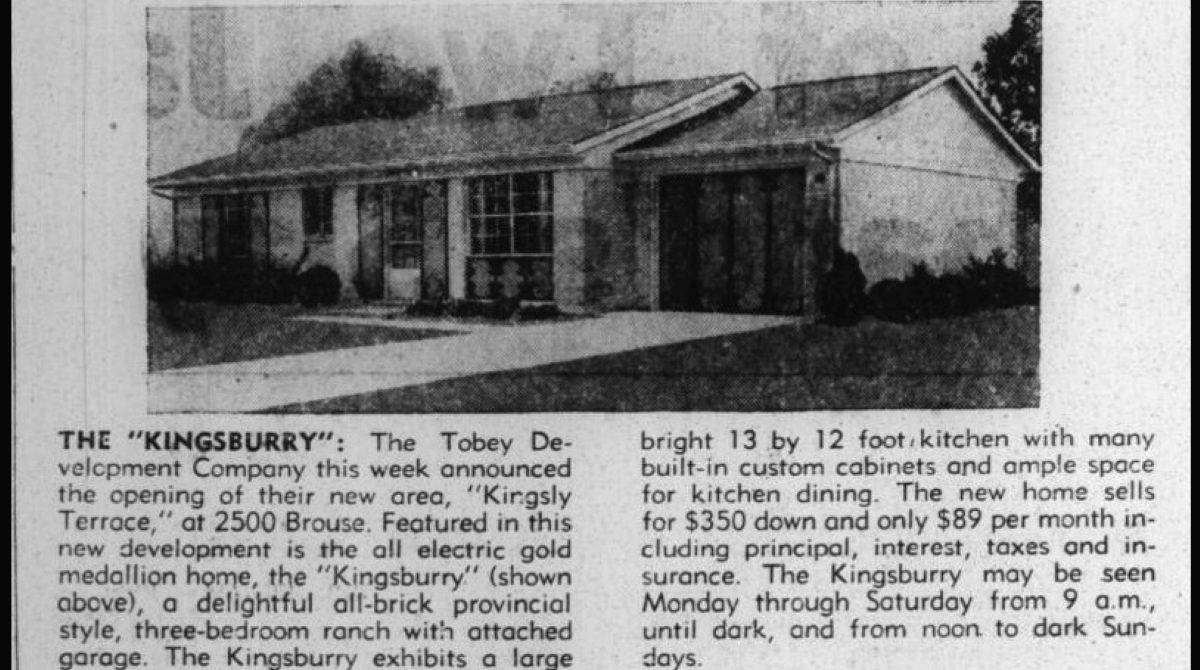
Pictured: A home in the suburb of Kingsly Terrace in 1963. Kingsly Terrace was one of several Black suburbs of the 1950s and 1960s. The homes in these suburbs were built or purchased by Black families. Some were acquired by ground-breaking Black families who moved into White suburbs and watched as White neighbors fled, making room for more Black middle-class families to move into the neighborhood.

 A recent interview on National Public Radio’s program
  Just Vote No