Guns and North Carolina Senate Bill 50

The North Carolina legislature needs to deeply reflect on Senate Bill 50, calendered for September 22, 2025. Facilitating more guns in the hands of teens does not seem wise or necessary.

If you ever had children you know the challenges of the Terrible Twos and the Teen Years. The Teen Years especially at times seem designed to give parents premature white hair. Yet, the North Carolina Legislature would like to allow 18 and 19 year olds to waltz into a gun shop, purchase a gun, no permit, no training, and carry that gun in whatever manner they please.

North Carolina Senate Bill 50, “Freedom to Carry NC” — sponsored by Senators Danny Britt, Warren Daniel, and Eddie Settle – was filed February 4, 2025. The bill was predictably vetoed by Governor Josh Stein on June 20 and returned to the Legislature. Stein’s veto was overridden by the Senate on July 29. But SB50 seems to have met with some cautious minds in the General Assembly and calendered, for the third time, for September 22, 2025.

Behind SB50 is the US Constitution’s Second Amendment.

Also predictably, Gun Owners of America emphatically responded to the veto of SB50. Here is an excerpt of their press release of July 23.

“We have reached a critical point in the fight for Constitutional Carry in North Carolina. As you know, Senate Bill 50, “Freedom to Carry NC,” successfully passed both the House and Senate this legislative session, a testament to your collective advocacy and the tireless efforts of state groups such as Grass Roots North Carolina.

However, last month anti-gun Governor Josh Stein chose to veto SB 50. This decision is a direct challenge to the fundamental rights of law-abiding gun owners across the state.”

Now, “the right of the people to keep and bear arms,” as stated in our Constitution’s Amendment II, absolutely must not be infringed. This Just Vote No Blog stands by the obvious truth that without the Second Amendment, all other Amendments are meaningless. Our Founders were totally clear that governments can go rogue, and without arms the people have no way to fight back.

Therefore, organizations like the Gun Owners of America are absolutely correct in defending the “fundamental rights of law-abiding gun owners.”

But what’s wrong with this picture?

Over the years, we have gone from rural families who used rifles for hunting and self defense, to an urban society with these statistics:

* About eight-in-ten US. murders in 2023 – 17,927 out of 22,830, or 79% – involved a firearm.

* More than half of all suicides in 2023 – 27,300 out of 49,316, or 55% – also involved a gun.

So, in a valiant effort to deal with this most unfortunate situation laws were passed to ensure that guns were only allowed in the hands of “law abiding” individuals.

Dutifully, North Carolina’s Senate Bill 50 sports a laundry list of folks who cannot own a gun, like felons, fugitives, addicts, mentally incapacitated, dishonorably discharged from the armed forces.

However, in North Carolina gun dealers not federally licensed can freely sell arms without any requirements for purchasers background checks. Their only responsibility is to avoid “knowingly” selling a firearm to anybody who by law cannot have one. Under such circumstances, how SB50 can limit the blessings of gun ownership only to the “law abiding” seems unclear.

Meanwhile a day does not go by without the news reporting someone being shot, fatally or otherwise. Youth remains hotheaded and eager to solve challenges by pressing a trigger. Mothers and fathers lose their children to suicides by firearms.

A balance of facts is needed.

The US has a sizable number of engaged voters, the highest rate of private gun ownership in the world, and the Posse Comitatus Act of 1878 which slows down (obviously not stops given recent events) US military action in US soil. Thus the likelihood of our government going rogue is not high.

Conversely, a report published by the Tampa Bay Times dated February 7, 2024 is much more clear in the likelihood of a youth 18 to 20 harming someone with a gun:

“Crime data in the United States is notoriously incomplete, but experts agreed that general trends from state and FBI data show people ages 18 to 20 — and in many datasets people in their early to mid-20s — are likelier to commit deadly shootings than other age groups.”

The North Carolina legislature needs to do further reflection on Senate Bill 50. Legislators, especially those with children, need to acknowledge that teens have developing – not developed – brains. Legislators also need to acknowledge that they are not being entirely honest placing the laundry list of who cannot have a gun, when North Carolina allows for gun sales without any background checks.

Yes, the Second Amendment is what really keeps the nation’s populace free. And we have more than enough brave law abiding adult citizens to ensure our freedom. Facilitating more guns in the hands of teens does not seem wise or necessary.

Picture:

Memorial for 14 year old Lyric Woods and 17 year old Devin Clark, who on September 17, 2022, were shot to death. Suspect is Issiah Mehki Ross, 17 years old at the time of the murders. New York Post, November 8, 2022.
North Carolina proposed a Convention of States – Be wary

Article V Convention of States is a bulwark against federal government abuses. Only problem is it has never been used and nobody knows how it works.

On December 5, 2024, the North Carolina State Legislature passed a Joint Resolution applying to the U.S. Congress for an Article V Convention of States to limit the term of Congressional Leaders.

To those familiar with what a Convention of States is and what pros/cons such a convention carries, kudos. This Just Vote No article is for folks who say, “What are we getting into here?”

So, first off, what is Article V

Article V of the U.S. Constitution is a crucial bulwark against federal government abuses. It gives states and its people the right to amend the Constitution whether the federal government likes it or not. This form of redress has never been used. All 27 Amendments to the Constitution have been placed via another route offered by Article V – Congress proposes, and states ratify. Here is Article V:

“The Congress, whenever two thirds of both houses shall deem it necessary, shall propose amendments to this Constitution, or, on the application of the legislatures of two thirds of the several states, shall call a convention for proposing amendments, which, in either case, shall be valid to all intents and purposes, as part of this Constitution, when ratified by the legislatures of three fourths of the several states, or by conventions in three fourths thereof, as the one or the other mode of ratification may be proposed by the Congress; provided that no amendment which may be made prior to the year one thousand eight hundred and eight shall in any manner affect the first and fourth clauses in the ninth section of the first article; and that no state, without its consent, shall be deprived of its equal suffrage in the Senate.”

The language of Article V is purposefully lean.

Our Founders established an experimental way of governing – We the People, on our own or via our elected representatives, decide the nation’s path. Article V guarantees an antidote against federal misconduct but leaves open how states (The People) use it.

It is clear from the language of Article V that applications from 34 states (2/3 of 50 states) are needed for Congress to call for a Convention of States, and that whatever amendments are proposed at such Convention must then be ratified by the legislatures of 38 states (3/4 of 50 states).

Other than that, at present, there is nothing.

We have no precedent for guidance. We have no rules that guarantee what states propose is what delegates will aim for at a Convention. There is nothing about who can be a delegate, or how delegates should be chosen. We have no guidance when or how U.S. Courts can intervene if amendments stray too far from the intentions of our Founders.

It is not even clear when Congress is required to call a Convention of States, since there is disagreement how applications should be counted. Article V says nothing about subjects on applications, nothing on whether applications expire or are forever valid, nothing on how to count or not count rescinded applications.

Even if we all agree to count only applications currently clearly on the table, does Congress count 9 applications for “Term Limits” and 25 to go. Or count 9 for terms limits plus 19 to “Limit the power and jurisdiction of the federal government, impose fiscal restraints, and place term limits on federal officials,” so only 6 to go.

Therefore, voters should be wary of assertive self-assured applications.

Here is the wording of Section 1 of the North Carolina application for a Convention of Stares,

“SECTION 1. The legislature of North Carolina hereby makes an application to Congress, as provided by Article V of the Constitution of the United States of America, to call a convention limited to proposing an amendment to the Constitution of the United States of America to set a limit on the number of terms that a person may be elected as a member of the United States House of Representatives and to set a limit on the number of terms that a person may be elected as a member of the United States Senate.”

Although this language and that of other applications sound completely straight forward, the people can only depend on the good character and promises of Convention delegates.

The chances that promises would be kept or not is anyone’s guess.

Even a cursory search on the Internet for “Convention of States” will yield numerous pros and cons. The pros mostly point out that a Convention is needed to do the job Congress refuses to do, and there should be no fear of a “runaway Convention” given the specificity of Convention applications. The cons simply disagree that any specificity can exist based on the language of Article V, and Congress’ dysfunction can be easily cured by voters at the ballot box.

Both sides can be right, since Article V doesn’t say much! Both sides can try to guess what the Founders intended via the Federalist Papers or other writings, and one guess would be just as good as another.

Both sides often bring up the first and only Constitutional Convention, which convened in Philadelphia in the summer of 1787. The pro side points to the fact that this was a Constitutional Convention, a different animal than a limited Article V Convention of States. The con side sees no difference, based on the language of Article V.

Y’all remember what happened there? That 1787 Convention, attended by George Washington, Alexander Hamilton, James Madison, and other great minds of the time convened to improve the Articles of Confederation which lacked a way that states could operate in concert by a set of rules. As we all know, delegates did not improve the Articles of Confederation but instead wrote a whole new Constitution.

It all sounds a bit too risky. Even if we say the real intent of Convention of States is to scare government into taking action, uncertainties of what happens if a Convention is called remain.

How about the good old ballot box?

The ballot box remains the only sure-fire way that people can control what government does. If voters want a smaller fiscally restrained government, don’t groan and grind teeth when radicals in Congress speak out against increasing spending limits. If voters want terms limits, stop voting for career politicians and support the “citizen statesmen” that our Founders envisioned.

Want to hear the pros/cons first hand?

For those interested in a good collection of pros and cons all in one place, here is a link to a YouTube video called Conference on the Constitutional Convention: Legal Panel. This conference was presented by the Harvard Law School. Five panelists participated in the discussion.

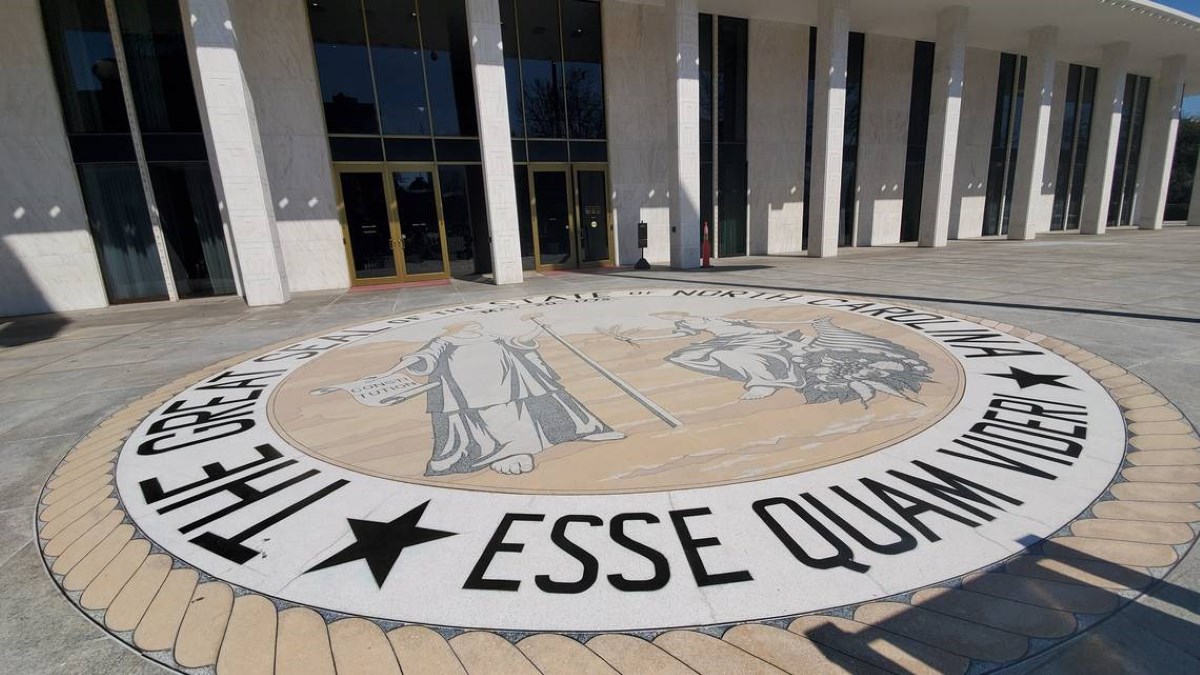
Picture: The Great Seal of North Carolina is embedded in the walkway at the main entrance of the North Carolina State Legislative Building. Around its edge is the state motto, “Esse Quam Videri,” Latin for “To be, rather than to seem.”

Budgets and bills with bolts from the blue

The North Carolina legislature is getting pretty good at inserting surprise policy into last-minute budgets and tacking unrelated items into bills. Some people call these “riders.” Some call it legislating by stealth. None of it good.

A useful new series of articles called “Power & Secrecy” in The News & Observer, one of North Carolina’s premier newspapers, digs into policies emanating from the current state legislature. As its name suggests, the series aims to shed light into veiled actions by the state’s legislative leaders meant to grow legislative power.

Spoiler alert.

The N&O leans left, so it is tempted to emphasize that the current state legislature, faults exposed, is a veto-proof Republican majority. Since seeking power is a party-independent endeavor, emphasis should be on the “veto-proof majority” part, not the “Republican” part.

Things that jump out unexpectedly from budgets and bills.

The North Carolina legislature is getting pretty good at inserting surprise policy into last-minute budgets and tacking unrelated items into bills. Some people call these “riders.”

By way of background. From the late 1980s to the mid-2000, operational rules of North Carolina’s House and Senate forbade tacking on new policy and spending in final versions of state budgets. In 2003, the Democrat-controlled state Senate started whacking off pieces of this prohibition. In 2011, the House, then Republican majority, started doing the same. Today, legislators are free to do both previously prohibited practices.

So, what’s the problem? Firstly, budgets are intended to be means by which legislators allocate funds to previously agreed upon rules, not means by which to create or modify rules. Secondly, there is no robust public debate on new policy inserted in budgets. Thirdly, legislators often pass budgets by way of conference reports, which require a Yes or No vote without possibility of compromise amendments. Fourthly, a tacked on unrelated rule to a bill also forces a Yes or No vote to the entire bill.

Lastly, the nature of riders is stealth, sliding by constituents.

An argument could be made that legislating by stealth saves time and contention. But, it also ignores a lot of constituents. Here are a couple of examples provided by the above-mentioned series of investigative articles:

  • Ignoring environmental concerns.

North Carolina is a pro-business state. However, it does have its share of liberal cities with environmentally conscious constituents that wish to curb business practices they deem environmentally harmful. Pre-emptive budget and bill riders passed by the state legislature prevent that.

The cities of Asheville and Durham were considering regulating plastic bags and food containers back in September 2023. Legislators stepped in with a rider on the state budget prohibiting any North Carolina city or county from regulating or taxing retail packaging.

The piles of Styrofoam and other plastics covering streams and other waterways can get pretty yucky. There isn’t much one can do to prevent wind and rain from moving litter in landfills and streets into storm drains and waterways. And there are biodegradable alternatives, like sugarcane containers.

  • Ignoring pollen, dust, smelly fumes…, and hard to trace campaign money.

Remember the Covid “guidelines” requiring that everybody wear a mask in public? Predictably, normalizing face masks prompted use by individuals who want to hide their identity – including rioters and demonstrators. So, in the usual first you create a problem then you try to solve it creating another problem, the North Carolina legislature passed House Bill 237, prohibiting public use of face masks. Sure, there are exceptions for people in seasonally-appropriate costumes, workers in unhealthy environments, and “Any person wearing a medical or surgical grade mask for the purpose of preventing the spread of contagious disease.” That’s it.

The “health exception” was placed when some legislators refused to sign the bill without the exception. But, apparently, in exchange, a campaign finance rider was tacked on to the mask bill. No, there is no connection between wearing masks in public and allowing political donors to give money to special federal political organizations, that then pass the money on to state and county parties.

Beware of mission creep.

As The News & Observer series on legislative power and secrecy continues, there will surely be much uncovered and placed in the public eye. Hopefully, voters will be watching.

The concern should be that without robust public input a legislature, regardless of stripe, becomes emboldened. It might also become less practical (i.e., being business friendly to grow the economy), and become more ideological (fill in the blank here with any ideology).

A recent article in the New York Times, picked up by several other publications, by columnist Nicholas Kristof wonders where have the majority-Democrat Party progressive legislatures in the West Coast gone wrong. He argues that “West Coast liberalism is more focused on the intentions behind its policies rather than its outcomes.”

A step beyond that would be more focused on personal ideologies than constituents’ wellbeing.

Picture: Micro plastics in the Neuse River. Plastic debris in waterways is not only unsightly, but disastrous. Most of it lasts for decades, and what decays ends up in fish’s stomachs and drinking water.

Why would wealthy families need school vouchers?

The newly-expanded North Carolina school voucher program – Choose your School, Choose your future – grants tuition assistance to any North Carolina family, regardless of income. Do wealthy families really need financial assistance to choose which ritzy school is best for their kids?

On May 17, 2023, the North Carolina Assembly passed House Bill 823, enthusiastically called Choose your School, Choose your Future. The bill expanded the state’s K-12 school voucher program, originally enacted in 2013 to assist low-income families. The Opportunity Scholarship, as the North Carolina voucher program is called, now grants vouchers to all North Carolina families regardless of income. Grants are on a sliding scale determined by family income, with amounts varying between $3,360 and $7,468 per child per year.

Legislators allocated $354.5 million for the Opportunity Scholarship program’s reserve fund for the 2024-2025 school year, and $416 million for the 2025-2026 year.

Lawmakers included HB-823 in the state’s $30 billion very much delayed and anticipated budget, which Governor Roy Cooper allowed to become law without his signature in September.

This program has received accolades as well as criticism.

Sadly, many traditional public schools are of poor quality and lately mired in controversy regarding race, gender, and sexuality. Children should not be stuck in such schools. The Opportunity Scholarship program is a godsend to lower-income families who cannot afford or who can barely afford private, including religious, schools.

However, back in May 2023, WFAE opinion columnist Tommy Tomlinson came up with an interesting description of the newly-overhauled North Carolina voucher program: “Robin Hood in reverse.” He said,

At some point, I have a certain grudging respect for the dedication some people have to playing Robin Hood in reverse — taking money from regular folks and handing it to the rich. Their latest maneuver here in North Carolina is a move to provide taxpayer-funded vouchers to any child in the state who wants to go to private school …

Kids from families with modest incomes have been eligible for similar vouchers here for the past 10 years. That, to me, actually makes some sense. It provides an escape route for a kid stuck in a failing school.

Wealthy families, whose children already attend the “ritziest schools in town” can argue that given the poor quality of public schools they are forced to pay both private school tuition and taxes that support public schools. Vouchers would help level their playing field. However, let us not forget that the working poor also pay taxes, some of which will help pay for school vouchers their wealthy neighbors receive.

Unfortunately, “Robin Hood in reverse” is not the only problem with universal school vouchers.

A worrisome possibility is a significant tuition increase.

North Carolina News & Observer education columnist T. Keung Hui noted in his excellent report of February 15, 2024, that some private schools have already announced tuition increases.

Private schools across the state are raising tuition and sending information to families about applying for Opportunity Scholarships. How much of the tuition increase is due to inflation or to take advantage of additional voucher funding is unclear. … The tuition rate increases for some schools across the state is more than 10%, which is well above the rate of inflation.”

People who attended college in the late 1980s might recall the shock wave of sudden tuition increases. Reasonably affordable four-year colleges became voracious, pushing students into quagmires of student loan debt. 1987 to 2010 witnessed a 106% increase in college tuition, according to a Mises Institute report dated November 30, 2021.

Coincidentally, the years 1980 – 2010 also saw expansion of college student loans guaranteed by the Federal government. William Bennett, President Ronald Reagan’s Secretary of Education, provided in 1987 his view for the college tuition increases he witnessed. Bennett’s assessment — what became known as the Bennett Hypothesis — was discussed in Science Direct, December, 2019

“Increases in financial aid in recent years have enabled colleges and universities blithely to raise their tuitions, confident that Federal loan subsidies would help cushion the increase.”

Scholars have debated the Bennett Hypothesis ever since it was first presented. But even when pitted against other possible reasons for substantial tuition surges — increase in attendance without concomitant growth in institutions, inflation, excessive regulation — the Bennett Hypothesis survives common sense. Is there a valid argument against the view that everybody likes money, and if it is available, most individuals and institutions will take it? Or a valid argument against expecting substantial expansion in school vouchers to have negative effects like those associated with college student loans?

Families should also be concerned about class sizes.

Mr. Hui of the News & Observer indicated an estimated 60% increase in students getting vouchers. Recipients that are already attending private schools will not affect class sizes, but students crossing over from public schools might. Chances are private schools will not rush to expand their facilities to accommodate the crossover population, which could result in increased class sizes.

Vouchers might not be operating on a level playing field.

Lower-income families and their advocates should ask themselves whether universal school voucher programs operate on a level playing field.

By way of comparison: Progressive advocates for poor and minorities often oppose voter ID requirements, citing that poor and minority voters face greater difficulties obtaining IDs. Would the same difficulties apply to obtaining school vouchers? Might more affluent, more educated families possessing greater resources hold advantages over the less fortunate?

Hopefully, in the interest of fairness, the priorities in receiving vouchers contained in HB-823 will lower any advantages held by wealthier families. Families whose children were voucher recipients prior to HB-823 (when there were income limits) will enter a voucher lottery first, followed by lower-income applicants; the more affluent applicants will enter the lottery last to receive what funds are left in the year’s allocation.

Lastly, do the wealthy really need vouchers?

The common-sense answer is clearly “No.” The title of House Bill 823 — Choose your School, Choose your Future – although catchy, is disingenuously applicable only to lower-income families. It is difficult to imagine circumstances in which wealthy families need vouchers to choose which ritzy school is best for their children.

Indeed, it is unfair that families with children who attend private schools pay both tuition and taxes that support public schools. However, universal school vouchers possess an unfortunate aura of benefits for the rich.

Conceivably a better idea might be to pass legislation absolving parents with K-12 children in private schools from paying taxes that support public schools, limiting vouchers to very low-income families living in poor-performing school districts, and improving the performance and cost effectiveness of public schools by practicing the good old focus on “reading, writing, and arithmetic.”

Picture: The beautiful Groton School in Groton, MA. Founded in 1884. Educating 380 students, grades 8-12.

Is North Carolina getting too Republican or too Democrat

As a California expatriate now residing in North Carolina, I can attest that any state heads for doom when it becomes “too” anything – too conservative, too progressive, too Democratic, too Republican.

California, the once Golden State known for sunny beaches, breathtaking scenery, and unbound opportunities, is now best known for unaffordable housing, high taxes, and uncontrolled homelessness. California became too progressive. It fell victim of the uni-party syndrome.

Should one be surprised? No. Power corrupts, and absolute power corrupts absolutely. In this case it is corruption of judgement. Most political leaders are fairly decent people. However, temptation to submit to special interests, to be part of the in-crowd, to outdo the doers is too great when there is strength in numbers. Unopposed thought and actions often become extreme – because they can.

North Carolina at present is reasonably balanced politically, but…

As of October 2022, there were 34% registered Democrat voters, 30% Republican, 36% Unaffiliated, and 0.7% Libertarian. The state’s executive branch is reasonably balanced as well: Democrat Governor, Republican Lieutenant Governor, Democrat Attorney General, Democrat Secretary of State, Republican State Treasurer, Republican Superintendent of Public Instruction.

However, Republicans control both chambers of the North Carolina legislative branch. The state’s House of Representatives enjoys a Republican supermajority with veto power. North Carolina’s Supreme Court – the body tasked with interpreting laws passed by the legislative chambers – is majority Republican.

With such majority and veto power since April 2023 (when a Democrat legislator switch her affiliation to Republican), Republican legislators easily passed an expected slate of bills: lowering the threshold when legal abortions can be performed from 20 weeks to 12 weeks; tightening elections laws, like requiring voter ID and ending grace period for counting absentee ballots; prohibiting health care professionals from administering gender enhancing drugs or performing gender transition surgery on minors under 18; prohibiting transgender athletes from competing in women’s leagues.

These are well intentioned bills meant to protect the unborn, children who are not fully cognizant of their desire to transgender, female athletes that should not be made to compete with biological males, election integrity, etc. The problem is these bills are broad, one-size fits all, and in some cases draconian.

Perhaps, compromise between legislators of different parties might have better considered unintended consequences of these bills – such as doctors making a fatal decision not to perform an abortion for fear of losing their license. (The Just Vote No Blog discussed the potential collateral damage inherent in the abortion and transgender bills).

One additional provision was not expected, or even noticed by most voters, since it was buried in the 625-page budget passed September 22, 2023. The provision states:

“… the custodian of any General Assembly record shall determine, in the custodian’s discretion, whether a record is a public record and whether to turn over to the Department of Natural and Cultural Resources, or retain, destroy, sell, loan, or otherwise dispose of, such records.”

Legislators are custodians of their own records, and can now destroy anything that might look bad in the eyes of voters.

Even more surprising was the inclusion of casino expansion outside of tribal lands in the 2023-2024 budget. Did legislators figure placing casino expansion in a stand alone bill that would properly go through committees never pass? Maybe. So, they placed the bill in a highly anticipated budget, containing highly anticipated Medicare expansion and teachers’ raises. Interestingly, the ploy did not succeed because Republicans did not agree on it among themselves.

Misguided legislation occurs when circumstances allow them to happen. A legislative supermajority can be fertile ground.

In California, anyone can trace the state’s ills to poorly considered legislation.

For example, homelessness could be considered California’s most serious problem. Vast areas of once busy, clean streets in the state’s downtowns now serve as homeless encampments. Popular hotels that once served California’s tourist and convention industry, now house the homeless at taxpayers’ expense.

Lenient voters, without much opposition, allowed for passage of lenient laws intended to “help” the homeless. The number of government agencies and non-profit organizations replete with employees dealing with homelessness and drug use grew exponentially. Finding a real solution and putting thousands of these employees out of work seems unlikely.

Hopefully, it is not entirely true that “as goes California, so goes the nation.” Although one could take note that North Carolina’s left-leaning strongholds like populous Wake County are already busy converting hotels into homeless shelters.

Our nation’s Founding Fathers were not at all keen on political parties.

Wisely, our Founders did not mention political parties in our Constitution, and strongly warned against them. One of the most emphatic of many quotes on the subject is that of John Adams,

“There is nothing which I dread so much as a division of the republic into two great parties, each arranged under its leader, and concerting measures in opposition to each other. This, in my humble apprehension, is to be dreaded as the greatest political evil under our Constitution.”

That is not to say that our Founders advocated that everyone hold the same ideas! What they preferred was a system under which leaders (and voters) thought for themselves, free of ideologies. Thomas Jefferson expresses this sentiment unequivocally,

“I never submitted the whole system of my opinions to the creed of any party of men whatever, in religion, in philosophy, in politics, or in anything else, where I was capable of thinking for myself. Such an addiction is the last degradation of a free and moral agent. If I could not go to heaven but with a party, I would not go there at all.”

Jefferson sounded the alarm against vain and destructive ideology – groupthink – and advocated careful individual thought.

A leader or a voter able to think independently, is more likely to listen to divergent opinions, work towards compromise, and avoid unfortunate unintended consequences.

Politically unaffiliated voters, growing exponentially in every state, might be channeling Thomas Jefferson and his fellow Founders. Let’s hope so.

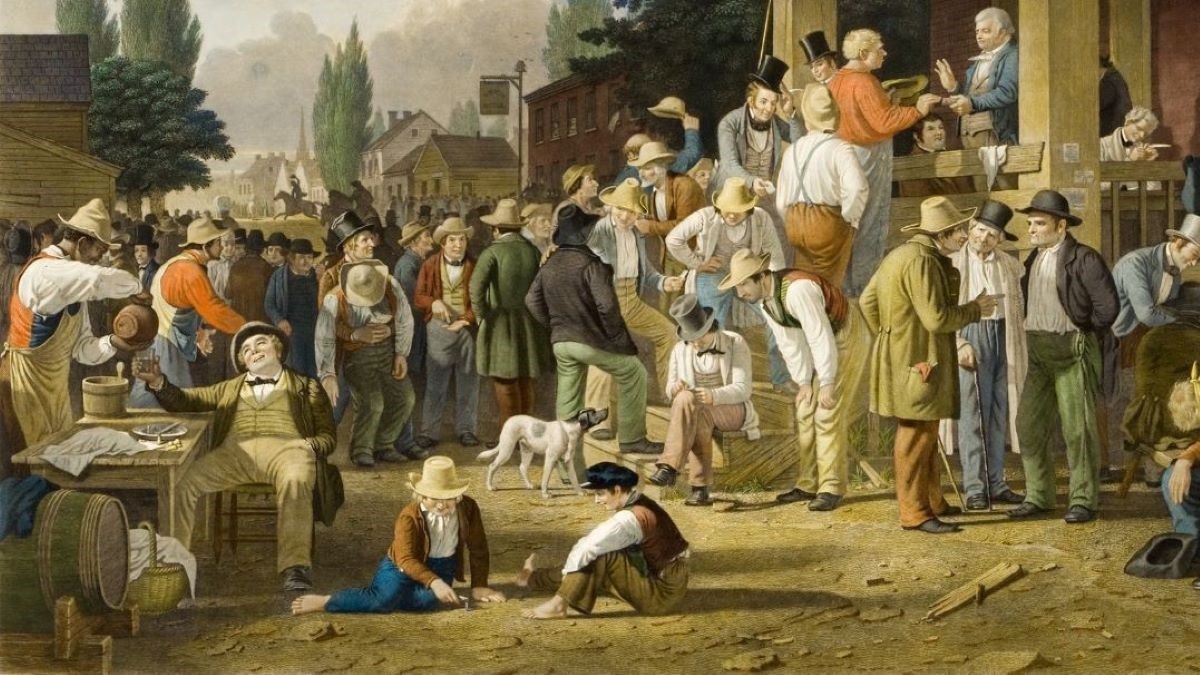
Pictured: 19th century painting by American artist Caleb Bingham. Notice that voters are telling the official who and what they are voting for, since ballots were not secret. Needless to say, opportunities for pressuring voters were great.

North Carolina, rent control is not a solution

State Senator Linda Grafstein recently introduced Bill 255 aimed at repealing North Carolina’s prohibition of rent control. Surely, Senator Grafstein is aware of the inefficiencies inherent in rent control?

Recently North Carolina state Senator Lisa Grafstein (Democrat – Senate District 13), submitted Bill 255, Act to Permit Local Governments to Enact Rent Control. Bill 255, if enacted, will repeal Statute 42-14-1 Rent Control, and allow municipalities to enact any form of rent control.

Statute 42-14-1 prohibits North Carolina jurisdictions from implementing rules that interfere with the rental of private property:

No county or city as defined by G.S. 160A‑1 may enact, maintain, or enforce any ordinance or resolution which regulates the amount of rent to be charged for privately owned, single‑family or multiple unit residential or commercial rental property.

Senator Grafstein’s reason for introducing this bill is the usual one: rising rental costs are causing financial hardships. Indeed, that is the case, especially since the start of the Covid-19 pandemic in 2019. Rent control is the easiest way to show constituents a representative is “doing something.”

Rent control is also an inefficient way to address housing costs.

Unfortunately, rent control is also plagued with consequences and uneven results. Renters under rent control love their housing cost stability. Lower-income workers with hopes of stable housing costs support rent control. On the other side of the coin, landlords who are unable to pass their rising costs to tenants due to rent control seek solutions detrimental to tenants: poor property maintenance, raising rents on units not under control (thus raising overall rental costs), or withdrawal from the controlled market.

Given rent control’s uneven consequences, opinions on it vary widely. Here are two seemingly heart-felt quotes.

…our family was always able to afford a roof over our heads, because we were living in a rent-controlled building. That most minimal form of economic security was crucial for our family. Senator Bernie Sanders, CNN Opinion, July 30, 1919.

In many cases rent control appears to be the most efficient technique presently known to destroy a city—except for bombing. Assar Lindbeck, The Political Economy of the New Left, 1972.

While lower-income residents, especially those in more progressive cities, support rent control in hopes of stabilizing their housing costs, economists generally agree controls are destructive. Here is a good summary of the challenges economists see in rent control. The author is economist John Phelan in his essay 81% of economists agree that rent controls are bad policy, Center of the American Experiment, December 18, 2018.

… there are, in fact, areas where the economists’ cacophony dies down and they speak with more or less one voice.

One such area is rent control. This proposal – to cap the price landlords can charge tenants – crops up perennially as a solution to high rents. This is mistaking the symptom for the illness. When prices are high they are sending you information. They are telling you that demand is high relative to supply. If you want to do something about this, act to either reduce demand or increase supply. Either way, trying to fiddle with the signal makes no more sense then trying to slow down your car by breaking the speedometer.

But fiddling with the signal is expedient if not effective.

Decreasing demand for housing or increasing supply are solutions to high rents more complex than implementing rent control. Decreasing demand requires decreasing population growth, a solution not embraced by governors or legislators. Increasing supply (and growth) sounds good to state leaders, but their efforts are very often met with public outcry from residents rejecting loss of open spaces, increased traffic, and change in neighborhood character.

Thus, legislators sometimes opt for rent control – even though rent control seldom works as intended.

At present, two states, California and Oregon, plus the District of Columbia have state-wide rent control ordinances. Seven states allow local rent control: California, New York, New Jersey, Maryland, Maine, Oregon, and Minnesota. California, New York and New Jersey have the highest rents in the nation.

Most certainly Senator Linda Grafstein is aware of challenges inherent in both rising rents and rent control. Hopefully, so are her constituents.

Pictured: From widely circulated videos of protesters in Charlotte, NC, on January 25, 2023. Protesters were demanding accountability from corporate landlords; specifically, a stop to the growing ownership of homes by corporate landlords, improved building maintenance, and a 3% cap on rents.

Friendly advice from a former Californian

California’s handling of its population growth resulted in astronomical housing costs and an exodus of residents. Hopefully, North Carolina will handle its current growth a lot better.

North Carolina is a beautiful state. It has ample open space and homes surrounded by lovely woods. It is strong economically, business friendly, rich in job opportunities, and still relatively affordable. World-class universities like Duke, University of North Carolina, and North Carolina State University, help attract businesses seeking a talented workforce.

But how long before the crucible of housing, or unhousing, ensnares North Carolina as it did California?

North Carolina’s strengths attract expatriates.

North Carolina is among the fastest growing states in the nation, as new arrivals pour in seeking jobs and lower living costs. Since 2010, North Carolina’s population grew by 9.7%, compared to the overall U. S. population growth of 7.4%.

New arrivals need housing, like everybody else. In North Carolina, growth in new housing production since 2010 has been around 8.8%. The 0.9% shortfall, predictably, has caused housings costs to rise. Since 2010, home prices have increased by 31.5%, and rents by 14.6%.

Some benefit, some don’t

Such significant increases in home prices provide benefits to current property owners and landlords. Meanwhile, house hunters are thrown out of housing markets and renters often out of rented homes. Eventually, disadvantages of increasing housing costs overwhelm the middle class. Then, we see the rise of “U cities” that become home for the rich and the very poor. Anyone in the middle who can afford to do so, departs.

In California, the economically-comfortable class easily outbids the lower-income middle class, gentrifies older communities, and pushes residents out of neighborhoods. Some residents slide into homelessness, some into dependency on subsidies, and many are trapped into immobility by rent control (move, and your rent might shoot up 100%).

So, just build?

Just build more housing, one might say. That is not at all an easy feat. In North Carolina, as in many other states, planners and policy makers face a litany of challenges in their quest to reach the holy grail of “equitable, affordable housing.” Here are some of these challenges:

Societal challenges like differing needs and often unwarranted fears make housing development difficult. Current homeowners, used to their tree-lined single-family neighborhoods, do not want changes in zoning that allow for density. But priced-out house hunters would welcome any hope of density creating affordability. Residents of affluent and peaceful neighborhoods fear intrusion by the working poor dreaming of safety and good schools for their kids.

Political challenges also impede housing construction. Leaders desire economic growth; therefore, they focus on welcoming new business, job creation, and population growth. But they thread lightly when it comes to developing homes for new workers, since their more established and economically comfortable constituents resent incursions into their neighborhoods.

Self-determination challenges are not often brought up in housing discussions. North Carolina, unlike California, has not yet felt the brunt of state and regional housing mandates. Chances are it will, if cities and counties do not find satisfactory ways to provide enough construction to house the state’s growing population.

We say, “Sorry we are full?”

Even if local leaders are willing to let old neighborhoods be, there are higher powers that might want to prevent that course of action.

North Carolina is governed by the Dillon Rule, with limited Home Rule. In Dillon Rule states, cities derive their power from what the state chooses to grant. That includes how much decision-making in housing development the state grants its cities.

Also, states must abide by The Federal-Aid Highway Act of 1962. Included in that Act is the creation of Metropolitan Planning Organizations (MPOs). Under the Act, all urbanized areas with 50,000 or more in population must join an MPO. North Carolina has 19 MPOs scattered around several regions of the state.

The original intent of MPOs was to coordinate transportation funding between regions. Today, the functions of MPOs include housing development. Recently, the Infrastructure Investment and Jobs Act of 2021 (Public Law 117-58 11/15/2021) further codified housing as a purview of MPO’s. The Act makes several changes to include housing considerations in the metropolitan transportation planning process, including:

“Within a metropolitan planning area that serves a transportation management area, permitting the transportation planning process to address the integration of housing, transportation, and economic development strategies through a process that provides for effective integration, including by developing a housing coordination plan. [§ 11201(d)(5); 23 U.S.C. 134(k)].”

MPOs in California serve as cautionary tales. The San Francisco Bay Area Metropolitan Transportation Commission (MTC), for example, is a behemoth agency with significant powers over housing development. The challenge for residents and voters is that MTC’s decision-making Commissioners are not elected to their MTC positions by the residents who they supposedly serve. No matter how harebrained their plans are, there is no way to kick them out of their positions.

North Carolina’s MPOs have not come close to exhibiting the power of MPOs in large California regions. Therefore, residents have not yet felt the impact of major housing mandates.

Growth is here and cannot be ignored

There is no denying that North Carolina is going through a population explosion. Legislators and other leaders are happy with the arrival of new job-creating companies. They are also happy with the influx of new residents that will help increase the state’s representation in the U.S. Congress. Their glee could be relatively short lived if they do not handle growth well. Growth involves numerous variables and cannot be solved by merely trying to match supply to demand.

Newcomers need realistically priced homes, so does a well-functioning market – nobody wants a way overvalued housing market that will surely correct with a plunge. Established residents love their single-family homes in tree-filled neighborhoods. Housing developers can be persuasive in calling for changes in zoning and building standards. When zoning changes, there will be homeowners that will sell their homes to developers at very good prices.

Once, California was a beautiful state. It was a destination state, just like North Carolina is today. Now, folks cannot leave the state fast enough, as they escape high taxes, astronomical housing costs, uncontrolled homelessness, and unsanitary cities. What happened?!

Some will say the rich refused to pay their fair share of taxes, so programs could not thrive. Others will say housing costs rose so much that people became homeless (and drug addicts as well). Others will say voters willingly chose ill-conceived proposals.

The latter is closer to the truth. And many of the ill-conceived ideas related to housing. Mandated affordable-housing allocations resulted in gentrification and no affordable housing. Piles of money allocated to housing non-profit organizations resulted in a thriving homeless industrial complex. Destruction of old neighborhoods to make room for development contributed to the rise of a serious missing middle.

Had voters and leaders handled growth by consensus of all residents, not just consensus of the elite and the government-dependent (those that enrich the bureaucracy), things would have worked out better. California has huge areas of protected open space where no housing development is allowed. Open space is great, but it remains pristine at the expense of destruction of established neighborhoods. Once there is enough destruction, people start voting with their feet.

Forewarned is forearmed. North Carolina can prosper while retaining its quality of life by handling population and housing growth wisely.

Views from a happy California expat

California boasts of being an economic powerhouse and a compassionate sanctuary. So, why are so many Californians moving to other states?

Thank you to Richard Eber, frequent contributor to California Political News & Views, for his article on reasons people are leaving California, and for including the Just Vote No Blog editor’s views. Actually, the article wonders why anyone would choose to stay in the once Golden State.

Certainly, there are reasons not to join the California exodus — family ties, a good job, balmy weather, lovely scenery, world-class art and music venues, health constraints, dependence on California’s generous welfare, or reliance on bountiful flow of drugs. However, as Richard Eber’s article points out, the reasons to leave are mounting.

Although Californians are leaving mainly because of exorbitant taxes, housing prices, and living costs, many are rejecting the principal underlying cause of those costs – the all-enveloping far-left one-party rule.

The resulting inefficiencies of the one-party rule make California less desirable than, say, North Carolina, one of the destination states mentioned in Eber’s article. Sure, there are Republicans, Greens, and Libertarians in California. But they have descended into near irrelevance given the power of the Democrat machine. Power of such magnitude, regardless of what party or faction holds it, empowers, and inspires extremes.

Richard Eber’s article is reproduced below:

__________________________________

Leaving California, by Richard Eber, published September 22, 2022, in California Political News & Views

It’s no secret families of all economic classes from the poor to the super rich are leaving California in droves. From illegal aliens to billionaire Elon Musk folks of all backgrounds are quickly putting the former “Golden State” in their rear view mirrors

Libertarian types like me would like to attribute the migration of about half a million people each year to Texas to be politically motivated. In reality this is not the case. Spurred by the socialistic government headed by Governor Gavin Newsom, high taxes, housing costs, energy costs, crime, and poor schools, are more important than politics.

Migrating businesses are following as well. Texas has been the main beneficiary of what amounts to a wealth transfer of billions of GNP each year welcoming 500,000 new residents. It is no coincidence Austin is quickly gaining the reputation of becoming the Silicon Valley of the South.

Typical is the family of my daughter’s best friend and her family who packed their life and moved to Texas after Lexi graduated from high school. Despite both of her parents having decent jobs, they could not afford to purchase a house in the Bay Area.

This soon changed in Texas when they bought a 2500 square foot home for less than half of what it might cost in California. If Lexi’s family would have stayed, it is doubtful they could even have purchased sardine like dwelling in a Priority Development Area (PDA) Sacramento believes people prefer to single family homes.

Prospering with an upper middle class standard of living, my daughter’s friends have never regretted bolting California. They are pretty much apolitical believing their standard of living and lifestyle is more important than living under expensive Progressive social values.

The truth of the matter is Bill Clinton’s campaign advisor James Carville’s remark in the 1992 Presidential election “It’s the economy stupid” is in the forefront of the exodus of folks departing for greener pastures. While this phenomenon has been partially balanced by immigrants settling in California from South of the border, there is major disparity in tax revenue being taken in.

Last week it was reported government revenues declined 11% in the last quarter. While Sacramento might sugar coat these statistics blaming Covid-19 for the drop, many economists believe this will be a preview of coming attractions as the land of Hollywood is fast losing its luster.

Apparently, Gavin Newsom with his fixation with promoting the use of electric vehicles doesn’t care if it costs up to $35.00 dollars more to fill up ones tank compared with several other states. This is but a tip of the iceberg families pay to live in a so called sunny paradise.

If those departing California were really interested in staying rather than being fitted for PF Fliers, they would try to change the Progressive agenda which dominates politics in all but a few rural communities. What then prevents voters from supporting more rational policies that would lower their cost of living?

There is no clear answer for middle of the road and conservative individuals who might want to change the current system. There doesn’t seem to be a clear path for those who wish to slow down going all in on climate change, Sanctuary Cities, defunding the police, reducing the influence of public employee labor unions and paying for costly social programs.

Apparently, this growing group of disenfranchised citizens doesn’t feel the Republican Party of California has the ability to elect candidates to carry out their wishes.

In contrast we have my friend Marcy Berry who recently departed San Francisco to live near her daughter’s family who relocated to North Carolina. As a Libertarian, she has been delighted with the political environment there. After a few months, here is her report from the land of Tar Heels and Blue Devils:

Hello from a transplanted Californian in North Carolina. Why are y’all still in California? Family ties, great job? Legitimate reasons. Barring that, anyone who stays must love California’s all-enveloping progressive reign. Just sayin’. And here are some more unsolicited opinions:

California’s all-enveloping progressive reign is the state’s most salient characteristic, and is what makes California so politically different from North Carolina, a swing state. Folks in a swing state just behave differently than those in a dominant regime.

North Carolina has a Democrat governor, and a majority-Republican but not veto-proof state legislature. Governor Roy Cooper navigates a peaceful balance, without the histrionics that Governor Gavin Newsom can perpetrate in his all-Democrat dominion.

Voter profile in North Carolina is currently 34.6% Democrat, 30.3% Republican, 1% Libertarian, and a whopping 34.5% unaffiliated. The unaffiliated contingent could account for the majority-Democrat voters and majority-Republican legislature. Let’s see what happens in the 2022 midterm elections, with unaffiliated voters residing mostly in the most populous counties.

North Carolina, not having (yet?) a dominant political party, is awash in both right and left-leaning voices. The local newspaper in my county leans left, my neighbors lean right, I am told that transplants arriving daily from California due to North Carolina’s rapidly expanding technology sector lean semi-left (they are aware of the mess they left behind but are not sure how else to think).

Unlike Republicans in California, Republicans in North Carolina are vocal and determined. Current and aspiring political candidates know they matter. They know they have a shot at making the state legislature veto proof and of turning the U.S. Senate majority-Republican.

Is there still hope to bring the two-party system back to California? Will the domination of the three quarters Democratic legislature and all State office holders continue indefinitely? The answer to this question is unequivocally “yes”. My only regret is wondering if such a change might occur in my lifetime.

I would suppose GOP State Chairwoman Jessica Patterson and her inept followers will eventually be replaced (if there is still a Republican Party). In a similar vein it is likely if Gavin Newsom and his successors continue to run the State into ground with their Marxist-Lite policies, needed changes will eventually occur.

There are so many “could have should of” scenarios to contend with in predicting California’s future. All we can do is hope.

__________________________________

Picture: Meme from Babylon Bee, a publication that never tires of having fun at California’s cost.

How Refreshing to have political choices!

Today’s political battles are about preserving our Constitutional Republic or abandoning it in preference of a Marxist-based democracy. States like California or New York have already chosen Marxism. Swing states like North Caroline are still waging war.

After living in California, a state forced into a progressive political bubble by the populous coastal region, it is refreshing to now call North Carolina home. This state has strong voices in both progressive and conservative camps.

Even within camps, there are divergent voices. In the conservative camp there are the Trump-anointed vs. establishment. In the progressive camp there are reformers vs. centrists. The libertarian camp is not as visible, although several libertarians are on the upcoming elections ballot.

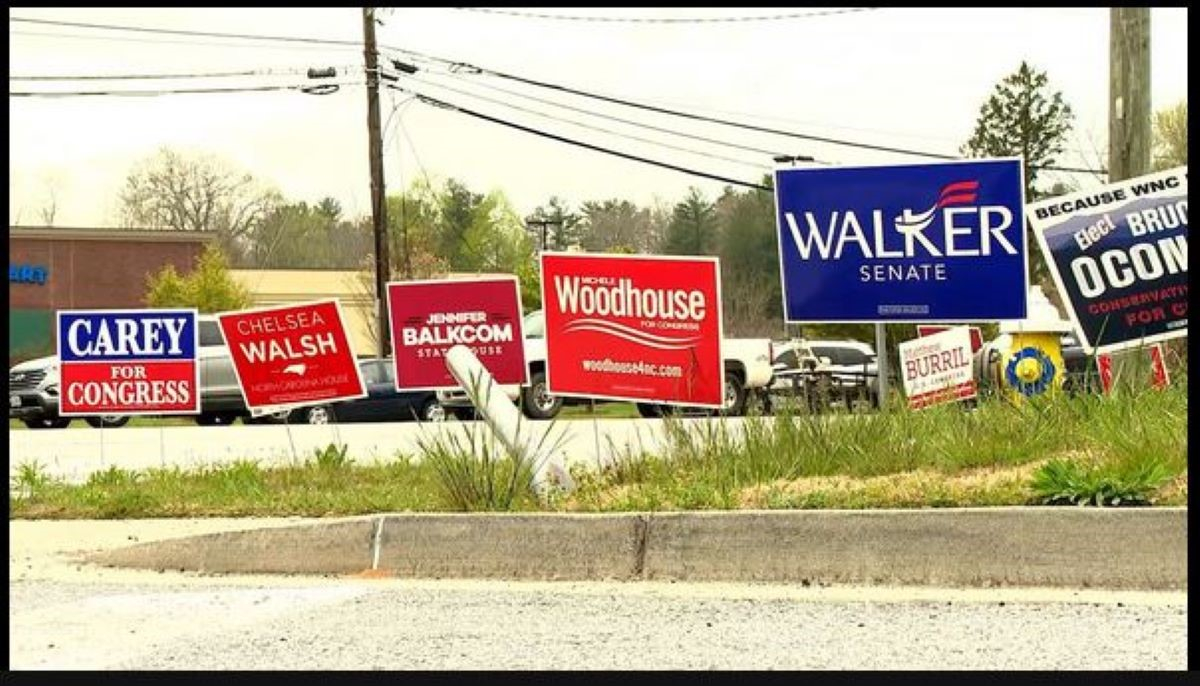
This mishmash of sides will thin out on May 17, when voters choose who will represent them in the General Election.

The stakes are not insignificant.

North Carolina has maintained a workable political balance with a Republican-majority state legislation and a Democrat governor. Although most voters seem content with such arrangement, activists are not.

At the more contentious Federal level is where swords are drawn. The U.S. Senate is divided 50-50, with the Vice President, a Democrat, being the tie breaker. U.S. Senator from North Carolina, Richard Burr, a Republican, is retiring. His successor, depending on affiliation, can help either maintain or upset the 50-50 balance.

Then there is the Trump Effect. Former President Donald Trump won in North Carolina in 2016 and in 2020. Some say Trump’s influence in North Carolina will be determined if his endorsed candidates do well in the May 17 primary. Others point that the leading contender in North Carolina’s important U.S. Senate race is Trump-endorsed Ted Budd.

On the other side of the coin is the Millennial Effect. Liberal states like California are emptying out, and the bulk of the out-migrants are young professionals. Wake County, N.C., for example, is full of them, since the burgeoning Research Triangle offers well-paying jobs and pleasant low-cost living. Wake County is politically blue, and locals say that Cary stands for “Concentrated Area of Relocated Yankees.”

Thus, battles between factions rage

In his speech marking the anniversary of the January 6 debacle President Joe Biden said,

“I have said it many times. It’s no more true or real than when we think about the events of January 6. We are in a battle for the soul of America.”

A bit melodramatic but apropos. Today’s battle is not over one or two issues, like The Vietnam War or the New Deal. The battle, daunting and relentless, is over a wide range of subjects that are sometimes lumped together in phrases like “our democracy” or “make America great.”

At its core, the fight is about preserving our Constitutional Republic or abandoning it in preference of a Marxist-based democracy. States like California or New York have already chosen Marxism, so there is no real battle there. Residents of swing states like North Caroline, Florida, and Texas are still waging war.

Good to be where political choices still exist.

Marcy Berry
Editor
Just Vote No Blog

North Carolina’s Dr. Ralph Baric, Virologist

North Carolina’s Dr. Ralph Baric is praised for his cutting-edge SARS-CoV-2 research, but not without controversy.

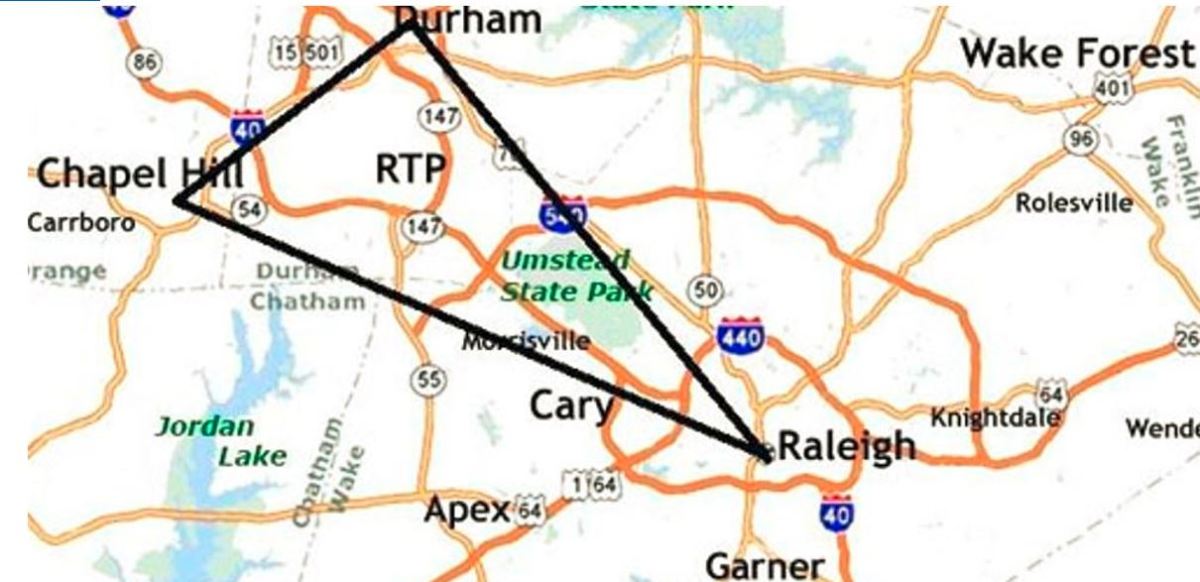
North Carolina’s Research Triangle is home to world-class institutions. The Triangle gets its name from Research Triangle Park and three Tier 1 research universities—Duke University, North Carolina State University and University of North Carolina Chapel Hill. Thus, it is not surprising to find North Carolina scientists on the forefront of coronavirus research and pharmaceutical development.

One such person is Dr. Ralph Baric, distinguished researcher and professor at the University of North Carolina, Chapel Hill. Recognition for his contributions to coronavirus research and vaccine development abound. Among his accolades in 2021 are the O. Max Gardner Award which recognizes faculty within the UNC System that make “the greatest contribution to the welfare of the human race,” and the News & Observer Tar Heel of the Year award given to North Carolina residents who have made lasting contributions to their community and state.

Acknowledgement of individuals in any cutting-edge endeavor never comes without controversy. In today’s hyper reaction and response to the corona virus pandemic, Dr. Baric’s virus engineering is especially controversial. Dismissing concern about his work as conspiracy theory does not help, since it detracts from the immense complexity of such work. Some of the arguments are worth repeating.

The Lab-Leak Debate

In its September 2021 issue, the Atlantic carried an article about a proposal presented by Peter Daszak, President the EcoHealth Alliance, to DARPA (Defense Advanced Research Projects Agency) in 2018, describing a $14.2 million project to defuse the threat of bat-borne coronaviruses. Here is an excerpt from The Lab-Leak Debate Just Got Even Messier, the Atlantic, 09/26/21.

The document seems almost tailor-made to buttress one specific theory of a laboratory origin: that SARS-CoV-2 wasn’t simply brought into a lab by scientists and then released by accident, but rather pieced together in a deliberate fashion. In fact, the work described in the proposal fits so well into that narrative of a “gain-of-function experiment gone wrong” that some wondered if it might be too good to be true.

Central figures in the coronavirus-origins debate were involved. Among Daszak’s listed partners on the grant were Ralph Baric of the University of North Carolina at Chapel Hill, an American virologist known for doing coronavirus gain-of-function studies in his lab, and Shi Zhengli, the renowned virus hunter from the Wuhan Institute of Virology.

Risks vs. Benefits of Virus Engineering

In June 2021, MIT Technology Review discussed the risks of bat-virus engineering that need to be weighed against the urgency of emerging pandemics. The article quoted Dr. Ralph Baric’s assessment of risk vs. benefit. Here is an excerpt from Inside the risky bat-virus engineering that links America to Wuhan, Technology Review, 06/29/21

His 2015 paper, “A SARS-like cluster of circulating bat coronaviruses shows potential for human emergence,” was a tour de force, utilizing bleeding-edge genetic technology to alert the civilized world to a looming danger on its periphery. It also revived concerns about gain-of-function experiments, which Baric had known it would.

In the paper, he spelled out the extra precautions he’d taken and held up the research as a test case. “The potential to prepare for and mitigate future outbreaks must be weighed against the risk of creating more dangerous pathogens,” he wrote. “Scientific review panels may deem similar studies building chimeric viruses based on circulating strains too risky to pursue.”

The NIH decided the risk was worth it. In a potentially fateful decision, it funded work similar to Baric’s at the Wuhan Institute of Virology, which soon used its own reverse-genetics technology to make numerous coronavirus chimeras.

Quest for the Universal Remedy

As arguments pro and con COVID-19 vaccines rage, scientists on the fore front of vaccine development will inevitably receive both accolades and criticism. Again, dismissing all con arguments as conspiracy, anti-science, or anti-vaxxer is unhelpful. More rational and helpful would be to acknowledge that, as human beings, none of us produces perfect solutions, free from human limitations and frailties. Picking a best balance between risk and rewards is perhaps the best any of us can do.

The MIT Technology Review article quoted earlier mentions Dr. Baric’s efforts to develop “universal drugs and vaccines against the full spectrum of SARS-like viruses.” A breakthrough came with his collaborative work in 2013 with Dr. Shi Zhengli, the virology at China’s Wuhan Institute of Virology.

Shi had detected the genome of a new virus, called SHC014, that was one of the two closest relatives to the original SARS virus, but her team had not been able to culture it in the lab.

Baric had developed a way around that problem—a technique for “reverse genetics” in coronaviruses. Not only did it allow him to bring an actual virus to life from its genetic code, but he could mix and match parts of multiple viruses. He wanted to take the “spike” gene from SHC014 and move it into a genetic copy of the SARS virus he already had in his lab. The spike molecule is what lets a coronavirus open a cell and get inside it.

The resulting chimera would demonstrate whether the spike of SHC014 would attach to human cells. If it could, then it could help him with his long-term project of developing universal drugs and vaccines against the full spectrum of SARS-like viruses that he increasingly considered sources of potential pandemics.

From Splicing to Vaccination

Dr. Baric holds Patent number 9884895 Methods and compositions for chimeric coronavirus spike proteins, among his many other scientific papents. As the inventor of this product (with Drs. Sudhakar Agnihothram and Boyd Yount), Dr. Baric can claim a major contribution to the development of COVID-19 vaccines.

Risks Necessitate Free and Informed Choices

Identification and manipulation of viral spike proteins entail serious risk. But so is being exposed to the coronavirus without the choice of protection via a vaccine.

Researchers in the life sciences are the primary line of defense against organisms that harms us. Polio and smallpox are no longer the scourges they once were. Hopefully, soon SARS-CoV-2 will also be tamed in a collaborative approach that allows for rational and free assessments of risks and benefits.