Guns and North Carolina Senate Bill 50

The North Carolina legislature needs to deeply reflect on Senate Bill 50, calendered for September 22, 2025. Facilitating more guns in the hands of teens does not seem wise or necessary.

If you ever had children you know the challenges of the Terrible Twos and the Teen Years. The Teen Years especially at times seem designed to give parents premature white hair. Yet, the North Carolina Legislature would like to allow 18 and 19 year olds to waltz into a gun shop, purchase a gun, no permit, no training, and carry that gun in whatever manner they please.

North Carolina Senate Bill 50, “Freedom to Carry NC” — sponsored by Senators Danny Britt, Warren Daniel, and Eddie Settle – was filed February 4, 2025. The bill was predictably vetoed by Governor Josh Stein on June 20 and returned to the Legislature. Stein’s veto was overridden by the Senate on July 29. But SB50 seems to have met with some cautious minds in the General Assembly and calendered, for the third time, for September 22, 2025.

Behind SB50 is the US Constitution’s Second Amendment.

Also predictably, Gun Owners of America emphatically responded to the veto of SB50. Here is an excerpt of their press release of July 23.

“We have reached a critical point in the fight for Constitutional Carry in North Carolina. As you know, Senate Bill 50, “Freedom to Carry NC,” successfully passed both the House and Senate this legislative session, a testament to your collective advocacy and the tireless efforts of state groups such as Grass Roots North Carolina.

However, last month anti-gun Governor Josh Stein chose to veto SB 50. This decision is a direct challenge to the fundamental rights of law-abiding gun owners across the state.”

Now, “the right of the people to keep and bear arms,” as stated in our Constitution’s Amendment II, absolutely must not be infringed. This Just Vote No Blog stands by the obvious truth that without the Second Amendment, all other Amendments are meaningless. Our Founders were totally clear that governments can go rogue, and without arms the people have no way to fight back.

Therefore, organizations like the Gun Owners of America are absolutely correct in defending the “fundamental rights of law-abiding gun owners.”

But what’s wrong with this picture?

Over the years, we have gone from rural families who used rifles for hunting and self defense, to an urban society with these statistics:

* About eight-in-ten US. murders in 2023 – 17,927 out of 22,830, or 79% – involved a firearm.

* More than half of all suicides in 2023 – 27,300 out of 49,316, or 55% – also involved a gun.

So, in a valiant effort to deal with this most unfortunate situation laws were passed to ensure that guns were only allowed in the hands of “law abiding” individuals.

Dutifully, North Carolina’s Senate Bill 50 sports a laundry list of folks who cannot own a gun, like felons, fugitives, addicts, mentally incapacitated, dishonorably discharged from the armed forces.

However, in North Carolina gun dealers not federally licensed can freely sell arms without any requirements for purchasers background checks. Their only responsibility is to avoid “knowingly” selling a firearm to anybody who by law cannot have one. Under such circumstances, how SB50 can limit the blessings of gun ownership only to the “law abiding” seems unclear.

Meanwhile a day does not go by without the news reporting someone being shot, fatally or otherwise. Youth remains hotheaded and eager to solve challenges by pressing a trigger. Mothers and fathers lose their children to suicides by firearms.

A balance of facts is needed.

The US has a sizable number of engaged voters, the highest rate of private gun ownership in the world, and the Posse Comitatus Act of 1878 which slows down (obviously not stops given recent events) US military action in US soil. Thus the likelihood of our government going rogue is not high.

Conversely, a report published by the Tampa Bay Times dated February 7, 2024 is much more clear in the likelihood of a youth 18 to 20 harming someone with a gun:

“Crime data in the United States is notoriously incomplete, but experts agreed that general trends from state and FBI data show people ages 18 to 20 — and in many datasets people in their early to mid-20s — are likelier to commit deadly shootings than other age groups.”

The North Carolina legislature needs to do further reflection on Senate Bill 50. Legislators, especially those with children, need to acknowledge that teens have developing – not developed – brains. Legislators also need to acknowledge that they are not being entirely honest placing the laundry list of who cannot have a gun, when North Carolina allows for gun sales without any background checks.

Yes, the Second Amendment is what really keeps the nation’s populace free. And we have more than enough brave law abiding adult citizens to ensure our freedom. Facilitating more guns in the hands of teens does not seem wise or necessary.

Picture:

Memorial for 14 year old Lyric Woods and 17 year old Devin Clark, who on September 17, 2022, were shot to death. Suspect is Issiah Mehki Ross, 17 years old at the time of the murders. New York Post, November 8, 2022.


Paycheck to paycheck America

Increasingly, since the 1970s Americans get stuck in survival mode, rather than thrive mode. More and more workers are living paycheck to paycheck. What happened?

There is no longer denying that the rich are getting richer and the poor are getting poorer. The once iconic American middle class has all but disappeared. There is, however, plenty of denying contributing events – and therefore solutions – for such a pickle.

There were plenty of events. Here are some, certainly not all:

The 1970s saw an economic watershed.

From the end of WWII until the 1970s, incomes of the rich, not so rich, and poor rose around the same pace. Household savings rates were around 7 to 10%, a healthy percentage that allowed people to build capital and improve their lot.

The 1970s saw the start of a widening income, savings, and wealth gap. Today’s average household savings rate is 4.5%. Incomes of the less-than-rich tend to cover household expenses and not much else. Moving up the economic ladder under such circumstances is a nearly impossible feat.

The 1970s also saw a cultural watershed.

Lyndon Johnson’s Great Society was a herculean effort to deal with poverty through social welfare. Congress passed legislation enshrining President Johnson’s agenda between 1964 and 1968. By the 1970s public assistance was culturally accepted as the way to improve the lot of the poor.

That is still the case today. Legions of government programs, non-profits, and billionaires’ tax-advantaged foundations exist today to end poverty.

1971 saw the birth of fiat money.

The Great Society social programs that started in 1964, the Vietnam War (1955 – 1975), and a Federal Reserve that did not respond forcefully enough to unbridled government spending and rising prices, all contributed to inflation that reached 5.89% in 1969.

Such level of inflation decimated the value of the U.S. dollar, and a run on U.S. gold appeared probable. So, President Richard Nixon ended the country’s gold standard in 1971 – releasing the fiat money genie out of the bottle!

Without the market restraints inherent in a gold standard, government folks became free to borrow and spend. And free to keep interest rates down to facilitate payment in the ever increasing national debt.

Sharp-eyed folks in the general population figured windows of low interest rates and cheap money allowed them to borrow, invest, and grow rich.

Technology helped.

In the olden days, stocks were considered risky business not suitable for average respectable people. However, as technology gave average respectable people the Internet, access to on-line accounts, apps, social media, and a dizzying array of asset classes, investment in intangibles was democratized.

Then came financialization.

An old working paper dated December 2007, by Thomas Palley, in conjunction with The Levy Economics Institute of Bard College, has a very good description of financialization. In Financialization: What is it and Why it Matters, Dr. Palley wrote:

“Financialization is a process whereby financial markets, financial institutions, and financial elites gain greater influence over economic policy and economic outcomes. Financialization transforms the functioning of economic systems at both the macro and micro levels.

Its principal impacts are to (1) elevate the significance of the financial sector relative to the real sector (2) transfer income from the real sector to the financial sector, and (3) increase income inequality and contribute to wage stagnation. Additionally, there are reasons to believe that financialization may put the economy at risk of debt deflation and prolonged recession.

Financialization operates through three different conduits: changes in the structure and operation of financial markets, changes in the behavior of nonfinancial corporations, and changes in economic policy.”

Basically, financialization says, why should a company bother with working to create better widgets or bother with managing a productive labor force. So much easier to make money from financial transactions like acquisitions facilitated by fiat money, stock buybacks to inflate value of outstanding shares, or speculation with today’s equivalent of puka shells– cryptocurrencies. What companies save on labor, goes to CEOs and shareholders.

On the other side, much of workers’ consumption changed from that based on wages to that based on debt. And looks like powers that be in the marketplace and in government are fine with that.

The rise of institutional investors followed.

Around the late 1970s, institutions like Vanguard, Fidelity Investors, and other fund managers popularized a variety of financial products, including mutual funds and 401-k management. This attracted investors, contributed to fund managers’ growth, and eventually resulted in institutional investors today accounting for about 80% of the volume of trades on the New York Stock Exchange.

Note that these institutions do not own the stocks and other instruments they manage. It is America’s wealthiest 1% that own 50% of stocks, while the 10% wealthiest own nearly 90% of stocks.

This level of shareholder power is bound to divert profits from labor to dividends and/or CEO compensation. Note that a large portion of CEO compensation today is in stock and tied to how well the CEO enriches the company’s shareholders.

Meanwhile, wars on poverty focus on social welfare.

Since the 1960s rivers of money have gone into social welfare. Most improvement, if any, in the lot of the poor has come from handouts. Lower-income earners have remained stuck in survival mode, rather than rise to thriving mode.

Certainly, there have been the relatively few that rose from very modest beginnings to wealth. But here we are talking about the average worker in the fast-food, home-health care, hospitality, and other lower-paying industries.

Included in handouts are government mandates such as minimum wage increases and rent control. These two mandates especially reveal the cynicism inherent in legislatures. Politicians surely have a modicum of knowledge of the realities of the marketplace, which they purposefully to ignore.

Surely, they must realize that when you increase people’s power to spend without an equal or greater increase in output, you end up with inflation. A 3% increase in the price of hamburger is not a big deal for the well to do, but very unfortunate for the poor.

Politicians must also realize that investors, like landlords, want a certain profit, and when you mess with that profit through rent control, they stop being landlords and go invest in something else. Fewer landlords mean fewer housing, and potentially more poor families living in their car or worse.

Awareness is the first step to cure

We cannot go back in time, but we can stop pretending handouts work.

Schools that teach not indoctrinate or coddle work, discipline works (in school and at home, for kids and for adults), work ethics work.

Cottage industries (stuff you make at home and sell) work. Fiscal responsibility at home and in government works (especially reducing the national debt before interest eats up all of GDP!). Politicians that promise wider opportunities for people to earn a living, not freebies and AI, work.

America is still the land people of over the world want to come to. But many American families must be wondering, “What happened to the Middle Class.”

We need to make our kids happy again

Today, our children and youth, coddled by parents and government, have shed the masters of the workhouses and acquired the masters of advertising and agendas.

School age children today exhibit greater emotional instability than in the past, seen since around the 1970s in poorer academic performance, inattention, incidents of violence, and suicides. Society’s response has been to significantly increase the number of mental health counselors present in schools, so far it appears to no avail.

To a hammer everything looks like a nail.

To the American Psychological Association, “With a growing mental health crisis among young people—a trend both exacerbated and illuminated by Covid—the need for school psychologists is multiplying.”

However, to a layperson with an open mind, there should be something amiss with this one-solution mindset, especially since it does not seem to be working. The “growing mental health crisis” did not develop in a vacuum – nothing does. Should we not look for what changed in the past few decades that might have contributed to the “crisis” and fix those variables?

Here are some likely candidates.

Bad Therapy: Let’s begin with the emphasis on mental health in schools – “trauma informed education” – that encourages inward-looking, self-awareness, and emotional skills. A common sense question should be whether “An individual is more likely to meet a challenge if she focuses on the task ahead, rather than her own emotional state. If she’s thinking about herself, she’s less likely to meet any challenge.” (How Bad Therapy Hijacked Our Nation’s Schools, The Free Press, 02/27/24.)

Clueless experts: “Experts” nowadays seem to come with an agenda, rather than with common sense. For example, when someone blames poverty and lack of sufficient services for the sad state of our youth, the question should arise, was there no poverty in the past?

Denatured foods: Nutrients in our foods feed our bodies, our brains, our energy levels, our well being. The detrimental effects of processed foods should be obvious to everyone. However, more insidious is the prevalence since the 1960s of denatured (meaning altered) fruits and vegetables, which contain significantly lower nutrient contents. In an effort to increase fresh produce yield, resistance to disease, storage life, transit capability, attractiveness, and other beneficial characteristics, farmers choose to grow hybrid varieties. Unfortunately, in nature we often lose one characteristic to gain another. (Industry Scandal: The Loss Of Nutrients, 07/20/24)

Barren existence: Boomers like to tell how when they were kids, their free time was spent outdoors, jumping rope, making up games, deciding who went first and whose turn it was to wait, watching fireflies, and hurrying home just before suppertime (lateness had consequences). Hot summers in the inner cities were famous for fire hydrant sprinkling & splashing. Too many kids today have supervised playdates and structured activities — if they are lucky. Otherwise, chances are their time is spent in front of TV screens, on endless scrolling on smartphones, texting, or immersed in video games where differences are solved by shooting opponents and blowing things up.

Screen time: It should be obvious to anyone with an iota of common sense that today’s addiction to screens cannot be healthy or lead to productive social interactions. Yet parents and teachers seem to lack the will or authority to keep youth away from screens (often they themselves suffer from screen addiction). Worse, video games — purposefully and obsessively designed to addict, extract information, and monetize — fill hours of youth time. “Gaming audiences form a wide-ranging, worldwide community that goes beyond age, gender, and cultural limits … They’re deeply involved in these games, making them a prime audience for tech, entertainment, and lifestyle ads … Gaming audience spend a lot of time playing, giving advertisers a great chance to connect.” ( Advertising in Gaming: Who are Gamers?, Iion, 03/25/24)

But in the old days there were the work houses…

Media and other communicators are fond of pointing out the plight of children and youth in days gone by, when there was no “regulation” or “services.” Indeed the life of poor and sometimes orphaned children and young adults was certainly not idyllic in the past. Child labor, work houses, illiteracy, and often hunger were common.

Society did eventually recognize and effectively deal with those egregious conditions, mostly though legislation.

Unfortunately, as is so often the case, solutions implemented to solve one problem spawn other problems. Today, our children and youth, coddled by parents and government, have shed the masters of the workhouses and acquired the masters of advertising and agendas. Promotional advertising creates lifestyles, and agendas create dependence on everything from government assistance to youth gang requirements.

Looking back might help

Maybe looking at the array of variables that made kids different back in the day would help. Those variables could include hard working two-parent households, parents with high expectations of their children, teachers willing to impose discipline and expect performance, focus on the 3 Rs of education, and effective (not ineffectively brutal) law enforcement to ensure safe neighborhoods where all kids can play outside.

Interestingly, all those variables include action, not the navel gazing today’s “experts” encourage our kids, to wallow in!

Picture: Kids playing in the street around the 1940s, from the New York Public Library Digital Collections.

North Carolina proposed a Convention of States – Be wary

Article V Convention of States is a bulwark against federal government abuses. Only problem is it has never been used and nobody knows how it works.

On December 5, 2024, the North Carolina State Legislature passed a Joint Resolution applying to the U.S. Congress for an Article V Convention of States to limit the term of Congressional Leaders.

To those familiar with what a Convention of States is and what pros/cons such a convention carries, kudos. This Just Vote No article is for folks who say, “What are we getting into here?”

So, first off, what is Article V

Article V of the U.S. Constitution is a crucial bulwark against federal government abuses. It gives states and its people the right to amend the Constitution whether the federal government likes it or not. This form of redress has never been used. All 27 Amendments to the Constitution have been placed via another route offered by Article V – Congress proposes, and states ratify. Here is Article V:

“The Congress, whenever two thirds of both houses shall deem it necessary, shall propose amendments to this Constitution, or, on the application of the legislatures of two thirds of the several states, shall call a convention for proposing amendments, which, in either case, shall be valid to all intents and purposes, as part of this Constitution, when ratified by the legislatures of three fourths of the several states, or by conventions in three fourths thereof, as the one or the other mode of ratification may be proposed by the Congress; provided that no amendment which may be made prior to the year one thousand eight hundred and eight shall in any manner affect the first and fourth clauses in the ninth section of the first article; and that no state, without its consent, shall be deprived of its equal suffrage in the Senate.”

The language of Article V is purposefully lean.

Our Founders established an experimental way of governing – We the People, on our own or via our elected representatives, decide the nation’s path. Article V guarantees an antidote against federal misconduct but leaves open how states (The People) use it.

It is clear from the language of Article V that applications from 34 states (2/3 of 50 states) are needed for Congress to call for a Convention of States, and that whatever amendments are proposed at such Convention must then be ratified by the legislatures of 38 states (3/4 of 50 states).

Other than that, at present, there is nothing.

We have no precedent for guidance. We have no rules that guarantee what states propose is what delegates will aim for at a Convention. There is nothing about who can be a delegate, or how delegates should be chosen. We have no guidance when or how U.S. Courts can intervene if amendments stray too far from the intentions of our Founders.

It is not even clear when Congress is required to call a Convention of States, since there is disagreement how applications should be counted. Article V says nothing about subjects on applications, nothing on whether applications expire or are forever valid, nothing on how to count or not count rescinded applications.

Even if we all agree to count only applications currently clearly on the table, does Congress count 9 applications for “Term Limits” and 25 to go. Or count 9 for terms limits plus 19 to “Limit the power and jurisdiction of the federal government, impose fiscal restraints, and place term limits on federal officials,” so only 6 to go.

Therefore, voters should be wary of assertive self-assured applications.

Here is the wording of Section 1 of the North Carolina application for a Convention of Stares,

“SECTION 1. The legislature of North Carolina hereby makes an application to Congress, as provided by Article V of the Constitution of the United States of America, to call a convention limited to proposing an amendment to the Constitution of the United States of America to set a limit on the number of terms that a person may be elected as a member of the United States House of Representatives and to set a limit on the number of terms that a person may be elected as a member of the United States Senate.”

Although this language and that of other applications sound completely straight forward, the people can only depend on the good character and promises of Convention delegates.

The chances that promises would be kept or not is anyone’s guess.

Even a cursory search on the Internet for “Convention of States” will yield numerous pros and cons. The pros mostly point out that a Convention is needed to do the job Congress refuses to do, and there should be no fear of a “runaway Convention” given the specificity of Convention applications. The cons simply disagree that any specificity can exist based on the language of Article V, and Congress’ dysfunction can be easily cured by voters at the ballot box.

Both sides can be right, since Article V doesn’t say much! Both sides can try to guess what the Founders intended via the Federalist Papers or other writings, and one guess would be just as good as another.

Both sides often bring up the first and only Constitutional Convention, which convened in Philadelphia in the summer of 1787. The pro side points to the fact that this was a Constitutional Convention, a different animal than a limited Article V Convention of States. The con side sees no difference, based on the language of Article V.

Y’all remember what happened there? That 1787 Convention, attended by George Washington, Alexander Hamilton, James Madison, and other great minds of the time convened to improve the Articles of Confederation which lacked a way that states could operate in concert by a set of rules. As we all know, delegates did not improve the Articles of Confederation but instead wrote a whole new Constitution.

It all sounds a bit too risky. Even if we say the real intent of Convention of States is to scare government into taking action, uncertainties of what happens if a Convention is called remain.

How about the good old ballot box?

The ballot box remains the only sure-fire way that people can control what government does. If voters want a smaller fiscally restrained government, don’t groan and grind teeth when radicals in Congress speak out against increasing spending limits. If voters want terms limits, stop voting for career politicians and support the “citizen statesmen” that our Founders envisioned.

Want to hear the pros/cons first hand?

For those interested in a good collection of pros and cons all in one place, here is a link to a YouTube video called Conference on the Constitutional Convention: Legal Panel. This conference was presented by the Harvard Law School. Five panelists participated in the discussion.

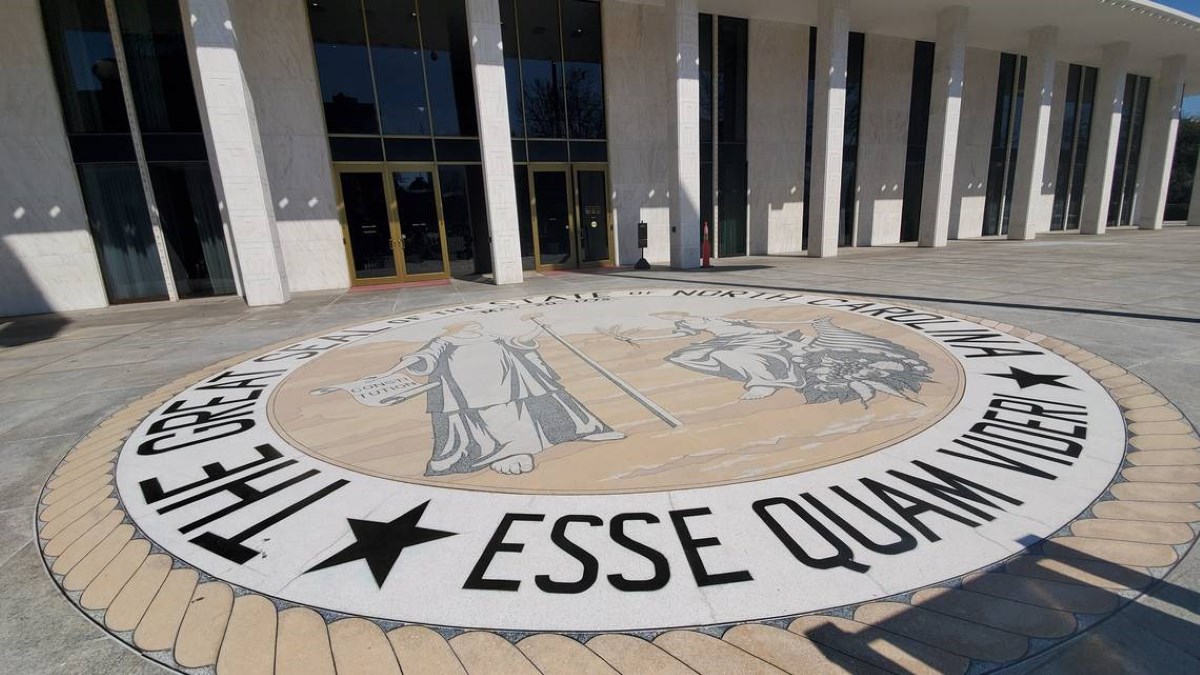
Picture: The Great Seal of North Carolina is embedded in the walkway at the main entrance of the North Carolina State Legislative Building. Around its edge is the state motto, “Esse Quam Videri,” Latin for “To be, rather than to seem.”

On day one, mind our house divided

Victorious conservatives see the recent decisive presidential election as a mandate for radical change. And progressives are predictably suiting up for battle. A house divided cannot stand.

The recent decisive presidential election showed that a significant number of voters were mad as hell and were not going to take it anymore. However, the aftermath showed some with fear of real and imagined threats and public figures vowing to fight in defense of their turf. Everyone seemingly ignoring that “A house divided against itself cannot stand.”

Abraham Lincoln spoke of the peril of a house divided — quoting Matthew 12:25 — at a time of great national sorrow, when the Southern economy dependent on slave labor was made to face an anti-slavery movement. Today, our nation is on a similar, although thankfully not as tragically wrenching, position of divisiveness: populous coastal states dependent on a redistributive economy were made to face a solid mass of conservative middle states.

Obviously, magnitude of suffering is not what can be compared between today’s divisiveness and the post-Civil War discord. What can be instructive, however, is an assessment of what works best after an upheaval. The post-Civil War Reconstruction period tried both change through conciliatory compromise and change through forced acquiescence. The latter overwhelmed the former, leaving unhealed wounds residues of which linger to this day.

Andrew Johnson, Vice President during Abraham Lincoln’s administration, assumed the presidency upon Lincoln’s assassination. He attempted to follow Lincoln’s advice to bind up the nation’s wounds by adopting a conciliatory approach to full emancipation of former slaves.

His efforts were ineffectively lenient, given the enormity of the challenge. The defeated South experienced rampant violence against former slaves. Radical Republicans in Congress upon achieving a majority, implemented a vastly more stringent agenda, imposing military rule in the South, and disenfranchising Southern rebels.

While Radical Republican actions enabled basic requirements of equality with passage of the 13th, 14th, and 15th Amendments to the Constitution, they also ushered Jim Crow. From Whites Only water fountains to Whites Only suburbs, Jim Crow lasted for nearly 100 years. The last vestiges of which were legislatively erased by the Civil Rights Act of 1964, but Jim Crow left an entire population of citizens playing catch up.

We should accept that Andrew Johnson’s conciliatory approach did not work. However, we should also speculate whether the Radical Republican approach might have been too harsh, producing unfortunate boomerang effects.

The result of the 2024 presidential election is being lauded by supporters as a mandate for radical change that will necessitate radical actions. Predictably, progressive-socialist bastions are already suiting up for battle – the boomerang effect is already evident.

Progressive state governors like Gavin Newsom of California, J.B. Pritzker of Illinois, Kathy Hochul of New York, and Maura Healey of Massachusetts are leading the charge – in the words of Gavin Newsom – to “Trump-proof” their states.

Less strident state leaders have issued more thoughtful messages. Minnesota Governor Tim Walz made a good point: the Trump-Vance team often spoke of leaving decisions to the states; therefore, he is “willing to take them at their word for that.” Walz listed the areas he will defend: abortion rights, climate change, gun restrictions in schools and labor rights. These issues are good ones for the federal government to handle with finesse rather than bluster.

Admitedly, there are issues that need to be handled firmly, but hopefully not belligerently.

It should be obvious by now given the nation’s current unsustainable $35 trillion debt that government is spending beyond its means trying to support an obscenely bloated bureaucracy and a dependent legal and illegal constituency. The incoming administration has pledged to trim both.

Hopefully, in its efforts to keep its pledge the new administration will act “with malice toward none” by avoiding unnecessary acrimonious words and deeds. This tactic will do wonders to heal the nation’s divisiveness and set it on a path to greater prosperity.

Hopefully, the new majority in Congress will heed its Constitutional duties “to pay the Debts and provide for the common Defense and general Welfare of the United States.” (Article I, Section 8, Clause 1). For the last two decades, Congress has abdicated most of its Constitutional responsibilities, by loosening its purse strings ($35 trillion in national debt), adopting a lenient approach to homeland security (open borders and a military not fully prepared), and forgetting what “general” as opposed to selective welfare means.

Hopefully, new leaders will focus on the big picture – national expenditures, prosperity, and a safe homeland. And defer posturing, especially in signing of Executive Orders.

Hopefully, new leaders will mind history and the perils of a house divided.

Budgets and bills with bolts from the blue

The North Carolina legislature is getting pretty good at inserting surprise policy into last-minute budgets and tacking unrelated items into bills. Some people call these “riders.” Some call it legislating by stealth. None of it good.

A useful new series of articles called “Power & Secrecy” in The News & Observer, one of North Carolina’s premier newspapers, digs into policies emanating from the current state legislature. As its name suggests, the series aims to shed light into veiled actions by the state’s legislative leaders meant to grow legislative power.

Spoiler alert.

The N&O leans left, so it is tempted to emphasize that the current state legislature, faults exposed, is a veto-proof Republican majority. Since seeking power is a party-independent endeavor, emphasis should be on the “veto-proof majority” part, not the “Republican” part.

Things that jump out unexpectedly from budgets and bills.

The North Carolina legislature is getting pretty good at inserting surprise policy into last-minute budgets and tacking unrelated items into bills. Some people call these “riders.”

By way of background. From the late 1980s to the mid-2000, operational rules of North Carolina’s House and Senate forbade tacking on new policy and spending in final versions of state budgets. In 2003, the Democrat-controlled state Senate started whacking off pieces of this prohibition. In 2011, the House, then Republican majority, started doing the same. Today, legislators are free to do both previously prohibited practices.

So, what’s the problem? Firstly, budgets are intended to be means by which legislators allocate funds to previously agreed upon rules, not means by which to create or modify rules. Secondly, there is no robust public debate on new policy inserted in budgets. Thirdly, legislators often pass budgets by way of conference reports, which require a Yes or No vote without possibility of compromise amendments. Fourthly, a tacked on unrelated rule to a bill also forces a Yes or No vote to the entire bill.

Lastly, the nature of riders is stealth, sliding by constituents.

An argument could be made that legislating by stealth saves time and contention. But, it also ignores a lot of constituents. Here are a couple of examples provided by the above-mentioned series of investigative articles:

  • Ignoring environmental concerns.

North Carolina is a pro-business state. However, it does have its share of liberal cities with environmentally conscious constituents that wish to curb business practices they deem environmentally harmful. Pre-emptive budget and bill riders passed by the state legislature prevent that.

The cities of Asheville and Durham were considering regulating plastic bags and food containers back in September 2023. Legislators stepped in with a rider on the state budget prohibiting any North Carolina city or county from regulating or taxing retail packaging.

The piles of Styrofoam and other plastics covering streams and other waterways can get pretty yucky. There isn’t much one can do to prevent wind and rain from moving litter in landfills and streets into storm drains and waterways. And there are biodegradable alternatives, like sugarcane containers.

  • Ignoring pollen, dust, smelly fumes…, and hard to trace campaign money.

Remember the Covid “guidelines” requiring that everybody wear a mask in public? Predictably, normalizing face masks prompted use by individuals who want to hide their identity – including rioters and demonstrators. So, in the usual first you create a problem then you try to solve it creating another problem, the North Carolina legislature passed House Bill 237, prohibiting public use of face masks. Sure, there are exceptions for people in seasonally-appropriate costumes, workers in unhealthy environments, and “Any person wearing a medical or surgical grade mask for the purpose of preventing the spread of contagious disease.” That’s it.

The “health exception” was placed when some legislators refused to sign the bill without the exception. But, apparently, in exchange, a campaign finance rider was tacked on to the mask bill. No, there is no connection between wearing masks in public and allowing political donors to give money to special federal political organizations, that then pass the money on to state and county parties.

Beware of mission creep.

As The News & Observer series on legislative power and secrecy continues, there will surely be much uncovered and placed in the public eye. Hopefully, voters will be watching.

The concern should be that without robust public input a legislature, regardless of stripe, becomes emboldened. It might also become less practical (i.e., being business friendly to grow the economy), and become more ideological (fill in the blank here with any ideology).

A recent article in the New York Times, picked up by several other publications, by columnist Nicholas Kristof wonders where have the majority-Democrat Party progressive legislatures in the West Coast gone wrong. He argues that “West Coast liberalism is more focused on the intentions behind its policies rather than its outcomes.”

A step beyond that would be more focused on personal ideologies than constituents’ wellbeing.

Picture: Micro plastics in the Neuse River. Plastic debris in waterways is not only unsightly, but disastrous. Most of it lasts for decades, and what decays ends up in fish’s stomachs and drinking water.

Student loans and the Great Bailout

Recommended item: Cameron Weber – economist, historian, and author of the popular book Economics for Everyone, is also producer of Hardfire TV, a political economics talk show. His latest show discusses student loan debt and debt “forgiveness.” It is worth watching for a different perspective.

Recommended item: Cameron Weber – economist, historian, and author of the popular book Economics for Everyone, is also producer of Hardfire TV, a political economics talk show. His latest show discusses student loan debt and debt “forgiveness.”

College tuition and student loan debt have suffered mind-boggling increases since the early 2000s. In an October 2023 report Education Data reported the following,

“Before adjusting for inflation, the average student loan debt at graduation has increased 106% since 2007; after adjusting for inflation, the average debt increased 41%.”

When adding to this sad statistic a February 2024 report by Inside Higher Ed indicating that nowadays 52% of college graduates are underemployed, seems that young people need to do some homework on what is causing such unfortunate situation.

The student loan segment on Hardfire TV might help. The show can be seen on YouTube.

A few words on political economics as preview.

Economics, especially political economics, wears several hats. It is not akin to, say, mathematics. Political economics is more like the costume of Le Bon Florian, Anatole France’s harlequin – viewed from one perspective the costume is red, and viewed from another it is blue.

The libertarian-leaning perspective of student loans and the accompanying student loan debt is that government intervention – subsidies – has incentivized colleges to raise their tuition to unsustainable levels. As tuition rises, so does student loan debt. The solution is to end the subsidies. This will force colleges to trim their offerings, staff, and tuition. Also, colleges will likely return to emphasizing work-study programs, and financial institutions in the marketplace will again compete to offer college assistance.

The progressive-leaning perspective is that government is a better provider than the marketplace. The marketplace increased tuition and student loan debt to untenable levels. Therefore, government needs to step in and abate that debt. Students and former students carrying the heavy burden of student loan debt are constrained from investing sufficiently in goods and services, thus fail to contribute fully to the economy. Everyone benefits when everyone contributes, which justifies taxation – income and debt redistribution.

And in the middle of these harlequinesque perspectives is the vision of the nation’s Founding Parents. This nation was founded as a grand experiment. It would be ruled not by kings or other sole decision makers, but by the people, like farmers, silversmiths, and carpenters. Therefore, education beyond that of the well to do and privileged was necessary. George Washington, Thomas Jefferson, John Adams were among those that argued in favor of public schools and colleges that would provide the populace with the wisdom, knowledge and awareness necessary to make wise decisions at the ballot box.

Letter from Thomas Jefferson to Richard Price, January 8, 1789. “… wherever the people are well informed they can be trusted with their own government…”

Letter from John Adams to John Jebb, September 10, 1785. “There should not be a district of one Mile Square without a school in it, not founded by a Charitable individual but maintained at the expense of the People themselves.”

So, would our Founders then support the idea of having free colleges today? Probably not. Today, things are quite different than back in the 1800s.

Today we talk about money earned by college graduates vs. non-graduates. Young people often major in trendy subjects, like gender studies or DEI, hoping to find positions in government programs or equally trendy corporations. Hardly expectations seeped in wisdom and awareness.

Agreed that not all was perfect back then. It took nearly 100 years for women and Black students to be routinely admitted into colleges. For a brief historical perspective:

Harvard University (originally called New College) was established in 1636, and Yale University in 1701. These and other equally fine schools, were Colonial institutions established for the education of white, mostly upper class, males.

Oberlin College started accepting women in 1837. 1865 saw the emergence of women’s colleges that offered courses comparable to those of men. By the 1880s women could acquire higher education at Vassar, Smith, Wellesley, Bryn Mawr, and Mount Holyoke colleges.

There were only a few Black colleges before the Civil War. However, between 1865 and 1900, several Historically Black Colleges were established, the majority in 1867, two years after Emancipation.

Today, qualified students are admitted to colleges and universities regardless of sex and color. But whether they are receiving the skills, wisdom, and work ethic the Founders had in mind is questionable.

As libertarian-leaning economists consistently point out, government often creates problems which it then tries to take credit for solving, only to create more problems. The problem of the ballooning student loan debt, and the perceived need for debt forgiveness is a prime example. Those of a libertarian bent suggest that government get out of the student loan business, and let private banks compete to offer students the best loan deal.

Maybe the November 2024 elections will inform us which side of the harlequin’s costume is the most appealing.

Picture: From YouTube video of the Hardfire TV show on Student Loans, with host Cameron Weber and guests Marcy Berry and Melissa Wilcox.

The consummate political football: Title IX

Rules under the new Title IX go into effect August 1, 2024. While the original 1972 Title IX was a straightforward 37-word mandate to treat women and men in educational environments equally, the new 2024 rules are a salad bowl of schemes sure to bring confusion rather than equality under the law.

On August 1, 2024, rules under President Joe Biden’s revision of Title IX go into effect. The new Title IX reverses the revisions provided by former President Donald Trump, which in turn reversed the revisions provided by former President Barack Obama.

Title IX has become a special kind of proverbial political football, as it grows bigger and more adorned with every presidential administration.

The rules, commonly known as Title IX, were signed into law by then President Richard M. Nixon as part of the Education Act of 1972. Title IX was a straightforward command based on the 14th Amendment’s Constitutional principle of equal protection under the law. It read,

“No person in the United States shall, on the basis of sex, be excluded from participation in, be denied the benefits of, or be subject to discrimination under any educational programs or activity receiving federal financial assistance.”

This 37-word directive worked just fine for three decades after its enactment, providing major educational opportunities for girls and women. Educational institutions could no longer exclude women from elite sports, courses, and activities – exclusions that were the norm rather than exceptions.

The original Title IX was not without opposition, especially from those concerned about its effect on time-honored and often lucrative men’s sports. However, all states complied with and implemented Title IX rules.

As time passed, meanings for the words “discrimination” and “sex” proliferated. In the case of Title IX, discrimination no longer simply meant not providing equal treatment, and sex no longer simply meant a difference in number of chromosomes or bodily characteristics.

Along with the growing interpretations of what is discrimination, of what is sex as opposed to gender as opposed to identity, and of who belongs to what category, came the proliferation of agendas. In 2024, the new Title IX looks more like a salad bowl of schemes than a necessary, ethical and Constitutional effort to provide equal protection under the law.

Yes, the argument can be made that the original 1972 Title IX broke with some conventions accepted by many at the time: Family and society need women as caregivers not as scholars or athletes. Elite educational institutions need the revenue and prestige brought by men’s athletics. Women’s athletics would dilute revenue and prestige. Women don’t like sports, anyway. However, all states accepted and complied with the new rules without major revolt.

The argument can also be made that a woman’s team that includes a biological male would have an advantage over an all-biological female team. And that would be a good thing for the inclusive team.

However, attorneys general in Alabama, Arkansas, Florida, Georgia, Idaho, Indiana, Iowa, Kentucky, Louisiana, Missouri, Mississippi, Montana, Nebraska, North Dakota, Ohio, Oklahoma, South Carolina, South Dakota, Tennessee, Texas, Virginia, and West Virginia have sued the Biden administration, arguing primarily that the administration exceeded its authority changing Title IX. Governors and state education officials in Arkansas, Florida, Louisiana, Montana, Oklahoma Nebraska, South Carolina, and Texas have directed their states’ educational institutions not to comply with the new Title IX rules.

The position of conservative, Republican-led states is that the new rules are a bridge too far in its intent to ignore physical differences by requiring protection against discrimination based on gender identity. Although the new rules stop short of specifically permitting biological men that identify as women competing in women’s sports, the rules lead to such permission by adding gender identity to protected characteristics.

Certainly, a biological male athlete that has received at least 2 years of gender-affirming care prior to puberty could claim his muscle size and strength is comparable to that of a biological female. Totally fair to allow him in women’s sports. But, nowhere in Title IX rules does that eventuality appear, thereby opening the doors to biological males unfairly competing with biological females.

The new Title IX rules are not only unfair to women but are also loaded with nuances likely to cause confusion.

The original 1972 Title IX established a new, straightforward rule that did not exist prior to the title’s enactment. The new 2024 Title IX heaps more prohibitions against infractions that are already punishable under federal, state and local laws, purportedly to tailor said infractions to sex and gender. For example, harassment, assault, violence, and stalking are already punishable. It should be questionable whether the new Title IX rules needed to list all of these already punishable infractions under “sex based” behavior – and why the rules did so. Is a sexual assault on a campus that receives federal assistance any different than a sexual assault in a shopping mall’s parking lot?

Legislators passed the original 1972 Title IX to help end the evident unfairness inherent in the exclusion of women from elite sports, courses, and educational activities. The Title IX rules helped women to achieve excellence in fields previously closed to them. If federal, state, and local jurisdictions abide by existing laws against all harassment and other violence, is there really a need for more than the original Title IX? Probably not. But factions have not resisted the urge to use Title IX as an agenda-driven political football.

Picture: New Zealand’s Laurel Hubbard, a trans athlete, competed in the women’s weightlifting team in the 2020 Tokyo Olympics. Hubbard was eligible to compete because his testosterone level was below the maximum allowed trans athletes at the time. Requirements did not take into account that if transgender care starts after puberty, biological males will keep their muscular advantage over females.

California dreamin’ of EVs

Often, when reading news from California, one wonders whether the state is at the forefront of innovation or delusion. California’s fixation with climate change and electric vehicles serves as example.

Often, when reading news from California, one wonders whether the state is at the forefront of innovation or delusion. California’s fixation with climate change and electric vehicles serves as example.

Here is a quote from one of the more progressive members of San Francisco’s Board of Supervisors, Rafael Mandelman.

We have to take action to expand our public EV-charging infrastructure and make EV ownership more accessible and practical for all San Franciscans.” … “Our curbside EV charging program is not just about installing charging stations. It’s about creating a more equitable and sustainable transportation ecosystem.” The City wants to add thousands of EV chargers by 2030, San Francisco Examiner, March 19, 2024.

San Francisco, as California, does have ambitious climate mandates, including plans for EVs for everyone and a ban on the sale of new gas-powered cars after 2035.

Given the real world, such climate ambitions border on delusional.

Supervisor Mandelman must be aware that San Francisco is projecting a deficit of $245 million in 2025 and a deficit of $554 million in 2026. He must also be aware that about 10% of the City’s residents live below San Francisco’s poverty rate, necessitating substantial subsidies if this population segment is to switch from gas-powered cars to EVs.

It is unknown whether Supervisor Mandelman wants to include the City’s 7,700 plus homeless population in his “equitable and sustainable transportation ecosystem.”

The high cost directly associated with EVs is not the only issue. Well-known shortcomings of current EVs include unreliable performance in extreme weather, need for more frequent charging than gasoline fill-ups, and electric grids that limit EV charging to specific times.

Beyond immediate inconveniences, EVs pose environmental challenges of their own.

Industry boasts that 95% of battery components can be recycled; extraordinarily expensively, but it can be done. However, industry seldom mentions that EV battery recycling is in its infancy, placing in question whether EV mandates are getting ahead of recycling capacity. As we all know, EV batteries are the last thing one would want in a landfill.

Although extraction of minerals necessary to produce EV batteries – mainly lithium and cobalt –is increasing, only a few countries extract these minerals in significant quantities. Australia, Chile and China extract the most lithium, while the Democratic Republic of the Congo extracts 70% of the world supply of cobalt. If EV mandates continue at the present rate, how long until environmentalists jump on the environmental challenges posed by widespread mining?

Despite mandates and incentives, drivers in the U.S. are not entirely sold on electric vehicles, according to an April 2023 Gallup poll. Current ownership is of EVs in the U.S. is only 4%. Gallup summarizes as follows.

“While ownership of electric vehicles is on the rise in the U.S., the percentage of Americans who say they own one remains limited at 4%. Though they are often promoted as a key way to reduce carbon dioxide emissions and address the effects of climate change, the public remains largely unconvinced that the use of EVs accomplishes this aim.”

As with all consumer goods, electric vehicles respond to price competitiveness and consumer needs. Without those two essentials, adoption of EVs at present can significantly increase only through government intervention. And here is where leaders like the aforementioned member of San Francisco’s Board of Supervisors, Rafael Mandelman, comes in.

Money to subsidize projects is never really a problem for governments, since taxpayers willing to fork over their hard-earned cash are always available. Consumer concerns with EVs are easily overcome by removing the alternative of purchasing gas-powered vehicles. Uneasiness with widespread mining is minimized by exporting environmental degradation.

Leaders have created a delusional world where petroleum disappears without credible supplies of products to replace petroleum and its thousands of derivatives. They have created an unnatural market where people buy what they don’t really want.

In the real world and the real market place innovators step in with new products that reliably and competitively replace products that no longer satisfy consumers. When whale bone became too costly due to overkilling of whales, plastics were invented. The decline of silkworms brought on the invention of nylon.

But, what can today reliably fly the thousands of airplanes in our skies except petroleum? What can credibly replace the hundreds of plastic products in our homes, especially our less affluent homes? Nothing. Because oil is efficient, and kept cheap relative to alternatives in large part as a result of government subsidies.

The oil and gas industry is expected to reap $1.7 billion in 2025 from the intangible drilling tax break, and $9.7 billion over the next 10 years, according to the White House. It is expected to realize $880 million in benefits from the depletion allowance tax break in 2025, and $15.6 billion by 2034.” The Zombies of the U.S. Tax Code: Why Fossil Fuels Subsidies Seem Impossible to Kill, The New York Times, March 20, 2024.

As long as oil is efficient and relatively cheap, it will take either gargantuan innovation to make EVs competitive or massive taxpayer-funded subsidies to make EVs affordable.

The real, non-delusional world, seldom allows us to have our cake and eat it too.

Pictured: Henry Ford’s electric vehicle prototype. The dream of electric vehicles is not new. Henry Ford worked with Thomas Edison for several years on an EV project before abandoning it. Some say the project did not work because of battery shortcomings, and some say the oil companies conspired to deep-six the project. Good article on the subject on Wired Magazine, Ford, Edison and the Cheap EV That Almost Was, June 18, 2010.

Why would wealthy families need school vouchers?

The newly-expanded North Carolina school voucher program – Choose your School, Choose your future – grants tuition assistance to any North Carolina family, regardless of income. Do wealthy families really need financial assistance to choose which ritzy school is best for their kids?

On May 17, 2023, the North Carolina Assembly passed House Bill 823, enthusiastically called Choose your School, Choose your Future. The bill expanded the state’s K-12 school voucher program, originally enacted in 2013 to assist low-income families. The Opportunity Scholarship, as the North Carolina voucher program is called, now grants vouchers to all North Carolina families regardless of income. Grants are on a sliding scale determined by family income, with amounts varying between $3,360 and $7,468 per child per year.

Legislators allocated $354.5 million for the Opportunity Scholarship program’s reserve fund for the 2024-2025 school year, and $416 million for the 2025-2026 year.

Lawmakers included HB-823 in the state’s $30 billion very much delayed and anticipated budget, which Governor Roy Cooper allowed to become law without his signature in September.

This program has received accolades as well as criticism.

Sadly, many traditional public schools are of poor quality and lately mired in controversy regarding race, gender, and sexuality. Children should not be stuck in such schools. The Opportunity Scholarship program is a godsend to lower-income families who cannot afford or who can barely afford private, including religious, schools.

However, back in May 2023, WFAE opinion columnist Tommy Tomlinson came up with an interesting description of the newly-overhauled North Carolina voucher program: “Robin Hood in reverse.” He said,

At some point, I have a certain grudging respect for the dedication some people have to playing Robin Hood in reverse — taking money from regular folks and handing it to the rich. Their latest maneuver here in North Carolina is a move to provide taxpayer-funded vouchers to any child in the state who wants to go to private school …

Kids from families with modest incomes have been eligible for similar vouchers here for the past 10 years. That, to me, actually makes some sense. It provides an escape route for a kid stuck in a failing school.

Wealthy families, whose children already attend the “ritziest schools in town” can argue that given the poor quality of public schools they are forced to pay both private school tuition and taxes that support public schools. Vouchers would help level their playing field. However, let us not forget that the working poor also pay taxes, some of which will help pay for school vouchers their wealthy neighbors receive.

Unfortunately, “Robin Hood in reverse” is not the only problem with universal school vouchers.

A worrisome possibility is a significant tuition increase.

North Carolina News & Observer education columnist T. Keung Hui noted in his excellent report of February 15, 2024, that some private schools have already announced tuition increases.

Private schools across the state are raising tuition and sending information to families about applying for Opportunity Scholarships. How much of the tuition increase is due to inflation or to take advantage of additional voucher funding is unclear. … The tuition rate increases for some schools across the state is more than 10%, which is well above the rate of inflation.”

People who attended college in the late 1980s might recall the shock wave of sudden tuition increases. Reasonably affordable four-year colleges became voracious, pushing students into quagmires of student loan debt. 1987 to 2010 witnessed a 106% increase in college tuition, according to a Mises Institute report dated November 30, 2021.

Coincidentally, the years 1980 – 2010 also saw expansion of college student loans guaranteed by the Federal government. William Bennett, President Ronald Reagan’s Secretary of Education, provided in 1987 his view for the college tuition increases he witnessed. Bennett’s assessment — what became known as the Bennett Hypothesis — was discussed in Science Direct, December, 2019

“Increases in financial aid in recent years have enabled colleges and universities blithely to raise their tuitions, confident that Federal loan subsidies would help cushion the increase.”

Scholars have debated the Bennett Hypothesis ever since it was first presented. But even when pitted against other possible reasons for substantial tuition surges — increase in attendance without concomitant growth in institutions, inflation, excessive regulation — the Bennett Hypothesis survives common sense. Is there a valid argument against the view that everybody likes money, and if it is available, most individuals and institutions will take it? Or a valid argument against expecting substantial expansion in school vouchers to have negative effects like those associated with college student loans?

Families should also be concerned about class sizes.

Mr. Hui of the News & Observer indicated an estimated 60% increase in students getting vouchers. Recipients that are already attending private schools will not affect class sizes, but students crossing over from public schools might. Chances are private schools will not rush to expand their facilities to accommodate the crossover population, which could result in increased class sizes.

Vouchers might not be operating on a level playing field.

Lower-income families and their advocates should ask themselves whether universal school voucher programs operate on a level playing field.

By way of comparison: Progressive advocates for poor and minorities often oppose voter ID requirements, citing that poor and minority voters face greater difficulties obtaining IDs. Would the same difficulties apply to obtaining school vouchers? Might more affluent, more educated families possessing greater resources hold advantages over the less fortunate?

Hopefully, in the interest of fairness, the priorities in receiving vouchers contained in HB-823 will lower any advantages held by wealthier families. Families whose children were voucher recipients prior to HB-823 (when there were income limits) will enter a voucher lottery first, followed by lower-income applicants; the more affluent applicants will enter the lottery last to receive what funds are left in the year’s allocation.

Lastly, do the wealthy really need vouchers?

The common-sense answer is clearly “No.” The title of House Bill 823 — Choose your School, Choose your Future – although catchy, is disingenuously applicable only to lower-income families. It is difficult to imagine circumstances in which wealthy families need vouchers to choose which ritzy school is best for their children.

Indeed, it is unfair that families with children who attend private schools pay both tuition and taxes that support public schools. However, universal school vouchers possess an unfortunate aura of benefits for the rich.

Conceivably a better idea might be to pass legislation absolving parents with K-12 children in private schools from paying taxes that support public schools, limiting vouchers to very low-income families living in poor-performing school districts, and improving the performance and cost effectiveness of public schools by practicing the good old focus on “reading, writing, and arithmetic.”

Picture: The beautiful Groton School in Groton, MA. Founded in 1884. Educating 380 students, grades 8-12.