The consummate political football: Title IX

Rules under the new Title IX go into effect August 1, 2024. While the original 1972 Title IX was a straightforward 37-word mandate to treat women and men in educational environments equally, the new 2024 rules are a salad bowl of schemes sure to bring confusion rather than equality under the law.

On August 1, 2024, rules under President Joe Biden’s revision of Title IX go into effect. The new Title IX reverses the revisions provided by former President Donald Trump, which in turn reversed the revisions provided by former President Barack Obama.

Title IX has become a special kind of proverbial political football, as it grows bigger and more adorned with every presidential administration.

The rules, commonly known as Title IX, were signed into law by then President Richard M. Nixon as part of the Education Act of 1972. Title IX was a straightforward command based on the 14th Amendment’s Constitutional principle of equal protection under the law. It read,

“No person in the United States shall, on the basis of sex, be excluded from participation in, be denied the benefits of, or be subject to discrimination under any educational programs or activity receiving federal financial assistance.”

This 37-word directive worked just fine for three decades after its enactment, providing major educational opportunities for girls and women. Educational institutions could no longer exclude women from elite sports, courses, and activities – exclusions that were the norm rather than exceptions.

The original Title IX was not without opposition, especially from those concerned about its effect on time-honored and often lucrative men’s sports. However, all states complied with and implemented Title IX rules.

As time passed, meanings for the words “discrimination” and “sex” proliferated. In the case of Title IX, discrimination no longer simply meant not providing equal treatment, and sex no longer simply meant a difference in number of chromosomes or bodily characteristics.

Along with the growing interpretations of what is discrimination, of what is sex as opposed to gender as opposed to identity, and of who belongs to what category, came the proliferation of agendas. In 2024, the new Title IX looks more like a salad bowl of schemes than a necessary, ethical and Constitutional effort to provide equal protection under the law.

Yes, the argument can be made that the original 1972 Title IX broke with some conventions accepted by many at the time: Family and society need women as caregivers not as scholars or athletes. Elite educational institutions need the revenue and prestige brought by men’s athletics. Women’s athletics would dilute revenue and prestige. Women don’t like sports, anyway. However, all states accepted and complied with the new rules without major revolt.

The argument can also be made that a woman’s team that includes a biological male would have an advantage over an all-biological female team. And that would be a good thing for the inclusive team.

However, attorneys general in Alabama, Arkansas, Florida, Georgia, Idaho, Indiana, Iowa, Kentucky, Louisiana, Missouri, Mississippi, Montana, Nebraska, North Dakota, Ohio, Oklahoma, South Carolina, South Dakota, Tennessee, Texas, Virginia, and West Virginia have sued the Biden administration, arguing primarily that the administration exceeded its authority changing Title IX. Governors and state education officials in Arkansas, Florida, Louisiana, Montana, Oklahoma Nebraska, South Carolina, and Texas have directed their states’ educational institutions not to comply with the new Title IX rules.

The position of conservative, Republican-led states is that the new rules are a bridge too far in its intent to ignore physical differences by requiring protection against discrimination based on gender identity. Although the new rules stop short of specifically permitting biological men that identify as women competing in women’s sports, the rules lead to such permission by adding gender identity to protected characteristics.

Certainly, a biological male athlete that has received at least 2 years of gender-affirming care prior to puberty could claim his muscle size and strength is comparable to that of a biological female. Totally fair to allow him in women’s sports. But, nowhere in Title IX rules does that eventuality appear, thereby opening the doors to biological males unfairly competing with biological females.

The new Title IX rules are not only unfair to women but are also loaded with nuances likely to cause confusion.

The original 1972 Title IX established a new, straightforward rule that did not exist prior to the title’s enactment. The new 2024 Title IX heaps more prohibitions against infractions that are already punishable under federal, state and local laws, purportedly to tailor said infractions to sex and gender. For example, harassment, assault, violence, and stalking are already punishable. It should be questionable whether the new Title IX rules needed to list all of these already punishable infractions under “sex based” behavior – and why the rules did so. Is a sexual assault on a campus that receives federal assistance any different than a sexual assault in a shopping mall’s parking lot?

Legislators passed the original 1972 Title IX to help end the evident unfairness inherent in the exclusion of women from elite sports, courses, and educational activities. The Title IX rules helped women to achieve excellence in fields previously closed to them. If federal, state, and local jurisdictions abide by existing laws against all harassment and other violence, is there really a need for more than the original Title IX? Probably not. But factions have not resisted the urge to use Title IX as an agenda-driven political football.

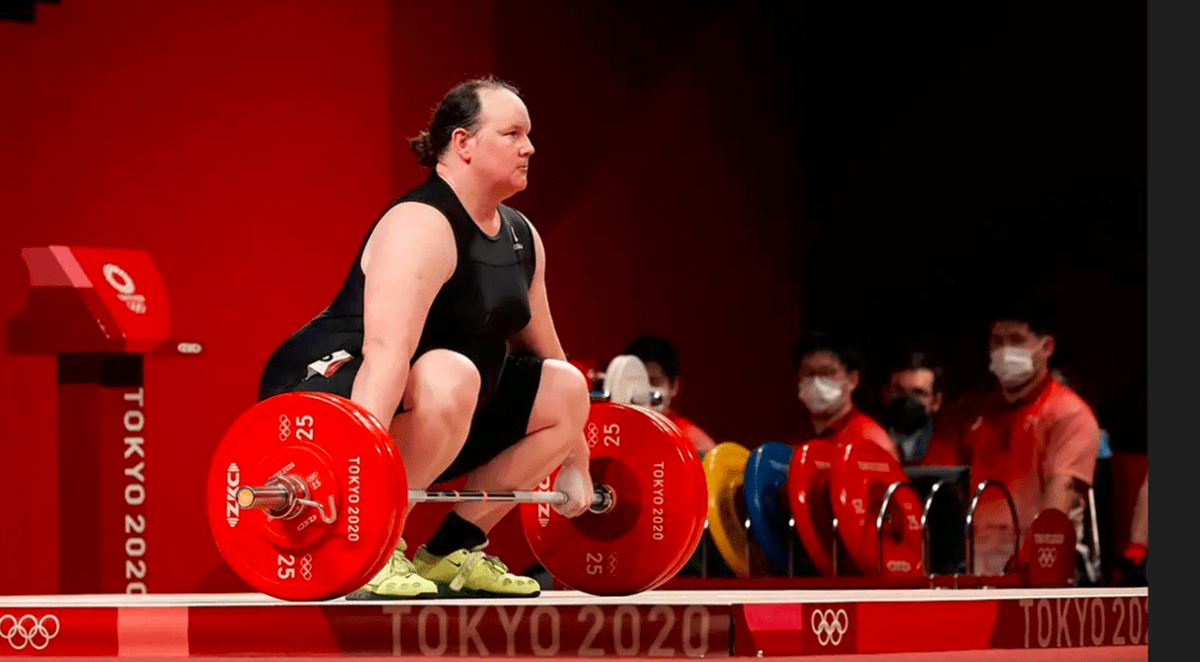
Picture: New Zealand’s Laurel Hubbard, a trans athlete, competed in the women’s weightlifting team in the 2020 Tokyo Olympics. Hubbard was eligible to compete because his testosterone level was below the maximum allowed trans athletes at the time. Requirements did not take into account that if transgender care starts after puberty, biological males will keep their muscular advantage over females.
Yoga Moms United for Slow Streets

Thank you to Steve Frank of California Political News and Views for publishing my article on “slow streets.” These streets, closed to vehicular traffic, at present affect only some neighborhoods. How long until they affect all neighborhoods? Marcy Berry JVN Website Editor.

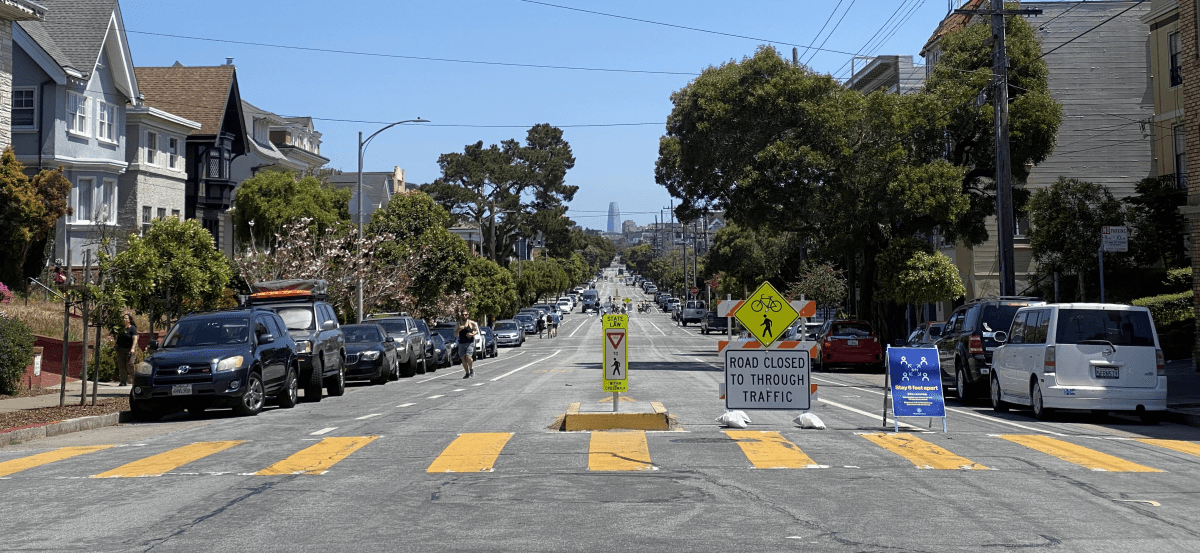
Today’s urban streets that feature barricades prohibiting thru traffic sport different names depending on target population – slow streets, car-free streets, safe streets, and open streets are the most popular titles.  Bikers, joggers, and central planners love these streets.  Central planners especially have been dreaming about the extinction of automobiles for decades.

The COVID-19 pandemic was the brass ring, the golden ticket for car-free-streets implementation in cities throughout the U.S.  Sheltered-in-place folks in urban areas needed safe outdoor spaces for fresh air and exercise, and car-free streets stepped in as a solution.

The City of Oakland was the first in California to implement a slow-streets program back in April 2020.  The cities of Emeryville, San Francisco, Los Angeles, San Diego, Berkeley, Alameda, and others soon followed.   

However now as the pandemic wanes, so does the temporary nature of car-free streets.  Local legislation is popping up to make these streets permanent.  Cities are rebranding the streets’ existence as good for health, recreation and pedestrian protection regardless of pandemics. 

California assembly member Adrin Nazarian (D-LA) introduced AB 773 (at present awaiting referral) to facilitate the “closing of a portion of any street to through vehicular traffic if local authorities deem such action necessary for the safety and protection of people using that portion of the street.”

All the enthusiasm for car-free streets comes with a measure of cynicism. 

Car-free streets are best suited for yoga moms, cycling dads and others in the higher-income brackets.  They fit right in with the lifestyles of work-from-home professionals that like to go out for a stroll between Zoom meetings.  They are fantastic for bike messengers and able-bodied non-workers. 

Generally, they are impediments for workers that need to drop off their kids in daycare and/or school and be at work by 8:00 am.  Closed areas that provide direct access to destinations, such as the Great Highway in San Francisco, represent scarce time spent on meandering.  Car-free streets do not serve residents of neighborhoods plagued with crime, where taking a stroll down a street might not be the wise thing to do. 

In spite of talk of aiming for racial equity in car-free streets initiatives, neighborhoods with majority black and brown residents often reject them. 

Ah, but slow streets help small businesses that often employ those of lower income, no?  – picture of happy people sitting outside in a “shared space” on a sunny day enjoying their margaritas.  Feels more like advertising than truthful reporting. 

But slow streets reduce pollution and traffic fatalities! – no picture of the irate motorist barreling through a slow street barricade, or another just clogging up the parallel street.

San Francisco Supervisor Shamann Walton made pretty clear what he thinks of slow-street equity.  Of the proposed permanent closure of the eastern half of Golden Gate Park’s JFK Drive, Supervisor Walton said like “1950s in the South.”  Walton’s supervisorial district contains large populations of lower-income residents that live in less than safe areas, without efficient public transit.  Thus car ownership and usage is high compared to the rest of the City.  Where do they park if they want to visit the north-eastern part of GGP?  No parking along the closed portion of JFK, and the park’s underground garage is expensive.

In the city of Oakland, initial surveys on car-free streets showed the program was popular.  Problem was, two thirds of survey respondents were white and 40% had household incomes of $150,000 or more (Oakland’s population is over 70% non-white, and the median household income is $76,000).  So, Oakland’s Essential Places program, designed for lower-income neighborhoods, chucked the strolling/biking narrative, strengthened barricades so cars would not plow through them, and rebranded objectives as helping pedestrians move around safely in reaching essential destinations.  Maybe lower-income Oaklanders view slow streets as suspiciously as does San Francisco Supervisor Walton? 

Government programs are immortal by nature.  Like government bureaus, they are also “the nearest thing to eternal life we’ll ever see on this earth.”   Especially so are programs such as car-free streets that help implement agendas like climate change, smart cities, or transit-oriented development.  For example, Smart Growth America, advocates for smart cities, contributed to the funding for Oakland’s slow-street initiative. 

The elites can comfortably ignore or embrace these agendas. The less affluent cannot.  Urban housing developments have contributed to gentrification and increased cost of housing for families.  Divestment from petroleum has increased the cost of energy and transportation.  Slow streets, coupled with a “transit first” policy that lacks reliable transit, only serve to inconvenience the working poor. 

Politicians and the public need to stop the cynicism.  Streets are for transit and responsible drivers that need to get where they need to go.  Bike lanes, street crossings, sidewalks, playgrounds and parks are the domain of folks not driving at the time. 

This article, written by JVN website editor, was first published on California Political News and Views

Why Wage Earners Live on Debt

Near zero interest rates and an abundance of fiat money have rendered U.S. wage earners redundant.

You keep hearing about free college, free healthcare, and “affordable” housing. Some of which, you might already be getting. But you are still living on credit card debt. Of course there is an infinite number of reasons why anyone might be living on debt or from paycheck-to-paycheck. There is, however, one reason that is shared with a great number of people: stagnant workers’ wages.

Although our grandparents may have lived relatively comfortably on a job that paid them $3 an hour, today we struggle at $15 an hour. That’s because our wages have not kept up with the cost of living. Our wages have been stagnant in relation to what we can purchase with them. Why is that? Depends on whom you ask.

Here is the usual list of reason for stagnant wages:

* Global competition – U.S. wage earners must compete with lower-wage workers outside the U.S.

* Automation – Employers search for the least costly options that will provide the same results for their companies. If cost of human labor raises above the cost of robots, employers will opt for robots.

* Decline in union membership – During our grandparents’ time union membership was around 30% of workers. Today union membership is around 10.5%.

Here is one reason that pundits do not like to talk about:
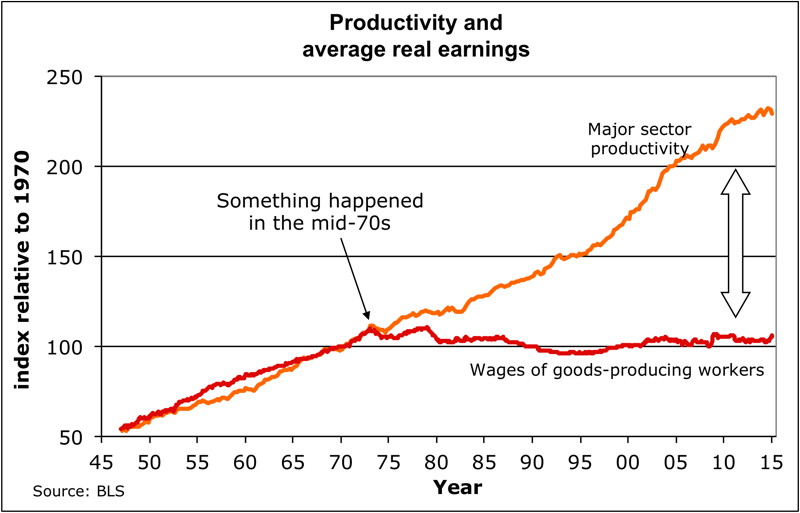
Wage stagnation and productivity

What’s the most important date on the chart above? 1971 – the year Nixon closed the “gold window.” It was in this year that the US dollar officially become completely fiat. We could no longer exchange our paper money for gold.  Income Inequality and the End of the Gold Standard, SchiffGold, March 2015.

President Richard Nixon drove the final nail on the coffin of the U.S. gold standard in 1971, thereby unleashing the creation of money backed by nothing.  Here is the cascading of events:

* What we call money these days is also popularly called fiat money, funny money, money out of thin air, and debauched currency.

* This kind of money is created at will by the U.S. Treasury when it prints dollar bills. It is also created by banks when they loan out funds to the general population. The balance in your account at your bank represents an IOU the bank issues to you, since your money is not sitting in some vault marked with your name, but has been lent out to other consumers holding mortgages and other loans.

* The amount of funny money in circulation is controlled by the U.S. central bank, the Federal Reserve. The Fed does this mainly by mandating what level of capital banks need to have on reserve (high level of reserves means less money available to lend out, thus less money created), and by manipulating interest rates (high interest rates produce fewer loans.

* Since around 2008, the Federal Reserve has kept interest rates at near zero. Consumers and businesses have taken advantage of the cheap money, and borrowed.

* Consumers incurred considerable credit card, mortgage, and student loan debt.

* Businesses took advantage of the cheap money to build monopolies. They bought out competitors with cheap borrowed funds. Businesses also learned that they no longer depended on their workers to produce money – if they wanted money for capital investment or other big thing, they just borrowed cheap money.

* As workers became redundant, their wages did not raise in relation to their productivity.

* In the absence of wages that keep up with rising prices, workers rely on debt.

Stacy Herbert reporting on Keiser Report

In this episode of the Keiser Report, Max and Stacy discuss how US workers stopped being compensated for their increased productivity only once the US went off the gold standard and there was no longer any honest way to gauge value.  Something happened in 1971  March 2, 2019.

Addendum:

So, where is money in the economy that used to go workers now going? It is going to investors, those whose income does not depend on wages. Low interest rates encourage those with some money not needed for basic living to buy stocks and other investment assets, thus increasing the prices of such assets. As the prices of assets raise so do the net worth of investors.

It is a commonly held belief that the Fed’s low interest rates have been responsible for inflating stock market values. Because people with more wealth tend to own more stock, to the extent that the Fed has been the cause of higher stock prices, it has worsened wealth inequality. Similarly, low interest rates have meant low borrowing costs for large corporations with direct access to capital markets (through corporate bonds). This cheap money helps to boost corporate profits which, again, flow mostly to the wealthy.  How the Fed;s Low Interest Rates are Increasing Inequality, Forbes, May 2015.