Bloggers Beware of California SB 1424

Never let a crisis go to waste seems to be in every legislator’s catechism. We have lived with all types of snake oil since the beginning of time. Caveat emptor – buyer beware – used to be the rule of the marketplace. However, little by little, consumers of products, ideas, and news have been increasingly deemed incapable of determining what is snake oil and what is not.

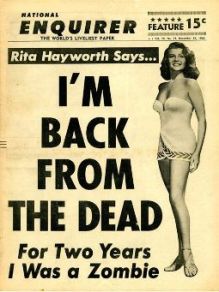
Rita Hayworth in the Enquirer

California Senator Richard Pan introduced in February 2018 Senate Bill 1424 Social Media Advisory Group, presently in committee process. The bill would,

… require the Attorney General, not later than April 1, 2019, to establish an advisory group consisting of at least one member of the Department of Justice, as well as Internet-based social media providers, civil liberties advocates, and First Amendment scholars to study the problem of the spread of false information through Internet-based social media platforms, and draft a model strategic plan for Internet-based social media platforms to use to mitigate this problem.

The bill in its present form, after amendments, mentions only “Internet-based social media platforms,” bringing to mind Internet giants such as Facebook and Google. However, an earlier version of the bill reveals what Senator Pan may have had in mind,

As used in this section, “social media” means an electronic service or account, or electronic content, including, but not limited to, videos, still photographs, blogs, video blogs, podcasts, instant and text messages, email, online services or accounts, or Internet Web site profiles or locations.

The bill as amended simply requires a study. However, earlier versions of the bill specify requirements via legislation, giving a hint of what might eventually arise from the proposed “advisory group.” Here are a few requirements of the bill prior to amendments:  How, and on what basis, the social media Internet website determines what content to display to the user; whether the social media Internet website enables other parties to influence, through payment or the use of automated accounts, what content is displayed to a user; whether the social media Internet website utilizes factcheckers.

Small businesses, startups, as well as bloggers of every type with a presence on the Internet should consider themselves in the crosshairs of Senate Bill 1424. Senator Pan seems to be seizing an opportunity offered by a crisis du jour, fake news, to regulate what is said on the Internet.

Businesses

Small businesses and startups often depend on an Internet presence to acquaint the public with their products or services. What they say about their products or services is already covered by several rules to prevent false claims. The Federal Trade Commission summarizes responsibilities of businesses as follows: “Under the law, claims in advertisements must be truthful, cannot be deceptive or unfair, and must be evidence-based. For some specialized products or services, additional rules may apply.” Additional rules include claims that target children, involve endorsements, pertain to environmental or health products, indicate a product was made in the U.S.A., entail telemarketing or online advertising.

Assuming that fake news is described by the proposed “advisory group” as not evidence-based (although who knows what the group might come up with by way of description), what would be the purpose of Senator Pan’s idea of adding to what is already in the FTC’s books?

Ideas

While for the most part businesses offer products or services for a price or a fee, non-profits, columnists, bloggers, activists, candidates running for office, political observers offer arguments and ideas. Determining whether such arguments and ideas are patently false, i.e. whether they are fake news, seems to be skating on thin ice. At what point Senator Pan’s proposal crosses the line from attempting to keep untruths from spreading to regulating arguments and ideas. At what point does Senator Pan’s proposal become a violation of the U.S. Constitution First Amendment?

Invent a Crisis Then Milk It

Never let a crisis go to waste seems to be in every legislator’s catechism. We have lived with all types of snake oil since the beginning of time. Caveat emptor – buyer beware – used to be the rule of the marketplace. However, little by little, consumers of products, ideas, and news have been increasingly deemed incapable of determining what is snake oil and what is not. Some rules can be beneficial, such as requiring evidence-based label information on products. But what is an evidence-based idea?

When our Declaration of Independence stated that all men are created equal and endowed with certain unalienable rights, would Senator Pan object to this phrase as fake news, since all men at that time were not being really deemed to be created equally? Would Senator Pan understand the magnitude of that phrase as a new idea upon which the Founding Fathers intended to build a new nation? Or would Senator Pan try to pass a law preventing the spread of those words?

Soft Tyranny

Alexis de Tocqueville, of Democracy in America fame, offered the following image,

… the sovereign power extends its arms over the entire society; it covers the surface of society with a network of small, complicated, minute, and uniform rules, which the most original minds and the most vigorous souls cannot break through to go beyond the crowd; it does not break wills, but it softens them, bends them and directs them; it rarely forces action, but it constantly opposes your acting; it does not destroy, it prevents birth; it does not tyrannize, it hinders, it represses, it enervates, it extinguishes, it stupefies, and finally it reduces each nation to being nothing more than a flock of timid and industrious animals, of which the government is the shepherd.

Are we experiencing such pall draping our nation, or have we even gone beyond it?

Diversity vs. Performance

Has the constant talk of diversity integrated our schools, or equalized pay, or flooded Silicon Valley with high-level coders of both genders equally?

In the old days employers asked employees to keep job description manuals, so new employees and others in the office or shop could better understand how a task was performed or how a widget was made. Today employers focus on diversity and social justice manuals. Should this shift of emphasis from production and performance to personnel be included in statistics measuring GDP, national debt as percentage of GDP, balance of trade, decline of manufacturing, rise of an unskilled workforce, automation? Has the constant talk of diversity integrated our schools, or equalized pay, or flooded Silicon Valley with high-level coders of both genders equally?

If the response is “not really” then our doubling down on the diversity reasoning is innocently stupid, immensely hopeful, or intentionally evil. The quest for diversity permeates housing, employment and education. Although there is much to say on housing and employment, let’s start with this article on education, specifically school choice in New York City.

Should There Be a Debate On School Choice?

A new study entitled The Paradox of Choice: How School Choice Divides New York City Elementary Schools laments the “unintended consequences” of providing New York City parents with the choice of enrolling their kids in other than their zoned (neighborhood) schools.

Our analysis shows that the expansion of school choice in New York City in the past 10
years has, indeed, allowed thousands of children to leave low-performing schools for higher-performing schools, often outside their neighborhoods. But it has also resulted in higher concentrations of poverty and shrinking enrollments and budgets in the schools they leave behind, making it ever harder for those schools to serve their neighborhoods well.

The logic of choice can be used for segregation or integration. But in either case, it puts the onus on individual parents to find good schools for their children, rather than on society as a whole to provide for the education of all children. Correcting the disparities across the school system as a whole and providing equitable educational opportunity to all families should be a collective effort by all members of the community with strong central leadership from City Hall and the Department of Education.

A reasonable person should ask what is wrong with parents taking responsibility for finding good schools for their children. The legion of lower-income parents enrolling their kids in charter schools might wonder why any parent would not move their children out of poor-performing schools. True, newly arrived immigrants, speaking little or no English, would have a harder time navigating through the complex school-enrollment system; but hopefully these families anticipate such difficulties, persist, and eventually prevail.

Embedded in the lament for the consequences of school choice is the pervasive emphasis on diversity and government’s duty to ensure equity and social justice. Such focus obscures the success of parents and children who opt for production – performance, individual responsibility, effort, and hard work. There are such parents at all income levels and of all colors.

Who Leaves and Who Stays

The Paradox of School Choice discusses what families stay in their zoned school, and which do not. 60% of families in gentrifying neighborhoods choose kindergarten outside of their school zones, compared with 32% in higher-income neighborhoods (where schools tend to be higher-performing), and 35% in non-gentrifying poorer neighborhoods. Although 60% is significant, 35% of poorer families that, in spite of economic challenges, choose higher-performing schools outside their neighborhoods is impressive.

The study also offers a chart that further illustrates who left their zoned schools behind, and who stayed between 2007 and 2016.  Colors from bottom represent children who attended schools that were:  in their zone, in a different zone, had gifted children programs, had dual-language programs, were unzoned, were charter.

School Choice 6


The ideal situation would indeed be a system that did not exhibit disparities in quality between schools. However, significant disparities are an unfortunate reality that school officials have not corrected.  Therefore a growing number of parents are no longer waiting for someone to act on their children’s behalf, but are taking action themselves.  Their choices indicate what is important to them:  high-performing schools that exhibit good test scores.

The Socialist Establishment Threat

It is so comforting to know you are being taken care of, even when you are a healthy adult. Oh, but is that called slavery?

The Establishment and its supporters are not at all happy with current events in Washington DC. The discontent is not a partisan issue, since the Capitol is populated mostly by Establishment folk regardless of party affiliation.

Establishment folk like their constituents to be taken care of, be free of risk, remain docile and unquestioning. Any questioning would place front and center the unsustainable national debt, fiat currency, endless wars, gargantuan bureaucracy, and a populace dependent on public assistance and/or public services. Questioning might bring to mind the list of societies that disintegrated under the weight of those same events – from the Roman Empire to Venezuela.

So what appears to be different lately? The difference could be summarized by a couple of memes. One meme implies that government holds the responsibility for an individual’s well being; that government’s job is to do whatever it takes to provide all manner of services, since all services are rights. The other meme implies that government exists only to protect everyone’s life, liberty and property; everything else is each individual’s responsibility.

Border Wall 3

To be sure, today’s Washington DC is a very long way from returning to the nation the Founding Fathers intended. The military-crony capitalism-welfare state is still here. The national debt is still a distant blur in Congress’ collective mind. The Establishment folk are still sucking up gobs of tax money in salaries and benefits while they prance around “resisting.” It remains to be seen whether the corporation tax cut will result in more jobs or more bonuses. It remains to be seen if the economy grows sufficiently to make up for the tax cuts.

But progress can be seen in the slow shrinkage of the bureaucracy through attrition, efforts to awaken the nation’s dormant manufacturing, and promises in speeches of jobs not public-assistance.  Let’s hope it is not too late for this nation to escape the fate of Rome.  Let’s hope we are are able to fix what we broke, and not make debt and dependency our legacy to our grandchildren.

Recommended site: The Atlas Society

Ayn Rand’s objectivism vs. the coddling society.

AynRandHere is a website worth mentioning, The Atlas Society. The “Atlas” part refers to Ayn Rand’s book, Atlas Shrugged. The website features lessons in Objectivism, readers’ tools to assist in the understanding of Rand’s books, commentary on a variety of subjects relating to the objectivist view, and events. Students and educators in conventional schools, as well as homeschoolers, could benefit from such information.

Objectivism, as presented by writer Ayn Rand, is not a household word these days, but should be at least understood. The Atlas Society describes objectivism as follows,

Objectivism is the philosophy of rational individualism founded by Ayn Rand (1905-1982). In novels such as The Fountainhead and Atlas Shrugged, Rand dramatized her ideal individual, the producer who lives by his own effort and does not give or receive the undeserved, who honors achievement and rejects envy. Rand laid out the details of her world-view in nonfiction books such as The Virtue of Selfishness and Capitalism: The Unknown Ideal.

Today, politicians and advocates for a plethora of special interests continually call for greater taxation to support social programs and projects that for the most part discourage the practice of objectivism. Words like “equity,” “social justice,” and “inclusivity,” so prevalent in today’s vocabulary, would leave individualists like John Stuart Mill or Thomas Jefferson befuddled. Adam Smith, the father of free-market capitalism, would be equally perplexed with the terms “crony capitalism” or “corporate welfare.” Ayn Rand, were she alive today, would probably simply admonish us all with an “I told you so.”

However, just as big-government people worked to main stream their ideas, so can small-government, objectivist-leaning individualists work at spreading theirs. Returning the nation towards a path that encourages the self-directed true producer, not coddles the unhappy dependent, could easily start with just voting NO on proposals that “feed the beast” with workers’ hard-earned cash.