Grocery prices too high? You can fix that!

When inflation gets so high that voters complain, politicians can dance around the challenge by implementing price controls, breaking up big corporations, or trying other gimmicks that have never worked. Or they can refrain from pressuring the Federal Reserve, and allow them to bring inflation down by increasing interest rates and decreasing the money supply.

The working middle and modest-income classes in the United States are struggling with rising prices and stagnant incomes. They are also hoping government will “do something” to ease their pain. Unfortunately, most often government is the cause of the pain, not the cure.

An article dated November 2013, on the website Federal Reserve History, has some interesting things to say about the Great Inflation of 1965-1982.

Here are a few quotes from that article:

“The Great Inflation was the defining macroeconomic event of the second half of the twentieth century … It was, according to one prominent economist, ‘the greatest failure of American macroeconomic policy in the postwar period.’ “

“In 1964, inflation measured a little more than 1 percent per year. It had been in this vicinity over the preceding six years. Inflation began ratcheting upward in the mid-1960s and reached more than 14 percent in 1980.”

“While economists debate the relative importance of the factors that motivated and perpetuated inflation for more than a decade, there is little debate about its source. The origins of the Great Inflation were policies that allowed for an excessive growth in the supply of money—Federal Reserve policies.”

“The late 1960s and the early 1970s were a turbulent time for the US economy. President Johnson’s Great Society legislation brought about major spending programs across a broad array of social initiatives at a time when the US fiscal situation was already being strained by the Vietnam War.”

“A more disruptive force was the repeated energy crises that increased oil costs and sapped U.S. growth. The first crisis was an Arab oil embargo that began in October 1973 and lasted about five months. During this period, crude oil prices quadrupled to a plateau that held until the Iranian revolution brought a second energy crisis in 1979. The second crisis tripled the cost of oil.”

“The Nixon administration introduced wage and price controls over three phases between 1971 and 1974. Those controls only temporarily slowed the rise in prices while exacerbating shortages, particularly for food and energy. The Ford administration fared no better in its efforts. After declaring inflation “enemy number one,” the president in 1974 introduced the Whip Inflation Now (WIN) program, which consisted of voluntary measures to encourage more thrift. It was a failure.”

“In 1979, Paul Volcker, formerly the president of the Federal Reserve Bank of New York, became chairman of the Federal Reserve Board.”

“By this time, it was generally accepted that reducing inflation required greater control over the growth rate of [bank] reserves specifically, and broad money more generally. … Lending activity fell, unemployment rose, and the economy entered a brief recession … But the Volcker Fed continued to press the fight against high inflation with a combination of higher interest rates and even slower reserve growth … Unemployment peaked at nearly 11 percent, but inflation continued to move lower and by recession’s end, year-over-year inflation was back under 5 percent.”

The meaning, summarized:

*Government spent too much thanks to the Federal Reserve’s generous increase in the money supply and its failure to change monetary policy when inflation started to rise significantly.

*There was no oil price gouging. The significant increase in the price of gas and energy was the result of shortages caused by the Arab oil embargo and by the Iranian revolution.

*The Nixon administration’s wage and price controls did not work. They resulted in massive shortages of goods and an inflation rate of 11%.

*The Ford administration’s measures to encourage corporate and consumer thrift did not work either.

*What did work in bringing inflation down to 3.66% by 1987 were the policies of Paul Volcker, Federal Reserve Chairman from August 1979 to August 1987. He raised interest rates as high as 19.08% and decreased the money supply.

*The Federal Reserve continuously plays a balancing act in abiding by its objectives of maximum employment and price stability.

The Somewhat Great Inflation of 2022-2024.

The 9% inflation rate of 2022 pales by comparison to the 13.88% 1980 rate.

However, just as spending on the Vietnam war and the Great Society fueled inflation, spending in response to the 2019-2023 pandemic did as well. In 2020 federal spending increased 45% from 2019, as compared to a 18% increase in spending in response to the Great Recession of 2008-2009.

The Nixon administration price and wage control did nothing to stabilize prices. So far, neither has the Biden administration Inflation Reduction Act. However, interest rate increases have made a difference.

The unadjusted 12-months ended July 2024 inflation rate for all items of goods and services was 2.9%, down from 3.2% in 2023 and 8.5% in 2022. The decrease is thanks to the Federal Reserve Bank steadily increasing the Federal Funds rate from 1.68% in July 2022 to 5.33% in July 2024.

Other factors besides spending.

There are certainly other factors besides excessive government spending without significant increase in production that can trigger inflation. The factors that contributed to the current inflation are mentioned in these two studies:

*A study reported in July 2024 by MIT Sloan School of Management indicates the following triggers and their relative influence on the current inflation:

Money supply 2.90%
Yield curve 3.30%
Wages and salaries 4.80%
Personal consumption 6.20%
Producer prices 10.10%
Interest rates 14.30%
Inflation expectations 16.90%
Federal spending 41.60%

Federal spending outweighs all other influences. Interestingly, money supply is not a significant contributor according to this study. Although, this paragraph from Statista Research dated May 14, 2024, disagrees.

“While between 2000 and 2019, the M1 money supply increased at a slow pace, there was an exceptionally sharp increase in 2020, which was the result of the Federal Reserve’s quantitative easing in response to the COVID-19 pandemic. The sharpest increase took place in May 2020, when the M1 money supply was increased from 4.8 to 16.2 trillion U.S. dollars.”

*And from Brookings Institution research dated June 13, 2023:

“The pandemic-era inflation has been a complicated phenomenon that involved both multiple sources and complex dynamic interactions. Ultimately, as many have recognized, the inflation largely reflected strong aggregate demand, the product of easy fiscal and monetary policies, excess savings accumulated during the pandemic, and the reopening of locked-down economies.”

Additional factors.

Indeed, the current inflation is complex, with many variables. One variable that the above-mentioned studies do not emphasize because it does not play a major role in inflation is corporations’ ability to raise prices in a consolidated market. Microsoft and Alphabet are examples of near monopolies that are often accused of setting rules and prices largely undisturbed by competitors.

Although those accusations are partly true (Procter & Gamble’s recent report of sales decline attests that the company’s ability to raise prices is not unlimited!), the clamor that government “do something” is laughable, since it is government’s “easy money” that allows formation of such monopolies. Remember, buyouts are mostly leveraged, facilitated by low interest rates.

In conclusion.

Once upon a time, the U.S. dollar was backed by gold. In those old days, politicians could not get re-elected by just spending unlimited amounts of government fiat money giving their constituents the moon – today they can.

Unfortunately, unbridled spending brings on inflation. When inflation gets so high that voters complain, politicians can dance around the challenge by implementing price controls, breaking up big corporations, or trying other gimmicks that have never worked. Or they can refrain from pressuring the Federal Reserve, and allow them to bring inflation down by increasing interest rates and decreasing the money supply.

Thankfully, politicians do not simply step into their roles – they get elected by voters. Thus, voters can fix things that go wrong, like inflation, by voting wisely.
The Great Reset: Elites Caring About Us?

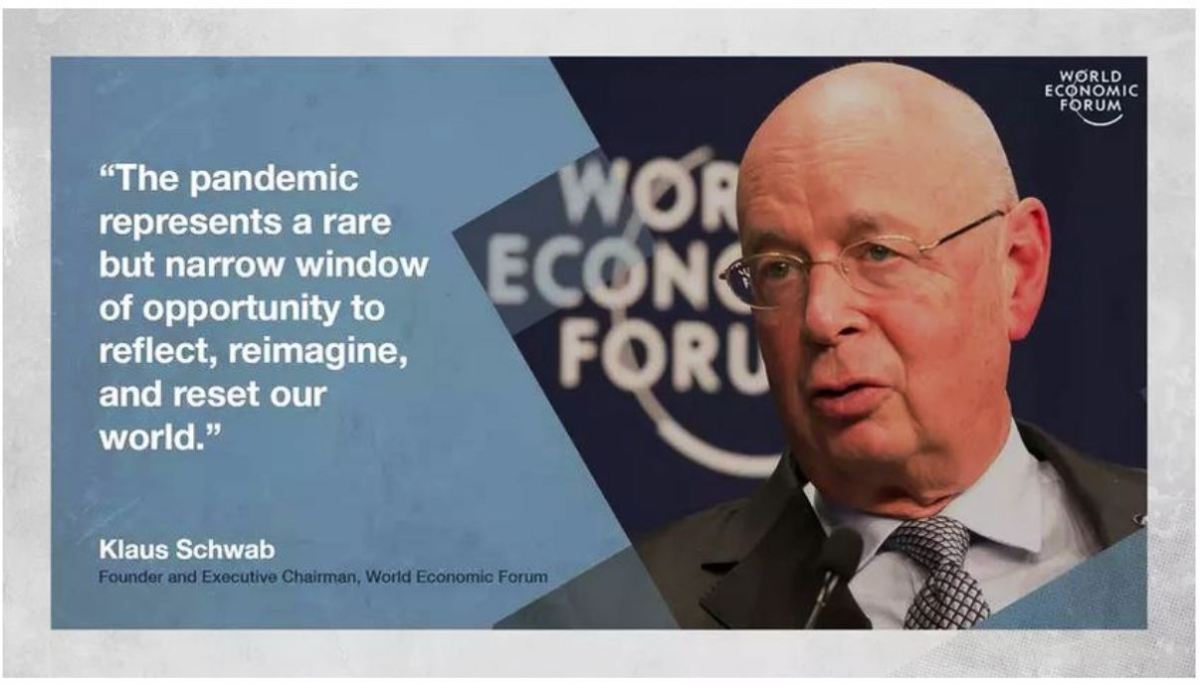
Proponents of The Great Reset view Covid-19 as “a great opportunity” to implement controlled globalization guided by moral governance. Note, “governance” is the term used, not government. By way of reminder, government implies leaders elected by their constituents; while “governance” implies rules implemented by the non-elected.

During the week of January 25, the World Economic Forum will meet digitally for “high-level ‘Davos Dialogues’ where key global leaders will share their views on the state of the world in 2021.”

The WEF’s annual January in-person conference in Davos, Switzerland, has been postponed until May 2021.

Background

The Word Economic Forum, a non-profit foundation established in 1971 in Geneva, Switzerland, considers itself “the International Organization for Public-Private Cooperation.” Its mission is to engage “the foremost political, cultural and other leaders of society to shape global, regional and industry agendas.” It says its aim is to be impartial, global, holistic and forward looking.

WEF holds annual meetings in Davos, Switzerland. Although their Open Forum is free and “anybody can attend” (if you queue up early, since space is limited), free main events are by invitation only. Uninvited members of WEF can attend for a fee (around 480,000 Pounds Sterling or around 650,000 U.S. Dollars). Around 3,000 people typically attend, usually about 1/3 from business and the rest from government and quasi-government.

The Great Reset

WEF’s agenda for 2021will continue to be “The Great Reset”. The January 2020 meeting rebranded this long-time push for controlled globalization as response to Covid-19. The fine points of this agenda are expected in 2021. But the general platform seems to be set.

Build Back Better: Highlight of The Great Reset

“Build Back Better” is the core principle for those who believe capitalism is not working, so every aspect of our society needs to be re-shaped. Among the most ambitious plans are the following:

* Corporations must give up shareholder (owner) focus and adopt stakeholder (society as a whole) focus. The public sector must support this new focus.

* Harm to the global environment dominated the latest Global Risk Report. Therefore, both private and public sectors must take action to mitigate climate change and other environmental threats.

* New education models must equip children with skills demanded by globalization and rapid advances in technology.

* Building Back Better must include a wide-range of investments by the public sector – government spending in improved greener infrastructures as well as in human capital.

* Both private and public sectors must adapt to the Fourth Industrial Revolution.

The Fourth Industrial Revolution can be described as the advent of “cyber-physical systems” involving entirely new capabilities for people and machines … Examples include genome editing, new forms of machine intelligence, breakthrough materials and approaches to governance that rely on cryptographic methods such as the blockchain.

The Great Opportunity

Proponents of The Great Reset view Covid-19 as “a great opportunity” to implement controlled globalization guided by moral governance. Note, “governance” is the term used, not government. By way of reminder, government implies leaders elected by their constituents; while “governance” implies rules implemented by the non-elected.

Precedents

Jekyll Island and the Federal Reserve: In November of 1910 leaders of the financial world met in secret at Jekyll Island, off the coast of Georgia. The crisis that prompted the meeting was not a virus but persistent foolish investments that resulted in bank runs and general financial instability. The response was the creation of the Federal Reserve Bank, an independent institution that operates outside the control of Congress or any other elected body. Indeed the Fed provided reasonable financial stability, but unfortunately brought about undesirable results as well.

The fact that the Federal Reserve was born on Jekyll Island backed by the cream of the banking elite, it enables a debt-based economy, and it finances wars is freely acknowledged even by the Federal Reserve. End the Fed, April 25, 2018, Just Vote No

Bretton Woods and the short-lived gold-backed dollar: In 1944, the cream of the crop in the financial world met again, this time in Bretton Woods, New Hampshire. The crisis turned into opportunity was the need to plan for the reconstruction of war-torn Europe and Japan. The response was the establishment of the International Monetary Fund, the establishment of the Bank for Reconstruction and Development (now called the World Global Bank), and the creation of a totally new monetary system. The new system made the U.S. Dollar a global currency pegged to gold reserves, and all other currencies pegged to the dollar. The strong dollar allowed Europe and Japan to revive their manufacturing base by selling their goods to the U.S. Unfortunately, discipline required to maintain the dollar pegged to gold evaporated by 1971, opening the floodgates of government spending and unsustainable debt.

Now the “Public-Private” Elite Meets Again

Again people important enough to be invited to the table will meet at Davos. This time the meetings are not secret — as in Jekyll Island — or as narrowly focused — as in Bretton Woods.

This time, participants aim to shape all sectors of the global society: Manufacturing, Consumption, Digital Economy, Energy, Financial and Monetary Systems, Global Public Goods, Health and Healthcare, Investing, Media, Mobility, Technology Governance, Trade and Global Economic Interdependence, The Internet of Things, New Economy and Society.

We The Little People

Those of us nowhere near important to be invited to Davos or well off enough to pay around $600,000 to attend need to remain vigilant. When our elected officials start talking about “building back better” and reshaping institutions, we need to sift through the rhetoric and find out what it is we will eventually be voting for and how much will need to be taken out of our wallets.

Once Again the Fed Wants to Save Us

During the sub-prime massacre of 2008-2009, then Fed Chairman Ben Bernanke came to the economy’s rescue. Today’s Chairman Jerome Powell is trying to repeat the feat but in a massive scale.

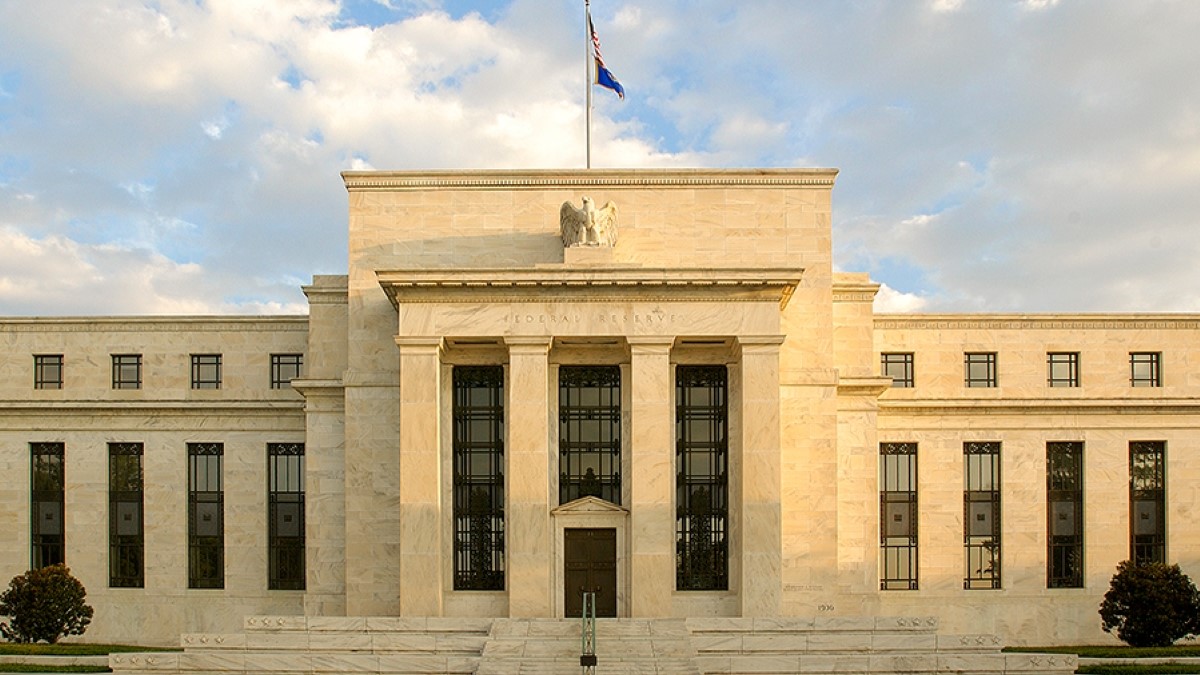
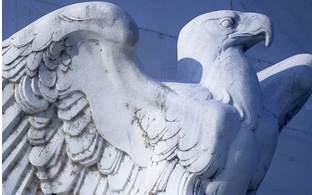
Fed Eagle

On March 23, 2020, the U.S. central bank, the Federal Reserve, announced extensive new measures to support the U.S. economy as the coronavirus continues to ravage small businesses and the livelihood of workers.

Fed Chairman Jerome Powell not only revived the tools used in the 2008-2009 financial crisis but implemented new ones.

In 2008-2009 then Federal Reserve Chairman Ben Bernanke was charged with saving the U.S. economy from the sub-prime massacre. He did that in part by resurrecting Section 13(3) of the Federal Reserve Act, which allowed him to implement key non-conventional tools to provide liquidity directly to borrowers and investors in critical credit markets: Commercial Paper Funding Facility (CPFF), Asset-Backed Commercial Paper Money Market Mutual Fund Liquidity Facility (AMLF), Money Market Investor Funding Facility (MMIFF), and the Term Asset-Backed Securities Loan Facility (TALF).

In 2020, Fed Chairman Jerome Powell was charged with a similar task. Here is what Reuters said on the matter back on March 18,

Pressure is growing in Washington for the U.S. Federal Reserve to use its emergency powers to lend directly to businesses hurt by the coronavirus, according to four people with knowledge of the discussions.

The U.S. Treasury, senior bankers, the U.S. Chamber of Commerce, and some senior senators want the central bank to make broader use of its powers under Section 13(3) of the Federal Reserve Act to provide credit directly to businesses under “unusual and exigent” circumstances, the sources said.

Thus, the Fed established two new programs to accomplish its bidding: The Primary Market Corporate Credit Facility (PMCCF) facilitates lending to small and medium-sized business. The Secondary Market Corporate Credit Facility (SMCCF) provides liquidity for outstanding corporate bonds.

Despite enthusiasm from some quarters for an aggressive Federal Reserve response, there is apprehension.

The Cato Institute points to a constitutional issue. The U.S. was built on the principle of “no taxation without representation.” The people’s representatives in the U.S. House hold the nation’s purse strings. When the Federal Reserve (over which theoretically neither taxpayers nor Congress have any authority) provides credit with little or no recourse, taxpayers are the ones to absorb defaults without having had any say so in the matter.

In a March 27 Bloomberg Opinion piece Jim Bianco (President and founder of Bianco Research) expressed his concerns. Although the 2020 response is similar to that of 2008-2009, the 2020 programs are larger in scale. Blurring of fiscal policy (carried out by the Treasury under the direction of Congress) and monetary policy (carried out by the Federal Reserve under the direction of nobody) endangers the important separation of these two entities. Special purpose vehicles (SPVs) underlying the Fed’s 2020 rescue programs could be abused, resulting in serious distortions in capital markets.  Bianco says,

In effect, the Fed is giving the Treasury access to its printing press. This means that, in the extreme, the administration would be free to use its control, not the Fed’s control, of these SPVs to instruct the Fed to print more money so it could buy securities and hand out loans in an effort to ramp financial markets higher going into the election.

Given the fact that once government programs are put in place they remain into eternity, the American people might find itself stuck with subsequent administrations that could abuse SPVs not only to ensure re-election but also to centralize control of the economy, artificially invigorate stocks, and reward favored industries.

$15 Wage – We’re from the Government and Here to Help

Without robust competition why would businesses pay workers good wages. They don’t.

Minimum wage

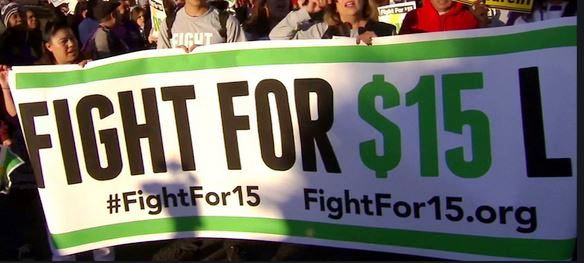
In July Congress passed legislation that gradually raises the minimum wage to reach $15 by 2025. Why would Congress feel the necessity to engage in the price control of wages? Since there are already probably as many answers to that question as there are wage earners, it will not hurt to add one more.

Say you sell soap, people love your product, and buy great quantities of it. You have the opportunity to raise your prices confident your sales will remain high. On the other hand, suppose you make a mediocre soap that people do not particularly like. You will be lucky to sell some of it at a low price.

Same with your abilities in the marketplace. If you are good at what you do and have abilities that are on demand, people will pay good money for your services. If you do not, you will be paid little, assuming someone will hire you. A mandate on how much people must pay for soap would be called price control. So would a mandate on how much people must pay for abilities.

Leaders resort to price controls when their jurisdictions lack a functioning market, either by misfortune, incompetence, or conscious choice. A functioning market encourages competition and efficiency from all participants – businesses and workers alike. Absent a functioning market, leaders must resort to ever increasing levels of interventions such as price controls.

Although the U.S. talks about a free market, it really does not have one. Leaders have slowly stifled it, starting in earnest with Roosevelt’s New Deal. Today, there is economic intervention in every nook and cranny of the economy. If some law or regulation is not mandating subsidized housing for those who cannot afford to live where they want to live, it is mandating subsidized electric cars to fight climate change.

As legislators spend more than they collect in taxes to ensure today’s equivalent of Herbert Hoover’s chicken in every pot and car in every garage, the national debt explodes, the Federal Reserve decimates interest rates so as to afford the servicing of the debt, and cheap money allows businesses to buy out competitors.

So now, with less competition, why would businesses worry about paying workers good wages? They don’t.

Meanwhile, the economy needs lots of purchasers of goods and services in order not to collapse. The solution is a mandated minimum wage, sometimes over and above what workers with inadequate or unneeded skills are worth.

So, there is a reason why Congress passed the $15 minimum wage.

No Sign Congress Wants to Go Back to Work

Certainly, we the people want Congress to root out corruption, and the fall from grace of many who Mueller dispatched into the arms of the judicial system might have been worthwhile. But, was this mere collateral damage within a higher agenda? Is it time for every voter and taxpayer to ask whether there is a higher agenda and what that agenda might be?

If anyone at all harbored any hope that the U.S. Congress would go back to work after Special Counsel Robert Mueller issued his report on “Russian Collusion” stating there was none, those unfortunate hopeful folks need to abandon all optimism and go back to just shelling out tax money.

After nearly two years and approximately $30 million in expenses incurred by the Mueller investigation, Congress and the public got to see a redacted version of the Mueller Report in April 2019 – and a new round of pulling of hair and rending of garments commenced. The Democrat majority in the House of Representatives renewed its cry for more investigations and possible impeachment of the President. They want to look into his tax returns and his private real estate deals. They want to investigate who paid for his inaugural event, and why he is calling for changes in the U.S. Census.

Monopoly OligarchCertainly, we the people want Congress to root out corruption, and the fall from grace of many who Mueller dispatched into the arms of the judicial system might have been worthwhile. But, was this mere collateral damage within a higher agenda? Is it time for every voter and taxpayer to ask whether there is a higher agenda and what that agenda might be? Might such a higher agenda be the innocent belief that Donald Trump threatens the venues that government uses to take care of us? Or might the higher agenda be that of oligarchs who do not wish to relinquish control of government venues in charge of funneling wealth?
The innocents truly believe government can better their lives by providing free stuff. They ignore the fact that there is no such thing as free stuff. Take education that became unaffordable to the average American college aspirant when predictably colleges raised tuition in order to capture the largess offered by taxpayer-funded student loans.

On the other hand, oligarchs know exactly what they are doing by encouraging endless printing of fiat money. Think your rent is so high you barely can keep a roof over your family’s head? Look at all the practically free money created by rock bottom interest rates that end up parked in real estate that remains vacant for decades. Think your city is full of techies that can afford to price you out of purchasing a home? Look again at all the fiat money floating around that needs to be parked somewhere, and tech companies are as good a parking space right now as anything else. By the way, this scenario is not the result of capitalism, but the result of policies such as those established by the Federal Reserve (low interest rates) and your government at work (endless spending on entitlements and forever wars).

Voters and taxpayers might want to consider the invisible strings pulling the visible puppets that are so intent on avoiding change at all cost.

Why Wage Earners Live on Debt

Near zero interest rates and an abundance of fiat money have rendered U.S. wage earners redundant.

You keep hearing about free college, free healthcare, and “affordable” housing. Some of which, you might already be getting. But you are still living on credit card debt. Of course there is an infinite number of reasons why anyone might be living on debt or from paycheck-to-paycheck. There is, however, one reason that is shared with a great number of people: stagnant workers’ wages.

Although our grandparents may have lived relatively comfortably on a job that paid them $3 an hour, today we struggle at $15 an hour. That’s because our wages have not kept up with the cost of living. Our wages have been stagnant in relation to what we can purchase with them. Why is that? Depends on whom you ask.

Here is the usual list of reason for stagnant wages:

* Global competition – U.S. wage earners must compete with lower-wage workers outside the U.S.

* Automation – Employers search for the least costly options that will provide the same results for their companies. If cost of human labor raises above the cost of robots, employers will opt for robots.

* Decline in union membership – During our grandparents’ time union membership was around 30% of workers. Today union membership is around 10.5%.

Here is one reason that pundits do not like to talk about:
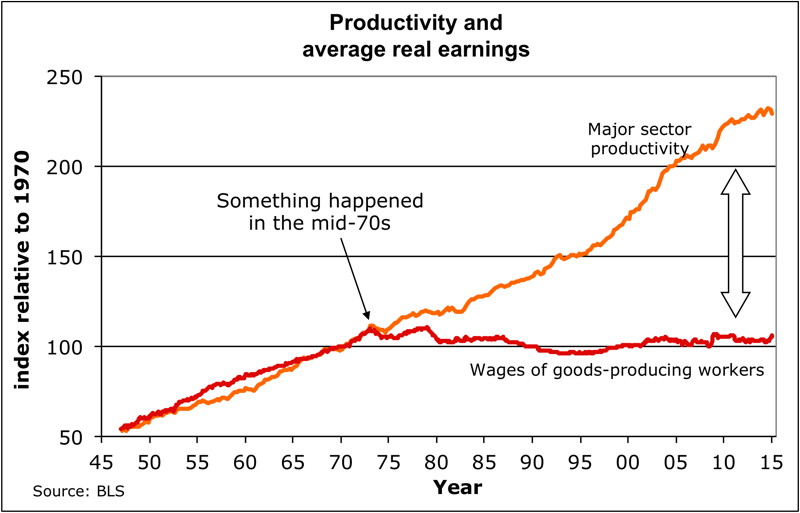
Wage stagnation and productivity

What’s the most important date on the chart above? 1971 – the year Nixon closed the “gold window.” It was in this year that the US dollar officially become completely fiat. We could no longer exchange our paper money for gold.  Income Inequality and the End of the Gold Standard, SchiffGold, March 2015.

President Richard Nixon drove the final nail on the coffin of the U.S. gold standard in 1971, thereby unleashing the creation of money backed by nothing.  Here is the cascading of events:

* What we call money these days is also popularly called fiat money, funny money, money out of thin air, and debauched currency.

* This kind of money is created at will by the U.S. Treasury when it prints dollar bills. It is also created by banks when they loan out funds to the general population. The balance in your account at your bank represents an IOU the bank issues to you, since your money is not sitting in some vault marked with your name, but has been lent out to other consumers holding mortgages and other loans.

* The amount of funny money in circulation is controlled by the U.S. central bank, the Federal Reserve. The Fed does this mainly by mandating what level of capital banks need to have on reserve (high level of reserves means less money available to lend out, thus less money created), and by manipulating interest rates (high interest rates produce fewer loans.

* Since around 2008, the Federal Reserve has kept interest rates at near zero. Consumers and businesses have taken advantage of the cheap money, and borrowed.

* Consumers incurred considerable credit card, mortgage, and student loan debt.

* Businesses took advantage of the cheap money to build monopolies. They bought out competitors with cheap borrowed funds. Businesses also learned that they no longer depended on their workers to produce money – if they wanted money for capital investment or other big thing, they just borrowed cheap money.

* As workers became redundant, their wages did not raise in relation to their productivity.

* In the absence of wages that keep up with rising prices, workers rely on debt.

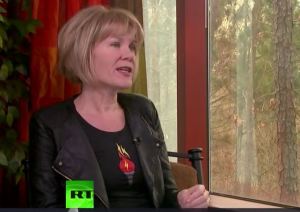
Stacy Herbert reporting on Keiser Report

In this episode of the Keiser Report, Max and Stacy discuss how US workers stopped being compensated for their increased productivity only once the US went off the gold standard and there was no longer any honest way to gauge value.  Something happened in 1971  March 2, 2019.

Addendum:

So, where is money in the economy that used to go workers now going? It is going to investors, those whose income does not depend on wages. Low interest rates encourage those with some money not needed for basic living to buy stocks and other investment assets, thus increasing the prices of such assets. As the prices of assets raise so do the net worth of investors.

It is a commonly held belief that the Fed’s low interest rates have been responsible for inflating stock market values. Because people with more wealth tend to own more stock, to the extent that the Fed has been the cause of higher stock prices, it has worsened wealth inequality. Similarly, low interest rates have meant low borrowing costs for large corporations with direct access to capital markets (through corporate bonds). This cheap money helps to boost corporate profits which, again, flow mostly to the wealthy.  How the Fed;s Low Interest Rates are Increasing Inequality, Forbes, May 2015.

How the U.S. Debt Affects You

Fiat money, that is money without intrinsic value, is a fascinating topic. Only money backed by a commodity that has intrinsic value, such as gold and silver, can be said to be of value. The money we use today has only government’s say so that it is of “value.”

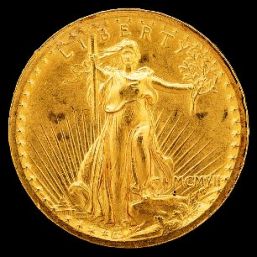
$20 Gold Coin
Real Money: 1907 $20 gold coin

Fiat money, that is money without intrinsic value, is a fascinating topic. Only money backed by a commodity that has intrinsic value, such as gold and silver, can be said to be of value. Such money is redeemable in gold or silver, and its quantity in circulation is limited by the amount of gold of silver available.

The money we use today has only government’s say so that it is of “value.” It is not redeemable in anything. Its quantity is at the will of the Federal Reserve, who has control of the money supply via its power to create credit with interest rates and reserve requirements.

Pictured above on the left is a $20 United States Bank Note, which was redeemable in gold until 1971; that can be considered real money.  On the right is a $20 Federal Reserve Note, backed by the “full faith and credit” of the federal government.  Good luck hoping it will maintain any “value.”

An associate of the Just Vote No Blog editor considers the topic of fiat money the most important one of our day, and provided some insights used by JVN in this article.

Money 101

The U.S. Constitution has two authorities on “money” (Article 1, Section 8):

* To coin money and regulate the value thereof.

During Colonial days gold and silver were considered “money”.  Money was a commodity. “Setting the value thereof” is like making sure a pound is a pound so people can buy the same pound of coffee, for example. A dollar is a dollar is a dollar. This is not the case today. As Consumer Price Index fluctuations show, a dollar today may not buy the same amount of goods as a dollar tomorrow.

* To borrow money on the credit of the United States.

This is the arrangement under which we operate today. There is no actual “money” with intrinsic value in circulation. We are operating under a credit/debit system which is a system of accounts. Under this system, money and debt can be created at will to finance government operations, provide for public assistance, maintain the armed forces, and pay for any other function government decides to undertake. Near-zero interest rates allow for servicing the debt.

Outcomes

All actions, including implementation of government policies, have outcomes or consequences – good and bad. The U.S. monetary/financial model characterized by liberal use of borrowing and the existence of a central bank (the Federal Reserve Bank) is no different. Let’s pick some outcomes at random:

* The Federal Reserve System through debt-issued currency, manipulation of interest rates and steady inflation allows our wealth to be eroded without us even realizing. When government increases money in circulation, consumers will likely use it to purchase additional items they would not have normally bought. Often the supply of goods does not keep up with the increased demand, resulting in a rise in prices. So, if you needed $20 to buy your lunch, now you need $25 or $30. If you were confident your bank savings would help you through a financial setback, you might not be now.

* A central bank’s control of interest rates and bank reserve requirements allow for manipulation of people’s behavior. Near-zero interest rates form the habit of living on credit – why worry about saving or having any cash to pay one’s living expenses or obligations? Cash is anonymous, but credit is not. When you buy with credit, businesses inventory and catalog you, not only so they can stay in touch and collect the debt, but also so that they can try to sell you even more stuff.

* The current U.S. debt was about $21 trillion in March 2018 — the largest sovereign debt in the world for a single country. Debt is necessary to run a country when revenues such as taxes and fees are not sufficient to cover expenses. As debt approaches unsustainable limits, it is logical for government to ensure that every citizen pays his/her “fair share” of taxes. That includes encouraging traceable payments systems. So, it is not only businesses that want you to move towards a “cashless society” so you can be watched. 

The Fading Free Society

We cannot preserve our liberty if we cannot maintain our purchasing power and stay solvent as people, as a state and as a nation. We need to focus on the issue of fiat money, and the associated issues of central planning and debt. The Founding Fathers were forced to do so when faced with enormous war debts and worthless currency. Their solution was to include in the U.S. Constitution Article I Section 10, which prevents states from making “any Thing but gold and silver Coin a Tender in Payment of Debts.” But the U.S. Congress was granted power the “to borrow money on credit.” We the People need to be more mindful of that credit card.

Recommended Lecture on the Federal Reserve

Today’s mantra is “We need the Federal Reserve, or the country would experience terrible economic cycles.” Really? How come countries without a central bank do just fine?

Economics Lecture: The Historical Case Against the Federal Reserve – Regulatory Origins of American Banking and Financial Instability Before 1914

Monday, June 25, 2018   7:00 – 10:00 pm
Community Room (located behind the station building)
Richmond Police Station (between Geary Blvd. and Anza St.)
461 – 6th Avenue, San Francisco, California

Hosted by Golden Gate Liberty Revolution Meetup (fka the Ron Paul Meetup).  GGLR holds its meetings on the 4th Monday of the month. Meetings are free and open to the public.

After-meeting socials are around 10:00 pm at Overtime Sports Bar & Restaurant, 4134 Geary Blvd, San Francisco.

Details contributed by lecture presenter Chris Silber:

The Federal Reserve has received renewed criticism and scrutiny in the decade since the global financial crisis. Yet the Fed has large and powerful lobbies of apologists among the mainstream press, academics, and policymakers who have argued without the Fed the U.S. banking system would return to the more frequent and disruptive financial crises of the pre-Fed era.

While it’s true that the U.S suffered from frequent banking panics throughout the 19th century, was the absence of a central bank really the cause? And if so, why then during the same period did countries like Canada and Scotland experience remarkable financial stability without a central bank? Were in fact pernicious state and federal regulations the real source of the U.S. banking system’s fragility? And if so shouldn’t Fed apologists in academia and the mainstream press know better?

Chris Silber will discuss the regulatory history of U.S. banking including the real causes of frequent financial crises during the period: restrictive unit banking laws, America’s antebellum central banks, and the post-Civil War National Banking System. The similarly unstable English and contrasting sound Canadian and Scottish systems will also be examined.

Chris Silber previously presented at GGLR Meetup lectures on monetary history, business cycles, and the Great Depression.

RSVP: Golden Gate Liberty Revolution Meetup