Climate Change: View from the other side

This post is in fairness to those who truly believe that climate change is an existential threat requiring collective, globally-mandated action.

The Just Vote No Blog View

“Climate change” and “Climate denial” are charged phrases that often elicit strong responses. The Just Vote No Blog has often noted that the subject of climate has grown beyond common sense efforts like installing scrubbers on smokestacks, investing in useful transit systems, or driving reasonably-sized gas-saving private automobiles. Today the subject serves to implement the cause of “social justice and equity.” The Just Vote No Blog has encouraged honest appraisal of the costs and benefits of such a cause.

The View From the Other Side

In all fairness to social justice warriors who truly believe that climate change constitutes an existential threat that requires globally-implemented mandates, the JVN Blog asked the permission of a fellow activist to post some heartfelt beautifully expressed responses he wrote during an email discussion on climate change.

Primarily, he visualizes need for transformation in our social institutions that will bring about renewal of collective action based on trust. He sees a culture of individualism that since the 1960s rose in tandem with mistrust of social institutions, thus spawning impediments to the kind of collective action that fighting climate change requires.

Here are Steve J.’s thoughts, posted without editing and with the respect that is due to honestly differing views.

In response to a question why research is limited to rise in CO2:

“The reason why ‘changes caused by other than CO2’ have not been studied is an excellent question. One explanation for alternative climate change theories not being funded is that they are opposed by a vast conspiracy that includes the government, the scientific community, and their funding sources. The other reason may be that in the last 30 years alternative theories to the greenhouse effect have been examined by scientists in multiple disciplines and dismissed as less plausible. What are we to believe?”

“There is considerable evidence that counter arguments to James Hansen’s 1988 theory and subsequent scientific research are funded by the fossil fuel industry. While I don’t dismiss the possibility that the scientific consensus is wrong and is the result of an extremely broad conspiracy, there is substantial evidence that there has been a profit-driven PR campaign to oppose the scientific consensus, leaving us with unanswered questions like yours. Here’s one example, Kochland: The Secret History of Koch Industries and Corporate Power in America, by business reporter Christopher Leonard: ‘A new book reveals that Charles Koch, along with his brother David, played an earlier and more central role in climate-change denial than was previously understood.’ Reported in The New Yorker by Jane Mayer (the author of Dark Money), August 13, 2019.”

Continue reading “Climate Change: View from the other side”

Looking for Free Education: Watch Hardfire TV

Thomas Jefferson said, “Enlighten the people generally, and tyranny and oppression of body & mind will vanish like evil spirits at the dawn of day.” It is up to each of us, though, to seek real enlightenment. Cameron Weber, an economist from Brooklyn, has a bunch of YouTube episodes to help you start.

Hardfire TV 2

This is an interesting find, scholarly discussions on economics in lay-person’s language.  There are over 150 episodes on YouTube of Hardfire: Libertarian Issues in Focus, produced by Cameron Weber, PhD economics.

Dr. Weber is generally pleasantly soft spoken, which is a plus in today’s strident public dialogue. As the title of the show suggests, issues are discussed from a libertarian (versus collective or socialist) perspective.

Why is the Just Vote No Blog recommending this show? 

As a nation, we are in need of the basic education that allows us to competently fill out a resume, keep a financially sound household budget, point to where a country is located on a map, and assess the economic feasibility of what is proposed at the ballot box.  Some point to home schooling, charter schools, and on-line courses as a way for students to improve their chances of competing favorably in an increasingly complex job market.  Others point to free or low-cost life-long learning as a way for everybody to stay informed.

The trick is not only to find free or low cost instruction, but to avoid the echo-chamber trap of learning only what often agenda-driven groups prescribe.  One way to avoid this trap is to explore different sources of information.  It is good to listen to what Robert Reich (professor of public policy at U.C. Berkeley and partial to Keynesian economics) has to say, but counter that with what Thomas Sowell (Senior Fellow at the Hoover Institution and partial to Chicago School economics) says.

Cameron Weber’s show represents instruction that is freely available as well as libertarian (free market) economics which today is less widespread than the liberal central planning.

An Example of a Hardfire Episode

On the segment of August 2, 2019, Dr. Weber discusses what at first glance borders on the heretical – Adam Smith, father of free market capitalism, called for non-market government intervention!  However, as Cameron Weber explains, this apparent contradiction is the result of Adam Smith’s discussion of two separate situations.

One situation describes economic relationships between individuals.  For example, you sell widgets and I know you for being an honest and knowledgeable maker of widgets, so I decide to buy widgets from you.  In this situation, the free market is the best judge of who are the most successful widget makers.  Adam Smith discussed this theme in one of his two principal books, The Theory of Modern Sentiment (1759).

The other situation regards not individuals but nations, thus the title of Smith’s other principal work, The Wealth of Nations.  Now, the free market must take second place to national wealth and security.  Any benefit that might accrue to individuals comes as a result of government-determined policies on manufacturing and trade that aim to make nations wealthy and secure.  Such policies according to Smith must include exceptions to the free market that protect 1) products used in national defense, and 2) infant industries.

From a libertarian viewpoint, the questions would be 1) are we really talking about national defense or imperialism, 2) do industry protections ever end once implemented, and 3) where does the line of protectionism end.

Sprinkled throughout this segment are explanations of mercantilism, social scores, analytic egalitarianism, and other interesting terms.

The Just Vote No Blog hopes you will enjoy this show and also watch a variety of points of views on economics, so much of it free of change on YouTube.

Enlighten the people generally, and tyranny and oppressions of body & mind will vanish like evil spirits at the dawn of day.  Thomas Jefferson

Observing the Great Blackout of 2003

We have become a nation of Tweets. Our national infrastructure is crumbling before our eyes, while we name call on Tweets. The Just Vote No Blog suggests that on August 14 we observe the 16th anniversary of the great Northeastern Blackout of 2003 by urging our legislators to stop squabbling and mind our increasingly over-burdened power grid.

ottawablackout014.jpg

Photo:  The Atlantic, August 13, 2018

August 14, 2019 marks the 16th anniversary of the Northeastern Blackout of 2003. On that day, over 50 million people in the Northeastern United States and in parts of the Midwest and Canada found themselves without any electric power. Fears of another 9/11 immediately surfaced, especially in New York City.  However, the culprits were over-loaded power lines that brushed against some overgrown trees on northern Ohio.

Alarm software failed to prompt human controllers into action, power was not re-routed among affected regions, resulting in a massive blackout that for some residents lasted three days.

Although sadly there were some deaths and injuries attributed to the blackout, thankfully residents met the challenge with civility and good will, thus avoiding greater harm to people and property.

Why Should We Remember the Great Blackout of 2003

Disasters like the Northeastern Blackout, as well as tragic events such as the 2018 Camp and Paradise wildfires in California, should be reminders of the need for private citizens and legislators to pay attention to the nation’s infrastructure.

Overloaded power lines, overgrown trees adjacent to power lines, neglected equipment, and outdated or poorly deployed software are major causes of blackouts, as well as wildfires. Blaming climate change and pouring tax money into green deals won’t help. Blaming power utilities or clamoring for government-owned suppliers won’t help. Using tragedies to advance agendas won’t help.

Even when there is specific legislation purporting to address power grid challenges, such legislation is often questionable, wasteful or both. The recent return to the U.S. Senate of Senator Angus King’s (I-Maine) proposal to replace digital power nodes with analog ones could serve as example. The Senator’s argument for proposing (in 2017, 2018 and now in 2019) a return to analog power systems is that the U.S. needs to protect its power grid from a cyber attack such as the one Ukraine suffered in 2015. True, no way to digitally attack what is not digital. However, with analog systems, there is no way to deal with massive and immediate movement of power when that is necessary to prevent or curtail regional overloads.

We Need To Focus on Infrastructure Not On Tweets

We have become a nation of Tweets. Why are we Tweeting about some legislator’s racial profile instead of his responsibility to keep his state free of crime and rats? Why are we Tweeting about Pacific Gas & Electric’s profit “greed” instead demanding that inspection crews follow up on aging or neglected equipment? Our infrastructure is crumbling before our eyes, including some of our power systems, but we focus on agenda-driven and/or distracting tactics instead.

Take Action of August 14, 2019

The Just Vote No Blog suggests observance on August 14 of the great Northeastern Blackout of 2003.  This would be a good day for everybody to contact their legislators and suggest they stop squabbling and start working on the increasing demands on our power grids.

America First vs. US Dollar as Major Reserve Currency

With the fall of every major currency there are winners and there are losers. Today, some powerful potential winners are working to be the successful contenders in replacing the dollar, or working to implement their agenda by dethroning it.

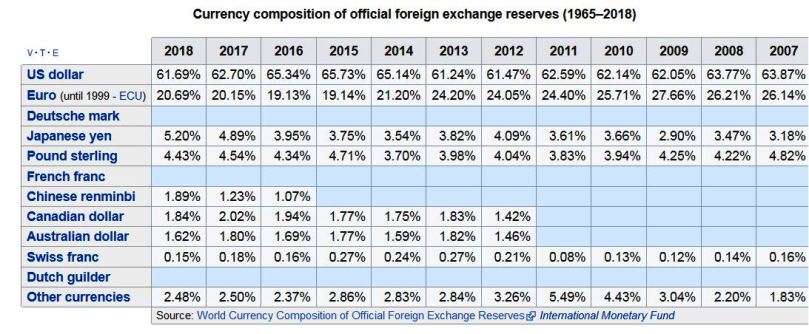
The Internet has been crawling with articles about the “death” of the U.S. dollar as the world’s principal reserve currency. Although reports of such “death” have been greatly exaggerated, the amount of U.S. dollars held by the world’s central banks in relation to the amount held in other reserve currencies has been fluctuating downward.
Reserve Currencies Historical 2
Why Should You Care?

Why care? Why would the U.S. dollar present status as major reserve currency be of interest to the average American?

The U.S. has an enormous national debt, a huge trade imbalance, and a disappearing middle class due to focus on either high-paying tech jobs or low-paying service jobs. Add to these concerns a push toward more of the same from current legislators that propose vote-getting green deals and Medicare for everybody.

The U.S. dollar status as a major reserve currency has a significant effect on all of these matters.

Background

Reserve currencies are held by governments and institutions to facilitate international payments. They also serve to influence the value of national currencies – for example, a country can buy or sell its national currency to boost or deflate the currency’s value.

What becomes a reserve currency depends on the global market. The currency of a developed country with a reputation for a stable economic and monetary system becomes popular, government central banks start shoring up their reserve accounts with it, and pretty soon the International Monetary Fund declares that currency a reserve currency.

Today the major global reserve currencies are: U.S. dollar, euro, Chinese renminbi, Japanese yen, and pounds sterling. The latest entrant is the Chinese renminbi, declared a reserve currency by the IMF in October 2016, as a result of China’s economic growth.

Benefits of Being the Issuer of a Reserve Currency

The issuers of these elite currencies enjoy two principal benefits only dreamt of by non-reserve-currency countries.

* Reduced exchange risks: Example – Commodities such as oil are sold in U.S. dollars. So the U.S. can purchase oil without needing to do any exchange of currency. But Brazil, for example, needs to first exchange its currency into dollars in order to purchase oil. Currency values fluctuate hour to hour, so planning and executing currency exchanges are risky and expensive propositions.

* Reduced borrowing costs: Reserve currencies enjoy higher demand than non-reserve-currency ones, since countries need to keep them in their portfolio in order to engage in global trade. This demand translates into low borrowing costs for the issuing country. The same would hold true if, say, Apple or Facebook issued corporate bonds that were in high demand – the companies could promise lower yields than if fewer investors wanted to purchase the bonds.

The Drawbacks

Unfortunately, being the issuer of a major reserve currency brings curses as well as benefits:

* Reduced borrowing costs induces more borrowing. That is true whether we are talking about a family taking advantage of lower credit card rates to purchase a new washing machine, or a legislators taking advantage of lower bond rates to finance his promises of more benefits for his constituents. Easy money eventually results into detrimental and unsustainable debt, such as we have today in the U.S.

* Countries that hold reserve currencies issued by another country are slow to rise against issuers, thus allowing issuers more leeway in economic and monetary policies. The U.S. for example can keep its voters happy by showering them with a variety of programs, paying for them by printing money. As the pile of fiat currency backed by nothing but “full faith and credit” rises, global trust eventually diminishes.

* Issuers of reserve currencies must be willing to operate under a current account deficit, which is mostly caused by importing more goods than exporting. For example: If U.S. consumers buy a lot of computer equipment made in China, a lot of U.S. dollars end up in China. China can then use those dollars to invest in bonds issued by the U.S. government. With money from the sale of those bonds, the U.S. can finance road construction, green new deals, etc. The U.S. factory worker, though, is left behind.

To put it in simpler terms, if the USD weren’t the world’s major reserve currency, probably its value would have fallen, US exports would be more competitive, and more people in the US would have jobs making goods for exports … While some people have said that the use of the dollar as the world’s major reserve currency is an “exorbitant privilege,” other people argue that it’s actually an “exorbitant burden” for just this reason.” What Happens if the US Dollar loses its Status as the World’s Major Reserve Currency, Quora.com, April 15, 2019.

Reserve currencies

* Major currencies have come and gone throughout history, so there is no reason to expect the U.S. dollar to retain its status forever.  This chart developed by JP Morgan’s Michael Cembalest, is helpful in visualizing the turnover of reserve currencies.

Source:  We Believe the US Dollar Could Lose Its Status as a World Reserve, Zero Hedge, July 23, 2019.


The Contenders

With the fall of every major currency there are winners and there are losers. Today, some powerful potential winners are working to be the successful contenders in replacing the dollar, or working to implement their agenda by dethroning it.

* China makes no bones about wanting the renminbi to replace the dollar as the principal global reserve currency.

* Germany, France and the U.K. adopted the Instex system in January 2019 in order to allow their companies to get around U.S. sanctions, dollars and banks, and trade with Iran.

* Even Facebook has gotten into the act by developing its own “global currency.” Some say FB has aspirations that the Libra will someday serve as a reserve currency, although that goal is not listed in the white paper that describes the objectives of this blockchain currency.

* The United Nations is not a country nor a jurisdiction such as the Eurozone (really!), so theoretically it cannot issue currency that might compete for reserve status. However, the U.N. is an amazingly powerful force that can drill its ideas into the heads of globalists everywhere. One of its ideas is the “retooling” of the current reserve currency system. The current system still has as its basis, albeit tangentially, in the economic market. Countries get to be reserve currency issuers because the market finds their currency desirable. Conversely, the U.N. wants a managed system based on what one could call “from each according to his ability to each according to his need.” Sound familiar?

… the build-up of global imbalances to global crisis levels may be traced back to a trap inherent in the reserve and payment system whereby reserve-creating countries are able to run payment deficits as long as other countries find it in their interest to keep building up their international reserves in the currencies of the reserve-creating countries … What is required is a reserve and payments system that does not rely on national deficits to provide reserve assets … Of great interest are proposals to shift to the allocation of SDRs based on need or performance, instead of on economic significance that determines voting shares in the IMF. Ocampo (2009) proposes giving larger allocations to countries with the highest demand for reserves and allowing IMF to use unutilized SDR’s to buy bonds from developing countries.”  UN report Retooling Global Development and Governance edited by Bloomsbury, June 2010.

So the pressure is on, and the U.S. is at a crossroads. As with so many things in life, the choices are based on short-term gains that benefit the here and now and long-term gains that make present perpetrators pay for their sins.

Decisions should be made, hopefully in favor a retaining the market-based system of reserve currencies.

What To Do?

More folks need to care about real issues. The eventual unraveling of the nation’s economy due to unsustainable national debt and negative trade will harm everyone – conservatives, progressives, the privileged by birth and the unfortunate by circumstances.

Conventional wisdom has embraced a “strong dollar” and defense of its status as the principal reserve currency no matter what. However, today’s scenarios are developing into something quite different. The current administration and President Donald Trump in particular have called for the following U.S. goals,

* Growth of good-paying manufacturing jobs in order to diversify from the trend toward high-paying white collar jobs and low-paying service jobs. A strong dollar would hinder sales of U.S. made goods to domestic consumers who could easily keep buying imported goods. Assuming that U.S.-made goods would not depend heavily on imported components, a strong dollar would hinder U.S. manufacturers’ ability to export their goods.

* Lowering the level of the national debt. U.S. administrations always give lip service to the need to control the gargantuan national debt, without ever doing anything about it. The dollar’s strong position as the major global reserve currency, as noted above, aids and abets the continued growth of debt.

For decades, the U.S. stood out as the one nation that traditionally preferred its money superpower-strong. Investors flocked to it, enabling the U.S. to borrow lots of money at low interest rates. American consumers feasted on it, buying imported goodies for less … The president obliterated any remaining strong-dollar allegiance with a July 20 tweet saying the strengthening dollar was “taking away our big competitive edge.” …
By abandoning the strong-dollar mantra, Trump may be signifying he’s willing to toss tradition aside and join ranks with other countries that have weakened their currencies to get a leg-up in world trade.  The Strong Dollar, July 20, 2018.

President Donald Trump’s viewpoint as expressed in the above-mentioned tweet might be something for conservatives who traditionally support the idea of a strong dollar to consider.

Progressives who claim to want everyone taken care of might note that blue collar workers have been left behind since the U.S. push to focus on the white collar financial and technical sectors.

And everybody might consider what our current piling up of cheap debt to support our lifestyles will do to our children, grandchildren and generations to come that will have to deal with that can that we have kicked down the road.


Time for Congress to Solve the Border Crisis

Taxpayers are paying Congress to bicker. Our legislators are not effectively solving the nation’s challenges, including the tragic situation at our Southern Border.

Are We Paying Congress to Bicker or to Deal With the Nation’s Challenges?

Right after the Mueller Report, the more sanely-inclined among the U.S. population Border Patrolhoped that Congress would go back to work. Unfortunately, that has not happened. Taxpayers are paying Congress to bicker. Congress is not working with the Administrative Branch in developing an effective foreign policy. It is not addressing the nation’s unsustainable level of debt. It is not producing a realistic immigration policy. The latter is the most egregious inattention of the current members of our Federal Legislature.


Theatrics Won’t Help

Tears, fake or real, are not going to solve the problem of what to do with thousands of undocumented people who presented themselves voluntarily at the U.S. border. Mainstream media profiting from the dialog of “caged children” will not address why parents would subject their children to such conditions. Demonstrations and sign waiving will not speed up the process by which the case of each detained individual can be reviewed and decided upon. Constant harangue on the subject of impeachment will not ease the crowding, the unhealthy conditions, the diseases, the tragic deaths. It will not give relief to exhausted border agents.

Such theatrics are useless in remedying the border crisis because none of it offers effective or lawful solutions or contribute to productive dialog.

Disorderly Patchwork is Not Sustainable

Because Congress has failed to develop effective and lawful solutions acceptable to the nation as a whole, the Administrative branch has felt compelled to resort to what has proven to be disorderly patchwork.

Perhaps making undocumented people as uncomfortable as possible and scaring them as relentlessly as possible might discourage more from attempting to enter the country. However, one would need to ask whether such efforts bring desired results, are sustainable, or present the nation in a positive image before the world.

ICE raids on individuals who have lived peaceably in the U.S. for decades might instill enough fear that some of them might leave or advise relatives not to come. But the tactic also results in advocates rallying their forces to protect immigrants, sometimes including the ones who have not lived in peace.

Endless busloads of detainees dropped by Border Patrol agents into various communities certainly serve to show what border agents are going through, but is equally unsustainable:

“They’re catching 3,000 to 4,000 people across the whole southwest border a day,” DeSio [Ralph DeSio, spokesperson for the San Diego office of U.S. Customs and Border Protection] said. “You could fill a stadium with these people in a few days. The enormity of this is flying over many people’s heads.”  Orange County Register, as quoted in GOPUSA, May 27, 2019.

In the progressive mind, and in the mind of many libertarians who believe in freedom of movement, the border crisis could be easily solved by simply not making much of an effort to apprehend those crossing the border without U.S. authorization. Maybe that is what Native Americans did back in the 16th Century when the Pilgrims started to arrive – for a while.

“Now, in Coachella, the places that can offer shelter are at capacity. Meanwhile, the Greyhound station in Indio, where many migrants hoped to catch a bus to get to their families didn’t have enough capacity to transport so many people. After that,” Amaya [Emilio Amaya, executive director of the San Bernardino Community Services Center] said, “agents started taking people further north, to San Bernardino … It’s a capacity issue more than a political issue …”   Orange County Register, as quoted in GOPUSA, May 27, 2019.

Yes, it is a capacity issue.

Time for Voters to Take Action

It is time for the people in each precinct, county, township or parish to hold their legislative representatives’ feet to the fire. Demand Town Halls and demand representation. Once representatives have orders from their constituents and understand their job is on the line if they do not perform, they will start working on solutions based on realistic and amicable negotiation.

Of course, the folks back home need to also remain flexible, and they need to eschew bickering themselves. This nation has ultra progressive areas that stand by their immigrant populations and ultra conservative areas that emphasize the need for law and order. Thus, any effective immigration reform would need to be the result of compromises. But a solution that is not perfect to each taste is better than the unhappy turmoil we have now.

Justin Amash Declared his Independence

Justin Amash maybe did not leave a political party, but joined the growing number of disaffected unaffiliated voters who had enough of the present dysfunctional two-party system.

Picture of Justin Amash

Fifth-term Congressman from Michigan Justin Amash declared his independence from partisan politics on July 4th. He made his announcement in an op-ed in the Washington Post, citing disenchantment with the present system and quoting George Washington’s warning regarding the detrimental influences of partisanship:

In recent years, though, I’ve become disenchanted with party politics and frightened by what I see from it. The two-party system has evolved into an existential threat to American principles and institutions.

Washington said of partisanship, in one of America’s most prescient addresses: “… It serves always to distract the public councils and enfeeble the public administration. It agitates the community with ill-founded jealousies and false alarms, kindles the animosity of one part against another, foments occasionally riot and insurrection…”

Indeed, we can clearly see the results of partisanship gone amok in our current constantly-bickering leadership.

As one of the 63 members of Congress elected as a result of the Tea Party Movement and as Chairman of the House Liberty Caucus, Amash is considered a conservative-libertarian. Perhaps he proved to be more of a libertarian in the tradition of former Congressman from Texas Ron Paul than a conservative in the Tea Party mold. Thus, Amash is not only out of step with Democrats, but also with conservative Republicans. Notoriously, he is the only Republican at present to support the impeachment of Donald Trump.

A recent exchange between five GOP Representatives working on a deal to bring a missile defense site to Fort Custer in Michigan and Justin Amash might provide insight where Amash stands regarding the powerful military-industrial complex.

The GOP Representatives highlighted figures showing the missile defense site could have an estimated $3.2 billion in economic impact, including 300 direct jobs and 1,800 support jobs; and Amash replied that the Defense Department is not a jobs program.

“It appears that Congressman Amash’s consistent opposition to all defense spending bills over the years was too much for the Pentagon to accept,” the statement from the five other members of Congress read. “It did not help and now they selected New York for the new missile defense site.” 

Amash replied in a statement released Friday that “taxpayer dollars for defense should be used to boost American’s safety, not to boost politicians,” he said. “The Department of Defense is not a jobs program.”  The Battlecreek Enquirer, June 28, 2019.

Perhaps Justin Amash is not leaving a political party but joining a growing number of equally disaffected voters who have no party affiliation. For clarification, citizens do not need to belong to a political party to be able to vote.

A pair of Nike sneakers

Unaffiliated voters are voting with their feet. They are registering their disdain for the current dysfunctional, bickering, do-nothing-productive two-party system that reflects the divisiveness we see in the general public. When so much focus is placed on the design of some (over-priced) sneakers, we are all in trouble.


4th of July: Hotdogs But No History?

In his first draft of the Declaration of Independence, Thomas Jefferson condemned the importation of slaves into the colonies as an “abominable crime.” Delegates to the Continental Congress of 1776 removed that language and replaced it with ambiguous reference to “domestic insurrections” so as to ensure support for Independence from the Southern colonies. What would you have done instead?

On Thursday, communities across these United States will celebrate 4th of July with hotdogs and fireworks, but all too often without much understanding of what the Founding Fathers aimed to create when they signed the Declaration of Independence.

Understanding requires objectivity, emotional stability, and perspective – all of which in short supply. Students do not study history objectively, people readily respond to sound bites and catchphrases, and single-minded views take the place of perspective of events. Thus, Thomas Jefferson has descended to the level of a mere slaveholder. Thus, schools call for the removal of statues and murals depicting our nation’s history. Once history is erased, there is no way to learn from it, or avoid repeating horrendous acts such as building an economy based on indentured servitude.

So, what is going on? Are voices calling Jefferson and Washington brigands uncovering ugly truths that need to be told, or do such voices represent another agenda?  Let’s compare what the Founding Fathers aimed to create vs. what today’s politicians want to do.

What the Founding Fathers Wanted

When leaders in the American Colonies decided to break with Great Britain, they were faced not only with a War of Revolution but also with a clean slate upon which to design a new nation. They did not wish another Britain or France, but a nation that embodied the ideals of individual liberty and self government. To do that, they needed to codify the ideas contained in documents that discussed such ideals. For example:  The Magna Carta (1215) spoke of curtailment of a King’s absolute power and of limited government.  In his Second Treatise on Government (1690), John Locke discussed natural rights that everyone is born with and the duty of government to protect those natural rights.

Revolutionaries like Thomas Paine (“If there must be trouble, let it be in my day, that my child may have peace.”) and Patrick Henry (“Give me liberty or give me death!”) are best known for the oratory that spread the word about Independence. George Washington led the War of Independence. John Adams, Benjamin Franklin, Thomas Jefferson, and James Madison were the principal architects of the new nation. Thomas Jefferson wrote the first draft of the Declaration of Independence. All these and many more placed their lives, their fortunes and their sacred honor to create a republic in which the individual was paramount, and government existed only to protect the natural rights of the people.

What Today’s Politicians Want

With few exceptions politicians today want unlimited government, an obedient populace that does not understand government is their servant not their master, and replacement of natural rights with civil rights.

But the words of those pesky Founding Fathers and that bothersome old U.S. Constitution are in the way. Give such politicians a chance and they will do away with just about every single word in the Constitution. However, since they feel that time has not yet come, best alternative is to crank out rules and laws that keep expanding the reach of government and malign those who called for limited government.

Have a Great 4th of July! Here is a Suggestion:

If you are having a 4th of July get together with family and friends, maybe take a moment to reflect on what you are celebrating.  If you want to frame your call for reflection with a topic du jour, pose the question: If you were a Founding Father creating a new nation out disparate colonies, how would you go about changing the structure of colonies whose economy was based on slave labor?

Would you visualize such an endeavor as challenging for the new Republic?  For example:  In his first draft of the Declaration of Independence, Thomas Jefferson condemned the importation of slaves into the colonies as an “abominable crime.” Delegates to the Continental Congress of 1776 removed that language and replaced it with ambiguous reference to “domestic insurrections” so as to ensure support for Independence from the Southern colonies. What would you have done instead?

Do you view individuals even possessing the best intentions to be fallible?  Do you see a comparison between the fallibility of today’s politicians who are unable to remedy tragedies such as homelessness and deaths from drug addiction with the fallibility of yesterday’s politicians who failed to end slavery in a rational and peaceful manner?

Enjoy your Independence Day!

patrick-henry-1775-granger

Free Speech Rights Do Not Exist in the Private Sector

There is no such thing as “free speech rights” in the private arena, and the U.S. Supreme Court just told us that.

Internet platforms, especially dominant social media arenas, are now the populace’s principal venues for personal, community, business and political communication. With the growth of social media, platform users benefitted from massive reach and ignored the potential perils of oligarchies. Now we hear howls about some users being excluded from social media and accusations of violation of “free speech rights.”

Well, there is no such thing as free speech rights in the private sector. With some specific exceptions (such as your shouting “fire!” in a crowded theater when you know there is none, engaging in libel, or making serious threats) government is prohibited by the First Amendment of the U.S. Constitution from abridging your freedom of speech. The Constitution says nothing about private individuals or entities choosing not to propagate speech they do not like for whatever reason. So, if you are banned from a social media platform, at present you are probably out of luck. On June 17, 2019, the U.S. Supreme Court may have cemented this state of affairs.

MNN v. Halleck

Manhattan Community Access Corp., also known as Manhattan Neighborhood Network (MNN), is a non-profit public-access television network serving New York City. As a community media center, it offers media production, education, and distributions services for Manhattan residents and community organizations. MNN is the entity New York City chose to operate the public access channels on Time Warner’s cable system in Manhattan. Its website says that MNN’s purpose is,

…to ensure the ability of Manhattan residents to exercise their First Amendment rights through moving image media to create opportunities for communication, education, artistic expression and other non-commercial uses of video facilities on an open and equitable basis.

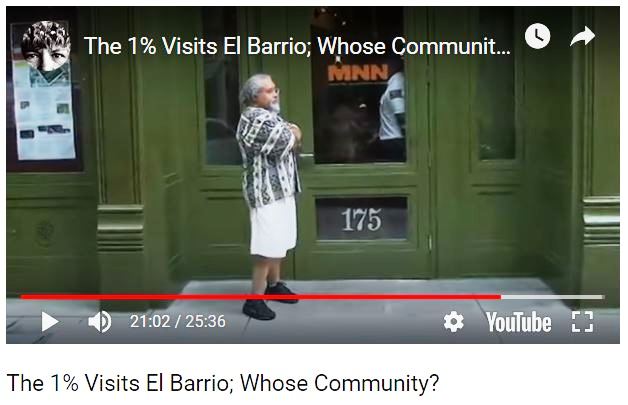
DeeDee Halleck and Jesus Papoleto Melendez, Manhattan residents and participants in MNN’ activities, produced a film called The 1% Visits El Barrio; Whose Community? The 1% refers to the politicians, government agency representatives, and corporate officials who were invited to the grand opening of the Barrio Firehouse (a former firehouse on East 104 Street that MNN converted into television studios), to the exclusion of “the 99%” Papolete Melendez says he represents. The film did air on MNN, but was removed, and Melendez barred from using MNN’s facilities, due to viewers’ complaints over inappropriate content in the film, according to MNN.

MNN Halleck Case
Video by Dee-Dee Halleck and Jesus Melendez that resulted in the MNN v. Halleck lawsuit

Halleck and Melendez were not pleased, and filed a lawsuit, against MNN, claiming the network violated their free speech protections under the First Amendment of the U.S. Constitution. The District Court dismissed the claim on the grounds that MNN is not government but a private entity. The Second Circuit State Court of Appeals reversed the lower-court decision saying MNN was a “state actor,” since it was designated by New York City as the community access network.

The U.S. Supreme Court heard arguments on Manhattan Community Access Corporation et al v. Dee-Dee Halleck et al in February 2019, and issued its decision on June 17, 2019. Justices Kavanaugh (delivering the majority opinion), Roberts, Thomas, Alito, and Gorsuch did not view MNN as a state actor subject to First Amendment responsibilities. Justices Sotomayor (delivering the dissenting opinion), Ginsburg, Breyer, and Kagan did not agree.

Justice Kavanaugh indicated in his remarks that this decision applies only to the case at hand. However, his concluding statement contains broader implications.

It is sometimes said that the bigger the government, the smaller the individual. Consistent with the text of the Constitution, the state-action doctrine enforces a critical boundary between the government and the individual, and thereby protects a robust sphere of individual liberty. Expanding the state-action doctrine beyond its traditional boundaries would expand governmental control while restricting individual liberty and private enterprise. We decline to do so in this case.

MNN is a private entity that operates public access channels on a cable system. Operating public access channels on a cable system is not a traditional, exclusive public function. A private entity such as MNN who opens its property for speech by others is not transformed by that fact alone into a state actor. Under the text of the Constitution and our precedents, MNN is not a state actor subject to the First Amendment.

Justice Sotomayor and her colleagues in their dissenting opinion argued that although MNN is indeed private, government rents it. The situation would be akin to government renting a billboard to communicate with passersby, then excluding from that billboard messages it did not like. The billboard is private, but the communicator is not.

This is a case about an organization appointed by the government to administer a constitutional public forum. (It is not, as the Court suggests, about a private property owner that simply opened up its property to others.) New York City (the City) secured a property interest in public-access television channels when it granted a cable franchise to a cable company. State regulations require those public-access channels to be made open to the public on terms that render them a public forum. The City contracted out the administration of that forum to a private organization, petitioner Manhattan Community Access Corporation (MNN). By accepting that agency relationship, MNN stepped into the City’s shoes and thus qualifies as a state actor, subject to the First Amendment like any other.

The Conservative/Liberal Divide

As often happens “conservative” justices and “liberal” justices disagreed, as indicated in their decisions. Commentators disagreed as well.

Property and free speech rights both scored a big victory at the Supreme Court this week, when the Court decided Manhattan Community Access Corp. v. Halleck. Although the facts of this case focus narrowly on public access television networks, the Supreme Court’s decision has significant implications for all property owners, the internet, and social media more specifically.  The Pacific Legal Foundation, June 17, 2019.

The Court is unconvinced by the fact that the private company running New York’s public access channel was specifically selected and is heavily regulated by the city government. And while the dissent, authored by Justice Sotomayor, disagrees with the majority about whether the facts of the case reflect a government property interest in the forum at issue, it largely signs onto the idea that property rights precede political rights.  MerionWest, June 23, 2019.

The First Amendment only limits governmental actors—federal, state, and local—but there are good reasons why this should be changed. Certain powerful private entities—particularly social networking sites such as Facebook, Twitter, and others—can limit, control, and censor speech as much or more than governmental entities. A society that cares for the protection of free expression needs to recognize that the time has come to extend the reach of the First Amendment to cover these powerful, private entities that have ushered in a revolution in terms of communication capabilities.”  David L. Hudson, Jr, In the Age of Social Media, Expand the Reach of the First Amendment,” The American Bar Association.

Interestingly, there appears to be fans of free speech for owners of social media platforms and fans of free speech for non-owner users of such platforms. Also, what are “political rights?” Further, the U.S. Constitution Bill of Rights serves only to protect individual liberties against tyrannical behavior by government; therefore, it seems awkward to call for extending the reach of the First Amendment to private entities regardless of how big or powerful such entities become.

So what to do?

The Just Vote No Blog likes the Court’s decision and Justice Kavanaugh’s suggestion that the bigger the government the smaller the individual, and thus a narrow definition of “state actor” serves the cause of liberty. If some of us are harmed by social media curbing our ability to reach community and customers, well, that is the price we must all pay for ignoring the growth of enticing behemoths. Competition is a good antidote to institutional transgressions, but there cannot be competition in an age of gigantic oligarchies.

Perhaps in a post-MNN vs. Halleck world folks that hold views different from those preferred by the dominant social media players need to imagine new ways of outreach. Efforts toward enforcing existing but largely ignored antitrust laws would also help in the blossoming of a wider variety of platforms.

Now a Credit Card Crisis?

U.S. Senator Bernie Sanders and Representative Alexandria Ocasio-Cortez plan to introduce legislation that would cap credit card interest rates at 15%. Sounds good – just cap interest rates, and consumers will benefit. But is that all that would happen?

U.S. Senator Bernie Sanders and Representative Alexandria Ocasio-Cortez plan to introduce legislation that would cap credit card interest rates at 15%. Proposals such as this sound great on paper – cap interest rates, and consumers will benefit. But is that all that would happen?

Consider the Following Track Record

* College Tuition

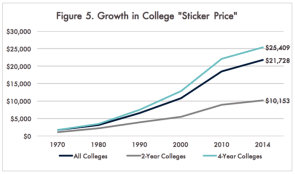
Rise in College Tuition 2If anything, increases in financial aid in recent years have enabled colleges and universities blithely to raise their tuitions, confident that Federal loan subsidies would help cushion the increase. In 1978, subsidies became available to a greatly expanded number of students. In 1980, college tuitions began rising year after year at a rate that exceeded inflation.” William Bennett, Secretary of Education, Our Greedy Colleges, The New York Times, February 18, 1987.
* Health Care

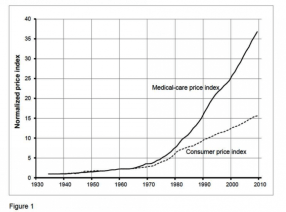
Rise in health care costThe U.S. “health care cost crisis” didn’t start until 1965. The government increased demand with the passage of Medicare and Medicaid while restricting the supply of doctors and hospitals. Health care prices responded at twice the rate of inflation. Mike Holly, How Government Regulations Made Healthcare So Expensive, Mises Wire, May 01, 2017
 

* Housing

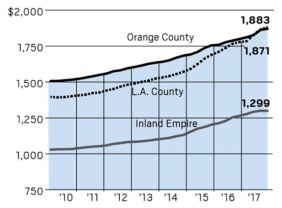
Rise in California RentsRent controls protect tenants when rents rise faster than incomes. Because it makes owning rental properties less profitable, rent control discourages landlords from maintaining apartments and encourages them to convert apartments to condominiums, thus reducing housing supply. California’s current housing crisis has resulted in calls to expand rent controls, despite evidence that this practice may drive up rents in uncontrolled buildings.   Jenny Schuetz, Under US Housing Policies Homeowners Mostly Win, While Renters Mostly Lose, Brookings, July 10, 2018
* And Now Credit Cards

Like any other economic good or service, interest rates are subject to the laws of supply and demand. The supply of genuine savings and the demand for those savings embody the interest rate, and this is reflected by its price. When the price of a good or service is capped, this produces a disincentive for entrepreneurs and suppliers to engage in economic activity in the affected industry. This is simultaneously coupled with an artificially low price, which in turn increases demand. The result of a decreased supply and an increased demand is a shortage.  Logan Davies, Ocasio-Cortez’s Plan to Cap Interest Rates is a Horrible Idea, Eccentric Economics, Being Libertarian, June 9, 2019.

Caveats and Externalities

Seldom there is just one reason that explains a situation; although often there is a fundamental reason. Also, it is sometimes difficult to establish whether concurrent events are causal or incidental; but if the incidence of a type of concurrent event produces similar results, one would suspect a causal relationship. Thirdly, economics is a fungible discipline that can regard John Maynard Keynes as well as Milton Friedman with equal seriousness, although the economic theories of these two folks are diametrically opposed.

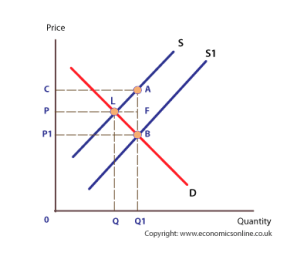
And fungibility of economic theory is good at both including widely – collective-leaning hypothesis are as acceptable in the economic arena as are market-leaning ones – and excluding imprudently. A couple of lines on a diagram cannot possibly take into account the countless characteristics in human behavior; therefore, those lines simply illustrate a scenario whereby “all other things being equal,” which hardly ever happens in real life.

Subsidy diagramFor example, the diagram at left is often used to illustrate the benefits of subsidies.  The higher “S” is pre-subsidy price, and the lower “S1” is post-subsidy.

A college administration’s greed response to government subsidies as described by Secretary William Bennett would be difficult to include in this diagram. Greed, that is, the capture of any marginal benefit, negates the assumption that all things remain equal. Thus, as subsidies grew, so did the number of college administrators, the variety of student services outside of basic instruction, and employee benefits such as pensions. It was not just demand that grew.

Are We Dealing With Microwave Mentality?

People use microwaves because they want their edibles now, not later. Microwave users want theirs now!

When politicians insists on, say, free college for all, universal health care, rent control, or a cap on credit card interest rates, they are catering to voters’ microwave mentality. In order to get elected or re-elected, politicians need to showcase immediate events that benefit constituents and ignore negative externalities that harm them.

Antonio Gramsci: The New Hegemony

Antonio Gramsci formulated possibly the most influential philosophy of our times – rule brought about not by violent force but by consent of the subjugated class. Some call Gramsci’s philosophy Neo-Marxism, but Gramsci himself does not appear to have called his philosophy anything; he simply described the plan’s components: hegemony, praxis, and civil society.

One of the most fascinating political writers of the early 20th century was Antonio Francesco Gramsci. Gramsci was born in 1891 in the beautiful Mediterranean island of Sardinia, and died at only 46 in Rome in 1937. During such a short life, he was able to formulate possibly the most influential philosophy of our times – rule brought about not by violent force but by consent of the subjugated class. Some call Gramsci’s philosophy Neo-Marxism, since it aims to achieve similar results without the extreme authoritarianism of Traditional Marxism. Gramsci himself does not appear to have called his philosophy anything; he simply described and emphasized the plan’s components: hegemony, praxis, and civil society.

Gramsci’s writings, mostly essays, are divided into pre-prison time and prison time. Prison time, courtesy of Benito Mussolini’s anti-Marxist Fascist Italy, lasted six years, 1929-1935. According to those who study Gramsci’s work, the pre-prison essays (1910-1926) lean towards the politically specific, while the latter woks are more historical and theoretical. Interestingly, Gramsci’s socio-political theories provide insight into common strategies used by both capitalists and Marxists. Concepts of hegemony, praxis, and civil society are entirely adaptable.

Hegemony

The bourgeoisie, in Gramsci’s view, develops a hegemonic culture using ideology rather than violence, economic force, or coercion. Hegemonic culture propagates its own values and norms so that they become the “common sense” values of all and thus maintain the status quo. Hegemonic power is therefore used to maintain consent to the capitalist order, rather than coercive power using force to maintain order. This cultural hegemony is produced and reproduced by the dominant class through the institutions that form the superstructure.  Wikipedia, Antonio Gramsci

The bourgeoisie indeed ruled, until it was officially challenged in the 1960s by Lyndon Johnson’s Great Society.  During the last 50 years, the U.S. has experienced a gradual and relatively peaceful normalization of the socialist order. The newly- socialist-bent institutions of the superstructure (courts, universities, news media) provide support to the superstructure itself (today popularly alternately called the military-industrial complex, the deep state, or the central banks). Meanwhile “the capitalist order” has assumed the full mantle of crony capitalism and is busy normalizing its own crony newspeak (bailouts, affordable housing, industry tax breaks). Hegemony brought about by the consent of the subjugated (taxpayers, the working-poor dependent on public assistance, the priced out renter) is totally fungible.

Praxis

Praxis is the process by which a theory, lesson, or skill is enacted, embodied, or realized. Praxis may also refer to the act of engaging, applying, exercising, realizing, or practicing ideas … It has meaning in the political, educational, spiritual and medical realms.  Wikipedia, Praxis

In other words, praxis is the end result of observation, study, and thinking. It is doing.  It can be action oriented towards changing societal norms and values. Or it can be action to defend the status quo against factions desiring change.  Endless discussions on the virtues of capitalism vs. socialism are fine, but movement towards or against one or the other can only come about via mobilization of armies of volunteers, financial supporters, and strategists.  Praxis is exemplified by mobilizers such as the Tea Party or MoveOn and the Koch brothers or George Soros.

Civil Society

What we can do, for the moment, is to fix two major superstructural “levels”: the one that can be called “civil society”, that is the ensemble of organisms commonly called “private”, and that of “political society” or “the State”. These two levels correspond on the one hand to the function of “hegemony” which the dominant group exercises throughout society and on the other hand to that of “direct domination” or command exercised through the State and “juridical” government. The functions in question are precisely organisational and connective. The intellectuals are the dominant group’s “deputies” exercising the sub-altern functions of social hegemony and political government.  Archive.org, Antonio Gramsci, Selections from the Prison Notebooks

In summary, civil society lives by consent, while the State ensures by force the continuation of consent. Intellectuals function as the principal manufacturers of consent.  Academics are the foot soldiers that help either preserve the status quo or generate fresh value systems from which new hegemony arises.  Civil society is the battleground that gives rise to hegemony.

The International Gramsci Society, until recently presided by the late literary scholar Joseph Buttigieg (father of Rhodes-scholar and Mayor of South Bend, Peter Buttigieg, a presidential candidate in the 2020 U.S. elections), is one of many societies developing the socialist/Marxist consensual hegemony within today’s civil society.

Gransci meetingPictured lecturer:  Marcus E. Green, Phd, Pasadena City College, author of several Gramsci-related essays and secretary of the International Gramsci Society.

Gramsci’s Other Concepts

Antonio Gramsci discussed several other important concepts, many of which we can clearly see playing out today. Here are three:

Organic intellectuals: Scholars, artists, and functionaries (administrators, bureaucrats, industrial managers, and politicians) that identify with the economic structure of their society more than traditional intellectuals. Thus, organic intellectuals are more able to spread organic ideology, since their communication is with structures they identify as their own. Our representatives in the U.S. Congress are good examples of organic intellectuals; they identify with today’s penchant for kicking the can of the obviously unsustainable national debt down the road, and their ideological hegemony persists.

War of Position: Struggle against the existing hegemonic system is necessary for the establishment of a new system. The war to establish a dominant position must be waged on all three levels of society – economic, political and cultural. The current thrashing about between the administrative and legislative arms of our federal government should go down in history as a quintessential war of position.

Organic Crisis: Differs from ordinary financial, economic, or political crises. It encompasses an entire system that is no longer able to generate social consensus because the system’s ruling classes are unable to resolve conflicts. Organic crisis appears when, as Antonio Gramsci describes in his Prison Notebooks, “the old is dying and the new cannot be born.” Has the U.S. reached that point yet?