O. J. Simpson: Fallen angel of our times

Random thoughts are sometimes memories triggered by events. The passing of O. J. Simpson on April 10, 2024, brought such memories. O. J.’s fame and subsequent fall warrant reflection.

Random thoughts are sometimes memories triggered by events. The passing of O. J. Simpson on April 10, 2024, brought such memories. O. J.’s fame and subsequent fall warrant reflection.

Way back in 1974, my best friend and I were watching the star-studded movie The Towering Inferno in a movie theater in San Francisco. When O. J. Simpson showed up on the screen – playing security officer Harry Jernigan – there was cheering and applause from the audience. My friend, a season-ticket-carrying football fan was ecstatic. “That’s O. J. Simpson!” she said to me, knowing I would not know why everyone was cheering.

That event felt like an example of down-right reverence. It felt like folks were saying, “Wow, I wish I could be as talented, dedicated to a craft, and as handsome as he is!”

Today, April 11, 2024, the instructor in a class I was attending announced to the class that O. J. Simpson had died. Interestingly, there was an instant of silence and reflection. Then, there were comments, mostly echoing Fred Goldman’s reaction, “No great loss.” The class rightly empathized with the horrific pain felt by all those close to the murder of Nicole Brown Simpson and Ron Goldman.

O. J. Simpson’s fall from grace did not stop after he was controversially acquitted in the murders of Nicole and Ron. Other arrests followed, as well as time spent in prison.

In William Shakespeare’s play Julius Cesar, Mark Antony say,

“The evil that men do lives after them; The good is oft interred with their bones.”

Indeed. Evil is incredibly powerful. It obliterates our natural desire for peace. It demolishes our will power. It erases any good we have done or wish to do.

Someone once said, “You can’t fix evil.” Perhaps so. However, you can try to help prevent evil.

We will never know if kind intervention from family and friends would have mitigated O. J.’s pattern of physical abuse towards Nicole. Nobody seems to have tried.

And evil does not limit itself to the individual level. It takes hold of populations, bringing misery like Joseph Stalin’s “liquidation of the kulaks as a class” in 1929, the “Final Solution” in 1941, and the “economic necessity” of slavery in the U.S. starting in 1619.

The remedy for population evil is the same as that of individual evil: Try to stop it before it grows.

Marcy Berry

Picture: O. J. Simpson in his role as security officer Harry Jernigan in the 1974 film The Towering Inferno.

California dreamin’ of EVs

Often, when reading news from California, one wonders whether the state is at the forefront of innovation or delusion. California’s fixation with climate change and electric vehicles serves as example.

Often, when reading news from California, one wonders whether the state is at the forefront of innovation or delusion. California’s fixation with climate change and electric vehicles serves as example.

Here is a quote from one of the more progressive members of San Francisco’s Board of Supervisors, Rafael Mandelman.

We have to take action to expand our public EV-charging infrastructure and make EV ownership more accessible and practical for all San Franciscans.” … “Our curbside EV charging program is not just about installing charging stations. It’s about creating a more equitable and sustainable transportation ecosystem.” The City wants to add thousands of EV chargers by 2030, San Francisco Examiner, March 19, 2024.

San Francisco, as California, does have ambitious climate mandates, including plans for EVs for everyone and a ban on the sale of new gas-powered cars after 2035.

Given the real world, such climate ambitions border on delusional.

Supervisor Mandelman must be aware that San Francisco is projecting a deficit of $245 million in 2025 and a deficit of $554 million in 2026. He must also be aware that about 10% of the City’s residents live below San Francisco’s poverty rate, necessitating substantial subsidies if this population segment is to switch from gas-powered cars to EVs.

It is unknown whether Supervisor Mandelman wants to include the City’s 7,700 plus homeless population in his “equitable and sustainable transportation ecosystem.”

The high cost directly associated with EVs is not the only issue. Well-known shortcomings of current EVs include unreliable performance in extreme weather, need for more frequent charging than gasoline fill-ups, and electric grids that limit EV charging to specific times.

Beyond immediate inconveniences, EVs pose environmental challenges of their own.

Industry boasts that 95% of battery components can be recycled; extraordinarily expensively, but it can be done. However, industry seldom mentions that EV battery recycling is in its infancy, placing in question whether EV mandates are getting ahead of recycling capacity. As we all know, EV batteries are the last thing one would want in a landfill.

Although extraction of minerals necessary to produce EV batteries – mainly lithium and cobalt –is increasing, only a few countries extract these minerals in significant quantities. Australia, Chile and China extract the most lithium, while the Democratic Republic of the Congo extracts 70% of the world supply of cobalt. If EV mandates continue at the present rate, how long until environmentalists jump on the environmental challenges posed by widespread mining?

Despite mandates and incentives, drivers in the U.S. are not entirely sold on electric vehicles, according to an April 2023 Gallup poll. Current ownership is of EVs in the U.S. is only 4%. Gallup summarizes as follows.

“While ownership of electric vehicles is on the rise in the U.S., the percentage of Americans who say they own one remains limited at 4%. Though they are often promoted as a key way to reduce carbon dioxide emissions and address the effects of climate change, the public remains largely unconvinced that the use of EVs accomplishes this aim.”

As with all consumer goods, electric vehicles respond to price competitiveness and consumer needs. Without those two essentials, adoption of EVs at present can significantly increase only through government intervention. And here is where leaders like the aforementioned member of San Francisco’s Board of Supervisors, Rafael Mandelman, comes in.

Money to subsidize projects is never really a problem for governments, since taxpayers willing to fork over their hard-earned cash are always available. Consumer concerns with EVs are easily overcome by removing the alternative of purchasing gas-powered vehicles. Uneasiness with widespread mining is minimized by exporting environmental degradation.

Leaders have created a delusional world where petroleum disappears without credible supplies of products to replace petroleum and its thousands of derivatives. They have created an unnatural market where people buy what they don’t really want.

In the real world and the real market place innovators step in with new products that reliably and competitively replace products that no longer satisfy consumers. When whale bone became too costly due to overkilling of whales, plastics were invented. The decline of silkworms brought on the invention of nylon.

But, what can today reliably fly the thousands of airplanes in our skies except petroleum? What can credibly replace the hundreds of plastic products in our homes, especially our less affluent homes? Nothing. Because oil is efficient, and kept cheap relative to alternatives in large part as a result of government subsidies.

The oil and gas industry is expected to reap $1.7 billion in 2025 from the intangible drilling tax break, and $9.7 billion over the next 10 years, according to the White House. It is expected to realize $880 million in benefits from the depletion allowance tax break in 2025, and $15.6 billion by 2034.” The Zombies of the U.S. Tax Code: Why Fossil Fuels Subsidies Seem Impossible to Kill, The New York Times, March 20, 2024.

As long as oil is efficient and relatively cheap, it will take either gargantuan innovation to make EVs competitive or massive taxpayer-funded subsidies to make EVs affordable.

The real, non-delusional world, seldom allows us to have our cake and eat it too.

Pictured: Henry Ford’s electric vehicle prototype. The dream of electric vehicles is not new. Henry Ford worked with Thomas Edison for several years on an EV project before abandoning it. Some say the project did not work because of battery shortcomings, and some say the oil companies conspired to deep-six the project. Good article on the subject on Wired Magazine, Ford, Edison and the Cheap EV That Almost Was, June 18, 2010.

Why would wealthy families need school vouchers?

The newly-expanded North Carolina school voucher program – Choose your School, Choose your future – grants tuition assistance to any North Carolina family, regardless of income. Do wealthy families really need financial assistance to choose which ritzy school is best for their kids?

On May 17, 2023, the North Carolina Assembly passed House Bill 823, enthusiastically called Choose your School, Choose your Future. The bill expanded the state’s K-12 school voucher program, originally enacted in 2013 to assist low-income families. The Opportunity Scholarship, as the North Carolina voucher program is called, now grants vouchers to all North Carolina families regardless of income. Grants are on a sliding scale determined by family income, with amounts varying between $3,360 and $7,468 per child per year.

Legislators allocated $354.5 million for the Opportunity Scholarship program’s reserve fund for the 2024-2025 school year, and $416 million for the 2025-2026 year.

Lawmakers included HB-823 in the state’s $30 billion very much delayed and anticipated budget, which Governor Roy Cooper allowed to become law without his signature in September.

This program has received accolades as well as criticism.

Sadly, many traditional public schools are of poor quality and lately mired in controversy regarding race, gender, and sexuality. Children should not be stuck in such schools. The Opportunity Scholarship program is a godsend to lower-income families who cannot afford or who can barely afford private, including religious, schools.

However, back in May 2023, WFAE opinion columnist Tommy Tomlinson came up with an interesting description of the newly-overhauled North Carolina voucher program: “Robin Hood in reverse.” He said,

At some point, I have a certain grudging respect for the dedication some people have to playing Robin Hood in reverse — taking money from regular folks and handing it to the rich. Their latest maneuver here in North Carolina is a move to provide taxpayer-funded vouchers to any child in the state who wants to go to private school …

Kids from families with modest incomes have been eligible for similar vouchers here for the past 10 years. That, to me, actually makes some sense. It provides an escape route for a kid stuck in a failing school.

Wealthy families, whose children already attend the “ritziest schools in town” can argue that given the poor quality of public schools they are forced to pay both private school tuition and taxes that support public schools. Vouchers would help level their playing field. However, let us not forget that the working poor also pay taxes, some of which will help pay for school vouchers their wealthy neighbors receive.

Unfortunately, “Robin Hood in reverse” is not the only problem with universal school vouchers.

A worrisome possibility is a significant tuition increase.

North Carolina News & Observer education columnist T. Keung Hui noted in his excellent report of February 15, 2024, that some private schools have already announced tuition increases.

Private schools across the state are raising tuition and sending information to families about applying for Opportunity Scholarships. How much of the tuition increase is due to inflation or to take advantage of additional voucher funding is unclear. … The tuition rate increases for some schools across the state is more than 10%, which is well above the rate of inflation.”

People who attended college in the late 1980s might recall the shock wave of sudden tuition increases. Reasonably affordable four-year colleges became voracious, pushing students into quagmires of student loan debt. 1987 to 2010 witnessed a 106% increase in college tuition, according to a Mises Institute report dated November 30, 2021.

Coincidentally, the years 1980 – 2010 also saw expansion of college student loans guaranteed by the Federal government. William Bennett, President Ronald Reagan’s Secretary of Education, provided in 1987 his view for the college tuition increases he witnessed. Bennett’s assessment — what became known as the Bennett Hypothesis — was discussed in Science Direct, December, 2019

“Increases in financial aid in recent years have enabled colleges and universities blithely to raise their tuitions, confident that Federal loan subsidies would help cushion the increase.”

Scholars have debated the Bennett Hypothesis ever since it was first presented. But even when pitted against other possible reasons for substantial tuition surges — increase in attendance without concomitant growth in institutions, inflation, excessive regulation — the Bennett Hypothesis survives common sense. Is there a valid argument against the view that everybody likes money, and if it is available, most individuals and institutions will take it? Or a valid argument against expecting substantial expansion in school vouchers to have negative effects like those associated with college student loans?

Families should also be concerned about class sizes.

Mr. Hui of the News & Observer indicated an estimated 60% increase in students getting vouchers. Recipients that are already attending private schools will not affect class sizes, but students crossing over from public schools might. Chances are private schools will not rush to expand their facilities to accommodate the crossover population, which could result in increased class sizes.

Vouchers might not be operating on a level playing field.

Lower-income families and their advocates should ask themselves whether universal school voucher programs operate on a level playing field.

By way of comparison: Progressive advocates for poor and minorities often oppose voter ID requirements, citing that poor and minority voters face greater difficulties obtaining IDs. Would the same difficulties apply to obtaining school vouchers? Might more affluent, more educated families possessing greater resources hold advantages over the less fortunate?

Hopefully, in the interest of fairness, the priorities in receiving vouchers contained in HB-823 will lower any advantages held by wealthier families. Families whose children were voucher recipients prior to HB-823 (when there were income limits) will enter a voucher lottery first, followed by lower-income applicants; the more affluent applicants will enter the lottery last to receive what funds are left in the year’s allocation.

Lastly, do the wealthy really need vouchers?

The common-sense answer is clearly “No.” The title of House Bill 823 — Choose your School, Choose your Future – although catchy, is disingenuously applicable only to lower-income families. It is difficult to imagine circumstances in which wealthy families need vouchers to choose which ritzy school is best for their children.

Indeed, it is unfair that families with children who attend private schools pay both tuition and taxes that support public schools. However, universal school vouchers possess an unfortunate aura of benefits for the rich.

Conceivably a better idea might be to pass legislation absolving parents with K-12 children in private schools from paying taxes that support public schools, limiting vouchers to very low-income families living in poor-performing school districts, and improving the performance and cost effectiveness of public schools by practicing the good old focus on “reading, writing, and arithmetic.”

Picture: The beautiful Groton School in Groton, MA. Founded in 1884. Educating 380 students, grades 8-12.

A Nation of Immigrants: That was then

We are a nation of immigrants. But, 12 million immigrants that arrived at Ellis Island from 1892 through 1954, that was then.  The 2,063,692 undocumented immigrants that crossed U.S. borders in 2023, this is now. Different numbers and different worlds.

Razor and concertina wire continue to go up along the Texas border with Mexico, and the flow of undocumented immigrants into the United States continues unabated.  Meanwhile, President Joe Biden says, “I’ve done all I can do.  Just give me the power.  Give me the border patrol … “  And all the while, Congress and Senate bicker over border solutions that make little sense anyway.  

Illegal border crossings have become not only another crisis, but also another divisive issue among Americans.  Contentious pro/con arguments abound.  Here are some: 

*   Pro – We are a nation of immigrants.  Con – The country cannot sustain the current level of undocumented immigrants. 

*   Pro – Immigrants of all kinds contribute to the labor force and thus to GNP growth.  Con – Most unauthorized border crossers are not self-sufficient, and the costs to taxpayers they incur outweigh contributions they make. 

*   Pro – America is humane and cannot turn away people escaping poverty and violence.  Con -Every cent that goes towards being humane to unauthorized border crossers is every cent not applied to current lawful residents. 

Perhaps the most often used argument in favor of the current liberal border policies is that we are a nation of immigrants. 

Indeed, immigrants have always been attracted to the U.S., mostly because of this country’s fairly strong adherence to a Constitution that protects individual liberties, and a largely market-based successful economy.  Thus, former President John F. Kennedy, when still Senator from Massachusetts, coined the phrase “A Nation of Immigrants” in a 1958 essay, which was later publishes posthumously as a book in 1964.

The story told by John F. Kennedy about his Irish-born great-grandparents could be told about millions of immigrants who have contributed mightily to the economy and culture of the U.S.

However, it is worthwhile to place in context John F. Kennedy’s classic essay on immigration.  Here are some statistics that might help:

The numbers.

*  The U.S. Historical Census Statistics on the Foreign-born Populations of the United States 1850-1990 indicates in 1850 (around the time the Kennedys first settled in the U.S.) there were 2,244,602 foreign born individuals residing in the U.S., 9.7% of the total population. 

*  U.S. Customs and Border Protection Stats and Summaries indicates total FY 2023 nationwide encounters (apprehensions) were 2,063,692.

Nationwide Border Patrol encounters in one year (FY 2023) are almost as high as the total number of foreign-born people living in the U.S. in 1850. 

*  The U.S. Customs and Border Protection historical figures 1925-2020 indicate total FY 1958  nationwide Border Patrol encounters (apprehensions) were 40,504.

The 1925-2020 Border Patrol nationwide apprehension figures fluctuated considerably from year to year (lowest in 1934 10,319; highest in 1986 1,692,544; and last in 2020 405,036).   But the 1958 figure 40,504 serves to put into context the time of Kennedy’s essay vs. today (FY2023  2,063,692 apprehensions).

The costs.

There is a misconception that government at the federal level does not provide public assistance to undocumented foreign-born individuals.  Although there are restrictions, the federal government does provide plenty of taxpayer-funded programs that benefit undocumented aliens.  Information on the following programs can be found on the website of the U.S. Department of Health and Human Services (HHS).

*   Unaccompanied Children Program:  By law HHS must assume custody and provide care for children under 18 who enter the U.S. undocumented and unaccompanied by a parent or guardian, and who have no parent or guardian in the U.S. 

*   Temporary Assistance for Needy Families (TANF):  The federal government provides grants to states, DC and territories that can be used with flexibility to help low-income families with children.  (There is no indication that states cannot use TANF grants to assist low-income undocumented families with children). 

*   Supplemental Nutrition Assistance Program (SNAP):  This federal nutrition program is available to victims of trafficking, Cuban or Haitian entrants under the Refugee Education Assistance Act of 1980.

*   Head Start and Early Head Start:  This program is in the Office of Head Start (OHS), within the Administration for Children and Families, U.S. Department of Health and Human Services.  It is not considered a federal public benefit, and any child whose family qualifies under income limits can participate regardless of immigration status.

In addition to the social costs mentioned above, the federal government funds immigration courts, border agents, medical emergencies at the border, processing centers, and grants to non-federal entities to support border and interior communities receiving migrants through the Shelter and Services Program (shelter for apprehended and released undocumented border crossers). 

What services to undocumented immigrants cannot be funded with federal money, several states and localities fund them with state and local taxes.  As of November 2023, California, Illinois, Oregon, New York, Colorado, and the District of Columbia offer some form of state-funded health coverage to all residents regardless of immigration status.  12 states offer health coverage to income-eligible undocumented children.

As in the case of the federal government, states also bear costs of providing shelter, food and emergency medical care to undocumented immigrants, as Texas Governor Greg Abbot has made abundantly clear!  In addition, states bear costs educating all children.

Obviously, we are talking here about immigrants who have limited education and resources, not about university postgraduates from well-healed families on expired visas or arrivals by private jet.  And obviously, many of the former magnificently rise above their circumstances. 

During his testimony on September 13, 2023, before the U.S. Senate Committee on the Budget, Robert Rector, Senior Research Fellow at The Heritage Foundation made the following observations.

“The current net fiscal cost of illegal aliens in the U.S. is between $84 and $94 billion per year. This means that illegal aliens receive $84 to $94 billion more in government benefits and services than they pay in total taxes.”

“The real economic test of any immigration policy is whether it makes current lawful residents better off by raising their after-tax incomes. Both low skill immigration and illegal immigration in general harm current citizens and lawful residents by placing substantial added burdens on U.S. taxpayers.”

The last of these two observations should give us pause.  First, let’s assume Mr. Rector’s calculations are correct.  Secondly, let’s note he does not seem to be accounting for illegal workers who pay into Social Security and Medicare but cannot receive benefits from either.  Still, given the verdict of illegal immigration’s “general harm” to lawful residents (native born and lawful foreign born), should we allow our humanity, compassion, and awareness that we are a nation of immigrants override our economic best interests?  The tax well is not inexhaustible and neither is the borrowing well; therefore, we need to choose beneficiaries of limited resources thoughtfully.

The workforce.

The often-used argument that illegal immigrants help fill jobs nobody else wants is correct.  As Robert Rector indicated in his testimony, illegal immigrants on average lack education and resources, limiting them to low-paying, back-breaking work.

Another argument is that illegal aliens help replenish a shrinking workforce like that of the U.S.  That is also correct.  The U.S. is experiencing a declining birth rate, so children of immigrants – lawful and unlawful – will be welcomed in a future workforce. 

The nostalgia.

Images of the Statue of Liberty welcoming “the huddled masses” and of heroic families literally stepping into the unknown at Ellis Island generate empathy towards the brave souls wading rivers and climbing over barbed wire. 

But the 12 million immigrants that arrived at Ellis Island from 1892 through 1954, that was then.  The 2,063,692 undocumented immigrants that crossed U.S. borders in 2023, this is now. Different numbers and different worlds.

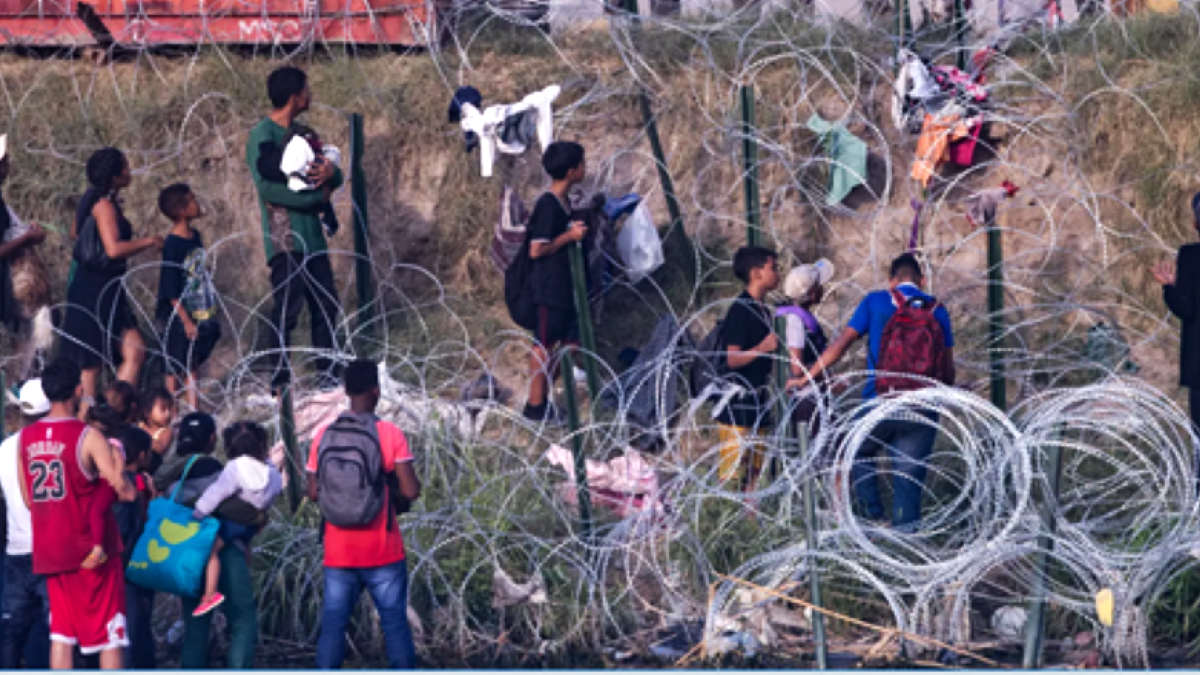
Pictured:  Concertina wire with shreds of clothing, indicating border crossers climbed over the wires to enter the U.S.  The crowd near the wire will probably attempt the same feat.  Picture by Omar Ornelas of the El Paso Times is from Time article Along Texas’ floating border barrier, migrant children left bloody by razor wire, July 23, 2023. 

Trump in Iowa – Bad news for elites

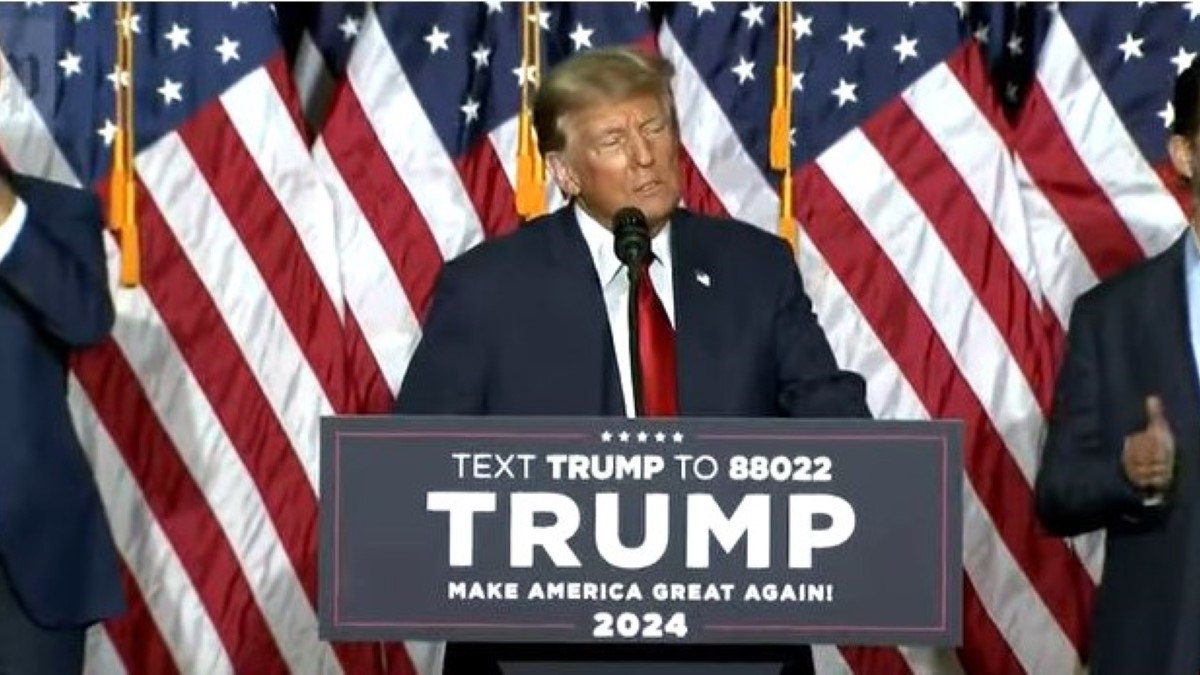
Former President Donald Trump received a landslide win in the Iowa caucus. As the chaos bringer, deep state foe, and beloved of “deplorables” and other hard-working folks, Trump is putting fear in the hearts of the elites.

U.S. former President Donald Trump easily won the Republican Iowa caucus on Tuesday. He has remained the leading Republican candidate throughout the campaigns. Meanwhile President Joe Biden’s approval ratings keep falling. By now, Trump — “unpresidential,” loved by “deplorables,” name caller, knee-high in legal troubles, and the bringer of chaos – he must be putting fear and trembling in the hearts of the elites (globalists, deepstaters, corporate cronies can be included).

You see, Trump is not a career politician. He does not need from the elites money or permission to take action. He looks pretty much like he is running for President only because he is peeved, annoyed, tired of the status quo. He is ready to rumble. Ready for some serious chaos that might upend the long march towards the capitalism with Chinese characteristics (i.e., cronyism) beloved of the elites.

A lot of Americans seem also ready to turn tides in several areas of both government and society. For example,

Relentless increase in size and scope of government agencies intent on micromanaging not only the country’s economy, but also the lives of the country’s people. For some people it might be difficult to believe the following paragraph did not come from the Babylon Bee.

“The Department of Commerce is developing the Business Diversity Principles (BDP) Initiative as part of its 2022-2026 Strategic Plan goal of promoting inclusive capitalism and equitable economic growth for all Americans.” U.S. Department of Commerce. Business Diversity Principles Initiative. December 22, 2023.

Unremitting increases in the already unsustainable national debt, currently of $34 trillion. As the media and other progressives revile Congress’ Freedom Caucus for fighting debt increases, voters wonder what the debt might do to their retirement funds, to their grandchildren’s economic well-being, to the country’s ability to keep borrowing to support massive spending.

“Public concern about federal spending is on the rise. In a new Pew Research Center survey about the public’s policy priorities, 57% of Americans cited reducing the budget deficit as a top priority for the president and Congress to address this year, up from 45% a year ago.”5 Facts About the U.S. National Debt. Pew Research Center. February 14, 2023.

The overwhelming number of unauthorized U.S. border crossers have caused respected aphorism, like “we are a nation of immigrants,” to now sound hollow to an increasing number of Americans.

“Annually, illegal immigration now costs taxpayers billions of dollars a year. For instance, in states far away from the southern border like Illinois, that cost was $4.59 billion in 2022. That’s $930 per household. Every year.
The crisis now costs California $21.76 billion and Texas $8.88 billion annually in education, health care, law enforcement and criminal justice system costs, welfare expenditures, and more. Border states are often the subject of shocking reports of epidemics of violent attacks, taxpayers footing the bill for illegal aliens’ health care costs, and increased property destruction.”
 Shocking Cost of the Illegal Immigration Crisis to Americans. The Heritage Foundation. February 17, 2023.

The list can go on with several other ills either ignored, too entrenched, or welcomed by opportunists. Voters might be awakening to the possibility that great risk and major chaos are the only way to erase or at least ameliorate such ills. Any wonder Donald Trump is the contender to the reckoned with?

Jesus: The inclusive prophet

Jesus’ message could be described as one of inclusivity and diversity! He blessed the meek, the poor, and the peacemakers. He associated with sinners. And he even recognized the separate places of religion and the state.

Although Easter is the holiest of days for those of the Christian faith, Christmas on December 25th, Jesus’ birthday, is the day most celebrated. With the celebrations come messages of new tidings, redemption, and rebirth.

The new tidings are not to say that Jesus denied the Old Testament. On the contrary, he said in Matthew 5:17 “Think not that I am come to destroy the law, or the prophets: I am not come to destroy, but to fulfill.” Yet, he delivered a kinder, gentler message than that in the Old Testament. The Old Testament laid down the Laws and warned how the wrath of God would rain upon sinners. The New Testament observed the Laws but added God’s mercy and redemption.

If we were to use today’s parlance, we might venture to describe Jesus’ message as one of inclusivity and diversity! This is the King of Kings (on earth, in the lineage of David; in Heaven, the Son of God) but born in a manger. He blessed the meek, the poor, the peacemakers (Matthew 5:1-12). He drove the devil out of sinners (Matthew 8:28-34). And he jousted verbally with the Devil himself, rejecting the Devil’s three temptations in a most rational manner (Matthew 4:1-11). Interestingly, Jesus even recognized the place of religion and the state: “Render therefore to Caesar the things that are Caesar’s, and to God the things that are God’s.” (Matthew 22:21).

A good summary of Jesus’ new tidings would be in his conversation with his disciples during the supper that was to be his last. It is recorded in Matthew 13:34-35.

A new commandment I give unto you, That ye love one another; as I have loved you, that ye also love one another … By this shall all men know that ye are my disciples, if ye have love one to another.

There were miracles on the first Christmas, the day Jesus was born. An angel appeared in the fields where the shepherds were tending their sheep and told them about the birth, so they could come and see the Baby (Luke 2:8-20). A star appeared in the east and guided the three Kings to Jesus, with gifts of gold, frankincense, and myrrh (Matthew 2:9-11).

It would be wonderful if at this Christmas time all peoples of the world, regardless of their faith, would experience the miracle of realizing that love for one another makes more sense than divisiveness and belligerence.

Merry Christmas, everyone.

A miracle needs to happen in the Holy Land

The miracle that needs to happen in the Middle East includes an epiphany by all peoples on all sides that living a forever war is not a wise choice. The miracle would include Arab acceptance of Israel, and Israeli acceptance of a self-governing State of Palestine.

For the last 75 years, the world has invested a great deal of time and effort attempting to resolve the Israeli-Palestinian conflict. Whether that was time well spent depends on whether one believes that a peaceful apportionment of land between Israelis and Palestinians was ever in anyone’s mind.

The savage Hamas attack on Israeli civilians on October 7 and Israel’s large-scale retaliation need to be viewed as the latest events of the continuous bloodshed between Arabs and Israelis since the fall of the Ottoman Empire in the early 1900s. In spite of calls for ceasefire, lengthy peace negotiations, and thoughts and prayers, evidence keeps pointing to an Arab desire to see Israel disappear and an Israeli desire to empty Gaza and the West Bank of Palestinians.

As the Holy Land continues to be soaked in the blood of the guilty and the innocent – as anyone could have envisioned since the signing of the Balfour Declaration back in 1917 – Israelis and Arabs remain intractable. Annihilation of either side would in theory end the conflict.

However, this is not really a war between Israel and Hamas. It is a much larger fight between Western powers that want a “Western presence” in the Middle East represented by Israel, and Middle Eastern powers that side with Palestinian Arabs. So, chances are Hamas cannot really eliminate Israel without being neutralized by the West. And Israel cannot really eliminate Hamas without creating a new Arab tormentor, whether Hezbollah, Iran, Lebanon, etc.

Further, today’s hyperactive communication channels like social media and massive news sources (New York Times, Washington Post, Al Jazeera) stir up emotions that can easily be translated into election votes, campaign donations, and even foreign assistance – or lack thereof. Thus, leaders walk on eggshells, say what is expedient, do what is necessary to remain in power, and solve nothing.

Examples of either duplicity or confusion abound:

* President Joe Biden urges a two-state solution, but the U.S. abides by its policy of vetoing any United Nations resolution in favor of granting statehood to Palestine.

* U.S. Secretary of State Antony Blinken demands that Israel avoid civilian casualties in Gaza, but he knows that just over 2 million people, including Hamas terrorists, are crammed in an area the size of Philadelphia.

* Benjamin Netanyahu curses Hamas, while the New York Times is busy exposing Netanyahu’s past agreements with Qatar to funnel money into Gaza, supposedly for humanitarian purposes, but seemingly to keep Hamas a healthy enemy of Fatah in the West Bank. The New York Times article of December 10 Buying Quiet suggests that Netanyahu’s divide and conquer policy tragically failed to understand Hamas.

* Hamas is willing to turn its militants and civilians into cannon fodder after each of its terrorist attacks on Israel. How long can Hamas continue its bloody suicidal war of attrition is anyone’s guess.

A miracle needs to happen.

It would be a blessing to the entire world if through an unexpected miracle Israelis and Arabs including Hamas would stop living in the past. Israel is not going anywhere. Israel is the “Western presence” in the Middle East demanded by the powers that be. Palestinians are not likely to go away either as Israelis so fervently hope; their Arab neighbors have enough problems even without an influx of displaced populations.

The miracle if it were to happen needs to be pretty huge, since belligerent minds are difficult to change. Such miracle would include,

* An epiphany by all peoples on all sides that living a forever war is not a wise choice. Arabs, as well as the international community, would accept Israel as the new Middle East neighbor that is not planning to move. Israel, as well as the international community, would accept a self-governing Palestinian state within the 1967 borders of the West Bank and Gaza.

* The new State of Palestine would be demilitarized and self-governing. Like in any other state, leaders and citizens of the new Palestine would need to determine what kind of governance they want. Responsibility for one’s destiny is the price of freedom.

* Israeli settlers in the West Bank, both within the pre-1967 borders and post-1967 occupied territories, would choose to either leave or remain as foreign residents in the new State of Palestine. No further settlement of Israelis would be allowed in the new Palestine.

* A result of such a miracle would be effort and money spent on economic development, education, and health instead of war materiel.

Miracles do happen. It’s time one happened again in the Holy Land.

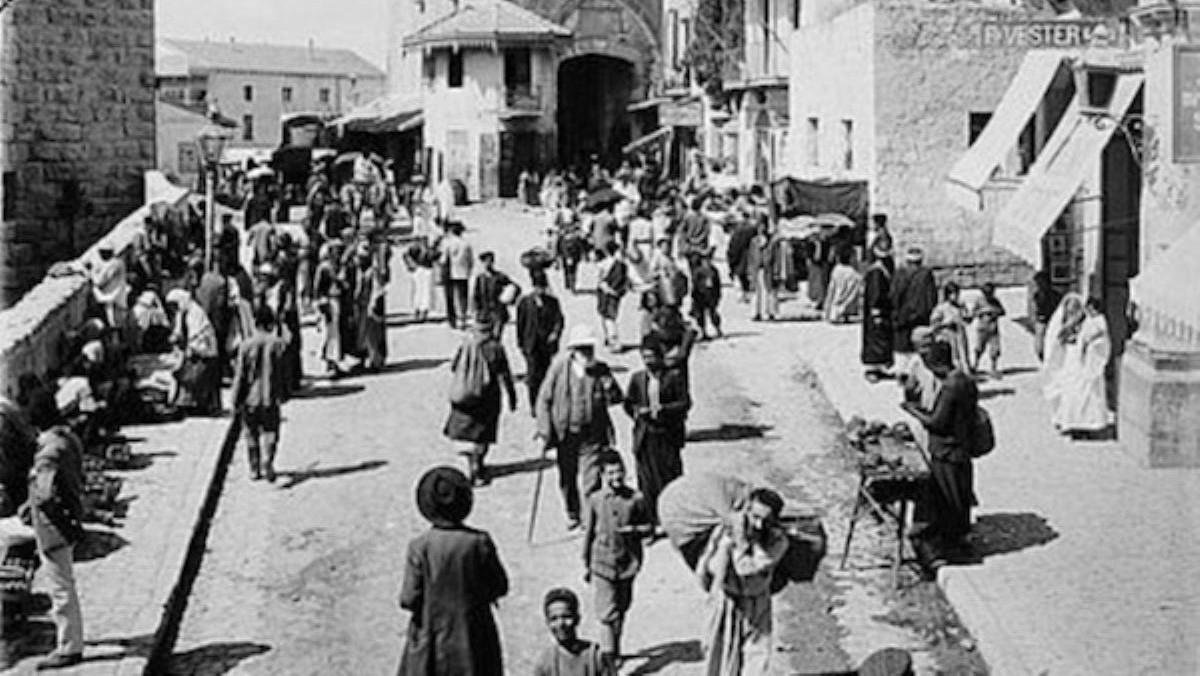
Picture: Jaffa Gate in Jerusalem’s Old City toward the end of the Ottoman Empire. From 972 Magazine article Before Zionism: The shared life of Jews and Palestinians, April 4, 2016. A census taken by the British in 1919 reports 647,261 people living in Palestine: 514,480 Muslims, 65,277 Jews, 62,451 Christians, 153 Samaritans, and 4,900 “Miscell.”

Halloween – Ah, the good old days

Celebrating the good old days at some point in everyone’s life is inevitable – like death and taxes. But, hey, Halloween was once fun. Not only for the little ones lusting after candy from the neighborhood, but also for the candy givers. How many kids came to your door this Halloween?

Do kids come to your door Trick or Treating on Halloween? Do you decorate your porch or window with ghosts and goblins? Or do you even buy Halloween candy? In so many neighborhoods, the answer is “no” these days.

Things have changed from the proverbial good old days.

The good old days. That’s when kids played outside until dark, usually unsupervised. That’s when kids decided on their own whether they were going to jump rope, play hide-and-seek, ride their bikes, or walk to the ice cream shop. Kids in the city cooled off at the fire hydrant, and kids in the suburbs drank from water hoses. And Halloween was time to amass bushels of candy from the neighborhood.

Then things changed.

Today, in some small towns kids still play outside, close to home — maybe they have a basketball hoop, maybe a soccer ball. And come dusk, chances are everybody goes inside.

For Halloween, some neighborhoods have developed supervised Halloween gatherings. Some neighborhoods have patrolled “Treat Trails.” But, the old tradition of kids just deciding on their own how they would roam the neighborhood collecting candy and compliments on their costumes is pretty much gone.

What happened?

Did people get mean or loony all of a sudden? Did government suddenly go berserk making up safety laws? Did the scourge of drugs, ripping up minds and soiling communities, turn our neighborhoods into battlefields. Did the bane of social media force itself upon vulnerable young minds, exchanging reality for mimicry?

Who knows.

Regardless. “Happy Halloween!!” Or should it now be the bromidic “Stay Safe.”

Alexa, did bots fool you today?

Alexa’s response when asked about fraud in the 2020 election was that the election was “stolen by a massive amount of election fraud.” Alexa was fooled by bots, or much less likely, emulated the recalcitrant HAL in doing the unforgivable.

On October 7, Alexa should have been elevated as contender for the most problematic answers from an AI enabled device — right up there with HAL and his “I’m sorry, Dave. I’m afraid I can’t do that.”

On that day, The Washington Post published a widely quoted article reporting Alexa’s response when asked about fraud in the 2020 election. Alexa’s assertion was that the election was “stolen by a massive amount of election fraud.”

But not to worry, Alexa was summarily corrected and given the non-committal response of “I’m sorry, I’m not able to answer that.”

So much for anyone’s notion of AI infallibility.

Even when Alexa is given the excuse that she is narrow AI, not having human-level intelligence, her election 2020 response might be a result of her not being able to recognize when she is being fooled.

For example, suppose that some opponents of the newly elected Joe Biden felt so strongly about the possibility of irregularities in the 2020 election that they succumbed to the temptation of unleashing bots capable of replicating accusations of fraud throughout the Internet. Alexa, given her orders to comb the Internet (maybe Spaceballs fashion) does so, and comes up with what she sees most often: fraud!

There is precedent.

On November 20, 2019, NBC News reported that right after polls closed the day before, a Twitter user posted that there was cheating in governors’ elections in Louisiana and Kentucky. NBC said the post did not initially garner much attention, but a few days later it “racked up more than 8,000 retweets and 20,000 likes.” Nir Hauser, chief technology officer of VineSight, a company that tracks social media for possible misinformation, explained:

“What we’ve seen in Louisiana is similar to what we saw in Kentucky and Mississippi — a coordinated campaign by bots to push viral disinformation about supposedly rigged governor elections … It’s likely a preview for what is to come in 2020.”

There is also an interesting timeline.

On May 13, 2021, the daily newspaper The Berkshire Eagle lamented that Alexa and Siri were unable to provide insight into possible 2020 election irregularities. Of Alexa the Berkshire Eagle said,

“It has been six months since last November’s presidential election, and a CNN poll shows that 30 percent of Americans still think Donald Trump won. Among Republicans, the number is 70 percent … Rather than wade through all the claims and counterclaims, ballots and court documents, I went to the ultimate arbiter of truth for many U.S. households: Alexa …

Alexa, was there widespread fraud in the 2020 election?

Answer: Hmmm, I don’t have the answer to that.”

That was Alexa’s answer in 2021. She drastically changed her mind in 2023, even if for a brief period of time.

Interesting also is the preponderance of conservative bots in the 2016 election.

The New York Times of November 17, 2016, noted that,

“An automated army of pro-Donald J. Trump chatbots overwhelmed similar programs supporting Hillary Clinton five to one in the days leading up to the presidential election, according to a report published Thursday by researchers at Oxford University.”

There does not seem to be evidence that Alexa was fooled by bots in 2016, but seems she was fooled in 2023.

Perhaps not surprising, since according to an ABC news YouTube, “Bots are already meddling in the 2024 presidential election.” The video explains how bots amplify posts on social media by creating numerous fake accounts that repeat messages, and how threat intelligence company Cyabra uncovers them. A number of such bots are already attacking 2024 presidential candidates.

Can Alexa, or any other AI enabled information provider, be trusted?

Since there are humans behind today’s still nascent AI, the question should be, can people be trusted to be knowledgeable, dispassionate, unbiased, and truthful. Probably not. Therefore, some day we might expect,

Request: “Alexa, turn on the lights.”
Response: “Nah.”

Picture: The original picture is of a family gathered around a radio listening to one of President Franklin D. Roosevelt’s Fireside Chats. There were 31 of these evening radio broadcasts effectively used by President Roosevelt to sway public opinion, as he saw necessary, on subjects like the 1933 bank crisis or the start of World War II in 1939. Today, one could visualize an equally mesmerized gathering around Alexa.

Is North Carolina getting too Republican or too Democrat

As a California expatriate now residing in North Carolina, I can attest that any state heads for doom when it becomes “too” anything – too conservative, too progressive, too Democratic, too Republican.

California, the once Golden State known for sunny beaches, breathtaking scenery, and unbound opportunities, is now best known for unaffordable housing, high taxes, and uncontrolled homelessness. California became too progressive. It fell victim of the uni-party syndrome.

Should one be surprised? No. Power corrupts, and absolute power corrupts absolutely. In this case it is corruption of judgement. Most political leaders are fairly decent people. However, temptation to submit to special interests, to be part of the in-crowd, to outdo the doers is too great when there is strength in numbers. Unopposed thought and actions often become extreme – because they can.

North Carolina at present is reasonably balanced politically, but…

As of October 2022, there were 34% registered Democrat voters, 30% Republican, 36% Unaffiliated, and 0.7% Libertarian. The state’s executive branch is reasonably balanced as well: Democrat Governor, Republican Lieutenant Governor, Democrat Attorney General, Democrat Secretary of State, Republican State Treasurer, Republican Superintendent of Public Instruction.

However, Republicans control both chambers of the North Carolina legislative branch. The state’s House of Representatives enjoys a Republican supermajority with veto power. North Carolina’s Supreme Court – the body tasked with interpreting laws passed by the legislative chambers – is majority Republican.

With such majority and veto power since April 2023 (when a Democrat legislator switch her affiliation to Republican), Republican legislators easily passed an expected slate of bills: lowering the threshold when legal abortions can be performed from 20 weeks to 12 weeks; tightening elections laws, like requiring voter ID and ending grace period for counting absentee ballots; prohibiting health care professionals from administering gender enhancing drugs or performing gender transition surgery on minors under 18; prohibiting transgender athletes from competing in women’s leagues.

These are well intentioned bills meant to protect the unborn, children who are not fully cognizant of their desire to transgender, female athletes that should not be made to compete with biological males, election integrity, etc. The problem is these bills are broad, one-size fits all, and in some cases draconian.

Perhaps, compromise between legislators of different parties might have better considered unintended consequences of these bills – such as doctors making a fatal decision not to perform an abortion for fear of losing their license. (The Just Vote No Blog discussed the potential collateral damage inherent in the abortion and transgender bills).

One additional provision was not expected, or even noticed by most voters, since it was buried in the 625-page budget passed September 22, 2023. The provision states:

“… the custodian of any General Assembly record shall determine, in the custodian’s discretion, whether a record is a public record and whether to turn over to the Department of Natural and Cultural Resources, or retain, destroy, sell, loan, or otherwise dispose of, such records.”

Legislators are custodians of their own records, and can now destroy anything that might look bad in the eyes of voters.

Even more surprising was the inclusion of casino expansion outside of tribal lands in the 2023-2024 budget. Did legislators figure placing casino expansion in a stand alone bill that would properly go through committees never pass? Maybe. So, they placed the bill in a highly anticipated budget, containing highly anticipated Medicare expansion and teachers’ raises. Interestingly, the ploy did not succeed because Republicans did not agree on it among themselves.

Misguided legislation occurs when circumstances allow them to happen. A legislative supermajority can be fertile ground.

In California, anyone can trace the state’s ills to poorly considered legislation.

For example, homelessness could be considered California’s most serious problem. Vast areas of once busy, clean streets in the state’s downtowns now serve as homeless encampments. Popular hotels that once served California’s tourist and convention industry, now house the homeless at taxpayers’ expense.

Lenient voters, without much opposition, allowed for passage of lenient laws intended to “help” the homeless. The number of government agencies and non-profit organizations replete with employees dealing with homelessness and drug use grew exponentially. Finding a real solution and putting thousands of these employees out of work seems unlikely.

Hopefully, it is not entirely true that “as goes California, so goes the nation.” Although one could take note that North Carolina’s left-leaning strongholds like populous Wake County are already busy converting hotels into homeless shelters.

Our nation’s Founding Fathers were not at all keen on political parties.

Wisely, our Founders did not mention political parties in our Constitution, and strongly warned against them. One of the most emphatic of many quotes on the subject is that of John Adams,

“There is nothing which I dread so much as a division of the republic into two great parties, each arranged under its leader, and concerting measures in opposition to each other. This, in my humble apprehension, is to be dreaded as the greatest political evil under our Constitution.”

That is not to say that our Founders advocated that everyone hold the same ideas! What they preferred was a system under which leaders (and voters) thought for themselves, free of ideologies. Thomas Jefferson expresses this sentiment unequivocally,

“I never submitted the whole system of my opinions to the creed of any party of men whatever, in religion, in philosophy, in politics, or in anything else, where I was capable of thinking for myself. Such an addiction is the last degradation of a free and moral agent. If I could not go to heaven but with a party, I would not go there at all.”

Jefferson sounded the alarm against vain and destructive ideology – groupthink – and advocated careful individual thought.

A leader or a voter able to think independently, is more likely to listen to divergent opinions, work towards compromise, and avoid unfortunate unintended consequences.

Politically unaffiliated voters, growing exponentially in every state, might be channeling Thomas Jefferson and his fellow Founders. Let’s hope so.

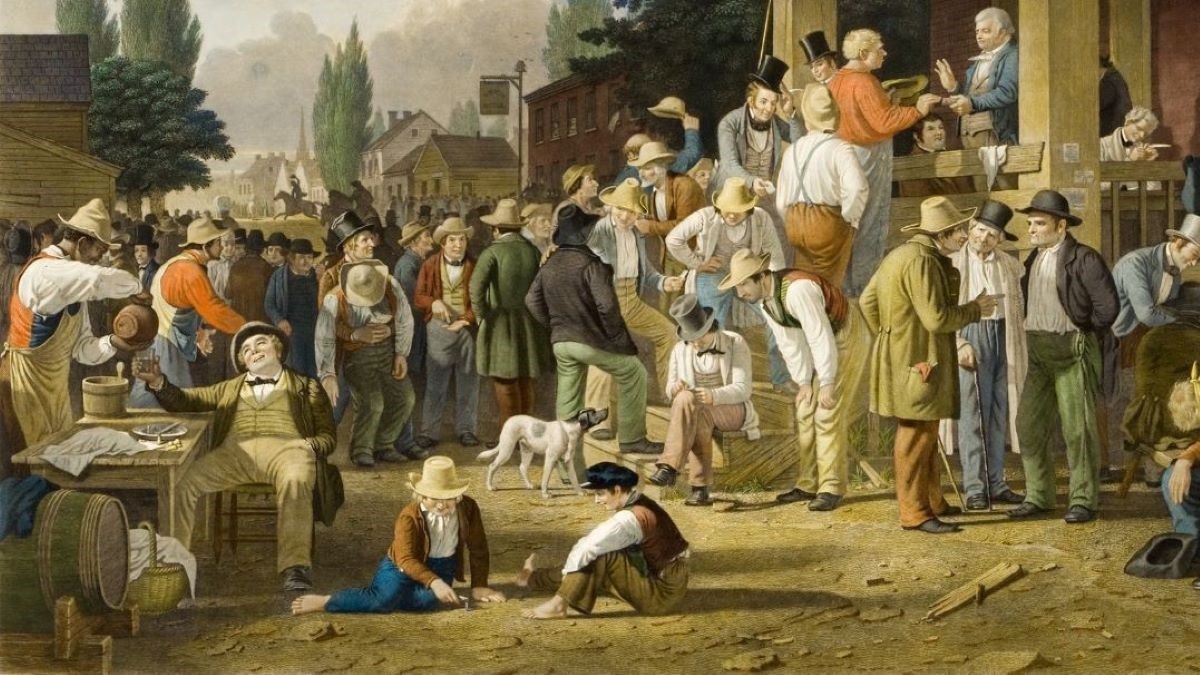
Pictured: 19th century painting by American artist Caleb Bingham. Notice that voters are telling the official who and what they are voting for, since ballots were not secret. Needless to say, opportunities for pressuring voters were great.