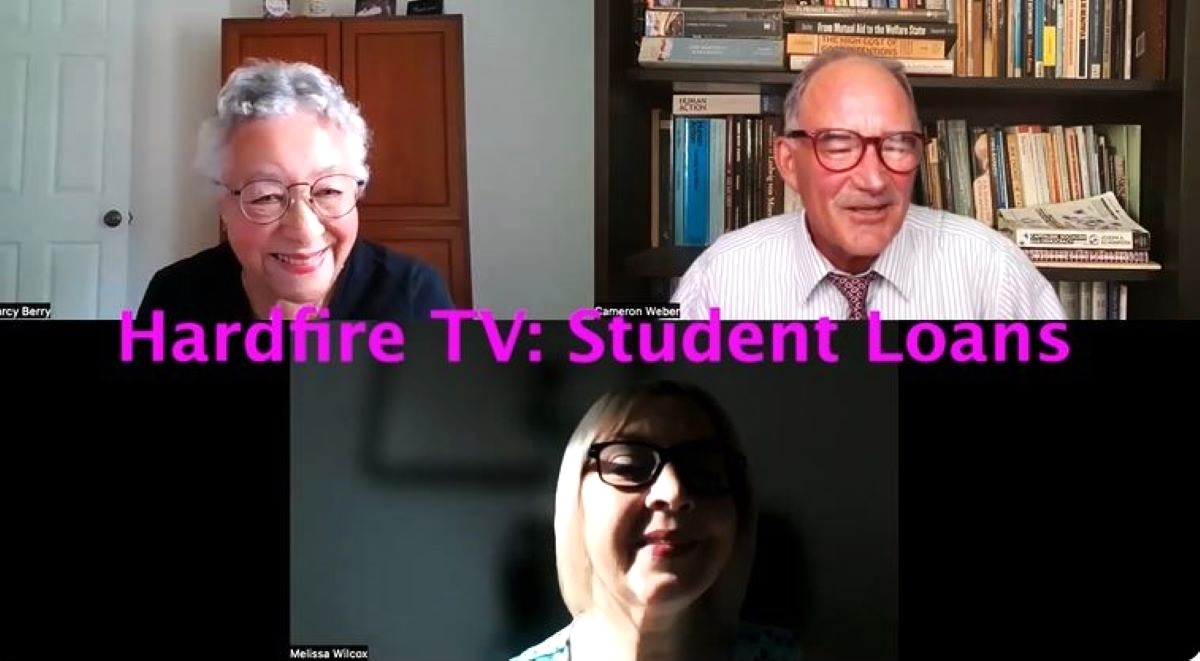
Recommended item: Cameron Weber – economist, historian, and author of the popular book Economics for Everyone, is also producer of Hardfire TV, a political economics talk show. His latest show discusses student loan debt and debt “forgiveness.”
College tuition and student loan debt have suffered mind-boggling increases since the early 2000s. In an October 2023 report Education Data reported the following,
“Before adjusting for inflation, the average student loan debt at graduation has increased 106% since 2007; after adjusting for inflation, the average debt increased 41%.”
When adding to this sad statistic a February 2024 report by Inside Higher Ed indicating that nowadays 52% of college graduates are underemployed, seems that young people need to do some homework on what is causing such unfortunate situation.
The student loan segment on Hardfire TV might help. The show can be seen on YouTube.
A few words on political economics as preview.
Economics, especially political economics, wears several hats. It is not akin to, say, mathematics. Political economics is more like the costume of Le Bon Florian, Anatole France’s harlequin – viewed from one perspective the costume is red, and viewed from another it is blue.
The libertarian-leaning perspective of student loans and the accompanying student loan debt is that government intervention – subsidies – has incentivized colleges to raise their tuition to unsustainable levels. As tuition rises, so does student loan debt. The solution is to end the subsidies. This will force colleges to trim their offerings, staff, and tuition. Also, colleges will likely return to emphasizing work-study programs, and financial institutions in the marketplace will again compete to offer college assistance.
The progressive-leaning perspective is that government is a better provider than the marketplace. The marketplace increased tuition and student loan debt to untenable levels. Therefore, government needs to step in and abate that debt. Students and former students carrying the heavy burden of student loan debt are constrained from investing sufficiently in goods and services, thus fail to contribute fully to the economy. Everyone benefits when everyone contributes, which justifies taxation – income and debt redistribution.
And in the middle of these harlequinesque perspectives is the vision of the nation’s Founding Parents. This nation was founded as a grand experiment. It would be ruled not by kings or other sole decision makers, but by the people, like farmers, silversmiths, and carpenters. Therefore, education beyond that of the well to do and privileged was necessary. George Washington, Thomas Jefferson, John Adams were among those that argued in favor of public schools and colleges that would provide the populace with the wisdom, knowledge and awareness necessary to make wise decisions at the ballot box.
Letter from Thomas Jefferson to Richard Price, January 8, 1789. “… wherever the people are well informed they can be trusted with their own government…”
Letter from John Adams to John Jebb, September 10, 1785. “There should not be a district of one Mile Square without a school in it, not founded by a Charitable individual but maintained at the expense of the People themselves.”
So, would our Founders then support the idea of having free colleges today? Probably not. Today, things are quite different than back in the 1800s.
Today we talk about money earned by college graduates vs. non-graduates. Young people often major in trendy subjects, like gender studies or DEI, hoping to find positions in government programs or equally trendy corporations. Hardly expectations seeped in wisdom and awareness.
Agreed that not all was perfect back then. It took nearly 100 years for women and Black students to be routinely admitted into colleges. For a brief historical perspective:
Harvard University (originally called New College) was established in 1636, and Yale University in 1701. These and other equally fine schools, were Colonial institutions established for the education of white, mostly upper class, males.
Oberlin College started accepting women in 1837. 1865 saw the emergence of women’s colleges that offered courses comparable to those of men. By the 1880s women could acquire higher education at Vassar, Smith, Wellesley, Bryn Mawr, and Mount Holyoke colleges.
There were only a few Black colleges before the Civil War. However, between 1865 and 1900, several Historically Black Colleges were established, the majority in 1867, two years after Emancipation.
Today, qualified students are admitted to colleges and universities regardless of sex and color. But whether they are receiving the skills, wisdom, and work ethic the Founders had in mind is questionable.
As libertarian-leaning economists consistently point out, government often creates problems which it then tries to take credit for solving, only to create more problems. The problem of the ballooning student loan debt, and the perceived need for debt forgiveness is a prime example. Those of a libertarian bent suggest that government get out of the student loan business, and let private banks compete to offer students the best loan deal.
Maybe the November 2024 elections will inform us which side of the harlequin’s costume is the most appealing.
Picture: From YouTube video of the Hardfire TV show on Student Loans, with host Cameron Weber and guests Marcy Berry and Melissa Wilcox.
Discover more from Just Vote No
Subscribe to get the latest posts sent to your email.

 Just Vote No
Review my Blog America’s Watchman God’s Philosopher Stone of Ancient Wisdom, Justice ⚖️ Guardian of Liberty 🗽 and Read to Understand The Required Obligated Constitutional Procedural Basic Principles Norms and Interpretations The United States House of Congress Executives and Judicial Departments must follow In Order to Obtain American’s Government’s Authority to Enact Legislation.
The United States House of Congress Executives and Judicial Departments are Not 🚫 Constitutional Representatives for The American People.
Thank you
LikeLiked by 1 person