As a California expatriate now residing in North Carolina, I can attest that any state heads for doom when it becomes “too” anything – too conservative, too progressive, too Democratic, too Republican.
California, the once Golden State known for sunny beaches, breathtaking scenery, and unbound opportunities, is now best known for unaffordable housing, high taxes, and uncontrolled homelessness. California became too progressive. It fell victim of the uni-party syndrome.
Should one be surprised? No. Power corrupts, and absolute power corrupts absolutely. In this case it is corruption of judgement. Most political leaders are fairly decent people. However, temptation to submit to special interests, to be part of the in-crowd, to outdo the doers is too great when there is strength in numbers. Unopposed thought and actions often become extreme – because they can.
North Carolina at present is reasonably balanced politically, but…
As of October 2022, there were 34% registered Democrat voters, 30% Republican, 36% Unaffiliated, and 0.7% Libertarian. The state’s executive branch is reasonably balanced as well: Democrat Governor, Republican Lieutenant Governor, Democrat Attorney General, Democrat Secretary of State, Republican State Treasurer, Republican Superintendent of Public Instruction.
However, Republicans control both chambers of the North Carolina legislative branch. The state’s House of Representatives enjoys a Republican supermajority with veto power. North Carolina’s Supreme Court – the body tasked with interpreting laws passed by the legislative chambers – is majority Republican.
With such majority and veto power since April 2023 (when a Democrat legislator switch her affiliation to Republican), Republican legislators easily passed an expected slate of bills: lowering the threshold when legal abortions can be performed from 20 weeks to 12 weeks; tightening elections laws, like requiring voter ID and ending grace period for counting absentee ballots; prohibiting health care professionals from administering gender enhancing drugs or performing gender transition surgery on minors under 18; prohibiting transgender athletes from competing in women’s leagues.
These are well intentioned bills meant to protect the unborn, children who are not fully cognizant of their desire to transgender, female athletes that should not be made to compete with biological males, election integrity, etc. The problem is these bills are broad, one-size fits all, and in some cases draconian.
Perhaps, compromise between legislators of different parties might have better considered unintended consequences of these bills – such as doctors making a fatal decision not to perform an abortion for fear of losing their license. (The Just Vote No Blog discussed the potential collateral damage inherent in the abortion and transgender bills).
One additional provision was not expected, or even noticed by most voters, since it was buried in the 625-page budget passed September 22, 2023. The provision states:
“… the custodian of any General Assembly record shall determine, in the custodian’s discretion, whether a record is a public record and whether to turn over to the Department of Natural and Cultural Resources, or retain, destroy, sell, loan, or otherwise dispose of, such records.”
Legislators are custodians of their own records, and can now destroy anything that might look bad in the eyes of voters.
Even more surprising was the inclusion of casino expansion outside of tribal lands in the 2023-2024 budget. Did legislators figure placing casino expansion in a stand alone bill that would properly go through committees never pass? Maybe. So, they placed the bill in a highly anticipated budget, containing highly anticipated Medicare expansion and teachers’ raises. Interestingly, the ploy did not succeed because Republicans did not agree on it among themselves.
Misguided legislation occurs when circumstances allow them to happen. A legislative supermajority can be fertile ground.
In California, anyone can trace the state’s ills to poorly considered legislation.
For example, homelessness could be considered California’s most serious problem. Vast areas of once busy, clean streets in the state’s downtowns now serve as homeless encampments. Popular hotels that once served California’s tourist and convention industry, now house the homeless at taxpayers’ expense.
Lenient voters, without much opposition, allowed for passage of lenient laws intended to “help” the homeless. The number of government agencies and non-profit organizations replete with employees dealing with homelessness and drug use grew exponentially. Finding a real solution and putting thousands of these employees out of work seems unlikely.
Hopefully, it is not entirely true that “as goes California, so goes the nation.” Although one could take note that North Carolina’s left-leaning strongholds like populous Wake County are already busy converting hotels into homeless shelters.
Our nation’s Founding Fathers were not at all keen on political parties.
Wisely, our Founders did not mention political parties in our Constitution, and strongly warned against them. One of the most emphatic of many quotes on the subject is that of John Adams,
“There is nothing which I dread so much as a division of the republic into two great parties, each arranged under its leader, and concerting measures in opposition to each other. This, in my humble apprehension, is to be dreaded as the greatest political evil under our Constitution.”
That is not to say that our Founders advocated that everyone hold the same ideas! What they preferred was a system under which leaders (and voters) thought for themselves, free of ideologies. Thomas Jefferson expresses this sentiment unequivocally,
“I never submitted the whole system of my opinions to the creed of any party of men whatever, in religion, in philosophy, in politics, or in anything else, where I was capable of thinking for myself. Such an addiction is the last degradation of a free and moral agent. If I could not go to heaven but with a party, I would not go there at all.”
Jefferson sounded the alarm against vain and destructive ideology – groupthink – and advocated careful individual thought.
A leader or a voter able to think independently, is more likely to listen to divergent opinions, work towards compromise, and avoid unfortunate unintended consequences.
Politically unaffiliated voters, growing exponentially in every state, might be channeling Thomas Jefferson and his fellow Founders. Let’s hope so.
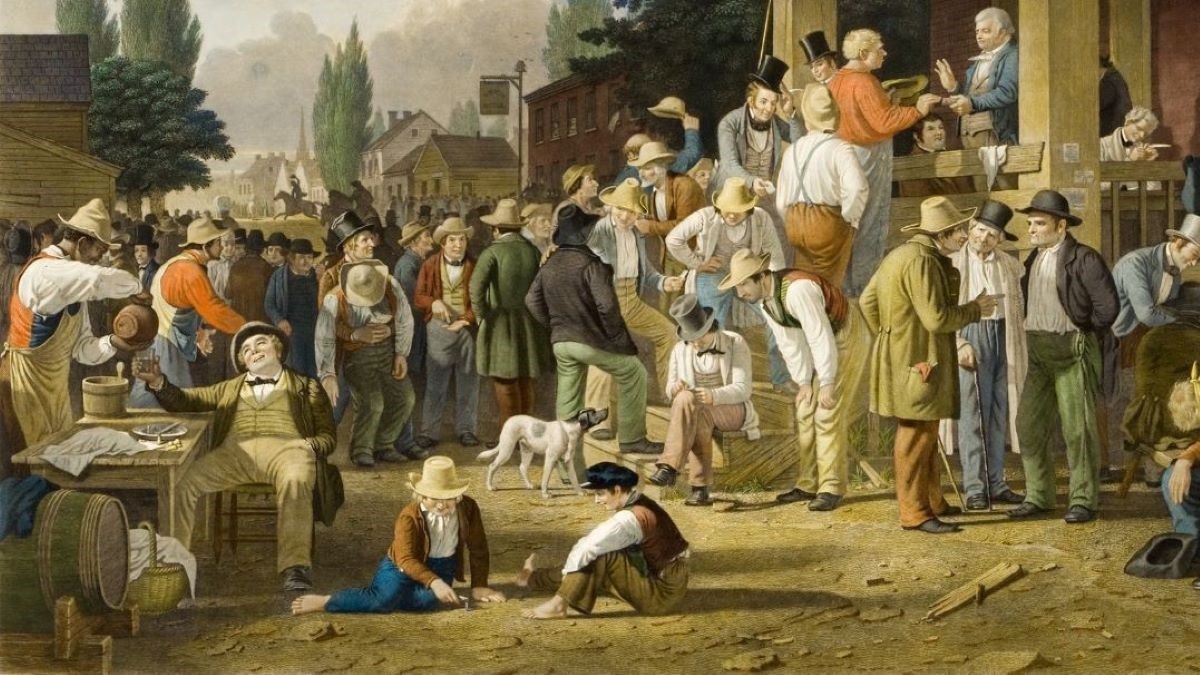
Pictured: 19th century painting by American artist Caleb Bingham. Notice that voters are telling the official who and what they are voting for, since ballots were not secret. Needless to say, opportunities for pressuring voters were great.
Discover more from Just Vote No
Subscribe to get the latest posts sent to your email.

 Just Vote No