As those of us blessed with a warm home gather to celebrate, let us give thought to how we can aim for the essential ingredient for the prosperity that can provide a warm blanket for the shivering child in neighborhoods or conflict zones around the world.
At present there is celebration. Homes – big or small – are decked in pine and holly. Carols are remembered, if not sung.
One carol that might come to mind is Do Your Hear What I Hear. And one verse from that carol that might ring most deeply is,
Said the shepherd boy to the mighty king Do you know what I know? In your palace warm, mighty king Do you know what I know? A Child, a Child shivers in the cold Let us bring him silver and gold.
As those of us blessed with palace or apartment warm gather and celebrate, let us for a moment give thought how we can aim for the essential ingredient in “silver and gold” – Peace. From Peace can come prosperity, and from prosperity a warm blanket for the shivering child in neighborhoods or conflict zones around the world.
But, the right kind of Peace.
The peace that comes from the barrel of a gun or from the stroke of a pen is a false peace, and does not last. Real Peace must come from all people’s hearts. It must come from the realization that making friendships and making love is infinitely more sensible than making war.
So, for another verse from the carol.
Said the king to the people everywhere Listen to what I say! Pray for peace, people, everywhere. Listen to what I say! The Child, the Child sleeping in the night He will bring us goodness and light He will bring us goodness and light!
Christian or not, believer or not, Peace be with you all.
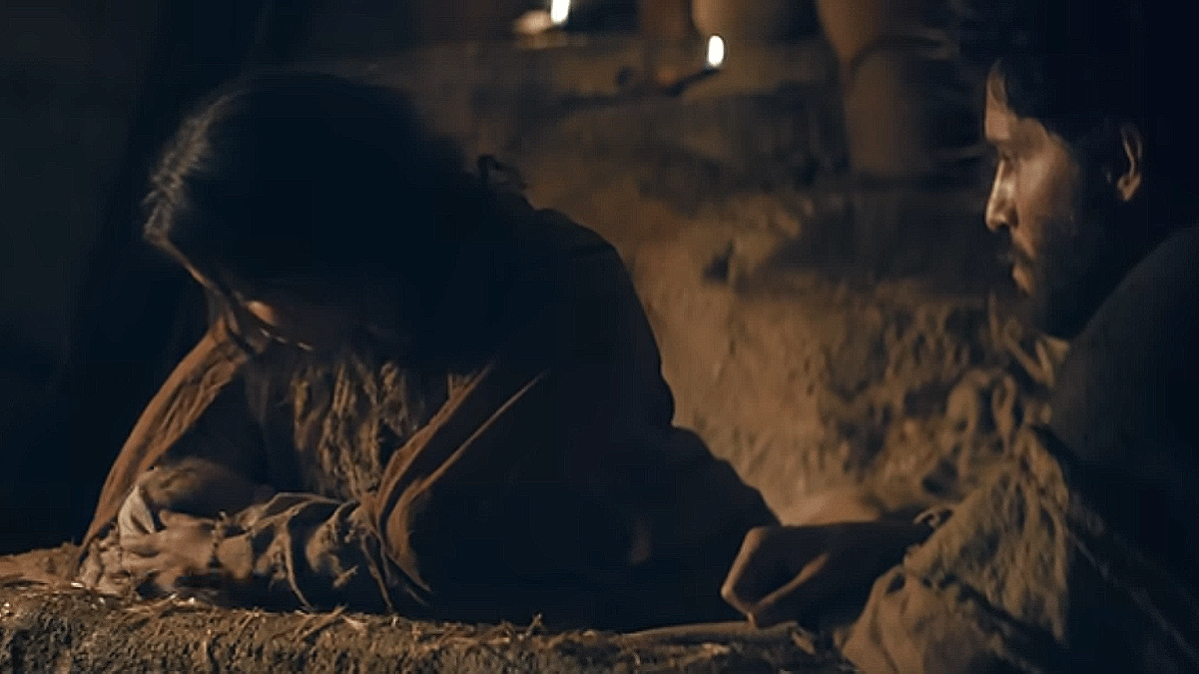
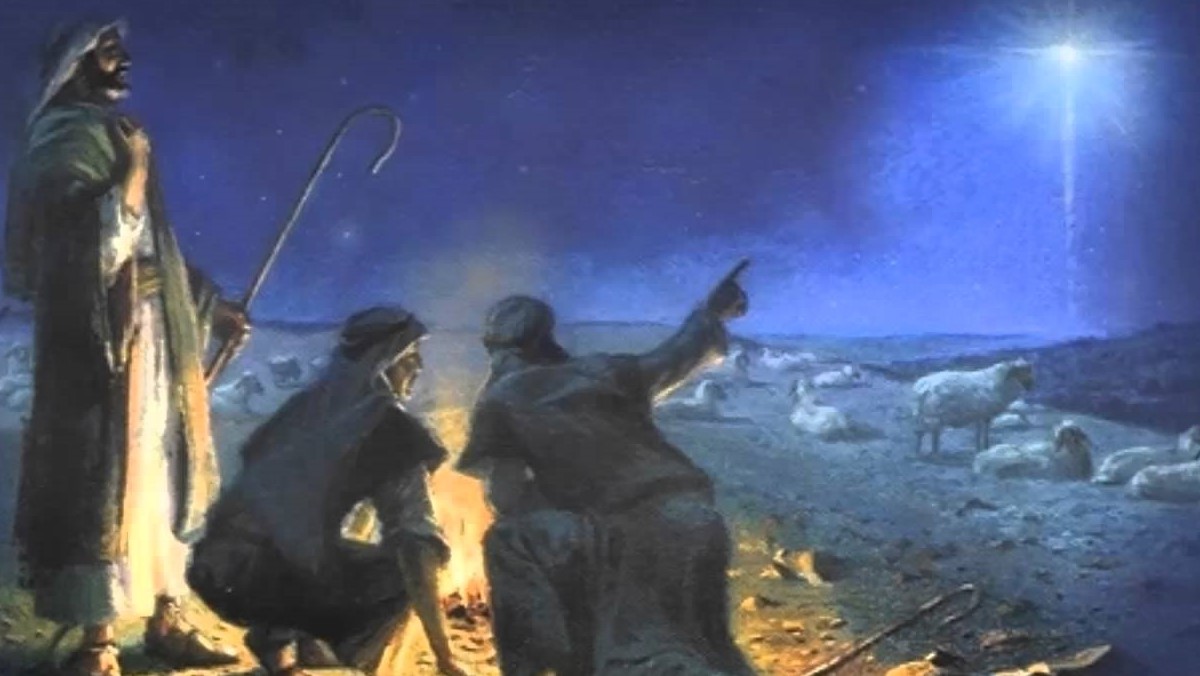
Picture: From The Christ Child: A Nativity Story. This is a beautiful short film about the birth of Jesus Christ, produced in 2019 by The Church of Jesus Christ of Latter-day Saints.
The asymmetry between Israel and Palestine is a fatal flaw always present in Middle East peace plans attempted by Western officials. The current plan is no different.
President Donald Trump, in his apparent effort to establish a new global order, is devising peace solutions to the world’s hot spots. The Middle East “20-point Peace Plan” is receiving the most press, possibly because the world would like to see an end to 77 years of lives destroyed or lost in conflict between Israelis and Palestinians. Most unfortunately, this plan suffers from the fatal flaw present in plans going way back to the end of World War I.
The fatal flaw is the asymmetry between Israel and Palestine. The Jewish State has the cultural, political and economic support of a world-wide Jewish community; and Israel has worked hard to be the Western presence in the Middle East. In contrast Palestine suffers from divergent factions, lacks a world-wide community as focused in unity as the Jewish community, and is perceived as anti-Western. Understandably, “peace plans” devised by Westerners will favor Israel.
Thus, we now have a peace plan on the table that includes disarmament of Hamas (understandable given Hamas’ horrific actions of October 7, 2023, but how realistic?), a dependent Palestinian population subject to whether Israel allows food into Gaza or not, an unclear deployment of “international security forces” to ensure success of the peace plan, and no acknowledgment in the plan about Islam’s discomfort with the existence of Israel or Israel’s desire to accommodate its growth via expanding settlements.
Time, effort and treasure spent by government officials in numerous Middle East peace plans have not yielded any peace so far. At this point, one might wonder whether peace through adult negotiation is really the heart-felt objective, or whether annihilation of one side or another is the endgame.
Also at this point, one might be reminded of the 1960s Vietnam Era embrace of a collective unconscious conceptualized in the adage “Make Love not War.” The 20-year carnage of the Vietnam War did not really end with official peace plans. It ended when peace started with a collective “Meh” directed at useless destruction. Obviously for such blessing to occur, individuals and families on all sides need to come to the conclusion that they are better off making love not war.
Picture: Sep 1, 2025 Al Jazeera “Gaza’s beaches, once popular destinations for leisure and relaxation, have been transformed into makeshift refugee camps … Thousands of displaced Palestinians now seek shelter on the very shores that were once symbols of joy and respite.“
Whether there is indeed a ceasefire between Iran and Israel or whether the US will remain in a rat hole of retaliations remains to be seen. But, as the recommended article explains, Iran will retain its irreversible knowledge gain in matters of nuclear enrichment, to be used or not as Iran sees fit.
In the midst of claims by President Donald Trump of “spectacular military success,” and fears of “descending into a rat hole of retaliation after retaliation” expressed by UN Chief Antonio Guterres, the Reuters news agency published a calm and rational article on June 22, 2025, which describes an additional scenario: nothing has changed as far as Iran’s ability to proceed with its nuclear research.
“You can destroy or disable a nuclear programme’s physical infrastructure but it is very hard or impossible to eliminate the knowledge a country has acquired.”
“Western powers including the United States have publicly suggested as much, complaining of the ‘irreversible knowledge gain’ Iran has made by carrying out activities they object to.”
“‘Military strikes alone cannot destroy Iran’s extensive nuclear knowledge,’ the Washington-based Arms Control Association said in a statement after the U.S. strikes with massive bunker-busting bombs on sites including Iran’s two main underground enrichment plants at Natanz and Fordow.”
“The strikes will set Iran’s programme back, but at the cost of strengthening Tehran’s resolve to reconstitute its sensitive nuclear activities, possibly prompting it to consider withdrawing from the nuclear Non-Proliferation Treaty, and possibly proceeding to weaponisation.”
“Israel has also said it has killed Iranian nuclear scientists but, while little is known about the personnel side of Iran’s nuclear programme, officials have said they are sceptical about that having a serious impact on Iran’s nuclear knowledge, even if it might slow progress in the near term.”
“One important open question is how much highly enriched uranium Iran still has and whether it is all accounted for.”
“A senior Iranian source told Reuters on Sunday most of the highly enriched uranium at Fordow, the site producing the bulk of Iran’s uranium refined to up to 60%, had been moved to an undisclosed location before the U.S. attack there.”
So, ceasefire or not…
Whether there is indeed a ceasefire between Iran and Israel as President Donal Trump announced today, June 23, 2025, or whether the US will remain in the rat hole of retaliations remains to be seen.
But, as the recommended article explains, Iran will retain its irreversible knowledge gain in matters of nuclear enrichment, to be used or not as Iran sees fit.
Nations have always felt comfortable taking over other nations. So, it should not be surprising that President-elect Donal Trump wants Greenland. Niccolo Machiavelli explained the situation way back in 1532.
No, Greenland did not say it wants Texas. However, nations have always felt comfortable taking over other nations or occupying foreign territories, and nothing has changed. Examples currently abound: China is committed to reunification with Taiwan, by force if necessary. Russia wants Ukraine as security against NATO encroachment. Israel also cites security as it expands settlements in Palestinian territories and occupies buffer zones in southern Syria. North Korea has never stopped eyeing South Korea.
Therefore, it should not be surprising that President-elect Donald Trump, especially given the expansionist aspirations of China and Russia – as well as the treasure trove of valuable minerals under Arctic soil — wants to take over Greenland. This despite the clear message “Greenland is not for sale” repeated by both Greenland and Denmark. And by the way, Trump also would like to take over Canada and the Panama Canal.
Whether Trump’s threat of maximum menace represent his version of negating tactics or his version of American exceptionalism — i.e. empire building — is anyone’s guess. However, either way, he is seemingly guided by what Niccolo Machiavelli called “effectual truth” in his novel The Prince (1532). Here is an excerpt,
“It remains now to see what the modes and government of a prince should be with subjects and with friends … it has appeared to me more fitting to go directly to the effectual truth of the thing than to the imagination of it … it is so far from how one lives to how one should live that he who lets go of what is done for what should be done learns his ruin rather than his preservation.“
Especially in developed nations, ideal leaders are often envisioned as behaving presidentially, respecting other nations’ sovereignty, practicing “peace, commerce, and honest friendship with all nations, entangling alliances with none” (as Thomas Jefferson advised during his inaugural speech of 1801).
But the U.S. has enjoyed very few years of peace since independence in 1776. During the 19th century, the U.S. used force during its Western expansion and its removal of French and Mexican presence. The 20th century saw the two great wars and combat against Communist expansion. In the 21st century U.S. lives and treasure have been spent establishing footholds in the Middle East. Today, thankfully not U.S. lives, but certainly plenty of U.S. treasure is being spent defending Israel and Ukraine. While China and Russia are just outside the gates.
Perhaps the world is engaging in imagining what should be rather than what is. So, Donald Trump’s expansionist pronouncements stick out like a sore thumb.
Alternatives? Peace through strength (waging war and calling it peace) is the historical possibility chosen by great empires. Globalization as exemplified by the European Union chooses peace and prosperity through national acquiescence. That’s it?
Niccolo Machiavelli is often perceived as supporting ruthless leaders. However, in Chapter 19 of The Prince he says,
… a prince ought to have two fears, one from within, on account of his subjects, the other from without, on account of external powers. From the latter he is defended by being well armed and having good allies … But concerning his subjects, when affairs outside are disturbed he has only to fear that they will conspire secretly, from which a prince can easily secure himself by avoiding being hated and despised, and by keeping the people satisfied with him, which it is most necessary for him to accomplish,
It appears a prince stays in power at the will of his subjects! Would that mean that in our time and place we could at the ballot box choose leaders who prefer peace, commerce, and honest friendship with all nations? If so, why have we not?
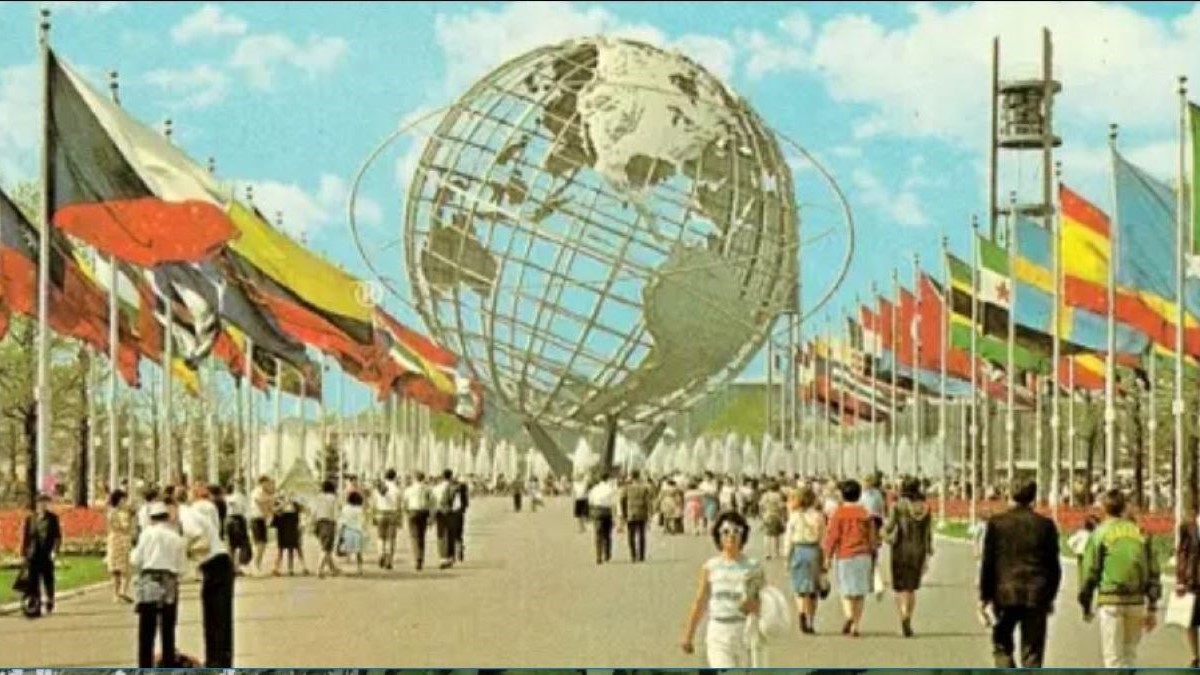
Picture: The symbol for the 1964 World’s Fair in New York state was The Unisphere. The theme of the fair was “Peace Through Understanding.”This picture is from The Legacy of the 1964 World’s Fair in the History website.
I was born in the Southern Hemisphere, where it can get
hot as blazes in December. So, snow-covered trees made no sense to my family. Ah, but wait ’till you hear about our DIY Nativity Scene. Merry Christmas everyone.
For some people, including me, no Christmas ever goes by without remembrance of childhood. Scenes of trees, sleighs and snow, remind me of my Christmases in sweltering hot weather. See, I was born in the Southern Hemisphere, in South America, where December is summertime.
For my family the snowy tree scenes so popular in the Northern Hemisphere made no sense at all. Besides, they said, what do trees have to do with the birth of Jesus?
Ah, also, real trees were expensive for folks of modest means like us, and they only lasted one season. Some fancy people had fake trees, like those shimmering aluminum ones, but that was equally out of our range.
But my Christmases were unforgettable!
The extended family in which I grew somehow managed to instill in all of us kids that experiences differ according to condition. The trick is to understand the condition, accept it, and build rituals of cheerful dedication.
The ritual of Christmas included us kids scouring the neighborhood for discarded wood, the older kids bringing sand from the beach, one of my uncles cutting branches with lovely leaves, and another uncle building the frame of what was to be the most beautiful Nativity Scene you have ever seen.
The gathering and building are what stand out in my memory.
The uncle whose job was to build the Nativity frame expected teamwork and precision (he was a draughtsman for the army). The uncle in charge of bringing the branches collected them from a veritable jungle that stood mysteriously abandoned for decades in the back of his property.
Gathering and transporting sand required deep planning. The gathering had to be when it was not too hot and the beach was not covered with sunbathing folks. Transporting entailed avoidance of market days when lots of people who also depended on the local streetcar brought home numerous bags of produce (and often a live chicken). My Dad, given that he was known for destroying a wall while trying to hammer in a small nail, did not participate in the building of the Nativity Scene. His job was the Christmas dinner.
Once the frame was built, the canopy of greenery was in place, and the sand was spread evenly on the frame’s platform, we kids were allowed to place rocks and other nature items that we felt were appropriate on the sand.
Lastly came the piece de resistance.
The adults cautiously and lovingly unwrapped the Holy Family, the Angel (the Bible does not mention an angel present at the manger, but Nativity Scenes like to have one), the Three Wise Men (the Bible does not say how many there were, but makes sense to say 3 since they brought 3 gifts), the shepherds and their sheep (yes, mentioned), and the cow and donkey (nothing about them in the Bible, but they fit the story so beautifully).
And voila, there was the Nativity Scene, to us a beautiful and joyous scene that seemed to shout “Hey, cooperation and good will can work. How abut spreading them around as far and wide as you can?”
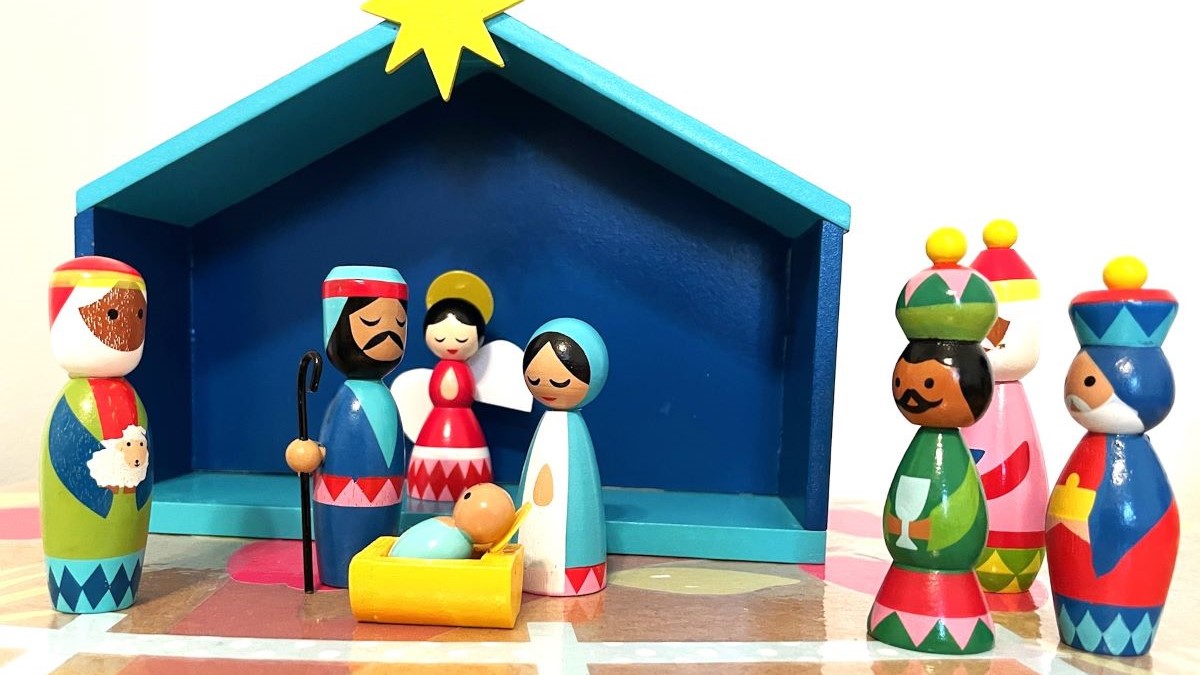
To this day, although I now live where it is cold in December, I set up a little Nativity Scene at Christmas time. I am happy that my little granddaughters cooperate setting up their tiny Scene in their room every year, the featured picture of this Christmas article.
Have a wonderful Christmas or Hanukkah (they fall on the same day this year), or just celebrate the Season. Best wishes for a prosperous and peaceful 2025.
Jesus’ message could be described as one of inclusivity and diversity! He blessed the meek, the poor, and the peacemakers. He associated with sinners. And he even recognized the separate places of religion and the state.
Although Easter is the holiest of days for those of the Christian faith, Christmas on December 25th, Jesus’ birthday, is the day most celebrated. With the celebrations come messages of new tidings, redemption, and rebirth.
The new tidings are not to say that Jesus denied the Old Testament. On the contrary, he said in Matthew 5:17 “Think not that I am come to destroy the law, or the prophets: I am not come to destroy, but to fulfill.” Yet, he delivered a kinder, gentler message than that in the Old Testament. The Old Testament laid down the Laws and warned how the wrath of God would rain upon sinners. The New Testament observed the Laws but added God’s mercy and redemption.
If we were to use today’s parlance, we might venture to describe Jesus’ message as one of inclusivity and diversity! This is the King of Kings (on earth, in the lineage of David; in Heaven, the Son of God) but born in a manger. He blessed the meek, the poor, the peacemakers (Matthew 5:1-12). He drove the devil out of sinners (Matthew 8:28-34). And he jousted verbally with the Devil himself, rejecting the Devil’s three temptations in a most rational manner (Matthew 4:1-11). Interestingly, Jesus even recognized the place of religion and the state: “Render therefore to Caesar the things that are Caesar’s, and to God the things that are God’s.” (Matthew 22:21).
A good summary of Jesus’ new tidings would be in his conversation with his disciples during the supper that was to be his last. It is recorded in Matthew 13:34-35.
A new commandment I give unto you, That ye love one another; as I have loved you, that ye also love one another … By this shall all men know that ye are my disciples, if ye have love one to another.
There were miracles on the first Christmas, the day Jesus was born. An angel appeared in the fields where the shepherds were tending their sheep and told them about the birth, so they could come and see the Baby (Luke 2:8-20). A star appeared in the east and guided the three Kings to Jesus, with gifts of gold, frankincense, and myrrh (Matthew 2:9-11).
It would be wonderful if at this Christmas time all peoples of the world, regardless of their faith, would experience the miracle of realizing that love for one another makes more sense than divisiveness and belligerence.
November 11 is Veterans Day. This commemorative day was once called Armistice Day, the day WWI ended. At war’s end came the infamous Paris Peace Conference that created a “peace to end all peace.”
On November 11, the United States celebrates Veterans Day. This same day is called Remembrance Day in most of the British Commonwealth. New Zealand, Belgium and Serbia call the day by its original name, Armistice Day. On Veterans Day we honor the men and women who have served in the U.S. armed forces. Prior to 1954, before Congress changed the holiday’s name, we observed on November 11 the end of World War I. Or more specifically, we remembered the horrific carnage that killed 9 million soldiers and wounded 21 million.
We also remembered, or should have remembered, on Armistice Day the questionable excuses for the start of WWI. How did WWI start? There are probably as many answers to that question as there are historians. But here is a likely scenario offered by Dr Heather Jones, associate professor in international history, LSE.
Relatively common before 1914, assassinations of royal figures did not normally result in war. But Austria-Hungary’s military hawks – principal culprits for the conflict – saw the Sarajevo assassination of the Austro-Hungarian Archduke Franz Ferdinand and his wife by a Bosnian Serb as an excuse to conquer and destroy Serbia, an unstable neighbour which sought to expand beyond its borders into Austro-Hungarian territories. Serbia, exhausted by the two Balkan wars of 1912-13 in which it had played a major role, did not want war in 1914.
Broader European war ensued because German political and military figures egged on Austria-Hungary, Germany’s ally, to attack Serbia. This alarmed Russia, Serbia’s supporter, which put its armies on a war footing before all options for peace had been fully exhausted.
Ambitions did not stop with European expansion but extended into the Middle East. In the world of 1914, the Ottoman Empire ruled Arabia, Bedouin leaders wanted self-rule, and European leaders wanted to divide Arab territories among themselves.
Thus, the British offered self rule and control of Syria to Arab leaders, in exchange for their expelling the Ottomans. This arrangement was made in ten letters exchanged from 1915 to 1916 between Hussein bin Ali, Sharif of Mecca and Lieutenant Colonel Sir Henry McMahon, British High Commissioner to Egypt. Sharif Hussein took the letters seriously and defeated the Ottomans in 1918. Events after the end of WWI bring into question whether Lieutenant Colonel McMahon took the letters to heart as well.
At war’s end, nearly 30 nations gathered at the Paris Peace Conference, including a token Arab Delegation, supposedly to iron out terms of peace. However, three of the Big Four – Prime Ministers David Lloyd George of Great Britain, Georges Clemenceau of France, and Vittorio Emanuele Orlando of Italy – had already decided to divide territories in Europe and the Middle East between themselves.
They had already also decided, encouraged by Clemenceau, to dispense ruthless punishment on Germany.
As for the fourth of the Big Four, United States President Woodrow Wilson, who hoped for a new era of cooperation and self-rule, British economist and delegate to the Conference, John Maynard Keynes referred to him as “a blind and deaf Don Quixote.” True, Wilson was slow to understand that attendees of the Paris Peace Conference were not interested in his 14 Points for Peace, or for that matter, apparently not interested in peace at all.
Germany was almost completely disarmed and required to pay reparations on a scale calculated to beggar her population for a generation. She lost 10 per cent of her population, 15 per cent of her agricultural production and 20 per cent of her iron, coal and steel.
Thus, the Weimar Republic, born in 1919 in the throes of German defeat and resentment, gave rise to Adolph Hitler only 14 years later.
In the Middle East, mandates created spheres of influence under which Syria and Lebanon went to the French, and Palestine and three Ottoman provinces of Mesopotamia – transformed into Iraq – went to Great Britain. This arrangement unraveled by the end of WWII. France retreated from Syria and Lebanon in 1946 after uprisings by the local inhabitants. Britain withdrew from Palestine in 1948, after partition and creation of new states of Israel and Jordan.
The British protectorate of Iraq formed after WWI went through an interesting iteration. Concerned about unrest, Britain established a kingdom in Iraq in 1921 and placed Faisal I bin Al-Hussein as King. That strategy calmed the populace a bit and pacified Faisal. Although not welcomed with open arms, King Faisal I proved an effective and unifying leader.
Faisal was the son of the Sharif of Mecca Hussein bin Ali (mentioned earlier), the Hashemite leader who started the Arab Revolt against the Ottoman Empire. Emir Faisal and British Intelligence Officer Thomas Edward Lawrence waged relentless guerilla warfare against the Ottomans, defeating the colonizers in 1918. The Emir was confident Britain would keep its promises, he would be the recognized King of Syria, and soon the Arab-speaking world would be united under his leadership. Since Britain decided otherwise, Faisal had to be content with being King of Iraq, where he ruled until his death in 1933.
At war’s end, T. E. Lawrence was skeptical but hopeful. Sadly, his skepticism proved correct and his hopes futile. A passage from his memoir Seven Pillars of Wisdom, originally published in 1926, perfectly describes his and Emir Faisal’s struggles for naught.
We were fond together because of the sweep of open places, the taste of wide winds, the sunlight, and the hopes in which we worked. The morning freshness of the world-to-be intoxicated us. We were wrought up with ideas inexpressible and vaporous, but to be fought for. We lived many lives in those whirling campaigns, never sparing ourselves: yet when we achieved and the new world dawned, the old men came out again and took our victory to remake in the likeness of the former world they knew. Youth could win, but had not learned to keep, and was pitiably weak against age. We stammered that we had worked for a new heaven and a new earth, and they thanked us kindly and made their peace.
The Treaty of Versailles peace was forged by the old men, as were many other agreements and mandates during and in the wake of WWI. Much of the maladroit world these old men created in their own likeness is still here today.
T. E. Lawrence has another often quoted passage in Seven Pillars of Wisdom:
All men dream: but not equally. Those who dream by night in the dusty recesses of their minds wake up in the day to find it was vanity, but the dreamers of the day are dangerous men, for they may act their dreams with open eyes, to make it possible.
Perhaps this November 11, 2022, Armistice Day of remembrance, might inspire dreamers of the day throughout the world to challenge the bellicose world we have inherited, and ask a fundamental question, is war really necessary?
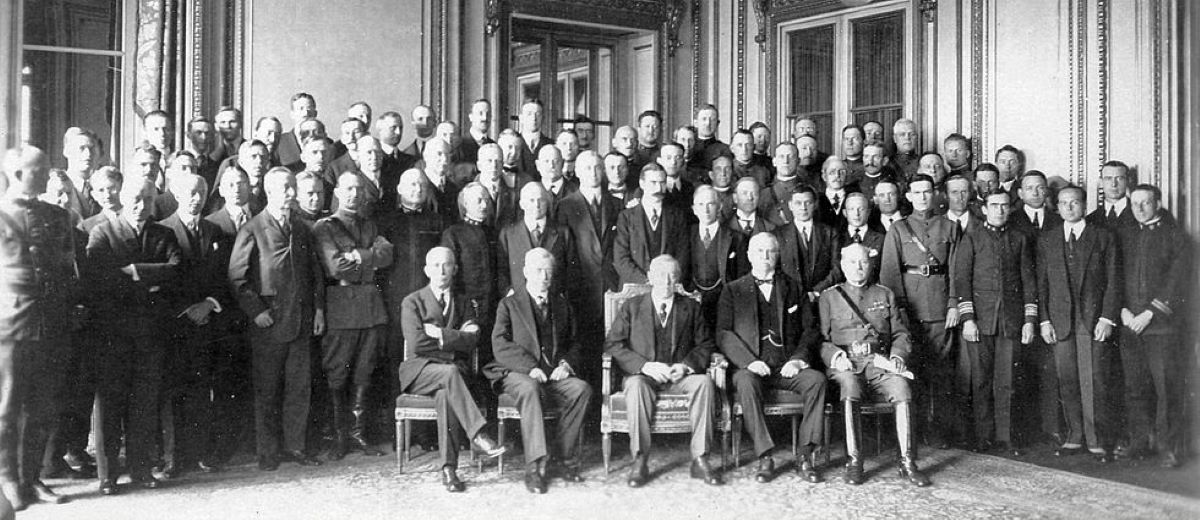
Pictured: Select delegates to the Paris Peace Conference of 1919
Choose Joy over Hopelessness, Light over Darkness on this Christmas Eve.
This is Christmas Eve, when Christians celebrate the birth of Jesus. It is a time of joy and sharing. The joy comes from the birth of the long-awaited Messiah predicted in The Book of Isaiah 7.14. The sharing is a practice started by the Three Wise Men, who as told in Matthew 2:1-12, guided by a magnificent star reached the Baby Jesus in Bethlehem bearing gifts of gold, frankincense and myrrh.
Nicholas, a monk born around 280 AD in what is now modern-day Turkey, furthered the sharing tradition. He is said to have used his inherited wealth to help the poor and the sick. For his good deeds he became St. Nicholas, a patron of children. As time went by, his name, Sinter Klaas in Dutch, became Santa Clause.
Not to be forgotten are other traditions of joy and sharing. Burning the Yule Log is a Nordic tradition going back to the Middle Ages. And that tradition evolved from the Pagan celebration of the Winter Solstice on December 21, the shortest day of the year in the Northern Hemisphere. To keep away bad spirits during the year’s longest night, and to observe the rebirth of the Sun, Druids lighted bonfires.
In the Southern Hemisphere, December 21 marks the Summer Solstice, and the longest day of the year. There is no snow or strong traditions associated with Santa Claus. In Spanish-speaking countries, children receive their presents on January 6, in remembrance of the day the Three Wise Men – also called the Three Kings or the Magi – reached the Baby Jesus.
Druids celebrated rebirth of the Sun on December 21, and 12 days after that, when the Sun was thought to stand still for that period of time. Christians celebrate the birth of Jesus on December 25, and 12 days after that the arrival of the Three Wise Men.
Whether you celebrate Christmas, the Winter Solstice, Hanukkah the Festival of Lights, or the Birth of Mithra the God of Light in Persian tradition, you are celebrating the triumph of Light over Darkness.
Of course, you need not celebrate any of these events at all to choose Light over Darkness, Joy over Hopelessness. The choice is yours.
It is good to remember and honor lives lost in tragic events. It is good to reflect on the events that 9/11 unleashed to establish our “post 9/11 world.”
It’s good to remember and honor innocent lives lost in tragic events. On September 11, 2001, 2976 men, women, and children from all walks of life died at the hand of 19 suicide hijackers in New York, Pennsylvania, and Virginia.
It is not good to say their death were not unique, since innocent civilians are routinely massacred during times of conflict. It is not good to dismiss this tragedy as the work of some hidden nefarious entity.
It is best to honor these lost lives by reflecting on the utter uselessness and evil of endless conflict and war.
Our reflection on this calamity should include the events the attack on these lives unleashed. It should include our assessment is the “post-9/11” world leaders created, and citizens demanded in the name of “security.”
A measure of conflict is unavoidable in any group, be it parents and children or the family of nations. However, any group regardless of size, location, ethnicity or religion could reflect on the uselessness of oppression, thirst for power, and myopic battles.
May the souls lost on September 11 be resting in peace. May we the living work towards an end to conflicts that inevitably result in slaughter of the innocent.
Former U.S. President George H.W. Bush died on November 30, 2018. May he rest in peace after a lifetime of public service. Among the kind eulogies, there have been unkind statements about Bush being an architect of the New World Order. Although mention of the New World Order adds intrigue, it does not seem to shed light on what the New World Order is supposed to be, and how President Bush Sr. is supposed to have built it.
Former U.S. President George H.W. Bush died on November 30, 2018. May he rest in peace after a lifetime of public service. Among the kind eulogies, there have been unkind statements about Bush being an architect of the New World Order. Although mention of the New World Order adds intrigue, it does not seem to shed light on what the New World Order is supposed to be, and how President Bush Sr. is supposed to have built it.
Reverse Side of the Great Seal of the United States. Annuit Coeptis: “Providence has Favored Our Undertakings.” Novus Ordo Seclorum: “A New Order of the Ages.”
Positive views of a NWO include a venue where sovereign nations can discuss common challenges and find solutions instead of taking up arms. Unkind views range from claims of the existence of an international cabal intent on establishing global governance for the benefit of the 1%, to the belief that climate change and income inequality will kill us all unless the United Nations saves us. In between are skeptical views of institutions that call themselves facilitators of “free trade,” rather than supra-national associations mandating “managed trade.” Appointed, not elected power brokers and bureaucrats like those administering the European Union or the world’s central banks are often lumped into the NWO. The view of a NWO in which nations cooperate towards achieving peace and prosperity, some say, is the gateway drug towards full implementation of a Brave New World.
How Does President Bush Sr. Fit In?
News that mentions a New World Order in connection with President Bush Sr. often refers to one of three of his speeches.
* September 11, 1990, address before a joint session of Congress. In that long speech, the President spoke about many things, domestic and international.
On the domestic front, Bush encouraged Congress to stop its squabble and work on correcting the deficit, passing growth-oriented tax measures, increasing savings and investment, increasing productivity and competitiveness, enacting measures to boost domestic energy production (“without damage to wildlife”) and conservation to reduce dependence on foreign oil.
On the international front, Bush called for Congress to enact a long-term defense program that took into account both the end of the Cold War and challenges that emerged with Saddam Hussein’s invasion of Kuwait. He also mentioned the opportunity for countries of the world to establish a new world order, where cooperation could promote peace.
… Congress should, this month, enact a prudent multiyear defense program, one that reflects not only the improvement in East-West relations but our broader responsibilities to deal with the continuing risks of outlaw action and regional conflict.
The crisis in the Persian Gulf, as grave as it is, also offers a rare opportunity to move toward an historic period of cooperation. Out of these troubled times, our fifth objective—a new world order—can emerge: a new era—freer from the threat of terror, stronger in the pursuit of justice, and more secure in the quest for peace.
* January 16, 1991, television speech to the American people. Here, Bush announced the start on that day of the bombing of Iraq by coalition forces. Bush reiterated that Iraq’s invasion of Kuwait was an example of rogue behavior that should not be tolerated. Again he mentioned the opportunity to establish a new world order based on rule of law. This time Bush also mentioned the United Nations as a venue for the NWO.
This is an historic moment. We have in this past year made great progress in ending the long era of conflict and cold war. We have before us the opportunity to forge for ourselves and for future generations a new world order — a world where the rule of law, not the law of the jungle, governs the conduct of nations. When we are successful — and we will be — we have a real chance at this new world order, an order in which a credible United Nations can use its peacekeeping role to fulfill the promise and vision of the U.N.’s founders.
* March 6, 1991, address before a joint session of Congress, announcing the successful ouster of Saddam Hussein from Kuwait. Here Bush once again emphasized that Desert Storm was a coalition of many nations, and once again he mentioned the opportunity to establish collective action through a new world order. But here he expands collective action to include solving the problems of nations, and fostering economic freedom and prosperity.
Tonight, I come to this House to speak about the world–the world after war. The recent challenge could not have been clearer. Saddam Hussein was the villain; Kuwait, the victim. To the aid of this small country came nations from North America and Europe, from Asia and South America, from Africa and the Arab world, all united against aggression … Now, we can see a new world coming into view. A world in which there is the very real prospect of a new world order …
The war with Iraq is over. The quest for solutions to the problems in Lebanon, in the Arab-Israeli dispute, and in the Gulf must go forward with new vigor and determination … We are already addressing the immediate economic consequences of Iraq’s aggression. Now, the challenge is to reach higher, to foster economic freedom and prosperity for all the people of the region.
Perspectives
For the sake of perspective, the U.S. was involved in conflicts in the Middle East since the 1940s, when Great Britain started to reduce its hold of the area. State Departments of the U.S. and Great Britain first tried to divvy up the oil of the Middle East by attempting to implement in 1944 and again in 1945 the Anglo-American Petroleum Agreement, but the agreement was soundly rejected by the U.S. Congress both times.
Next during the 1960s came the U.S. buildup of naval forces just off the Persian Gulf. Subsequently, the U.S. exercised its influence by providing strategic and arms support to Middle East countries threatened by the Soviet Union.
During the 1980s President Jimmy Carter implemented the Carter Doctrine in a Middle East “containing more than two-thirds of the world’s exportable oil.” He warned that “an attempt by any outside force to gain control of the Persian Gulf region will be regarded as an assault on the vital interests of the United States of America,” and “Such an assault will be repelled by any means necessary, including military force.” The warning came with a proliferation of military bases.
Flawed Beginnings
After the trauma of the Vietnam War, the end of the Cold War, the euphoric reunification of Germany, and the success of a coalition of nations in ousting Saddam Hussein from Kuwait, the world was ready to embrace collective action to bring about a peaceful and prosperous world. And the United Nations stood at the ready on a New York City piece of land provided by the powerful Rockefeller family. One could call this clean slate, upon which nations could draw new directions, a new world order.
Unfortunately, peace has been elusive since President Bush Sr.’s hopes for order in the world – just as peace was elusive after “the war to end all wars” or the “war to make the world safe for democracy.”
Major wars raged in Bosnia (1992-1995), Kosovo (1998-1999), Afghanistan (2001-2014), Iraq (2003-2011). Numerous civil wars and rebellions abounded as always. The war on terror has been a fact of life for the last 15 years.
The NWO Tent Keeps Getting Bigger
Meanwhile the United Nations evolved beyond primarily being a venue where participating sovereign countries could search for ways to ensure peace and order in the world. The U.N. now emphasizes sustainable communities and the importance of regional governance in contributing to sustainability. Note in the description of sustainability below, “peace” is next to last.
The Sustainable Development Goals are the blueprint to achieve a better and more sustainable future for all. They address the global challenges we face, including those related to poverty, inequality, climate, environmental degradation, prosperity, and peace and justice.
Nrg4SD [Network of Regional Governments for Sustainable Development] promotes understanding, collaboration and partnerships in sustainable development and seeks greater international recognition of the importance of the contribution which regions make to sustainable development. Nrg4SD aims to be a voice for, and to represent, regional governments at the global level, promoting sustainable development at regional level around the world.
We note that as a rule, “regions” are not jurisdictions governed by elected officials, but usually are an association of elected or unelected entities. Therefore, such entities may or may not represent the will of their residents.
Whether President George H.W. Bush was promoting this wider form of a new world order or the more focused collaboration of sovereign nations is not for us to know, only to surmise.

 It’s good to remember and honor innocent lives lost in tragic events. On September 11, 2001, 2976 men, women, and children from all walks of life died at the hand of 19 suicide hijackers in New York, Pennsylvania, and Virginia.
 Just Vote No