Shakespeare for Valentine’s Day

If Valentine’s Day candlelight dinner or box of chocolates is not in your budget this year, print a copy of Shakespeare’s Sonnet #116 and read it to your sweetheart. Then have a Happy Valentine’s Day!

How are you all celebrating Valentine’s Day? Romantic dinner by candlelight? Box of La Madeline au Truffe (US$25 per gram)? Or doing not much given the high cost of living?

If the latter, here is an unassuming suggestion: Print a copy of Shakespeare’s Sonnet #116 (funny thing about Shakespeare’s sonnets, they go by number instead of title), read it to your sweetheart, then talk a little bit about it. Not a big, deep discussion, please!

Why Sonnet #116? First, this is the most familiar of Shakespeare’s sonnets, so it must be good. Second, for so many folks, Sonnet #116 bursts into an epiphany when read or heard for the first time. Third, many find this sonnet worth revisiting by way of reminder.

So, here is Shakespeare’s Sonnet #116:

Let me not to the marriage of true minds
Admit impediments; love is not love
Which alters when it alteration finds,
Or bends with the remover to remove.
O no, it is an ever-fixèd mark
That looks on tempests and is never shaken;
It is the star to every wand’ring bark
Whose worth’s unknown, although his height be taken.
Love’s not time’s fool, though rosy lips and cheeks
Within his bending sickle’s compass come.
Love alters not with his brief hours and weeks,
But bears it out even to the edge of doom:
If this be error and upon me proved,
I never writ, nor no man ever loved.

Depending on our age and social milieu we might know couples that still hold hands walking down the street after 40 years together, or we might know some of today’s ubiquitous single parents (some divorced, some never married).

In Sonnet #116, Shakespeare characterized his view of the hand-holding oldsters – once young with “rosy lips and cheeks.” Challenges surely came their way. Certainly, at times one or the other had to stay steady, like a star, and not bend “with the remover to remove.” Chances are these couples will bear it out “even to the edge of doom.”

Agreed, this is not your typical Valentine’s Day poem, dripping with gleeful passion and lovely allusions. You can tell that from the sonnet’s first line which refers to the “marriage of true minds,” not the marriage of true hearts.

Happy Valentine’s Day!

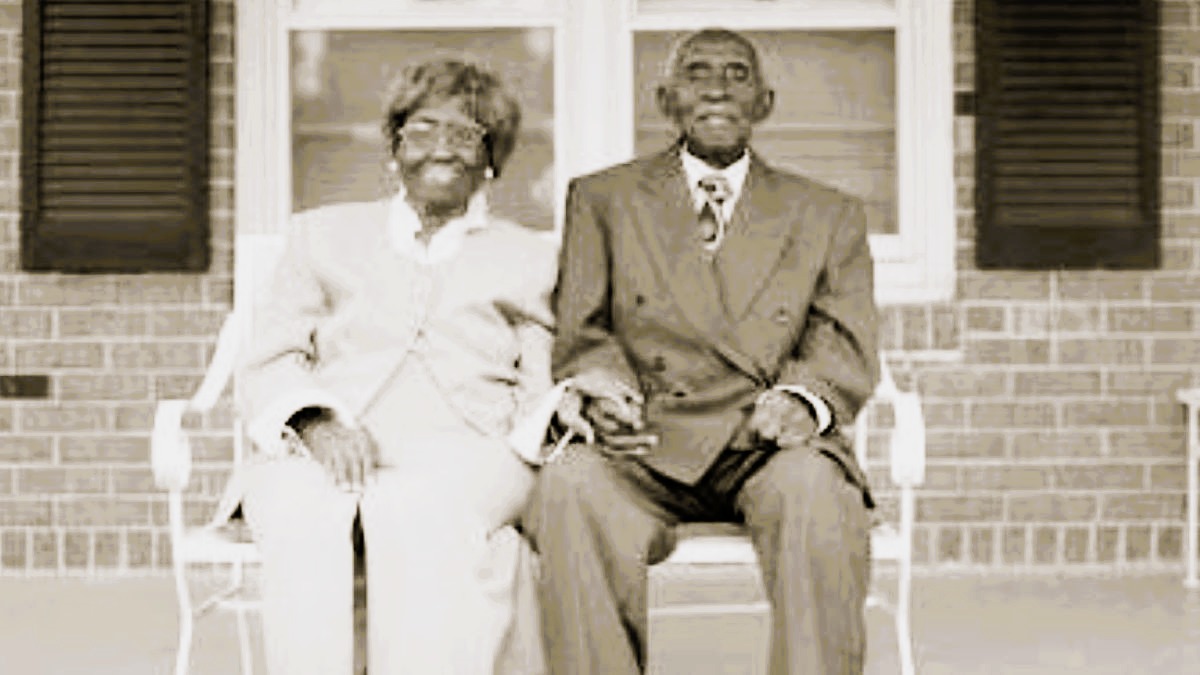
Picture: Herbert and Zelmyra Fisher of James City, North Carolina. This picture is from Deep Roots at Home. As of February 2024 Herbert and Zelmyra still held the Guinness record for the longest married couple: 86 years of marriage. Herbert passed away in 2011 at age 105, and Zelmyra followed him two years later also at 105.

Here is an excerpt from Herbert and Zelmyra’s Choice Secrets Of Successful & Long Marriage, Deep Roots at Home, September 14, 2020.

Together, as young friends and then later when married, they survived the effects of World War I and II, the Great Depression, the Korean War, the Vietnam War, the civil rights movement and 15 presidential administrations.

During the Depression, Herbert lived off the land and worked for as little as 5 cents a day. They had to raise their own food and ration it for their five children. Unable to afford a car, Herbert got to work as a mechanic the best way he could. Undaunted, Herbert built their home with his own hands in 1942.

Holy fatcats! Absolute Batman is coming!

Come October 9, 2024, there will be a new Batman in the Gotham neighborhood: Absolute Batman. He is, well, different, and thus worthy of perusal.

Come October 9, 2024, it is said there will be a new Batman in the Gotham neighborhood: Absolute Batman. He is, well, different, and thus worthy of perusal. More so, because the rest of the DC Comics Trinity — Wonder Woman and Superman – will follow Batman into the new Absolute Universe later in October.

Kudos for DC Comics, writer Scott Snyder, artist Nick Dragotta, and colorist Frank Martin for plunging into what could be called a Batman for our times. Not that DC has been shy about creating some extreme versions of Batman for its Absolute Editions, but this new Absolute Batman feels like a totally inverted image of the prime Batman.

This Batman is not one of the multiple iterations of prime Batman. He is not the brooding Batman of the 1930s (hey, there was a depression then), or the lighter Batman & Robin exclamatory duo of the 1950s (war hero Eisenhower was presiding over a prosperous economy), or even the focused-on-justice-for-Mom-and-Dad Batman of 1989 (people were suffering through an economic slowdown again). This oh so different Batman is not even a figment of his own imagination, like in the 2022 Batman Unburied series.

The new Absolute Batman has shed all his original self, for real!

Batman’s wealthy parents Martha and Thomas Wayne were not killed by thugs, as they were in the prime Batman Universe. They are now very much alive and not at all wealthy. Dad is a teacher, and Mom works in the Mayor’s Office.

As it must follow, Bruce Wayne is not the billionaire owner of Wayne Enterprises, but an engineer (or construction worker per some previews). Thugs are not among his shunned and hunted adversaries, since he grew up with them in the heart of Gotham.

From the perspective of the new Absolute Batman, there are bigger fish to fry than thugs and petty crime bosses. His principal adversaries are the powerful within the established system, those (like the traditional Bruce Wayne?) who have the wealth and resources that most citizens of Gotham lack.

This Batman no longer represents a perceived established system that aims to bring order to Gotham. Absolute Batman’s modus operandi is not to bring order where chaos reigns, but to use disorder and chaos to destroy the established order he finds objectionable.

In an interview with Comicbook, Scott Snyder encapsulates the core of the new Batman,

“I don’t want to give too much away but one of the core concepts of the series is that in this world, Bruce will be the small chaos in the system and the villains will be more powerful, have more resources.”

“We want it to feel like Batman, yet brand new,” … “But the core idea, that he is the anarchy, not the system, and his adversaries are more systemic … “

One must assume the new Absolute Batman is a Batman for our times.

The world is not yet Gotham. But how are we doing in the orderly establishment departments, public or private? Everybody feel comfortable with Big Tech or Big Pharma? Is everybody confident with their own safety and the safety of their family in their homes, streets, schools? Everybody feel confident that on November 5th all will go smoothly?

If sincerely answered, responses to the above questions would be “not great” and “no.” The established establishment, public or private, has no credible plan to lower the unsustainable national debt, curb the power of monopolies, make effective public education available to all children, heal the minds of our youth (think teen suicides and school shootings), or end what is becoming universal dependence on public assistance or selective dependence on criminal endeavors (think gang membership and drug dealing).

In the absence of cogent planning and action, we get extreme gibberish — We will end inflation with price controls! I can end a war with a phone call! Medicare for all! We are being run by a bunch of cat ladies! This real-life twaddle feels like the equivalent of the new Absolute Batman’s hulking inelegant frame bringing chaos and calling it remedy. Meanwhile, believers of the twaddle could be compared to the new Absolute Bruce Wayne, who continues to live in Crime Alley among the thugs so he can learn from them how to fight the “fat cats.”

“This is Absolute Batman, going up against the fat cats, the one percenters, the ones who play the populace and make them dance, sacrificing them for their own purposes, and then making them blame each other. This Absolute Batman has been planning for a long time, staying in Gotham to learn rather than travelling the world and doing the kind of jobs that an eccentric billionaire trust fund kid would never do.” Bleedingcool.com, September 12, 2024.

It will be interesting to see if this inverted Batman sells.

Hopefully, DC Comics will succeed in engaging their readers in the new personality of Bruce Wayne and the new modus operandi of Absolute Batman. A quick look at Reddit>Comics, or any of the numerous comics forums will show that readers pay attention to the origins, motives and conscience of their Superheroes. Will they feel that Absolute Bruce Wayne is a bit too average? A bit too much a product of our times? A bit too obviously a diversity and inclusion justice warrior?

After all, today’s readers can too often find chaos and disorder in their own neighborhoods, schools, and sadly their own homes. Will they be interested in someone who – unlike prime Batman who aims for return to order — uses bursts of brute force to simply plow through adversaries? We shall see.

Picture: This is what Batman looked like back in 1939, when he first appeared in the comics. He was slim, agile, sophisticated. When Absolute Batman comes out in October, make comparisons. The picture is from article on CBR.com, Every Single Batman Suit & Costume, In Chronological Order, dated July 1, 2024.

Read till you come to the end: then stop

Children are familiar with animated film version of classic tales. But how much more interesting are the original books! Even more interesting is the quest for learning to read well.

Has your highschooler read Alice in Wonderland or Through the Looking Glass? Not Walt Disney’s or other abridged versions, but the original Lewis Carroll, illustrated with the fantastical drawings of John Tenniel. The original Through the Looking Glass delights with the quirky poem Jabberwocky. Here is a sample,

Beware the Jabberwock, my son!
The jaws that bite, the claws that catch!
Beware the Jubjub bird, and shun
The frumious Bandersnatch!

… and the equally zany The Walrus and the Carpenter — one of the best verses for sample,

The sun was shining on the sea,
Shining with all his might:
He did his very best to make
The billows smooth and bright —
And this was odd, because it was
The middle of the night.

Cautionary tales

Good heavens, you might say, read such nonsense when there is so much strife and challenges in the world?

Well, yes. If your kid can read Through the Looking Glass cover to cover at his own pace and find it fascinating, then he is playing chess while others are playing checkers.

Also, if the reader uses her imagination to turn the “nonsense” into cautionary tales, then she is ready for life’s challenges! Let’s consider tricky folks one of life’s difficulties – like Mr. Walrus and Mr. Carpenter. These snippets from the poem summarize the situation well,

O Oysters, come and walk with us!’
The Walrus did beseech.
A pleasant walk, a pleasant talk,
Along the briny beach:
We cannot do with more than four,
To give a hand to each.’

The eldest Oyster looked at him,
But never a word he said:
The eldest Oyster winked his eye,
And shook his heavy head —
Meaning to say he did not choose
To leave the oyster-bed.

But four young Oysters hurried up,
All eager for the treat:
Their coats were brushed, their faces washed,
Their shoes were clean and neat —
And this was odd, because, you know,
They hadn’t any feet.

Guess what happened to the gullible little oysters.

O Oysters,’ said the Carpenter,
You’ve had a pleasant run!
Shall we be trotting home again?’
But answer came there none —
And this was scarcely odd, because
They’d eaten every one.”

Alas, innocents that believe in wondrous promises from the powerful.

The mathematician who wrote children’s books

Lewis Carroll was the pen name of Charles Lutwidge Dodgson, born in Daresbury, Cheshire, England, in 1832. He died in 1898. He is known for Alice in Wonderland (1865) and Through the Looking Glass (1871), although he wrote other books, short stories, and poems. His other most-often mentioned works are Bruno’s Revenge (1867), The Hunting of the Snark (1876), and A Tangled Tale (1885).

Carroll was not only a prolific writer, but also a mathematician, logician, photographer, and Anglican deacon. He taught mathematics and logic at Christ Church, Oxford, and wrote several mathematical books under his birth name. His mathematical puzzles are sometimes included in puzzle books. His most-often mentioned mathematical book is An Elementary Treatise on Determinants with their Application to Simultaneous Linear Equations and Algebraic Geometry (1867).

A whole lot of Carroll’s writings and puzzles were intended to teach children math and logic. His work can still do so today. The popular website Teachers Pay Teachers is just one of the several that have materials related to Lewis Carroll’s works for younger children as well as for highschoolers. Lesson Planet has good material on Lewis Carroll as well.

Gee, this book is long!

The last chapter of Alice in Wonderland has useful advice for readers of long books,

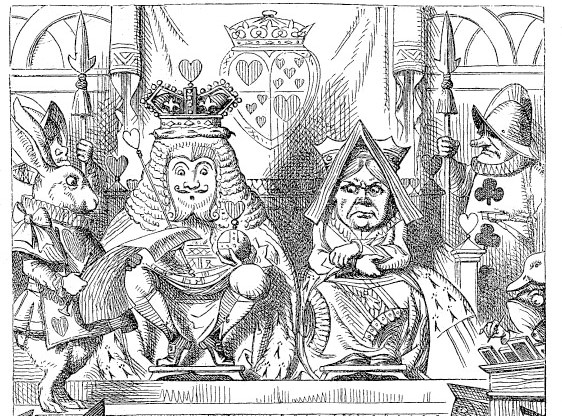
“There’s more evidence to come yet, please your Majesty,” said the White Rabbit, jumping up in a great hurry: “this paper has just been picked up …” “it’s a set of verses …” “Read them,” said the King. The White Rabbit put on his spectacles. “Where shall I begin, please your Majesty,” he asked.

Begin at the beginning,” the King said, very gravely, “and go on till you come to the end: then stop.

Alice at the Trial

Does Political Correctness Have Limits?

There is a world of difference between political correctness and civility. PC is rapidly replacing civility, to perhaps dire consequences.

The Difference

There is a world of difference between civility and political correctness (PC).  Civility is thoughtful behavior towards everyone.  PC is prescribed, agenda-driven speech and action that applies to some but not to others.  Civility comes from the inside, while PC is prompted from the outside.

Increasingly, PC is taking the place of civility.  PC harshly censors our speech, actions, and even thoughts.  Dare to call for discipline in a classroom, and the label of “privileged” soon follows.  Dare to criticize the work of a self-identified-female employee, the label of “sexist” immediately arises.  Oh, and calling anyone female or male without the qualifying “self-identified” borders on the self destructive.

The Advocates

Advocates of PC say they want to level the playing field, promote equality of outcomes, compensate for privilege.  At first blush, such objectives might even sound laudable.  But the problem is political correctness does not recognize limits.

The Example

Kurt Vonnegut’s short story Harrison Bergeron (1961) paints a world towards which PC advocates might be takings us all, a world in which the new and improved American Constitution prescribes complete equality for all.

In Vonnegut’s dystopian world nobody can be smarter, more talented or prettier than the rest.  Laws force people to wear “handicaps,” such as masks for the beautiful, sound to disrupt thought for the intelligent, and bags filled with lead balls for the strong and/or agile.

Here is Vonnegut’s idea of a domestic dialogue in the age of complete fairness:

“You been so tired lately — kind of wore out,” said Hazel.  “If there were just some way we could make a little hole in the bottom of the bag, and just take out a few of them lead balls.  Just a few.”

“Two years in prison and two thousand dollars fine for every ball I took out,” said George.  “I don’t call that a bargain.”…

“If I tried to get away with it,” said George, “then other people’d get away with it — and pretty soon we’d be right back to the dark ages again, with everybody competing against everybody else…”

The Consequences

And here is a concern related in an article on U.S. News.com about the downward trends of math and English scores as measured by college-readiness tests:

“Much more concerning, however, were readiness levels in math and English, which continued a downward slide dating to 2014.  This year [2018], math scores dropped to a 20-year low.”

“The news reignited concerns over whether there is a mismatch between what students learn in school and what college entrance exams ask of them, whether tests are an accurate barometer of college readiness, and — from an equity standpoint — whether the tests present an advantage to those with more means.”

Rich BoyHopefully colleges will not further waste parents and/or taxpayers’ money carrying out studies on whether “those with more means” have advantages over those without, since we all know that to be the case already.  Such advantages will always exist … that is unless legislators decide to really level the playing field by creating the position of “Handicapper General” as those in Kurt Vonnegut’s story did.

The Rough Beast at Your Ballot Box

“Things fall apart; the centre cannot hold … The best lack all conviction, while the worst are full of passionate intensity.” Sounds like politics!

W.B. Yeats wrote his often-quoted poem The Second Coming in 1919, in the wake of the devastation of WWI and that war’s chaotic aftermath that foretold the inevitability of WWII.

The poem is short, free verse with iambic pentameter, and somewhat to the point – “somewhat,” since, like all good art, The Second Coming does not spell out, but only hints. Here is the poem,

The Second Coming

Turning and turning in the widening gyre
The falcon cannot hear the falconer;
Things fall apart; the centre cannot hold;
Mere anarchy is loosed upon the world,
The blood-dimmed tide is loosed, and everywhere
The ceremony of innocence is drowned;
The best lack all conviction, while the worst
Are full of passionate intensity.

Surely some revelation is at hand;
Surely the Second Coming is at hand.
The Second Coming! Hardly are those words out
When a vast image out of Spiritus Mundi
Troubles my sight: a waste of desert sand;
A shape with lion body and the head of a man,
A gaze blank and pitiless as the sun,
Is moving its slow thighs, while all about it
Wind shadows of the indignant desert birds.

The darkness drops again but now I know
That twenty centuries of stony sleep
Were vexed to nightmare by a rocking cradle,
And what rough beast, its hour come round at last,
Slouches towards Bethlehem to be born?

Battle of SommeClick here for a link to a beautiful audio version.

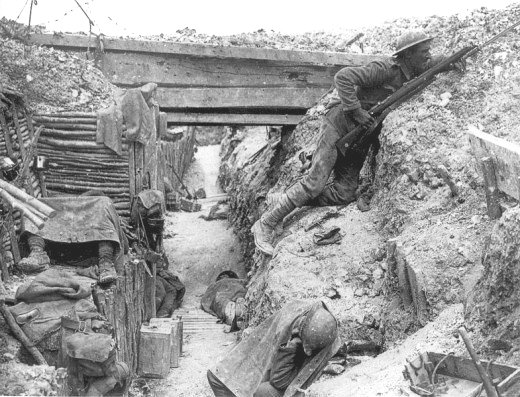
The images on the audio/visual Youtube post are from the World War II Battle of Somme — 141 days July 1 to November 18, 1916, of trench warfare on the Western Front, with a million men wounded or killed by its end.  The war did not end until 1918.

Why is the Just Vote No Blog Recommending Yeats Poem?

So, why would the Just Vote No Blog recommend The Second Coming? The poem makes for beautiful reading or listening, and it raises a favorite question of the Just Vote No Blog: are the forces of destruction and chaos inevitable reality or the result of bad ideas?

The literati in their analysis of The Second Coming often wax eloquent about Yeats’ reference to “the widening gyre” as testimony of his view of humanity and history as cyclical in the Biblical or mystic sense – birth, death and rebirth. Indeed the history of nations bears out such trajectory, with the rise and fall of the Roman Empire standing as prime example.

But here is what the Just Vote No Blog prefers to offer as testimony instead:

The best lack all conviction, while the worst
Are full of passionate intensity.

When a politician says that there ought to be a chicken in every pot and a car in every garage, he or she makes sure passion and intensity accompanies the message, which “the worst” immediately take up with equal verve and soon turn the message into reality. While “the best” often remain cynically aloof, lacking in conviction.

By the way, defining the difference between “the worst” and “the best” is up to you.  Maybe, though, you could look at results, or promises vs. reality.

The Rough Beast

Yeats ends The Second Coming with possibly the most utilized line in modern western literature:

And what rough beast, its hour come round at last,
Slouches towards Bethlehem to be born?

The Biblical second comer is no sloucher,

For as the lightning comes from the east and flashes as far as the west, so will be the coming of the Son of Man.  Matthew 24:27 

The vision Yates creates is of someone moving patiently but relentlessly towards a goal. What if we chose to take that beast as the embodiment of bad ideas, the type of bad ideas we vote for at the polls, or bad ideas proselytized by politicians? What if we just say no? Would we stop the beast?

Obviously, a website titled the Just Vote No Blog would have to say “yes.”