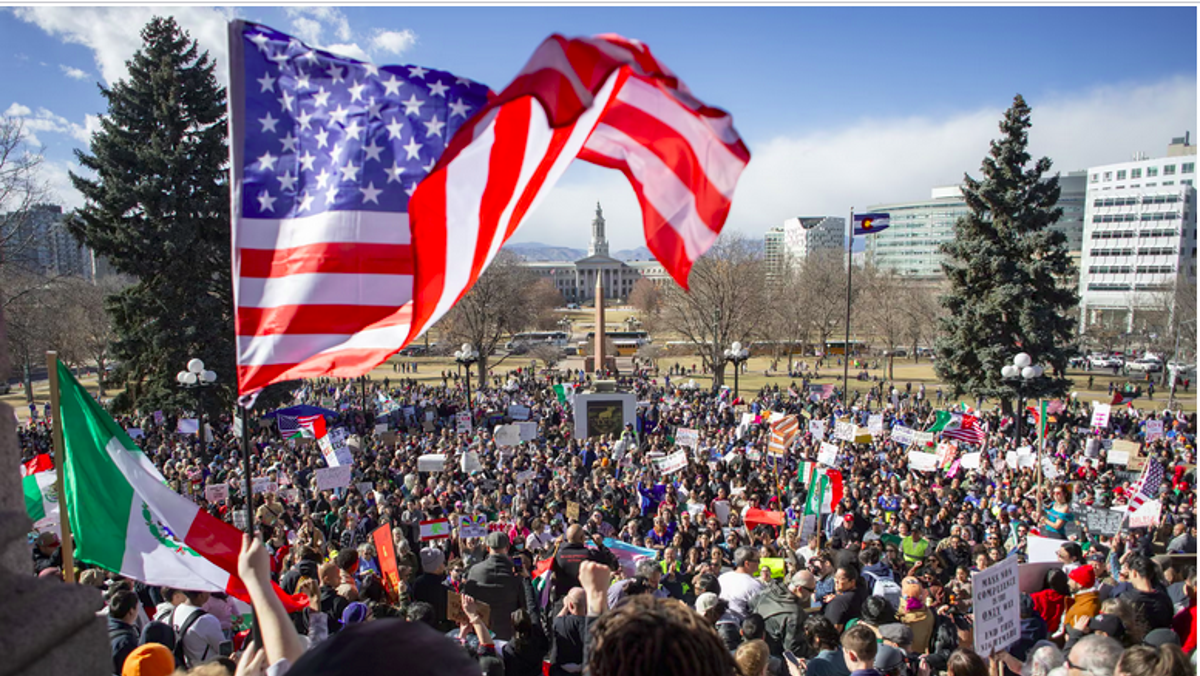
Do y’all feel tranquil these days? Like, waking up each morning confident your job is pretty secure, your children are learning essential skills in school, your savings are safe from devaluation and/or seizure, you are sure to return home safely after your day’s work, and WWIII is nothing but a conspiracy by negative people?
If the answer to such cogitation is “yes,” then our leaders are doing a good job abiding by their mandate as set forth in the Preamble of the US Constitution:
“We the People of the United States, in Order to form a more perfect Union, establish Justice, insure domestic Tranquility, provide for the common defense, promote the general Welfare, and secure the Blessings of Liberty to ourselves and our Posterity, do ordain and establish this Constitution for the United States of America.”
The key mandate in this Preface is “insure domestic Tranquility.” Without cool heads, capable of understanding challenges and picking best alternatives to fix them, union, justice, security, general well being, and most certainly liberty become difficult to achieve.
But, can the answer to the question be an honest “yes?”
Unfortunately, given our daily news, an honest answer should be “no,” we are not enjoying tranquil times.
Ideological polarization is ingrained, and therefore, radicalization is tainting our choices and our actions. We are confronted daily with demonstrations, allegations, judicial revenge, and violence. Our leaders are taking
extreme actions, not in response to foreign aggression (like Pearl Harbor or 9/11), nor in response to dire economic conditions (like the 1930s Depression). Extreme actions are being taken in attempts to quick fix ordinary problems that have been festering unattended for decades, and to satisfy wet dreams of imperialism.
Such radicalization often rises from an erosion of balanced powers.
The US Constitution dictates separation of powers, with the three branches of government possessing equal power. The legislative branch makes laws, the executive branch enforces laws, and the judicial branch interprets laws.
Founding Father James Madison described separation of powers succinctly in Federalist No. 47:
“The accumulation of all powers, legislative, executive, and judiciary, in the same hands, whether of one, a few, or many, and whether hereditary, self-appointed, or elective, may justly be pronounced the very definition of tyranny.”
In this quote, Madison simply described human nature – power corrupts. Such corruption is not necessarily unlawful or unethical, but might be corruption of thought processes caused by intoxication with power.
The executive branch has enjoyed slow mission creep.
For decades, Congress has been slowly abdicating its powers. First by not standing firm in requiring Congressional deliberation before sending our young to die in foreign wars, like Korea or Vietnam. Then by accepting barrels full of presidential executive orders and pretending they carry the weight of laws. Lately by failing to collaboratively deliberate alternatives, simply voting by party affiliation instead.
The citizenry, the media, think tanks, and sundry talking heads have also contributed to the imbalance of powers. These days, we often hear about the “RINOs impeding the President’s agenda,” referring to members of Congress who dare to question a presidential edict or action. On the other side of the aisle, we hear accusations of “stab in the back” when a Congress member breaks with his party and votes to curb some aspect of government spending.
Our current leaders are especially blind to separation of powers.
The current heightened power of the presidency has rendered the presidential agenda sacrosanct. The agenda has good objectives — cut government’s unsustainable spending, increase domestic manufacturing, grow the economy, ensure domestic security, prevent undocumented aliens from entering the US, deport criminal aliens.
However, implementation of the agenda has effaced the crucial Constitutional mandate of insuring domestic tranquility.
This is not to say that domestic tranquility was not seriously disrupted in the recent past. Particularly disturbing events were the race riots of the 1960s, and the Vietnam War riots that culminated in 1970 with National Guard members opening fire on student demonstrators killing four.
It is also not to say that the US has not engaged in executive foreign adventures and regime change in the recent past. A notable US invasion was that of Panama in 1989, ordered unilaterally by then President George H.W. Bush, resulting in the capture of Panama’s military leader Manuel Noriega under charges of drug trafficking. Notable recent regime change via support of coups occurred in Iran 1953, Guatemala 1954, and Chile 1973.
But today’s turmoil feels different, deeper, given Congress’ particularly evident inertia in the face of a particularly forceful President.
In the past, presidents have deployed military personnel to quell violence arising from disturbing events like the assassination of Martin Luther King Jr. Presently, heavily armed personnel arrive in cities first with a mandate to round up illegal aliens; and then come the protesters and the violence. Congress could have prevented such topsy-turvy turmoil by passing credible, effective immigration-related legislation.
Congress is also largely missing in action when it comes to the executive branch’s daily pivoting on tariffs, running Venezuela, acquiring Greenland, and threatening sundry countries with military action. All such actions made in the absence of clear and present dangers to the US, and in the absence of deliberation of alternatives.
Support for “the agenda” will be measured in the midterm elections.
Hopefully, during the coming midterm elections, races will be relatively free of irregularities, voters will be thoughtful of candidate qualities and value of issues, and blind partisanship will not dominate voters’ choices.
If all those wishes come true, the midterms can serve as a report card of the current administration. A report card is always a useful tool to determine one’s path – doing good, so continue on the current path; or not doing so good, so adjust the path.
Picture: From the Guardian, Thousands protest against Trump’s war on immigrants after Ice raids, February 9, 2025. This article regards ICE raids in Denver, Colorado, 11 months ago. Note that no adjustments in policy to prevent further violence has happened.
 Just Vote No