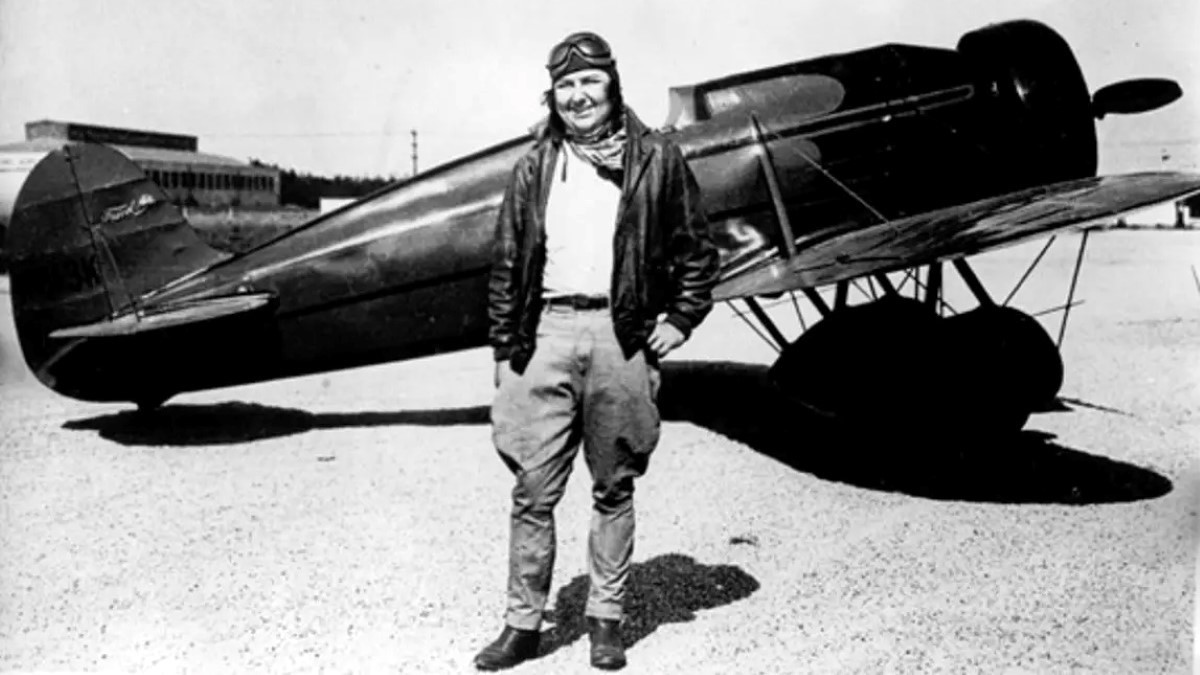
March is Women’s History Month, and the Just Vote No blog has chosen to celebrate the contributions of Pancho Barnes (July 22, 1901 – March 30, 1975). Who? Interestingly, a search of Google Doodles does not show that Pancho Barnes was ever celebrated. Amelia Earhart was celebrated twice. No wonder Barnes once said, “Amelia Earhart got all the publicity and Bobbi Trout made all the money, but I was the best pilot.” True.
Brief background.
Florence Leontine Lowe was born into a well-to-do family in San Marino, California. She attended fine private schools, became an accomplished equestrian at an early age, and acquired a love of flying from her paternal grandfather. Grandfather Thaddeus S. C. Lowe established the first military air unit during the American Civil War, the Army of the Potomac’s balloon corps.
At 18, Florence married the Reverend C. Rankin Barnes, with whom she had her only child, William E. Barnes. However, after a few years as a reluctant wife, she ran away and eventually ended up in Mexico. There Florence Barnes became Pancho Barnes.
Pancho Barnes returned to the U.S. at the death of her father, from whom she received a large inheritance. With that money, she purchased a Travel Air biplane and took flying lessons. History has it that after only six hours of instruction, she was flying solo.
Pancho was then on her way to becoming a legend in her own time.
Those were the times of early aviation when airplanes were still a mystery. Young men and women were eager to test their own maximum capacity as pilots as well as the capabilities of their airplanes. They were also eager to share their derring-do with an enthusiastic public.
Thus, there were the barnstormers, with Pancho Barnes among them. Barnstormers made their living putting on well attended flying shows in barn fields. Their spins, rolls, loop-the-loops, wing walking not only entertained large audiences, but also served to prove a barnstormer’s skills.
In 1929, when Cliff Henderson promoted his first Women’s Air Derby (immediately nicknamed the Powder Puff Derby by American humorist Will Rogers), Pacho Barnes was there. The transcontinental race ran from Santa Monica, California, to Cleveland, Ohio. Of the race’s 20 participants, 15 made it to the finish line. In the heavy airplane class, Louise Thaden finished first, Gladys O’Donnell second, and Amelia Earhart third. In the light airplane class the winners were Phoebe Omlie, Edith Foltz and Jessie Keith-Miller. Pancho Barnes was not one of the finalists because a car crashed into her airplane as she was landing in one of the stops.
But barnstorming and racing were not Pancho Barnes only interests. In Hollywood she was a popular stunt pilot. She is credited with forming one of the first Hollywood unions, the Associated Motion Picture Pilots, which gave stunt pilots more bargaining control over pay and safety.
Two other feats: Pancho Barnes was the first female test pilot for Lockheed. In 1930, Barnes broke Amelia Earhart’s speed record.
Then came the Great Depression and Pancho’s new lifestyle.
The Depression of the 1930s was a life-changing event for everyone, including Pancho Barnes. That’s when she pivoted from aviatrix to businesswoman.
In 1935, she sold her home in Los Angeles and purchased a ranch near Muroc Dry Lake in California’s Mojave Desert. Nearby was a small base called the Muroc Army Airfield, later to become Edwards Air Force Base. And there was nothing else in that hot, barren, dusty expanse.
At the ranch Pancho built an airstrip, hangers, and classrooms for her Civilian Pilot Training Program. During WWII, Pancho’s ranch was taken over by the military. After the war, she added rodeo grounds, racetracks, a swimming pool, and a 20-room motel. The ranch became a fly-in destination for her numerous pilot and Hollywood friends, as well as a place for the men from the Muroc base to gather. In 1946, the ranch became a private club named The Happy Bottom Riding Club, which at one point had 9,000 members worldwide.
The Happy Bottom Riding Club.
Pancho Barnes, like other female pioneers of early aviation, proved women could be skillful daring pilots — just like Valentina Tereshkova, Svetlana Savitskaya, and Sally Ride proved women could be cosmonauts and astronauts. These are invaluable cultural contributions.
But, Pancho Barnes’ contemporaries credit her not only with cultural contributions, but also with helping to advance America’s aviation and the space program. This point is entertainingly made in a video released in 1994 by Computer Sciences Corporation, funded by the Department of Defense Legacy Resource Management Program, called The Happy Bottom Riding Club: The Legacy of Pancho Barnes.
In the video, a narrator, several aviation pioneers, and Pancho herself tell stories about The Happy Bottom Riding Club. Here are a few snippets from the video’s transcript.
0:31 – 0:47 “What took place here a half century ago altered the course of history and changed the world. The events that happened here probably helped America win the cold war, launched us into the space program, and made America a major force to be reckoned.”
1:27 – 1:57 “But the story of Pancho Barnes and the Happy Bottom Riding Club is one that is tightly interwoven with the history of Edwards Air Force Base and the flight test center. You can’t tell one story without telling the other. Edwards is where the first American jet airplane flew, the sound barrier was broken, and where the rocket sled tests blasted through the sound barrier on the ground and proved that man could survive ejection from an airplane.”
16:50 – 17.04 “That’s where everybody would go and talk about your whatever kind of program you’d been on today. Whatever you’d encounter during the course of the day was invaluable to get around to each other and the way we managed to do that we’d always go over there and have a beer at Pancho’s place.”
32:11 “I knew we could break the sound barrier and I offered a free stake to the first man brave enough and smart enough to do it.”
32:17 “Most aviation riders I know consider the 1947 flight [when Chuck Yeager broke the sound barrier] probably the most important flight in history after the first flight of the Wright Brothers.”
35:34 – 35:45 “And when they heard the sharp double crack of the sonic boom although they didn’t realize it they were actually witnessing the dawn of the space era.”
36:17 – 36:29 “Chuck says, ‘Well, I broke it,’ and it was just like that, no big deal made out of it. He broke it. Everybody knew he would. We bee lined it to Pancho’s.”
Every aviation pioneer knew the sound barrier had to be broken before space could be conquered, and everybody knew Chuck Yeager could do it (even if he had two broken ribs at the time he climbed on his airplane). Yeager got the steak dinner promised by Pancho, and that was it.
Things changed when powers that be decided to “clean up” Muroc Army Airfield.
In 1949, Muroc Army Airfield was renamed Edwards Air Force Base. Then in 1952, the base’s commander, General Al Boyd was replaced by Brigadier General Stanley Holtoner. His mission was to turn Edwards into a modern aviation test center, which to him meant discipline and no fooling around.
So, maybe The Happy Bottom Riding Club had to go? Apparently. General Holtoner’s orders were to acquire Pancho’s land by eminent domain, because an extended runway had to be built. Pancho fought back in court and won, but to no avail, since a “mysterious” fire broke out that totally destroyed the ranch. Pancho did not feel it was feasible for her to rebuild and sold the land to Edwards Air Force Base. The runway was never built.
So, Pancho Barnes retired.
She rode horses and raised dogs. Until in 1975, Pancho Barnes died. Today she is best remembered by military and aviation enthusiasts, who understand her aviation skills and contributions.
Pancho was not pretty like Amelia Earhart, she did not disappear in mysterious circumstances, and she died in her home at 74 of natural causes.
But she definitely deserves a Google Doodle during Women’s History Month.
Picture: Pancho Barnes, age 29, with her Travel Air Mystery Ship. On that day, August 4, 1930, she set a new speed record for women. The record was previously held by Amelia Earhart.
 Just Vote No