In 2016, there were 550,000 homeless people in the United States, mostly concentrated in large cities such as New York and Los Angeles. California has the largest percentage of unsheltered (not in emergency shelters) homeless in the U.S. at 66%. California has 22% of U.S. homeless population (in shelters and unsheltered), and 12% of the total U.S. population.
The currently accepted reason for California’s large homeless population is the state’s traditional resistance to population density — the Not In My Back Yard syndrome. Therefore, the accepted remedy is to force all counties to build “enough” taxpayer subsidized housing. However, one could observe other contributing factors:
* Destruction of small transient hotels, where low-income or no-income individuals and families called home. Old timers will remember the last stand, the battle for survival of the International Hotel. The low-income residents lost and the developers won.
* Explosive growth in drug use that interferes with gainful employment. Is anyone going after the real causes of the growth?
* Advent of central planning that mandated high population densities along transit corridors and designated large swaths of land as conservation or protected areas closed to development. Some call it the Watermelon Plan, green on the outside and red on the inside.
* Acceptance of words such as “displacement,” “housing rights,” “fair housing.” Rejection of principles such as self reliance, freedom of movement, local control. Maybe Orwell’s Animal Farm is no longer read in school.
* Utter rejection of the word “suburban sprawl.” New rule: everybody stay put.
One would think that as density rises in confined spaces, housing prices would rise. Thus, all funding options should be viewed as ongoing and forever increasing – never “enough.”
On September 15, 2017, the open-ended nature of California’s “housing crisis” became clear. Senate Bills SB 35, SB 2, and SB 3 passed the legislature, and are expected to be signed into law by Governor Brown. SB 35 further moves decisions on housing from cities and counties to state. SB 2 loads residents with more fees when they need to file a property-related document. SB 3 funnels $4,000,000,000 in bond money into subsidized housing. Supporters in the legislature say “It’s just a start.”
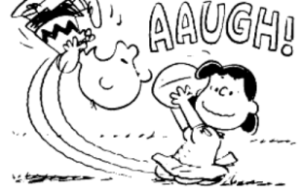 Lucy yanking the football just as Peanuts kicks – the iconic image created by the great Charles Schulz will forever live in the public consciousness as a badge of trusting souls. No matter how many times Lucy causes Peanuts to tumble as he kicks into empty space, Peanuts trust Lucy to keep the ball in place the next time.
 Just Vote No