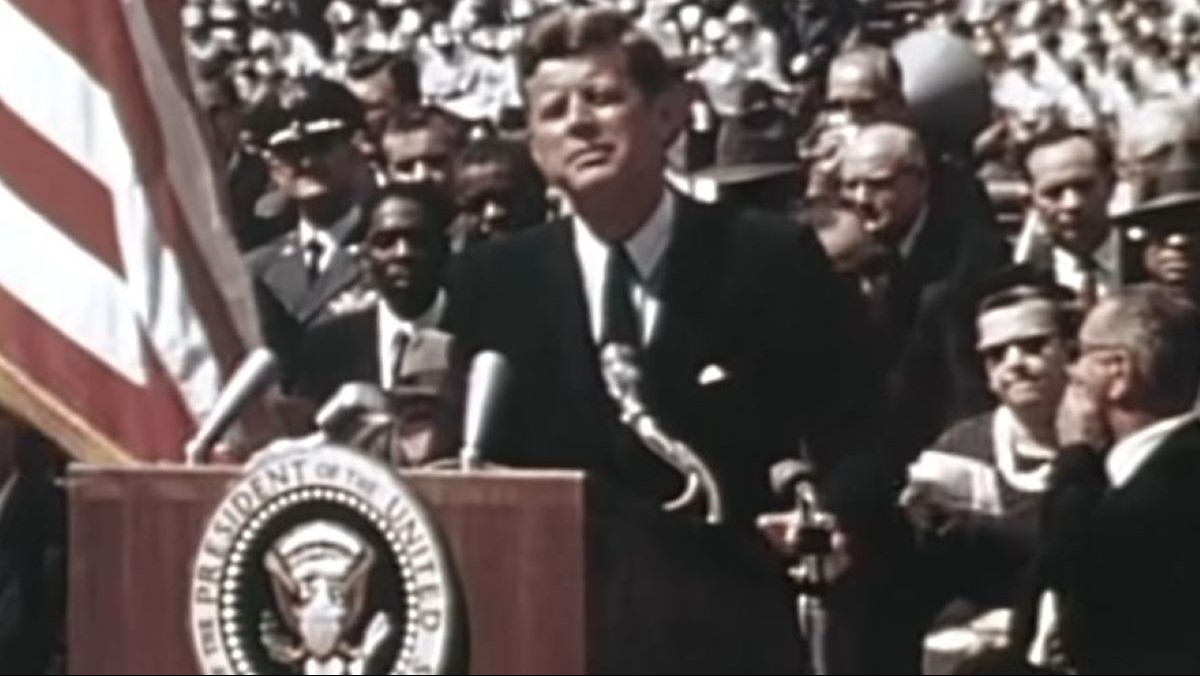
61 years ago, on September 12, 1962, U.S. President John F. Kennedy, stood at a podium at Rice University, under a searing Texas sun, and delivered his iconic “We choose to go to the Moon speech.” His was a call for the expectation of excellence. Not just from a few brave souls that chose to be launched toward the unknown lunar territory, not just from politicians and engineers. Kennedy called for an expectation of excellence from the entire nation.
Those who came before us made certain that this country rode the first waves of the industrial revolutions, the first waves of modern invention, and the first wave of nuclear power, and this generation does not intend to founder in the backwash of the coming age of space. We mean to be a part of it — we mean to lead it.
Kennedy regarded the expectation of excellence as a state of mind, in which dangers, uncertainties and costs are considered and freely chosen. He did not mince words or embellish sacrifices.
We have had our failures, but so have others, even if they do not admit them. And they may be less public.
To be sure, all of this costs us all a good deal of money … Space expenditures will soon rise some more, from 40 cents per person per week to more than 50 cents a week for every man, woman and child in the United States, for we have given this program a high national priority — even though I realize that this is in some measure an act of faith and vision, for we do not now know what benefits await us.
He also regarded excellence as a national commitment to explore space – the Moon, the planets, and beyond – in peace, freedom, and a spirit of sharing discoveries.
For the eyes of the world now look into space, to the moon and to the planets beyond, and we have vowed that we shall not see it governed by a hostile flag of conquest, but by a banner of freedom and peace. We have vowed that we shall not see space filled with weapons of mass destruction, but with instruments of knowledge and understanding.
It only took seven years.
Seven years after Kennedy’s speech at Rice University, a nation glued to television sets and radios heard Apollo 11 Commander Neil Armstrong’s message to NASA Mission Control Center in Houston,
Houston, Tranquility base here. The Eagle has landed.
The Saturn V rocket, developed at NASA’s Marshall Space Flight Center in Huntsville, Alabama: the Columbia command module built by North American Aviation in Downey, California; and the Eagle lunar module, built by Grumman Aerospace in Long Island, N.Y., safely landed Neil Armstrong, Edwin Aldrin, and Michael Collins on the lunar Sea of Tranquility on July 20, 1969. On July 24, 1969, aircraft carrier USS Hornet picked up the command module that had splashed down on the North Pacific Ocean with all three astronauts safely on board.
By that time, the inspiration for the lunar landing, John F. Kennedy, had been assassinated. Lyndon B. Johnson, who to his credit continued the Apollo Space Program, had served his term as president. And President Richard M. Nixon welcomed the three astronauts home.
Although Johnson and Nixon continued and supported the Apollo 11 Space Program after Kennedy’s assassination, the Moon landing would not have occurred when it did without Kennedy rallying the nation. He set great expectations, and as is always the case expectations pretty much determine outcome. Expect much, achieve much. Expect little, achieve little.
Since the Apollo 11 mission, six more lunar missions were successfully conducted by the United States, with 12 astronauts making lunar walks.
The New Frontiers of discovery and cooperation continue.
Space research and exploration thankfully continues in the spirit of peace, freedom, and cooperation envisioned by John F. Kennedy.
The International Space Station main construction was completed between 1998 and 2011. Members of the first crew that arrived at the station November of 2000, were NASA astronaut William Shepherd, and Russian Aviation and Space Agency cosmonauts Yuri Gidzenko and Sergei K Krikalev. Since then, the station has been continuously occupied by rotating crews of scientists, engineers, and researchers from 18 countries. The principal partners are the space agencies of the United States, Russia, Europe, Japan, and Canada.
NASA, along with six major space agency partners from the E.U., Germany, Japan, Canada, Israel, and Italy have been working since 2017 on the Artemis project, a Moon exploration program. Artemis will establish a habitat on the Moon by the end of this decade in preparation to establishing one on Mars.
In June, 4 volunteers entered a simulated Mars habitat, where they will remain for a year, in preparation for a Mars landing.
Just in case some would wonder why spend effort and money traveling to space, John F. Kennedy offered the obvious reason during his Rice University speech: “Because it is there.”
Well, space is there, and we’re going to climb it, and the moon and the planets are there, and new hopes for knowledge and peace are there.
As we celebrate the 61st anniversary of that speech, we might wish to practice expectations of excellence. Perhaps ask ourselves if leaders of our nation, heads of our institutions, and certainly educators of our children expect excellence or merely survival.
Discover more from Just Vote No
Subscribe to get the latest posts sent to your email.

 Just Vote No